
Look at the hands, the ears, and the necks of people in southern Europe going about an ordinary day, and you will notice something. Real gold, everywhere, worn by everyone, all the time.
A fine chain at the throat, small hoops in the ears, a signet ring, a thin bracelet, glinting on women at the market, men at the cafe, grandmothers on the bus. Not for a special occasion. Just for a Tuesday.
In America, this is not how real gold works. Fine gold jewelry is good jewelry, the special stuff, kept in a box and brought out for weddings, anniversaries, and events, then carefully put away again. Everyday jewelry, if any, tends to be the costume kind, the inexpensive fashion pieces you would not mind losing. The real gold is saved.
It is a small difference, a chain on a Tuesday, but it reveals two quite different relationships with jewelry, with value, and with the idea of saving nice things for later. Here is the everyday-gold divide, why southern Europeans wear their good jewelry to the supermarket, the pieces they actually reach for, and what their habit has to teach about enjoying your things rather than hoarding them. The lesson, it turns out, is about far more than gold.
The Everyday Gold

In the countries of southern Europe, Spain, Italy, Greece, Portugal, a little real gold is simply part of daily life, worn constantly and casually, with everything. It is not reserved for dressing up; it is worn with the plainest clothes, on the most ordinary errands, as a matter of course.
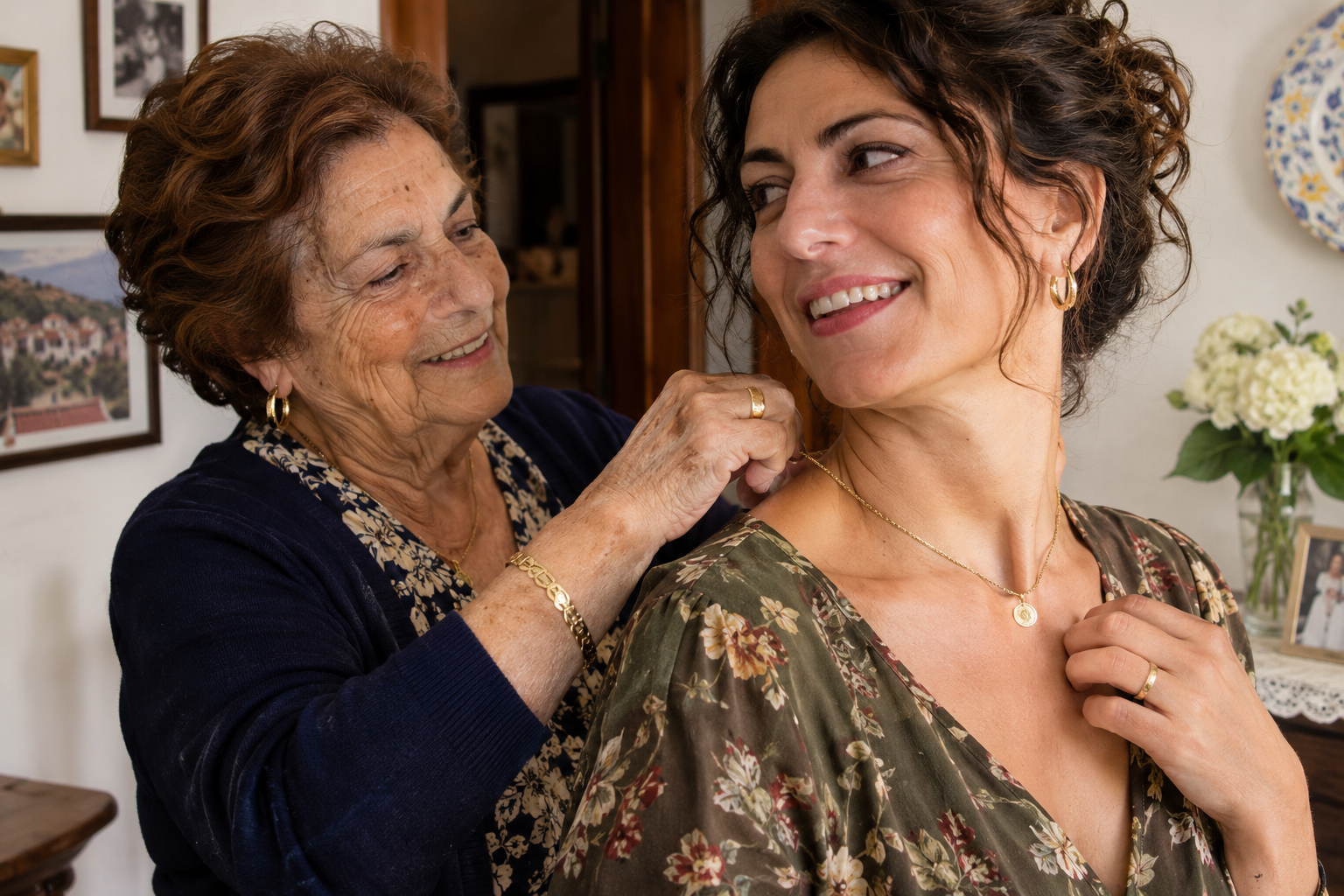
The pieces tend to be understated and classic rather than flashy. A delicate gold chain, often carrying a small pendant or a cross; small hoop earrings or simple studs; a signet ring or a plain band; a fine bracelet or a thin bangle. These are not big statement pieces but small, fine, everyday ones, worn in quiet combination and rarely taken off. A southern European woman might put her gold on in the morning and simply leave it on, through work, errands, cooking, and sleep, so that it becomes less an accessory she wears than a part of her she carries.
This is the key to the whole habit: the gold is woven into the person, not the occasion. It is there on the beach and there at the market, there in a housecoat and there at a wedding, a constant, unremarked presence rather than something produced for special moments. To a southern European, wearing real gold on an ordinary day is not extravagant or showy; it is simply normal, as unremarkable as wearing a watch, and the idea of locking it away for all but a handful of occasions a year would seem strange.
Saved for Weddings in America
The American relationship with fine jewelry runs almost exactly the other way, organized around the special occasion rather than the everyday. In America, real gold is categorized, consciously or not, as good jewelry, valuable and precious and therefore to be protected and reserved.
The logic is one of saving and safekeeping. The good pieces, the fine gold necklace, the real diamond studs, the inherited bracelet, live in a jewelry box most of the time, taken out for the occasions deemed worthy of them, weddings, anniversaries, holidays, parties, and then returned to safety. There is a real fear woven through this, of wearing out, damaging, or losing the valuable piece, which makes daily wear feel reckless, and so the good jewelry mostly waits. For everyday, Americans more often reach for costume jewelry, the fashionable, inexpensive pieces that it does not matter if you lose, which carry no such anxiety.
The result is that in America, a great deal of lovely real gold spends most of its life in a drawer, enjoyed only a few times a year. The special-occasion mindset, with its instinct to preserve and protect the valuable thing, means the good jewelry is treated as too precious for ordinary days, and so it sits unused far more than it is worn. It is a cautious, saving relationship with jewelry, and it is the near-opposite of the southern European one, where the gold is for living in, not for keeping safe.
There is a certain irony in the American version, when you look at it closely. The fear of losing or damaging the valuable piece leads to it being worn so rarely that it brings almost no joy, which is its own kind of loss. A beautiful necklace that spends ten years in a drawer has been protected into near-uselessness, kept perfectly safe and perfectly unenjoyed, which is arguably the worse fate of the two.
Jewelry as Part of Getting Dressed

To understand why southern Europeans wear their gold so freely, you have to see it as part of a larger habit, the one that runs through all of these differences: the sense that a little effort toward looking put-together is simply part of daily life. In the south, a bit of gold is not a special addition but a baseline, as ordinary a part of getting dressed as putting on your watch.
This fits the broader southern European instinct toward presentability, the feeling that one should look reasonably pulled-together to go out among people, even casually. A small amount of gold does exactly this quietly and effortlessly: it finishes an outfit, adds a touch of polish and warmth, and signals a person who is dressed rather than merely covered. It asks nothing, requires no decision once it is on, and quietly elevates even the plainest clothes, which is precisely why it became a daily habit rather than an occasional one.
Crucially, it is not treated as a statement or a display of wealth. The everyday gold of southern Europe is understated and modest, a fine chain and small earrings, not a show of riches, and nobody wears it to be noticed or admired. It is simply part of being dressed, the small finishing layer that comes after the clothes, worn for oneself and for the ordinary dignity of looking put-together, not to impress anyone. That modesty is part of why it can be worn every day without seeming like too much; it was never much in the first place.
It Is Usually Real, and It Lasts
There is a quality dimension to this too, and it connects to a theme that keeps recurring in these comparisons: the preference for a few good, real things over many cheap ones. The everyday jewelry of southern Europe is typically real gold, not costume, and that choice carries real logic.
Real gold has genuine advantages that make it suited to daily wear. It does not tarnish, corrode, or turn your skin green the way cheap metal does; it holds up to being worn constantly, year after year, without degrading; and it holds its value rather than becoming worthless the moment the trend passes. A few pieces of real gold, worn every day for decades, are both more beautiful and, over a lifetime, often more economical than a churn of cheap fashion jewelry that tarnishes, breaks, and is thrown away. The real thing, worn hard, outlasts everything.
This is why the southern European instinct to buy real, even if it means buying small, pays off over a lifetime. A single fine gold chain costs far more than a handful of fashion necklaces, but it will still be beautiful and wearable in forty years, when the cheap ones have long since tarnished, snapped, and been discarded. Measured across decades rather than seasons, the one good piece is not the extravagance; the endless churn of cheap ones is.
And gold carries meaning across time in a way costume jewelry never can. The everyday pieces of southern Europe are often heirlooms, a grandmother’s chain, a mother’s ring, passed down through generations and worn daily by each in turn.
A piece of real gold worn every day for fifty years and then given to a daughter is an object of extraordinary emotional weight, which a disposable fashion piece could never become. The daily wearing is part of what gives it that weight; a piece hidden away its whole life carries far less of the person than one that lived on their skin. This is part of why the gold is worn and not saved: it is meant to be lived in, to gather a life around it, and then to carry that life forward to the next person who wears it.
The Pieces They Actually Wear

For anyone drawn to the look, it helps to know what the everyday southern European gold actually consists of, because it is specific and consistent, and it is not about piling on. The aesthetic is delicate, classic, and understated, a few fine pieces worn together rather than a heap of ornament.
The core of it is simple. A fine gold chain, often quite thin, frequently carrying a small pendant, a cross, a saint’s medal, or a tiny charm, worn close at the throat. Small gold earrings, either little hoops or simple studs, are worn constantly, often from pierced ears that have held gold since childhood.
There is usually a ring or two, a signet, a plain band, a modest stone, and perhaps a thin bracelet or a fine bangle, delicate rather than chunky. Worn in combination, these create a quiet, warm, finished look, present but never loud.
What matters as much as the pieces is the restraint with which they are worn. This is not a maximalist, stacked, look-at-me approach to jewelry; it is a few fine, well-chosen pieces worn consistently and quietly, the gold catching the light here and there without ever dominating. The effect is of a person who is simply, habitually adorned, not decked out, and the understatement is exactly what lets it be worn every single day without ever seeming like too much. A little real gold, worn always, is the whole of it.
Why the Everyday Habit Wins

Set the two approaches side by side, and there is a genuine case that the southern European one is simply the better way to live with jewelry, quite apart from how it looks. The core of the case is straightforward: jewelry is meant to be worn, and worn is where it gives back.
A little real gold, worn daily, delivers a small, constant, effortless lift to how you look and feel. It elevates every plain outfit, it requires no thought once it is on, and over time it becomes a part of you, familiar and comforting, carrying its own quiet pleasure. The American habit of saving the good pieces for special occasions means that most of the time, that pleasure goes entirely unenjoyed: the lovely gold sits in a box, doing nothing, bringing no lift to the ordinary days that make up most of a life. The jewelry you never wear might as well not exist.
There is a gentle philosophy in here worth taking seriously, which is simply to wear the good stuff. The instinct to save nice things for a worthy occasion sounds prudent, but it often means those nice things are barely used, held in reserve for a someday that comes rarely, while the everyday goes unadorned. The southern European habit quietly rejects this, insisting that ordinary life is itself worthy of your good gold, that a Tuesday deserves the real chain, and that things are to be enjoyed rather than hoarded. It is a small idea, but applied widely it is a warmer, fuller way to live with the things you own.
Wearing Your Gold Every Day
The practical lesson is as simple and appealing as any in this whole series: get a few good pieces you love, and actually wear them, every day, with everything, rather than saving them for occasions that rarely come. That is the entire habit, and it costs nothing you do not already have.
If you want to build the look, a few fine, simple, classic pieces are all you need, a delicate chain, small earrings, a ring, worn in quiet combination and then simply left on. They do not have to be expensive or grand; they have to be things you love enough to wear daily and simple enough to go with everything. And they do not even have to be real gold, if that is not your thing, because the deeper lesson is about wearing what you love rather than about the metal.
Wear the jewelry, whatever it is, instead of keeping it safe and unworn. A piece enjoyed every day of an ordinary year has given you more than one saved for the three or four special days it might see, however precious it is.
The broadest version of the idea reaches well past jewelry, if you let it. So many of us save our good things, the nice china, the special perfume, the beautiful sweater, the real gold, for an occasion worthy of them.
And so we rarely use them at all, while the someday we are saving for never quite arrives. The southern European chain, worn to the supermarket on an ordinary morning, is a small daily argument against all that: a reminder that your real life, your ordinary days, are the occasion, and that the things you love are for living in now. Put on the gold, and enjoy it today.

About the Author: Ruben, co-founder of Gamintraveler.com since 2014, is a seasoned traveler from Spain who has explored over 100 countries since 2009. Known for his extensive travel adventures across South America, Europe, the US, Australia, New Zealand, Asia, and Africa, Ruben combines his passion for adventurous yet sustainable living with his love for cycling, highlighted by his remarkable 5-month bicycle journey from Spain to Norway. He currently resides in Spain, where he continues sharing his travel experiences with his partner, Rachel, and their son, Han.