
An American steps out early in a European city, before breakfast, to grab a coffee and a pastry. They are in their gym clothes, the workout leggings or athletic shorts, the technical top, perhaps straight from a jog or perhaps just because it is what feels comfortable first thing. And on the short walk to the cafe, the realization arrives: everyone else is in actual clothes, and the American is the only one dressed to exercise.
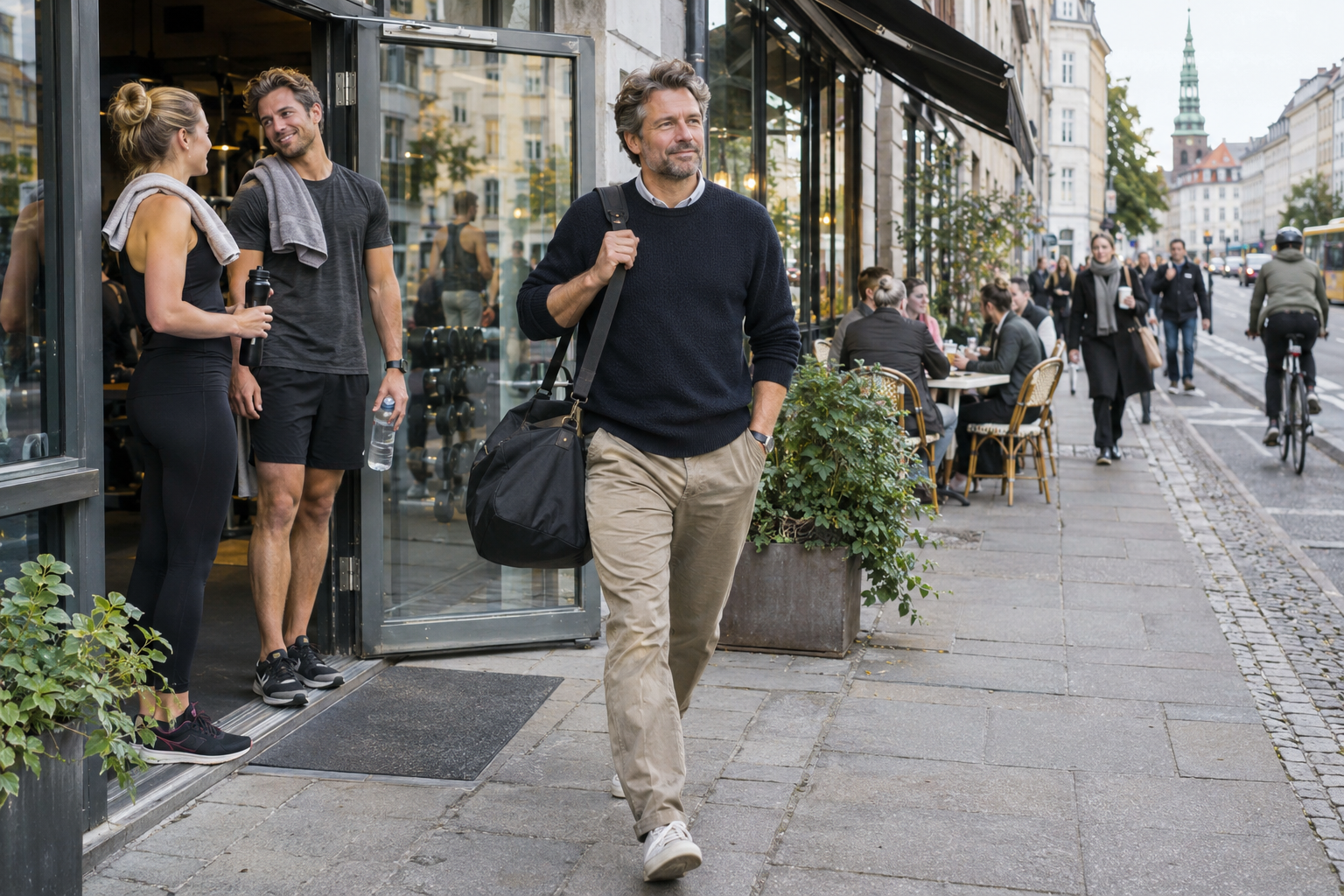
In Europe, gym clothes stay in the gym. Not as a written rule, but as a deep and consistent instinct: athletic wear belongs to the activity of exercising and to the place where you do it, and it is not worn out into the rest of life. The American habit of wearing workout clothes to run errands, grab coffee, or simply be out in the world is, to the European eye, a small misstep, and it is one visitors commit remarkably early, often before breakfast on their very first morning.
This is related to the broader truth that Europeans dress a notch up for public life, but it is really its own, more specific rule, and a more interesting one. It is not about being too casual; it is about clothes having a proper place. Here is the gym-clothes rule, the particular logic of clothing belonging to a context, the wider pattern it belongs to, and how to stop breaking it before your coffee has even cooled. It is a small habit with a surprisingly tidy idea behind it.
Clothes Have a Place

The deepest idea underneath this is one that organizes a great deal of how Europeans dress: the sense that different kinds of clothing belong to different places and purposes, and are not freely interchangeable. There is a clothing for exercising, a clothing for the beach, a clothing for sleeping, a clothing for being out among people, and these lanes are kept distinct.
Gym clothes, in this framework, are firmly in the exercising lane. They are what you wear to work out, at the gym, on a run, in a class, and their place is there, not at the cafe, the shop, or the street. Wearing them outside that context is not simply dressing casually; it is wearing the wrong category of clothing for where you are, like showing up to a dinner in pajamas. The issue is less that the clothes are too relaxed and more that they belong somewhere else entirely, and have been brought where they do not fit.
This is a subtly different objection from the one about informality, and it is worth separating the two. An American in gym clothes at a European cafe is not just underdressed; they are, to local eyes, wearing exercise equipment in a place meant for ordinary clothes, which reads as a small category error rather than merely a casual choice. The European instinct is that clothes have contexts, that each setting calls for its own kind of dress, and that keeping those contexts straight is simply part of dressing like a grown-up. Gym clothes have a context, and it is the gym.
Sportswear Is Equipment, Not an Outfit

The key to the whole thing is how differently the two cultures understand what athletic wear actually is. To the European eye, sportswear is not a style of casual clothing at all; it is functional equipment, specialized kit designed for the specific job of exercising.
Think about what workout clothes are actually built for. They are engineered to wick sweat, to stretch and move with the body, to provide support and ventilation, to perform during physical exertion. They are, in other words, technical gear for an activity, closer in spirit to a tool than to a wardrobe, and their every feature is designed around the act of exercising rather than around looking a particular way out in the world. Seen this way, wearing them to the cafe is a little like wearing a tool belt or a lab coat to brunch: it is professional equipment for a specific task, worn out of its proper setting.
This is exactly how the European reads the American in gym clothes at the shops, and it explains why it strikes them as odd rather than merely casual. The clothes announce, unmistakably, I am dressed to exercise, which looks perfectly normal at the gym and distinctly out of place anywhere else. The American, by contrast, has come to see athletic wear as a legitimate everyday outfit, comfortable clothes that happen to be stretchy, and that different understanding of the same garments is the whole root of the divide. One culture sees an outfit; the other sees equipment worn out of context.
This also explains why dressing it up does not quite rescue it. You can wear the nicest, most expensive designer athletic wear, and to the European eye it still reads as gym clothes worn out of place, because the objection was never about quality or cost but about category. Fancy exercise gear is still exercise gear, and no amount of polish moves it into the ordinary-clothes lane; only actually changing does that.
Before Breakfast
There is a reason the title singles out breakfast, because the morning is when this rule gets broken most, and the pattern is remarkably consistent. The classic scenario is the American out early, in gym clothes, grabbing coffee or breakfast, either after a morning workout or simply because athletic wear is what they reached for first thing.
The morning is the danger zone precisely because it is when the lanes are most likely to blur. You wake, you perhaps exercise or intend to, you are in your comfortable athletic clothes, and you pop out for a coffee and a pastry before the day has properly begun, without changing first. It feels entirely natural and efficient, and in America it is completely unremarkable. But it means that the American abroad is very often out in public in gym clothes at breakfast time, before they have thought about it, which is exactly why this is one of the first dressing rules visitors break, and one they break before they have even properly woken up.
The European who exercises in the morning does the thing that closes the gap: they change. After the gym or the run, they shower and put on real clothes before rejoining the day and the public world, so that the workout and its clothing are sealed off as their own episode, concluded before the ordinary business of the morning begins. The gym clothes go on to exercise and come off immediately afterward, and the coffee and the pastry are collected in actual clothes. It is a small extra step, the changing, and it is precisely the step the American habit skips.
The Same Instinct That Keeps Swimwear at the Beach

The gym-clothes rule is really one instance of a much broader European habit, and seeing the wider pattern makes the whole thing click into place. It is the same instinct that keeps swimwear at the beach, pajamas at home, and each kind of clothing in its proper domain.
Consider how strictly Europeans keep swimwear in its lane. On the beach, swimwear is correct and universal; walk a few streets inland into the town, still in just a swimsuit, and you have made a real misstep, wearing beach clothing where ordinary clothing belongs. Some places take this so seriously that they fine it: the Croatian island of Hvar, for instance, imposes substantial penalties on tourists who wander through town in their swimwear, treating the beach outfit as genuinely out of place in the streets. The principle is identical to the gym-clothes one, just applied at the shoreline: clothing has a context, and the beach outfit belongs on the beach exactly as the gym outfit belongs at the gym.
Pajamas follow the same logic, and so does much else. Nightwear is for sleeping and for home, not for the shop or the school run, and the idea of popping out in pajamas, normal enough in parts of America, strikes most Europeans as plainly wrong, clothing worn far out of its proper place. Across all these cases, the underlying rule is the same: each setting has its appropriate dress, and the specialized clothing of one domain, the gym, the beach, the bed, stays in that domain rather than wandering out into general public life. The gym-clothes habit is simply the most common way visitors bump into this whole, consistent European instinct.
Why Europeans Keep the Lanes Separate
It is worth asking why Europeans maintain these distinctions so carefully, because the answer reveals something about how the culture thinks. Part of it, inevitably, is the familiar instinct toward presentability, the sense that being out in public calls for being properly dressed, which specialized activity-wear simply is not.
But there is more to it than that, a genuine sense of appropriateness and of respect for context. Keeping clothing in its proper lane reflects a feeling that different settings deserve different dress, that one honors the occasion, however ordinary, by wearing what suits it, and that mixing the lanes, wearing exercise gear to lunch, beach clothes to the shops, signals a certain not-bothering, a failure to meet the setting on its own terms. There is a tidiness of categories in it, a sense that things have their place and that keeping them there is part of living in an orderly, considered way. The clothing lanes are one more expression of a culture that likes its contexts clear.
None of this is heavily policed or moralized in daily life, Hvar’s fines notwithstanding; for the most part it is simply a shared background assumption, absorbed from everyone around you, about what belongs where. A European does not consciously think, I must not wear my gym clothes to the cafe; they simply would not, because gym clothes are for the gym, as obviously as a raincoat is for rain. It is less a rule to be obeyed than a habit so ingrained it feels like common sense, which is exactly why it is invisible to the American, for whom the lanes were never drawn in the first place.
The American All-Purpose Wardrobe
In fairness, the American habit is not carelessness but the product of a different and genuinely appealing idea: the all-purpose wardrobe. America has moved steadily toward comfortable, versatile, multi-context clothing, and athletic wear is its purest expression, clothes you can wear to the gym, the errands, the lounge, the airport, and the coffee run alike.
There is real value in this, and it should not be dismissed. A wardrobe of comfortable, flexible clothes that work across every setting is efficient, practical, and democratic; it saves changing, saves thought, saves money, and suits a busy, informal, on-the-go life beautifully. The same leggings or athletic shorts that you exercised in can carry you comfortably through the rest of the day, and there is a genuine ease and freedom in not needing a different outfit for every context. The American all-purpose wardrobe reflects a culture that prizes comfort, versatility, and informality, and by those values it is a sensible and even elegant solution, getting maximum use from clothes that go anywhere.
So this is, once again, a difference of values rather than a matter of right and wrong, the one-wardrobe-for-everything instinct against the clothes-for-each-context one. Americans trade the European tidiness of distinct clothing lanes for the convenience of versatile, comfortable clothes that serve every occasion, which is a perfectly reasonable bargain, and not a failing. The two cultures have simply drawn the map differently, one with many small clothing territories, the other with one big comfortable one, and the American operating on the American map will keep wandering, unawares, across European borders that were never on their chart.
Changing Out of the Gym Clothes

The practical fix, for anyone who would rather not read as the visitor, is as simple as the one extra step the Europeans take: change out of your gym clothes before you rejoin the public day. Keep a set of ordinary clothes for being out, and treat the workout and its gear as their own sealed-off episode, concluded before the coffee run.
In practice this costs very little. It means showering and changing after the gym or the run rather than carrying on in the athletic clothes, and it means resisting the easy morning habit of popping out for breakfast in whatever you woke up or worked out in. A few minutes and a change of clothes, and you have moved yourself out of the exercise lane and back into the ordinary-clothes lane where the cafe and the street belong. It is the smallest of adjustments, and it quietly removes one of the most common tells of an American abroad.
And as with all of these, the choice is genuinely yours, and comfort is never wrong. If you would rather stay in your athletic wear on your trip, nothing bad will happen, and you are harming no one; this is a soft cultural habit, not a law, outside the odd swimwear-fining town.
But there is a gentle charm worth appreciating in the European way, a life in which clothes have their proper places and each setting is met in its own right dress. Borrowing even a little of it, starting with changing out of the gym clothes before breakfast, is an easy way to feel, and look, a bit more at home. Keep the workout gear for the workout, and let the rest of the day have its own clothes.

About the Author: Ruben, co-founder of Gamintraveler.com since 2014, is a seasoned traveler from Spain who has explored over 100 countries since 2009. Known for his extensive travel adventures across South America, Europe, the US, Australia, New Zealand, Asia, and Africa, Ruben combines his passion for adventurous yet sustainable living with his love for cycling, highlighted by his remarkable 5-month bicycle journey from Spain to Norway. He currently resides in Spain, where he continues sharing his travel experiences with his partner, Rachel, and their son, Han.