
Picture the scene. You have traveled to a mountain town in Japan for the hot springs, you have paid your entry, undressed, showered carefully as the etiquette demands, and you are about to step into the steaming water. And an attendant stops you, points at the small butterfly on your shoulder, and shakes her head. You are not getting in.
For a lot of tattooed travelers, this is the great disappointment of a trip to Japan. Even a tiny, delicate tattoo, the kind nobody back home would look at twice, can get you refused at a Japanese onsen, and finding out at the water’s edge, undressed and ready, is a uniquely awful way to learn it.
But here is the good news, and it is genuinely good: a tattoo no longer has to mean missing out on the onsen. The rule is not what most people think it is, and there are four reliable ways around it, from waterproof stickers to private baths to whole towns that welcome ink. Here is why the ban exists, why even a butterfly trips it, and exactly how tattooed visitors actually get to soak, whether your ink is a small flower or a full back piece. None of it requires giving up the hot springs.
It Is Not the Law, It Is the Yakuza
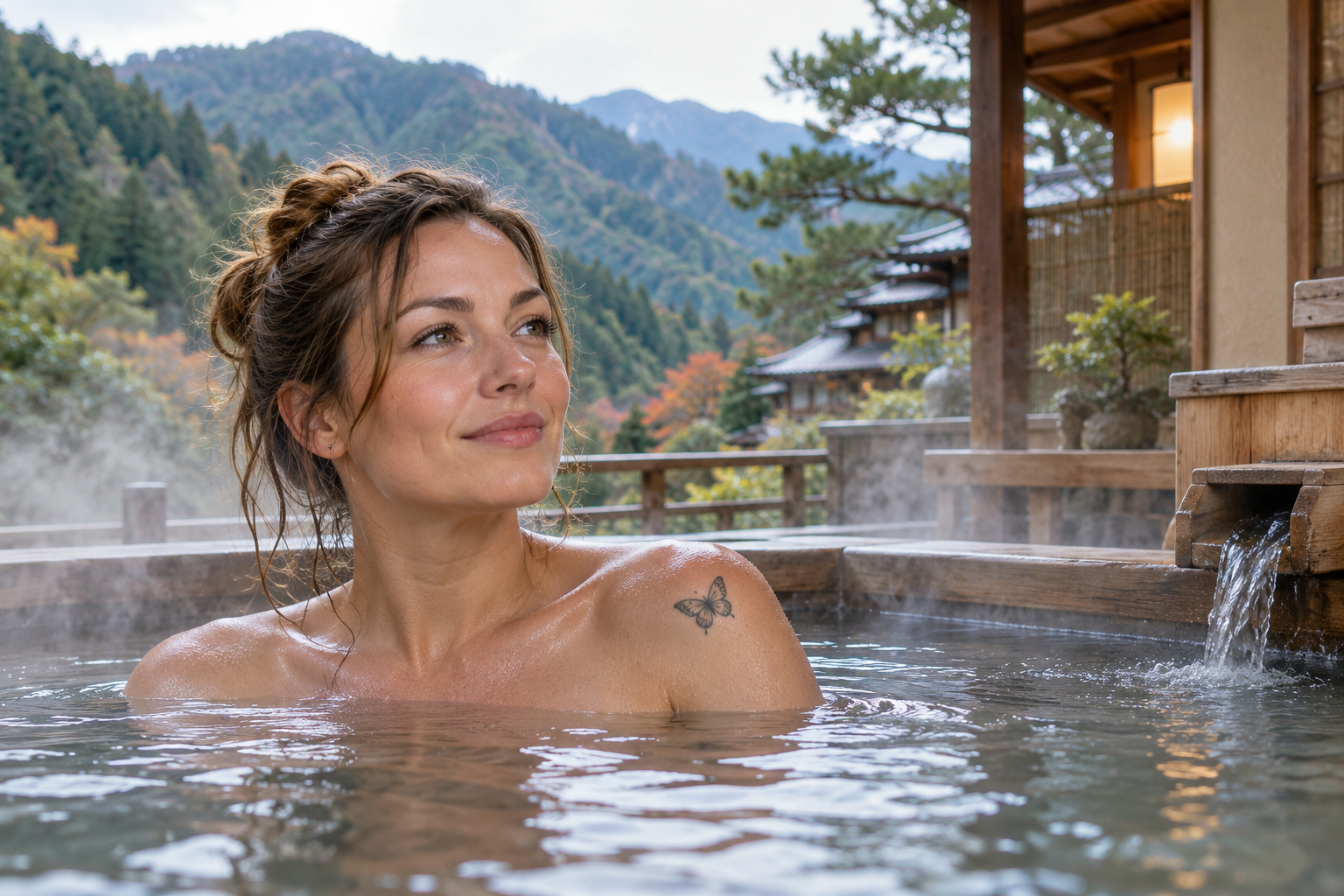
The first thing to understand is that the no-tattoo rule is not a law. Japan’s public bathhouse legislation does not mention tattoos at all, and there is no national rule banning inked bodies from the water. What you run into at the door is a house rule, set by each individual bath, and that distinction turns out to matter enormously.
The reason those house rules exist has almost nothing to do with you. In Japan, tattoos have long been associated with the yakuza, the organized crime syndicates whose members traditionally wore elaborate full-body tattoos, irezumi, as marks of identity and belonging. Decades of films and public fear cemented the link in the popular mind, so that a tattoo came to read, to many older Japanese, as a sign of a gangster. A no-tattoo sign at a bathhouse is really a quiet way of saying no gangsters.
Your butterfly, in other words, is collateral damage. The rule was never aimed at foreign tourists or at small decorative tattoos; it was aimed at keeping organized crime out of a shared, vulnerable, naked space. Even the Japanese government has acknowledged the awkwardness of this for visitors, with tourism authorities issuing guidance years ago suggesting that simply refusing every tattooed person is inappropriate and encouraging baths to find more flexible solutions. The official wind, in other words, is already blowing toward letting you in.
This is worth holding onto when you meet a strict sign, because it reframes the whole thing. You are not being judged as a bad person or an unwelcome guest; you have simply bumped into a crude rule written for somebody else entirely. Understanding that takes the sting out of a refusal and makes it much easier to treat the workarounds as the simple logistics they are, rather than as some personal rejection.
Why a Tiny Tattoo Still Gets You Refused
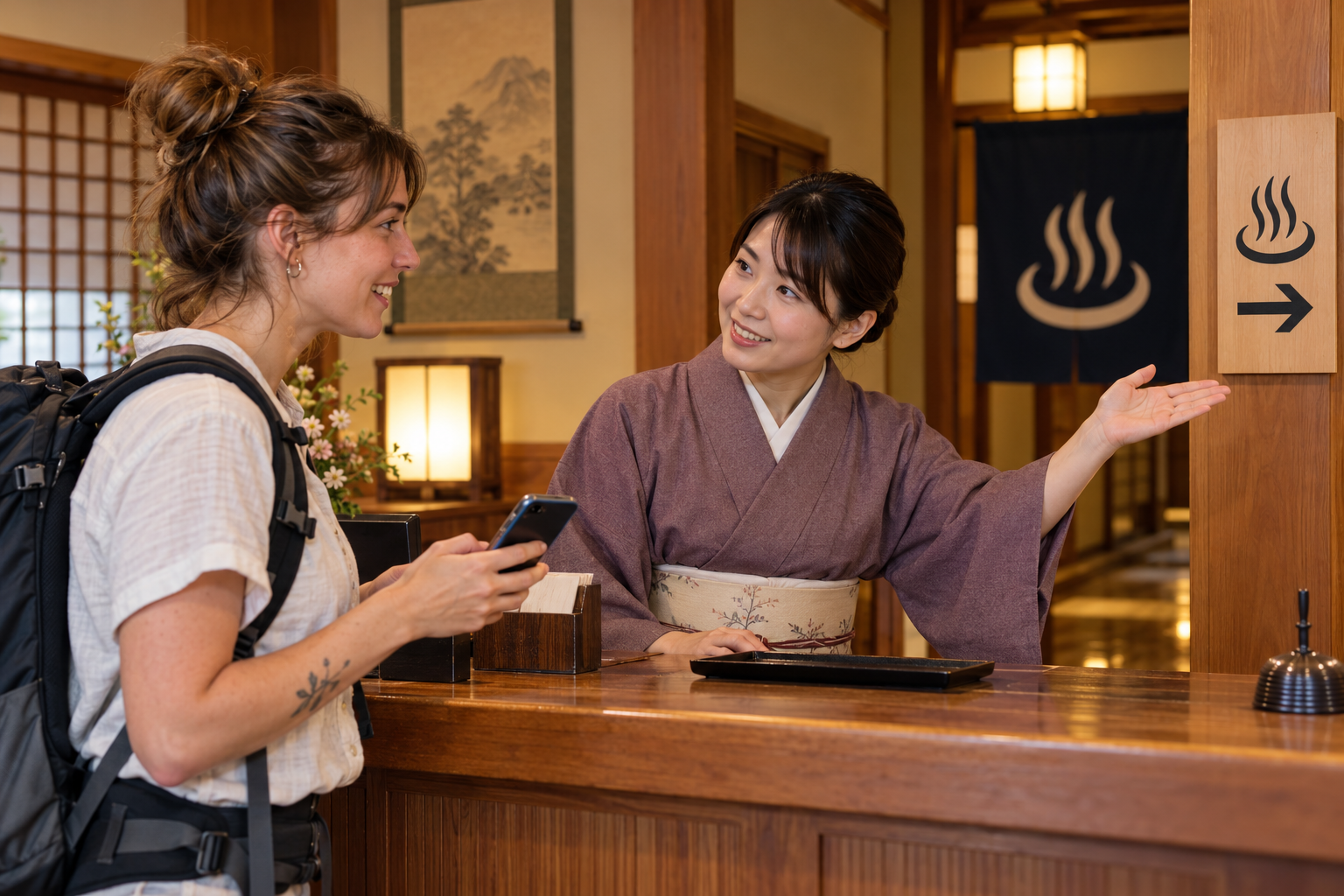
If the rule is really about gangsters, you might reasonably ask why a strict bath still turns away your harmless little tattoo. The answer is that a blanket ban is simply the easiest rule to enforce, and many baths have chosen the blunt instrument over the nuanced one.
From behind the counter, it is awkward and uncomfortable to start judging which tattoos are acceptable and which are not. Drawing a line between a tourist’s butterfly and a gangster’s sleeve means making subjective calls, risking offense, and inviting arguments, so a great many onsen have historically just banned all visible ink to avoid the whole problem. It is lazy, in a sense, but it is also understandable, and the result is that even the most innocent tattoo can fall foul of a strict blanket policy.
There is a cultural layer to it as well. In a traditional onsen, the bath is a shared, intimate, vulnerable space where everyone is naked and at ease, and the old thinking held that a visible tattoo, with its criminal associations, could make other bathers uncomfortable. Whether or not that logic still holds in an age of mainstream tattooing, it is the reasoning behind the sign, and it explains why some baths cling to the ban even as the world changes around them.
A significant share of onsen across Japan still ban tattoos outright, which is why you cannot simply show up anywhere and hope. The scenario to avoid at all costs is the one from the opening: arriving unprepared, paying, undressing, and only then being refused, which is both mortifying and a waste of your trip. The entire trick to bathing with tattoos in Japan is to stop leaving it to chance and to use one of the four workarounds instead, each of which sidesteps the blanket ban in a different way.
Workaround One: The Private Bath
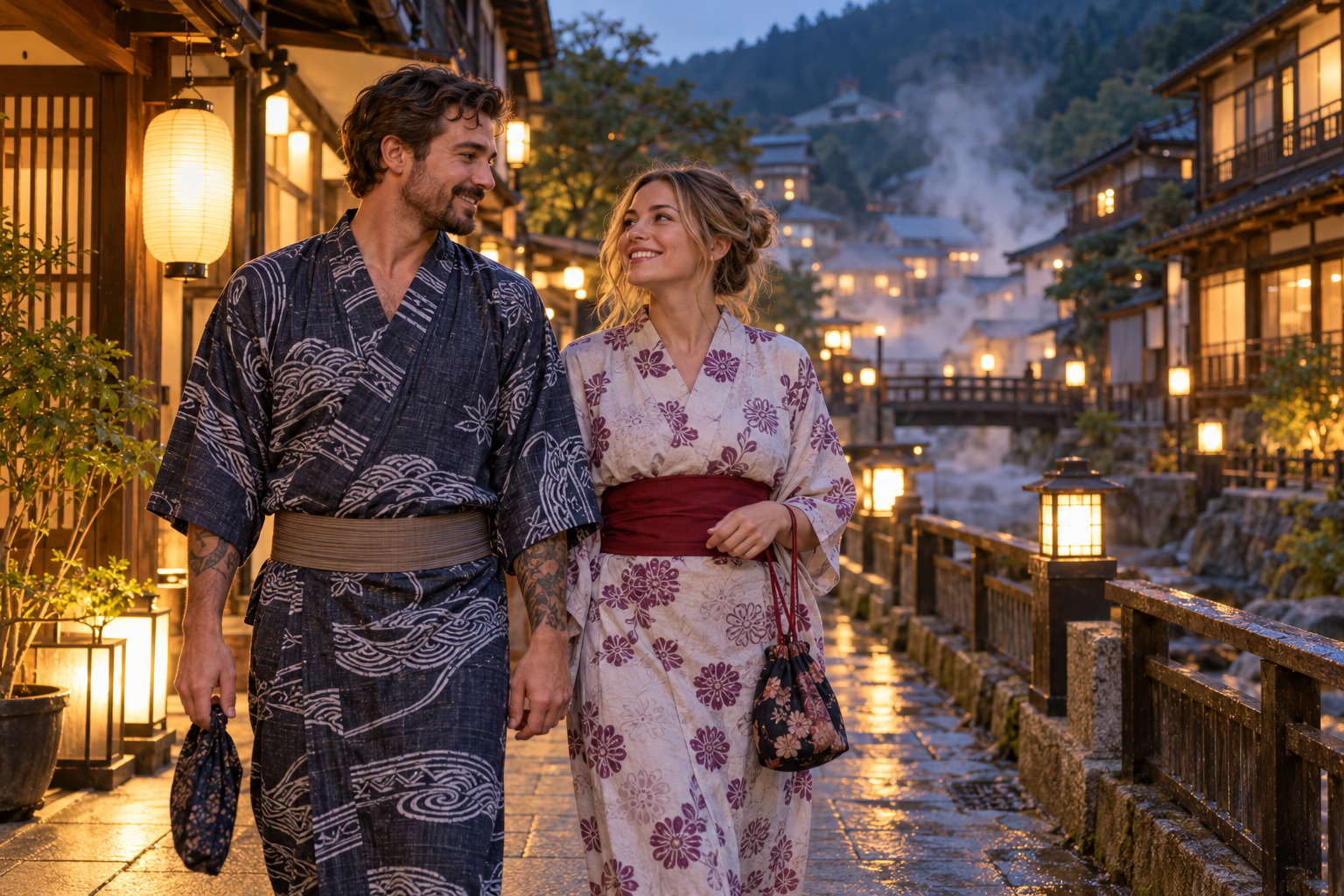
The single best and safest solution, especially if your tattoo is large or you simply want zero risk, is to book a private bath. In Japanese these are called kashikiri-buro, a bath you reserve for yourself alone, or kazokuburo, a family bath, and many ryokan inns and some day-use facilities offer them.
The beauty of the private bath is that the rules change entirely. Because a kashikiri is a private space rather than a shared public one, the no-tattoo house rules simply do not apply. There are no size limits, no stickers, and no covering up required; a full sleeve, a back piece, an entire bodysuit, all are completely fine, because there is nobody else in the water to object. You book it by the session, often for forty-five minutes to an hour, and the hot spring is yours.
Even better, many ryokan offer guest rooms with their own private open-air bath attached, your own personal onsen that you can slip into any time, tattoos and all. For anyone with extensive body art, or couples and families who want to bathe together rather than being split into gender-separated communal baths, the private route is the clear answer. It costs a little more than a public bath, but it removes every ounce of the anxiety, and it is the one option that works no matter how much ink you carry.
There is also something quietly lovely about the private option on its own terms. A reserved open-air bath, just you and the steam and the mountain view, with no strangers and no rules to worry about, is for many people the nicest way to experience an onsen anyway. What starts as a workaround for a tattoo often turns out to be the highlight of the trip.
Workaround Two: The Cover-Up Sticker
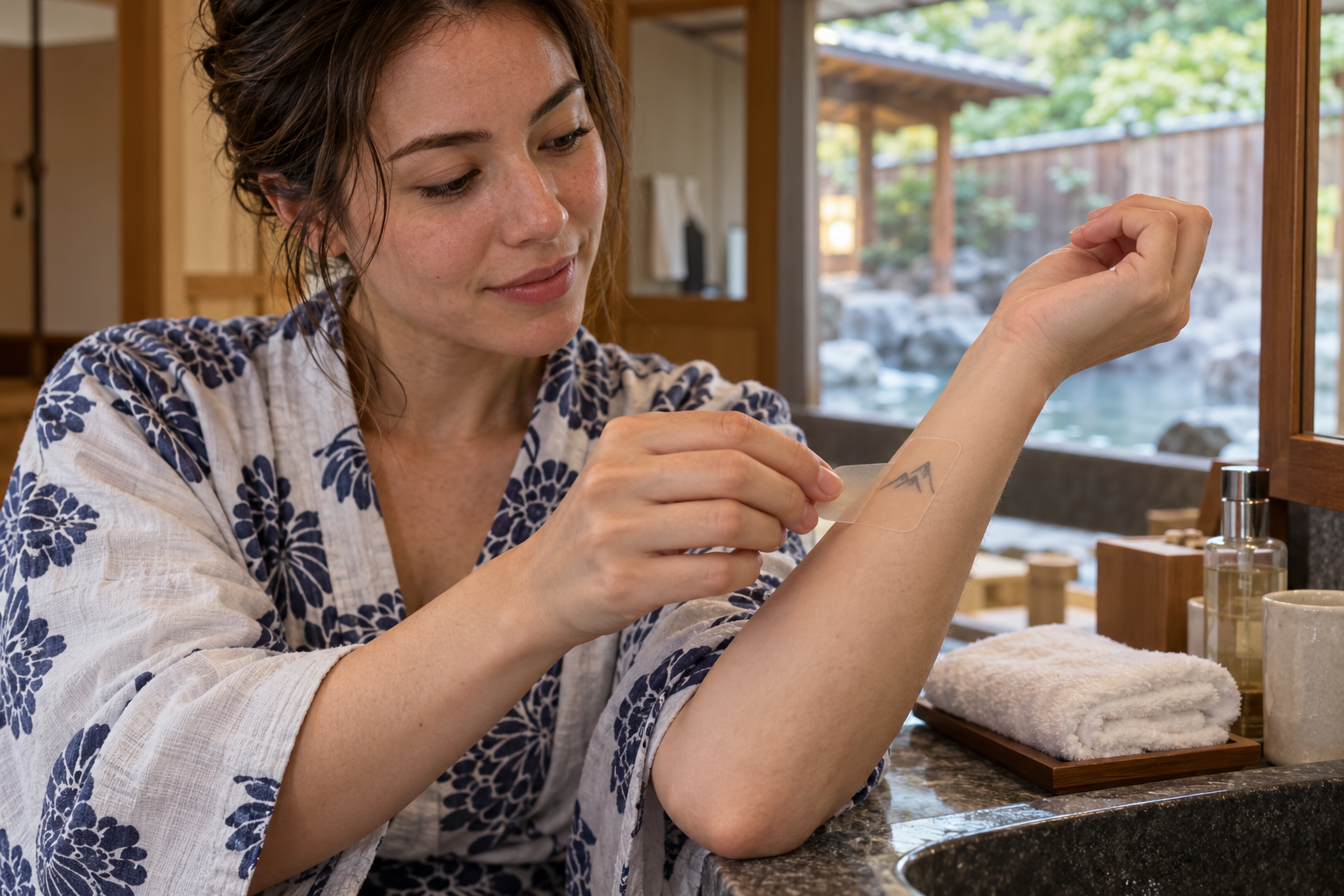
For a small tattoo, the simplest and cheapest fix is often just to cover it up, and there is a product made for exactly this. Waterproof, skin-toned adhesive patches, sold in Japan as tattoo cover seals, are designed to conceal a tattoo well enough to pass at a bath that would otherwise turn you away.
These are easy to find once you know where to look. They are sold at the big drugstore and discount chains like Don Quijote and the major pharmacies, as well as online, and they come in various sizes. One crucial tip: buy them before you head out to the onsen town, because a small mountain village may not stock them, and you do not want to be hunting for patches when you arrive. Some baths that allow covered tattoos set specific limits, such as everything fitting under a sticker of a certain size, so it is worth checking the facility’s policy.
The honest limitation is size. A cover sticker works for a small tattoo, roughly up to the size of your hand, but it is useless for anything larger; a full sleeve or a back piece simply cannot be hidden under a patch, no matter how many you use. The stickers can also peel in hot water, so you check them before stepping in. For a small, discreet tattoo, though, a cover seal is a cheap, quick solution that lets you enjoy an ordinary communal bath with no fuss at all.
Workaround Three: Tattoo-Friendly Towns
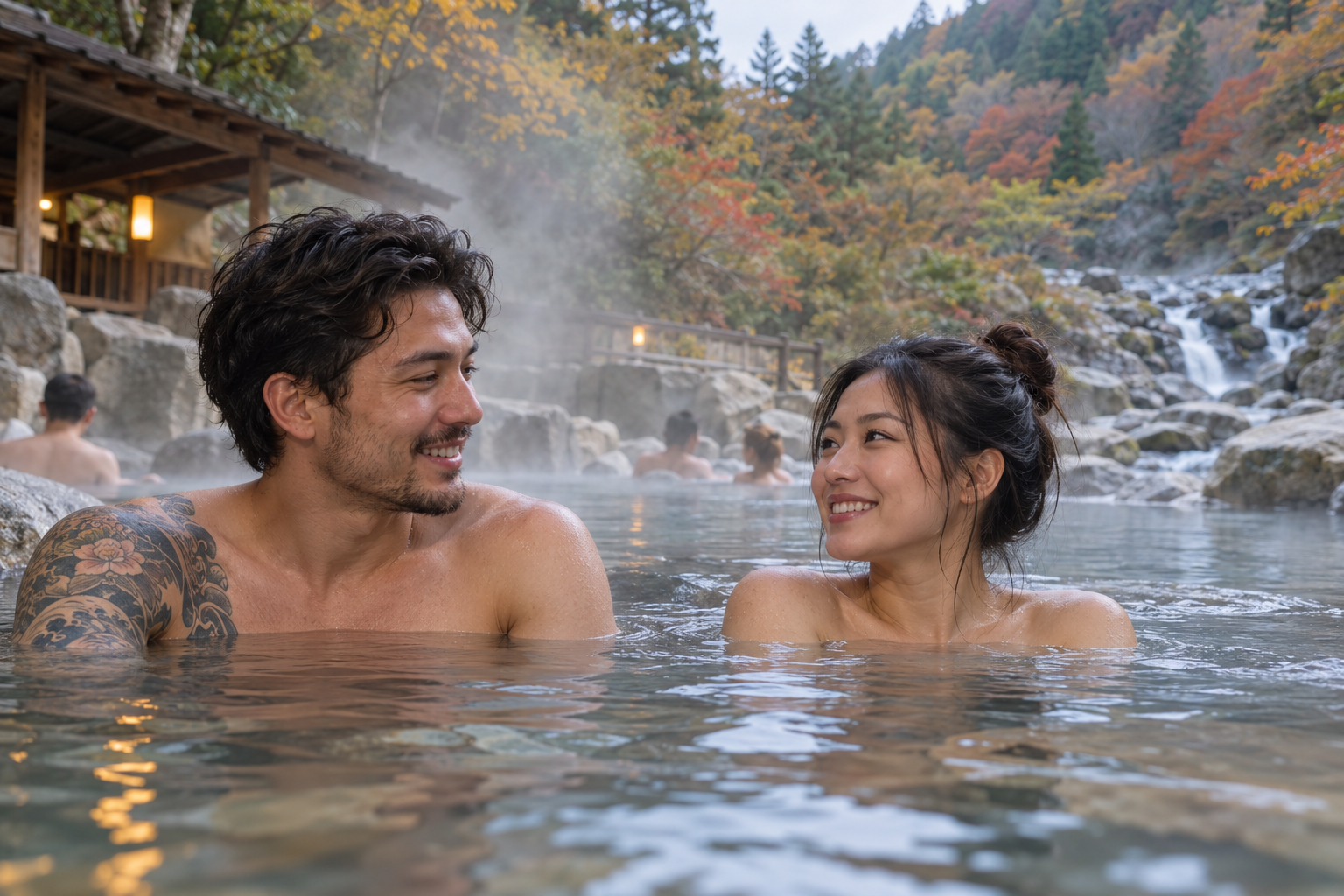
The third route is to skip the problem entirely by going somewhere that welcomes you, because a growing number of onsen and whole onsen towns have declared themselves openly tattoo-friendly. At these places, tattoos of any size are allowed in the communal baths with no cover-up and no questions.
The list is real and getting longer. The famous hot-spring town of Kinosaki, for instance, is celebrated for welcoming tattooed visitors across its baths, and the steaming resort area of Beppu, the mountain onsen of Nozawa, and many of the ryokan around Lake Kawaguchiko near Mount Fuji are known for being relaxed about ink. There are dedicated online lists and maps of tattoo-friendly facilities, maintained by tourism bodies and independent sites, that let you find them before you go.
The one piece of advice everyone agrees on is to confirm with the facility directly rather than relying only on a third-party list, since policies change and lists go stale. Check the onsen’s own website for an explicit tattoo-welcome statement, or message them to ask. Planning your trip around a tattoo-friendly town is arguably the most relaxing approach of all, because it lets you bathe in the full communal experience, the big shared pools and open-air baths, without ever having to hide anything or book a private room.
Workaround Four: Just Ask
The fourth workaround is the simplest, and the most overlooked: ask ahead. Rather than guessing, a quick message or call to a facility before you go removes almost all the uncertainty, and it costs you nothing but a few minutes.
This matters because the middle ground is expanding. More and more baths are moving away from blanket bans toward policies that distinguish by size, quietly allowing small tattoos, or small covered tattoos, even where large ones are still refused. A bath’s actual policy is often more flexible than its old signage suggests, and the only way to know is to ask. A polite email explaining that you have a small tattoo and asking whether it would be acceptable, perhaps covered, will usually get you a clear and friendly answer.
Asking also spares you the worst-case scenario entirely. The refusal at the water’s edge happens to people who assumed and showed up; it almost never happens to people who checked first. Message the facility, confirm the rule, pack your cover seals as a backup for small ink, and have a private bath in mind as your fallback, and you have removed essentially all the risk. A little planning is the difference between a relaxing soak and a humiliating turn-around at the door.
The Rule Is Quietly Changing
Step back, and the larger story is an encouraging one: the tattoo ban in Japan is slowly, steadily loosening. The pressure of a tourism boom, combined with the government’s own nudges toward flexibility, has pushed a great many facilities to reconsider a rule that was shutting out well-behaved foreign visitors by the millions.
By some surveys, around half of onsen facilities have modified their tattoo policies in recent years in one way or another, whether by permitting small tattoos, accepting cover-ups, offering private baths, or dropping the ban entirely. In the most tourist-heavy areas especially, more and more baths have simply decided that a world where tattoos are mainstream no longer squares with turning away everyone who has one. The old blanket ban is increasingly looking like a relic.
That does not mean the rule has vanished, and it still varies enormously from one bath to the next, so the workarounds remain essential and confirming each place individually still matters.
But the direction of travel is clear and in your favor. A tattoo in Japan is no longer the barrier to the onsen it once was; it is now a manageable detail, something you plan around with a sticker, a private bath, a friendly town, or a quick message ahead. Do that small bit of planning, and you can sink into the steaming water with your butterfly on full display, exactly as you came to do.

About the Author: Ruben, co-founder of Gamintraveler.com since 2014, is a seasoned traveler from Spain who has explored over 100 countries since 2009. Known for his extensive travel adventures across South America, Europe, the US, Australia, New Zealand, Asia, and Africa, Ruben combines his passion for adventurous yet sustainable living with his love for cycling, highlighted by his remarkable 5-month bicycle journey from Spain to Norway. He currently resides in Spain, where he continues sharing his travel experiences with his partner, Rachel, and their son, Han.