
If you have watched any Korean drama, you have probably seen it without knowing what you were looking at: people lounging on a warm floor in matching shorts and t-shirts, little towels folded into funny shapes on their heads, cracking open brown eggs and sipping a cloudy sweet drink. That is a jjimjilbang, the Korean bathhouse, and it is one of the most delightful and genuinely strange institutions in the country.
A jjimjilbang is not a spa in the Western sense, not a place you visit for an hour of pampering and leave. It is a whole world under one roof, open around the clock, where Koreans bathe, sweat, eat, socialize, and quite often sleep. You can arrive in the evening and leave the next morning, having bathed, baked yourself in a charcoal kiln, eaten eggs, and napped on the floor, all for the price of a cheap meal.
For a first-time foreign visitor, it is equal parts wonderful and bewildering, because almost nothing about it works the way a Western spa does. Here is what actually happens inside a jjimjilbang, from the naked bathing to the towel hat to the overnight stay, so you can walk in knowing exactly what you are getting into.
Not a Spa. A Whole World.
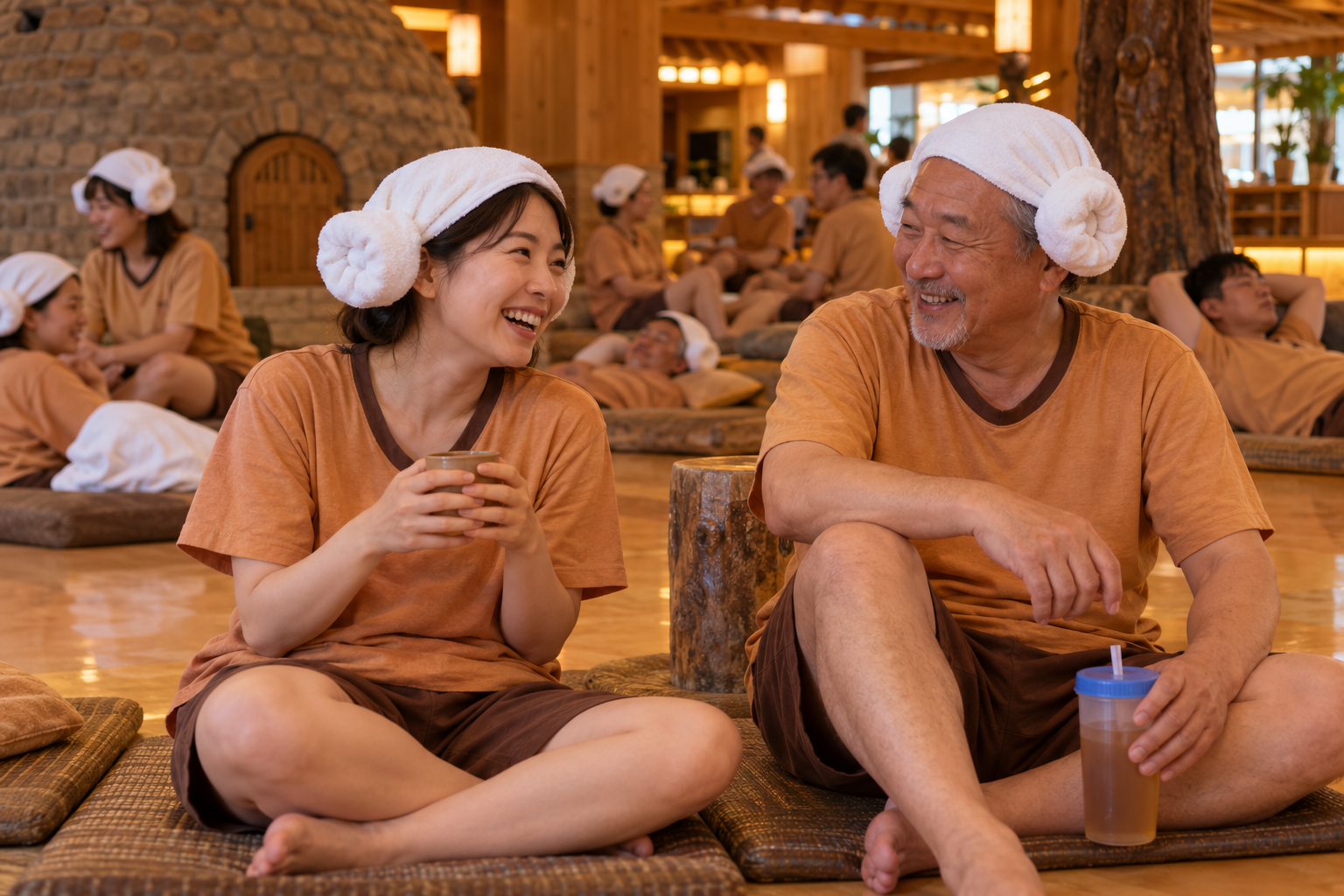
The first thing to understand is the sheer scope of the place. A jjimjilbang combines, under a single roof, a traditional bathhouse, a set of heated sauna rooms, relaxation lounges, a snack bar or restaurant, and communal sleeping areas, and most of them are open twenty-four hours a day.
The price is startlingly low for all of this. Entry typically costs somewhere around ten to fifteen thousand won, which is to say under fifteen dollars, and that buys you access for the whole day and, if you like, the whole night. It is one of the great bargains in Korea, which is a large part of why it is so woven into ordinary life.
And it genuinely is ordinary life. A jjimjilbang is not a tourist attraction or a special-occasion treat; it is a normal part of the week for all kinds of Koreans, used by families with small children, elderly couples, groups of teenagers, tired office workers, and everyone in between. People go to get clean, to relax, to recover from a hangover, to spend cheap time together as a family, or simply to have somewhere warm and comfortable to be. It is less a spa than a kind of communal living room for an entire society.
First, You Get Naked
Here is where many Western visitors get their first jolt, because the jjimjilbang begins with communal nudity. After you pay, store your shoes, and get your locker key, towel, and uniform, you head into the bathing area, and the bathing area is strictly, completely nude.
The bathing halls are separated by gender, and inside them nobody wears anything at all. There are rows of seated and standing showers, where you are expected to wash yourself thoroughly before getting into any of the water, a rule that is mandatory and strictly observed. Then there are the baths themselves: hot pools, warm pools, cold plunge pools, sometimes herbal or salt baths, and wet saunas, all to be soaked in with nothing on.
For anyone raised in a more body-shy culture, this sounds mortifying, and for about five minutes it is. But the striking thing that every visitor reports is how quickly the awkwardness evaporates, because Korean bath culture is utterly matter-of-fact about nudity in this context.
Nobody looks, nobody cares, and nobody is self-conscious; it is simply how bathing is done. Within a short while you stop noticing, and the warm water and the easy, unbothered atmosphere take over. Getting past this first hurdle is the price of admission to everything that follows, and it turns out to be a much smaller hurdle than it looks.
Then You Put On the Uniform
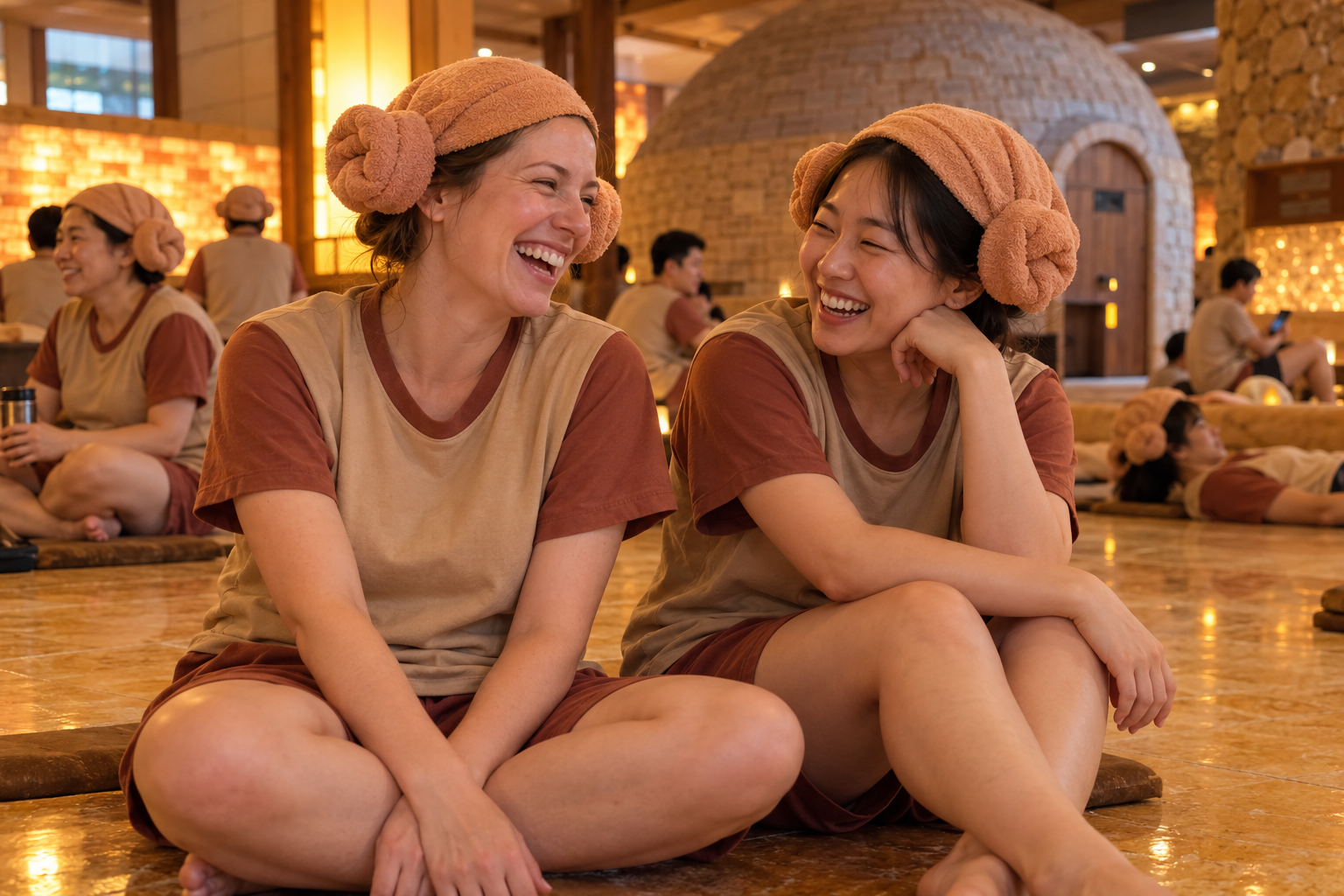
Once you have bathed, the jjimjilbang opens up into its second, larger half, and for this you get dressed, after a fashion. You put on the standard-issue uniform that comes with your entry: a simple matching t-shirt and shorts, usually in some cheerful institutional color, that everybody in the place is wearing.
This is the transition that defines the whole experience. The nude, gender-separated bathing area gives way to a vast, clothed, mixed-gender common space, where men and women, families and friends, all mingle freely in their identical pajama-like outfits. The uniform is a great equalizer; stripped of their normal clothes and dressed the same, everyone looks a little silly and a little equal, which is part of the charm.
From here on, you are free to roam the communal areas as you please, in your uniform, for as long as you want to stay. This clothed, co-ed zone, the jjimjil part proper, is where the baked eggs and the towel hats and the heated rooms live, and where most people actually spend the bulk of their visit. The bath got you clean; the uniform lets you settle in.
The Heated Rooms
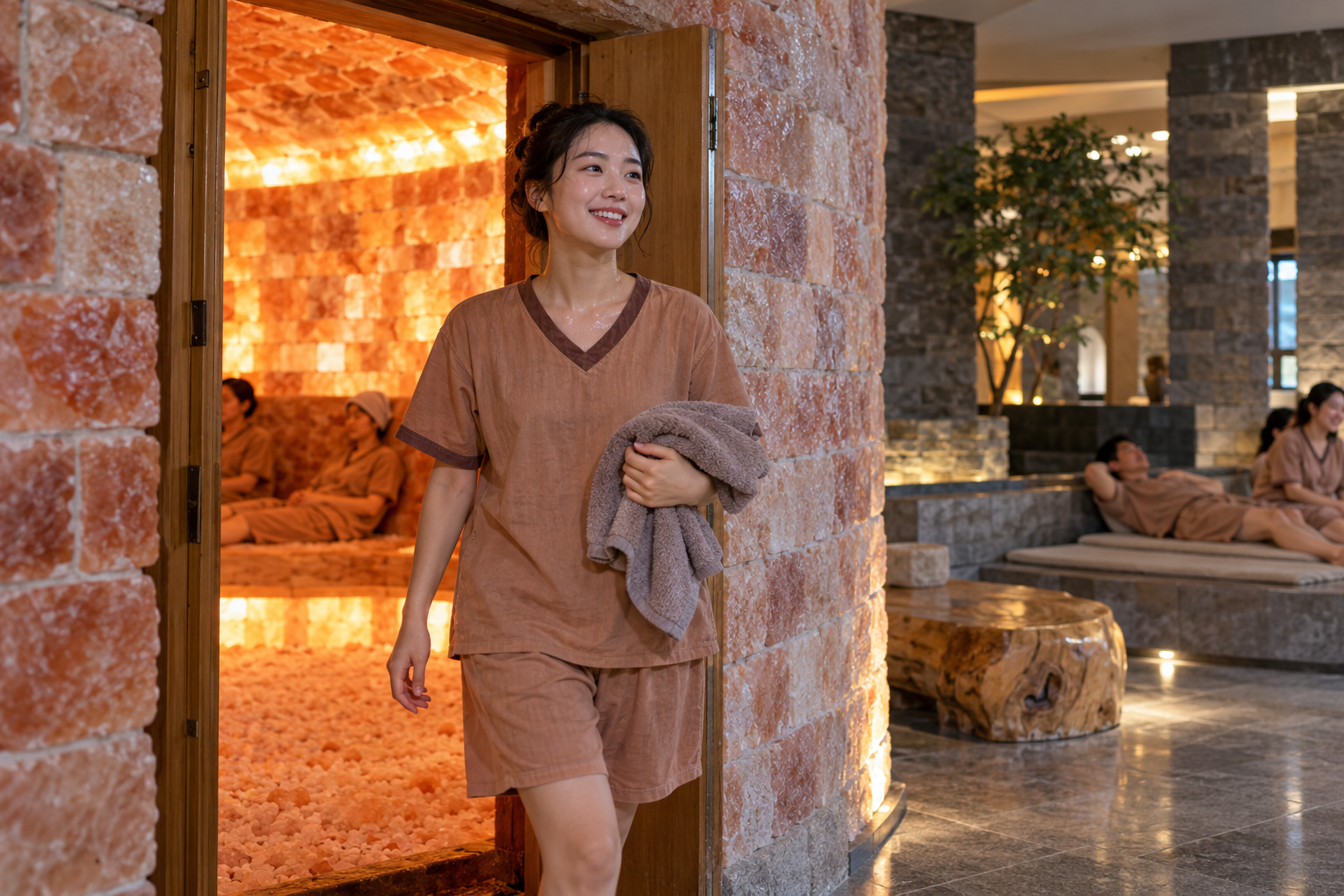
At the heart of the jjimjilbang are the kiln rooms, the heated chambers that give the place its name and its purpose, and exploring them is where the real magic happens. These are not the single steamy sauna of a Western gym but a whole collection of rooms, each kept at a different temperature and lined with a different material.
The variety is half the fun. There is typically a jade room, radiating gentle infrared heat from jade stones, a salt room lined with crystals said to help the skin and breathing, a clay or yellow-earth room, and the traditional charcoal kiln, a deep, enveloping heat with an earthy smell. Each material comes with its own folklore about what it does for your health, and part of the pleasure is wandering from room to room, trying each one. Many jjimjilbangs also have an ice room to cool off in between the hot ones.
Then there is the fierce one. The bulgama is the extreme sauna, a room heated to blistering temperatures, often eighty to a hundred degrees Celsius, where you can only last a few minutes before you have to stumble out. The rhythm of the jjimjilbang is built around this: you go into a hot room for a short while, sweat hard, come out, cool down with a cold drink, rest on the warm floor, and then do it again. It is a slow, cyclical, meditative way to spend hours, sweating and cooling and resting, and it is deeply, surprisingly relaxing.
The Towel Hat
Now for the detail you have definitely seen in the K-dramas: the towel hat. Wander the heated rooms and you will notice many Koreans wearing a small white towel folded into a peculiar shape on their heads, with two little rolls sticking up on either side like a lamb’s ears.
This is the yangmeori, usually translated as the sheep-head or lamb-head towel, and it is the single most iconic image of the jjimjilbang. You make it by folding and rolling a standard small towel in a particular way until it perches on your head with its two distinctive side bumps. It looks faintly ridiculous, which is entirely the point, and it is a beloved tradition that locals and knowing visitors alike wear with a kind of cheerful pride.
It is also genuinely practical, which is the lovely thing about it. The folded towel insulates your head and hair from the intense heat of the kiln rooms and soaks up the sweat, so it is useful as well as fun. Learning to fold your own yangmeori is a small rite of passage, and wearing one is the quickest way to stop feeling like a bewildered tourist and start feeling like you are in on the joke. Do not skip it; the towel hat is half the experience.
Baked Eggs and Sweet Rice
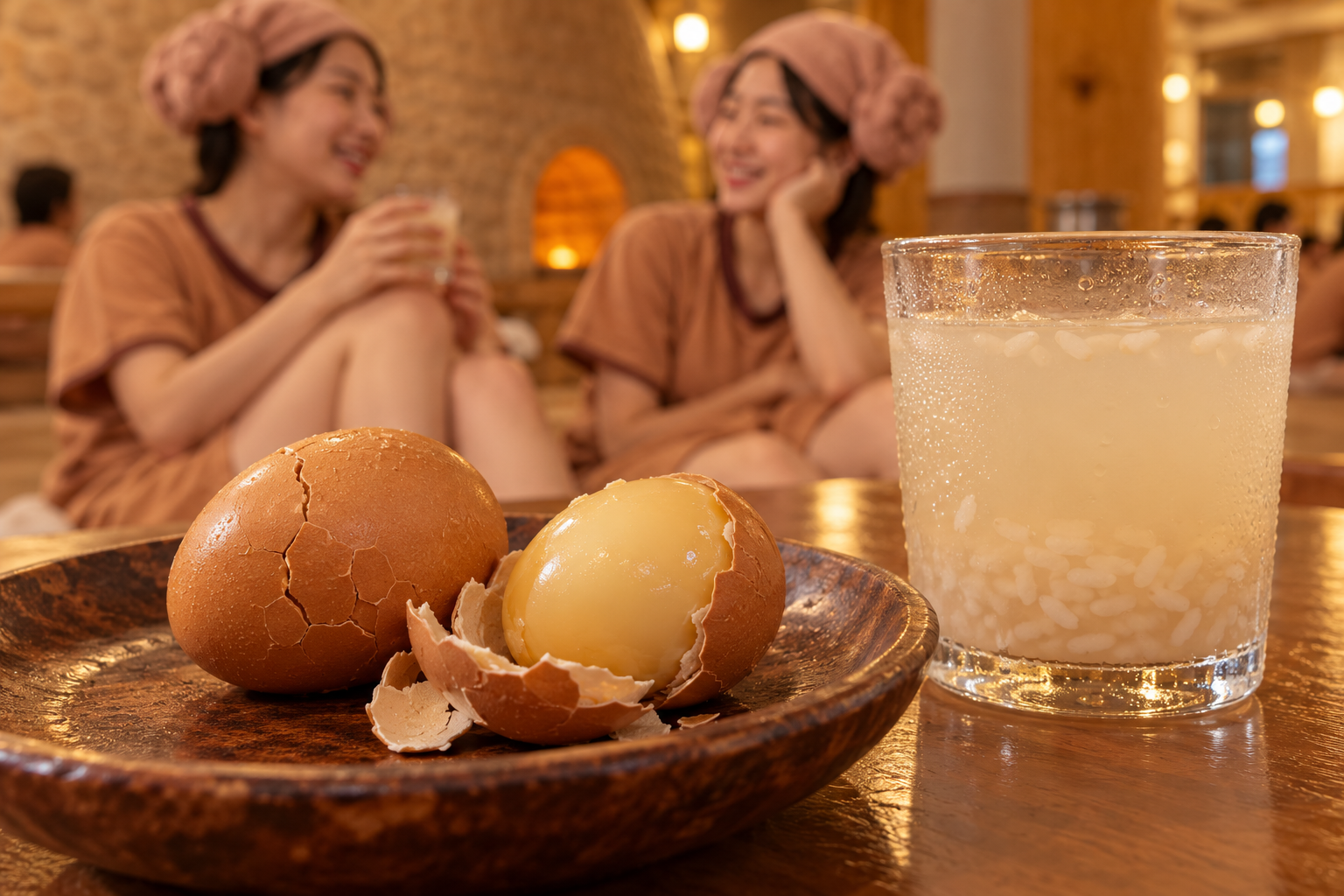
You cannot talk about the jjimjilbang without the food, because there is a specific, canonical jjimjilbang meal that every Korean knows and that you absolutely must try. It is two things, eaten together: baked eggs and sweet rice drink.
The eggs are the famous part. These are eggs slow-roasted on hot stones inside the sauna rooms until their shells turn brown and the insides become dense, smoky, and faintly caramelized, quite different from an ordinary boiled egg. They cost barely anything, a thousand or two thousand won, and after a long sweat in the hot rooms they are strangely, perfectly satisfying. The drink that goes with them is sikhye, a cold, lightly sweet, slightly fizzy fermented rice drink, refreshing and cooling in a way that is exactly what your overheated body wants.
Together, the roasted eggs and the sikhye are the classic jjimjilbang pairing, so canonical that ordering them marks you instantly as someone who knows what they are doing. Most tourists miss the combination entirely, which is a genuine shame, because the salty-smoky egg and the sweet cold drink after a session in the kiln is one of the small perfect pleasures of Korea. The snack bars also serve ramen, dumplings, and other Korean comfort food, so you never need to leave to eat, but the eggs and the sikhye are the ones to seek out.
The Scrub That Hurts So Good
For those willing to go further, there is the seshin, the legendary Korean body scrub, and it is an experience unlike anything in a Western spa. For an extra fee, back in the nude, gender-separated bathing area, you lie down on a table and a professional attendant scrubs every inch of your body with a coarse exfoliating mitt.
It is, by every account, a little brutal. The attendant, very often a no-nonsense ajumma, the Korean word for a middle-aged auntie, works over your entire body with the rough mitt, and the dead skin comes rolling off in gray little curls, like eraser shavings, in quantities that are frankly horrifying and strangely gratifying to witness. It is vigorous, occasionally bordering on painful, and utterly thorough, with no part of you spared or treated gently.
And yet people love it, and come back for it, because the result is a softness and cleanness of skin unlike anything a gentle Western exfoliation produces. It is routine and unembarrassing in Korea, a normal part of proper washing rather than a luxury treatment, and it has a devoted following among visitors who describe it as simultaneously the most uncomfortable and most satisfying scrub of their lives. If you can get past the awkwardness, it is worth trying at least once, if only to understand what truly clean feels like. Consider it a rite of passage.
You Can Sleep There
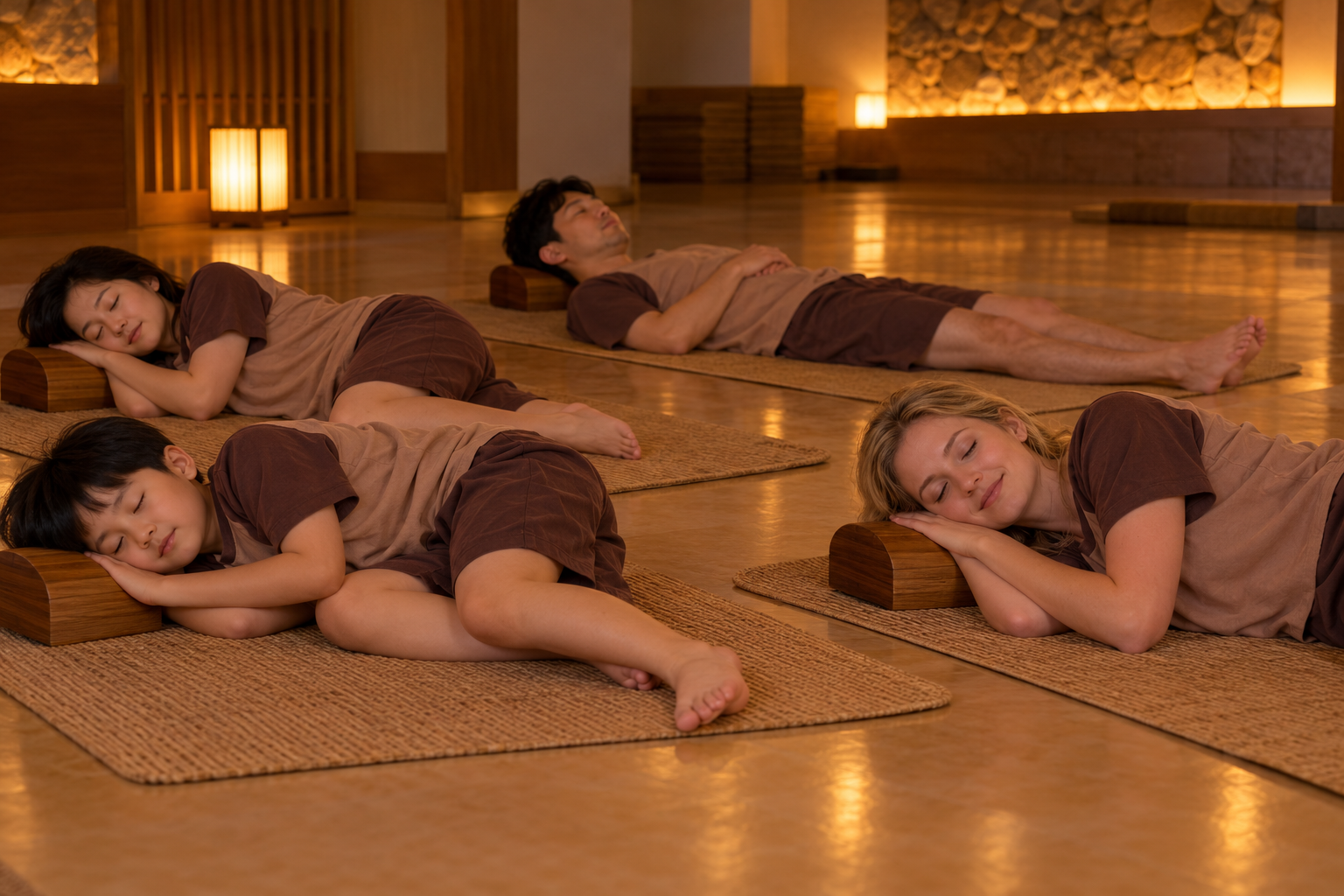
Here is the detail that most surprises foreigners: you can spend the night. Because most jjimjilbangs are open twenty-four hours and include communal sleeping areas as part of standard admission, people routinely stay over, and it is completely normal to do so.
The sleeping is wonderfully low-key. In the simplest places, you simply find a spot on the warm, heated floor of a quiet room, lie down on a mat with the little wooden or foam block Koreans use as a pillow, and go to sleep among strangers doing exactly the same thing. Fancier establishments offer sleeping rooms with capsule-style cubbyholes stacked in two levels for a bit more privacy. Either way, it is heated, safe, and included in your few dollars of entry.
This is why the jjimjilbang doubles as some of the cheapest accommodation in Korea. People who have missed the last train home, travelers on a tight budget, and night owls who simply do not want to leave all bed down in the jjimjilbang for the night, and whole families will sometimes make an evening and overnight of it together. There is something quietly marvelous about a place where, for the price of a sandwich, you can bathe, sweat, eat, and then simply lie down and sleep, and be welcome to stay until morning.
Why Koreans Love It
Put all of it together, and you start to understand why the jjimjilbang is so beloved and so uniquely Korean. It is affordable, it is democratic, and it is deeply communal, a place where a society that works famously hard goes to be warm, clean, fed, and at rest, together.
Nothing in the West quite matches it. It is not a spa, not a gym, not a hotel, not a restaurant, but a little of all of them at once, open to everyone from newborns to grandparents, where the normal barriers of clothing and class dissolve into identical cotton uniforms and shared warm floors. People go to recover, to bond, to kill time cheaply, to save on a hotel, or just to feel looked after for a few hours, and it does all of those things at once.
For a visitor, the jjimjilbang is one of the most rewarding cultural experiences Korea offers, provided you go in with an open mind and a willingness to get past the first awkward few minutes of nudity. Soak in the pools, brave the kiln rooms, fold yourself a sheep-head towel, eat the eggs with the sweet rice, try the scrub if you dare, and lie down on the warm floor afterward. Do that, and you will not just have visited a Korean bathhouse; you will have understood something real and warm about how Koreans actually live.

About the Author: Ruben, co-founder of Gamintraveler.com since 2014, is a seasoned traveler from Spain who has explored over 100 countries since 2009. Known for his extensive travel adventures across South America, Europe, the US, Australia, New Zealand, Asia, and Africa, Ruben combines his passion for adventurous yet sustainable living with his love for cycling, highlighted by his remarkable 5-month bicycle journey from Spain to Norway. He currently resides in Spain, where he continues sharing his travel experiences with his partner, Rachel, and their son, Han.