
For Americans, the end of October means one thing: Halloween. Costumes and candy, carved pumpkins and spooky decorations, children going door to door on the night of the thirty-first. It is loud, playful, secular, and enormously popular.
Cross the Atlantic, though, and the picture changes almost completely. In much of Europe, the thirty-first of October passes relatively quietly, and the day that really matters is the one right after it.
The first of November is All Saints’ Day, and across a great swath of Europe it is not about fright or fun at all. For many Europeans it is one of the most meaningful days of the entire year, as significant in its own quiet way as Christmas.
It is a solemn, tender day of remembering the dead, marked not with costumes but with candles, flowers, and visits to the graves of those who have gone. Here is what the first of November actually looks like across Europe, from Portugal in the west to Poland in the east, where the two traditions come from, and how profoundly they differ. It is one of the clearest windows there is onto how differently two parts of the Western world think about death and memory.
The Day After Halloween Is the Real One
To understand the European first of November, you have to flip the American calendar on its head. In the United States, the big event is the night of the thirty-first, and the first and second of November are just ordinary days, the morning after, when the decorations come down and the leftover candy gets eaten.
In much of Europe, it is the reverse. The thirty-first is the quiet night, and the days that follow are the ones that carry all the weight.
The first of November, All Saints’ Day, and the second, All Souls’ Day, are the significant days, and in many countries the first is a full public holiday. These are the days set aside to honor the saints and, above all, to remember and pray for the dead, the family and friends who are no longer living.
The whole orientation is different. Where American Halloween is about playful fright and sweets, the European days are about memory and reverence, a quiet turning toward those who have died.
Halloween itself, where it appears in Europe at all, is the secondary, imported event. The heart of the season is the remembrance that follows it, and for older Europeans especially, the thirty-first barely registers next to the days that come after.
The Same Root, Grown Two Ways
Here is the detail that makes the contrast genuinely fascinating: Halloween and All Saints’ Day are not rivals from different worlds but two branches of the very same tree. The word Halloween is a worn-down form of All Hallows’ Eve, meaning simply the eve of All Hallows, which is another name for All Saints’ Day.
In other words, the thirty-first of October is, by its very name, the evening before the first of November. The spooky American holiday and the solemn European one began as a single religious observance, the vigil and the feast, the night before and the holy day itself.
What happened next is a story of divergence. The customs of that season, carried to America in large part by Irish immigrants, slowly grew there into the secular, commercial, candy-filled Halloween the world now knows. Back in Catholic Europe, meanwhile, the older emphasis on the feast day and the remembrance of the dead was kept. Same origin, two very different destinations, which is why the American and European ends of these days can feel like opposites despite sharing a single name and a single root.
Candles, Flowers, and Cemeteries
What this remembrance looks like, in practice, is remarkably consistent across Europe, and it centers on the cemetery.
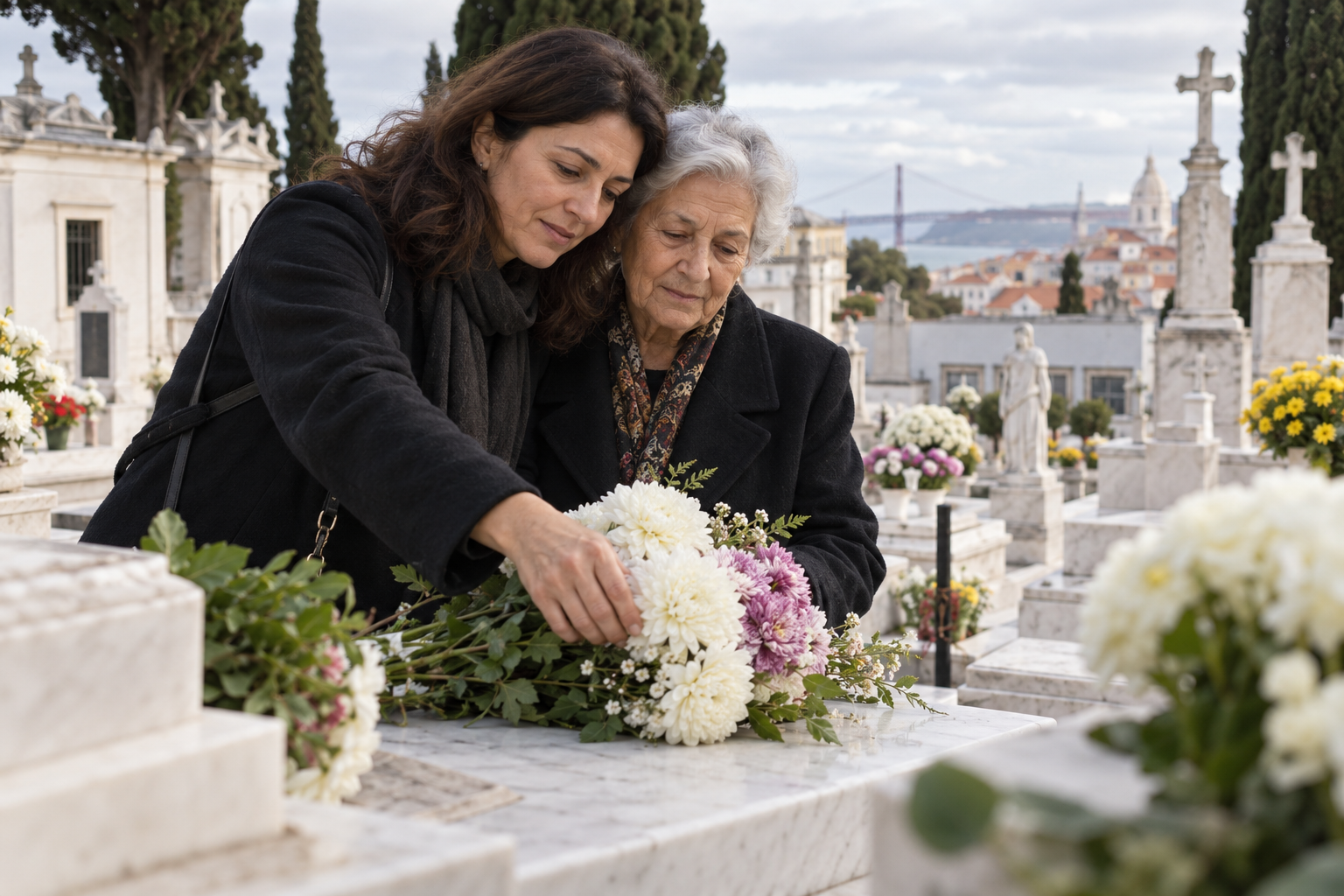
On the first and second of November, families across the continent go to visit the graves of their loved ones, often traveling some distance to do so. For many, it is the one time each year they make the journey, which gives the day the feel of a reunion, of the living and the dead alike.
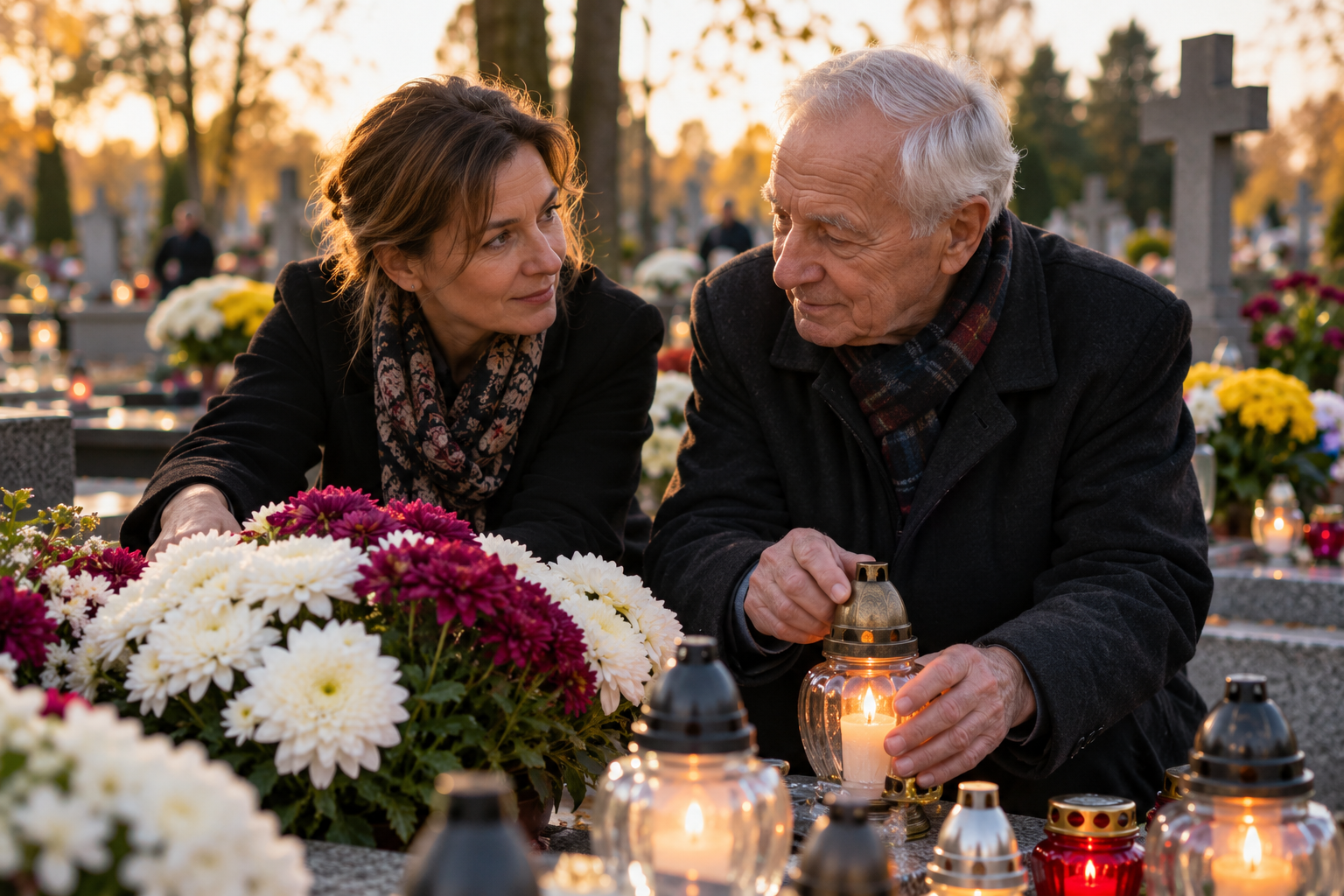
Once there, they clean and tend the graves, and they decorate them, laying flowers, especially chrysanthemums, which across much of Europe are the flower of the dead, and lighting candles.
Many also attend a special church mass for the departed. But it is a family occasion as much as a religious one, with relatives gathering to remember together, and plenty of people who are not especially religious take part all the same. The pull of the day is as much about family and memory as about faith.
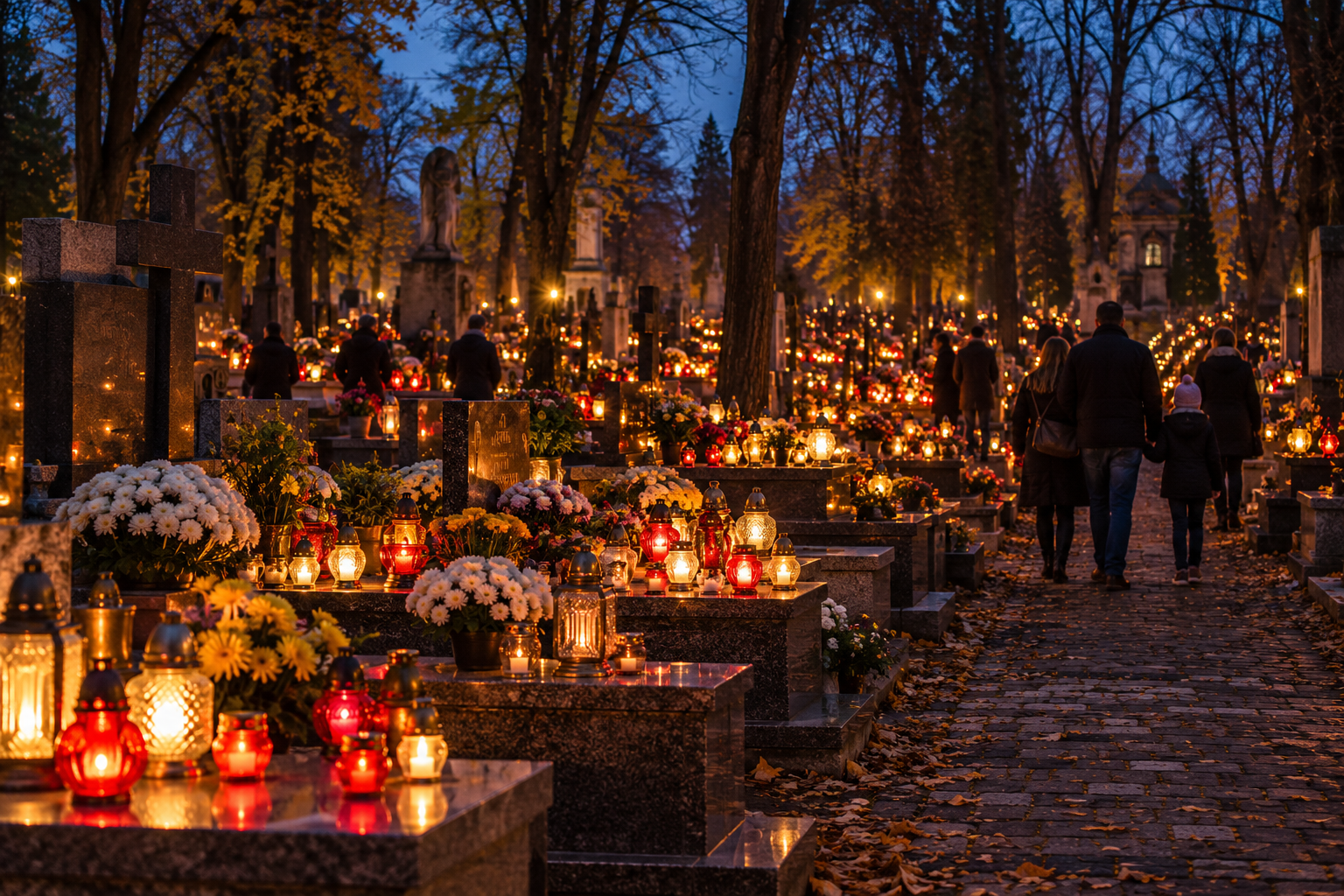
The effect, in a cemetery on these days, is extraordinary and quietly beautiful. The graves, suddenly tended and covered in flowers and flickering candlelight, are the most beautiful they will look all year.
The air carries the scent of chrysanthemums and melting wax, and the whole place hums with quiet activity. Far from the spooky graveyards of Halloween imagery, these are places of warmth, light, and love, filled with living families honoring their dead. The contrast with the plastic skeletons and fake cobwebs of an American October could hardly be greater.
Poland’s Sea of Candles
Nowhere is this more striking than in Poland, where the first and second of November produce one of the most moving sights in all of Europe. The days, known as Wszystkich Swietych and Zaduszki, are among the most important of the Polish year.
Poles travel across the entire country, often great distances, to return to their hometowns and the cemeteries where their relatives rest. There, they lay flowers and light candles, the small votive lanterns known as znicze, on the graves of their loved ones.
The result, by nightfall, is unforgettable. Cemeteries across Poland glow with millions of candles, red and amber and white, burning together through the night and visible from miles away. It is observed by the great majority of Poles, regardless of how religious they are, a near-universal act of national remembrance rendered in flickering light. To stand in a Polish cemetery on the night of the first of November is to witness one of the most beautiful expressions of collective memory anywhere on earth.
It is not a somber or frightening scene, either, despite being about death. The glow of all those candles is warm and alive, and the cemeteries are full of people, families talking quietly, children in tow, the old graves briefly at the center of the nation’s attention. It is grief and love and togetherness, all lit by candlelight.
From Lisbon to Warsaw
The same core tradition, honoring the dead at the start of November, stretches right across Catholic Europe, with each country adding its own customs. Travel from one end of the continent to the other and you find endless local variations on a shared theme.
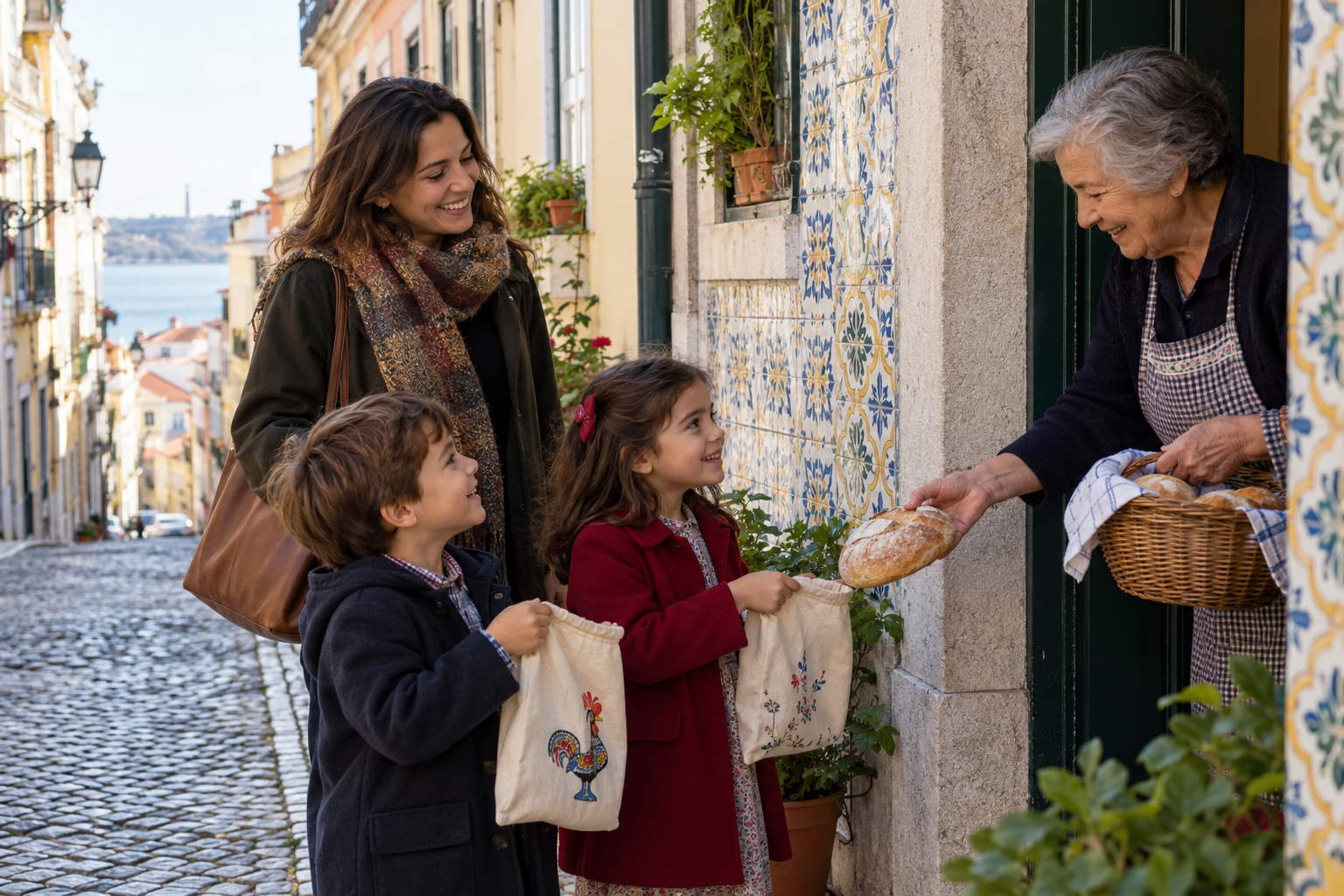
In Portugal, the day brings cemetery visits and the old custom of Pao por Deus, where children go door to door asking for bread and treats. In Spain, families gather, visit graves, and eat the season’s special sweets like huesos de santo, the little marzipan bones. In France, La Toussaint is a public holiday, and cemeteries fill with chrysanthemums, a flower so tied to the dead that the French would never dream of giving a pot of them as a gift to the living. Hand a French person chrysanthemums and you send an unmistakable, and unwelcome, message.
Italy marks Ognissanti with chrysanthemums, solemn masses, and families returning to their hometowns, and in some regions children receive small gifts said to come from the dead. And in Poland, as we have seen, the candles light up the night. Different foods, different small rituals, but everywhere the same quiet purpose: to gather, to remember, and to honor those who have gone before.
It is worth adding that this way of marking the start of November is not confined to Europe at all. Across the Atlantic, Mexico’s famous Day of the Dead, with its marigolds, altars, and sugar skulls, falls on the very same days and springs from the same Catholic root, carried over by the Spanish. From Warsaw to Lisbon to Mexico City, an enormous span of the world pauses at the start of November to tend its graves and remember its dead, each in its own color and key.
Set against that vast, shared act of remembrance, the American Halloween starts to look like the odd one out rather than the norm. Much of the world treats these days as a time to turn, gently and seriously, toward the dead. America, almost alone, turned them into a party. Neither is wrong, but it is worth knowing, when you are handing out candy on the thirty-first, that most of the world is doing something very different a day later.
It is worth noticing, too, how the food of the season reflects this. Where America’s Halloween treats are candy handed to costumed children, Europe’s are the special breads and sweets of remembrance, baked once a year and shared by families thinking of their dead. Even the eating is an act of memory.
The Food of Remembrance
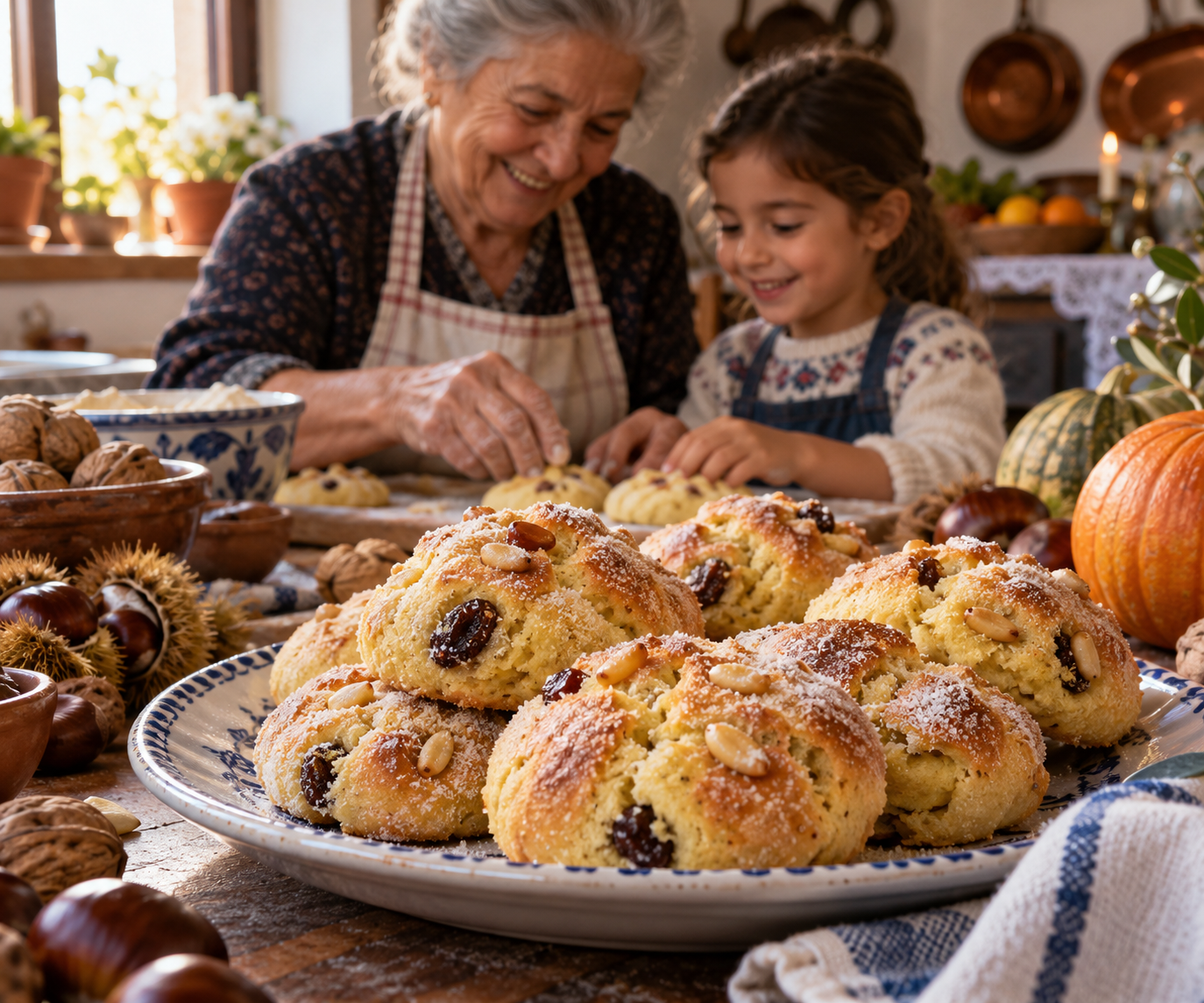
One of the quietest but most telling differences between the two traditions is on the plate. American Halloween food is candy, the brighter and more artificial the better, handed out by the bag to costumed children and poured into plastic pumpkins. European All Saints’ food is something else entirely.
Across the Catholic south, the first days of November come with their own special sweets and breads, made once a year and tied to the remembrance of the dead.
Spain has its huesos de santo, little marzipan bones, and its airy fried bunuelos. Italy bakes fave dei morti and ossa dei morti, the beans and bones of the dead. Portugal has the bread given out for Pao por Deus.
These are not treats to frighten or delight children so much as foods that carry meaning, shared by families thinking of those they have lost.
Even the eating, in other words, is an act of memory. Where America’s Halloween sweets are pure fun, Europe’s All Saints’ foods are a gentle, edible form of remembrance, often named quite openly for the dead, and made and shared in exactly that spirit.
Why the Difference Matters
Standing back, the contrast between the American and European approaches to this season is really a difference of spirit, and a revealing one. America took the ancient roots of the season and grew from them a secular festival of costumes, candy, and playful fright, a celebration that is enormous fun and almost entirely detached from death itself. Europe, by and large, kept the older thing: a solemn, tender few days given over to sitting with loss and honoring the dead.
Neither is wrong, and there is room in the world for both the joyful chaos of Halloween and the candlelit reverence of All Saints’. But they are profoundly different ways of meeting the same dark turn of the year, one looking outward into play and the other inward into memory.
There is something to be said for the European way, in particular, that an American visitor often feels keenly. A culture that sets aside a day, every single year, to go and sit with its dead, to tend their graves and light a candle and remember them by name, has a relationship with death that is gentler and more present than one that mostly hides it away. The candlelit cemetery is, in its own way, a healthier thing than it first appears.
It must be said that Halloween is creeping into Europe, especially among young people and in the cities, carried on films and marketing, and some Europeans worry it may one day overshadow the older tradition. For now, though, the real European first of November endures, quietly and deeply observed.
If you ever find yourself in Europe at the start of November, do not go looking for Halloween. Go instead, as evening falls, to a cemetery, and watch the candles come alight among the flowers.
It is one of the most moving things the continent does, and it will tell you more about how Europe thinks about death, memory, and family than any costume ever could.
And you may find it changes something in you. There is a quiet relief in a culture that does not hide death away but sets aside a day each year to face it gently, together, with flowers and candles and the names of the dead spoken aloud. An American visitor, used to a season of plastic skeletons and manufactured scares, often comes away from a European All Saints’ evening feeling that this older way of marking the dark turn of the year is, in the end, the wiser and the kinder one.

About the Author: Ruben, co-founder of Gamintraveler.com since 2014, is a seasoned traveler from Spain who has explored over 100 countries since 2009. Known for his extensive travel adventures across South America, Europe, the US, Australia, New Zealand, Asia, and Africa, Ruben combines his passion for adventurous yet sustainable living with his love for cycling, highlighted by his remarkable 5-month bicycle journey from Spain to Norway. He currently resides in Spain, where he continues sharing his travel experiences with his partner, Rachel, and their son, Han.