
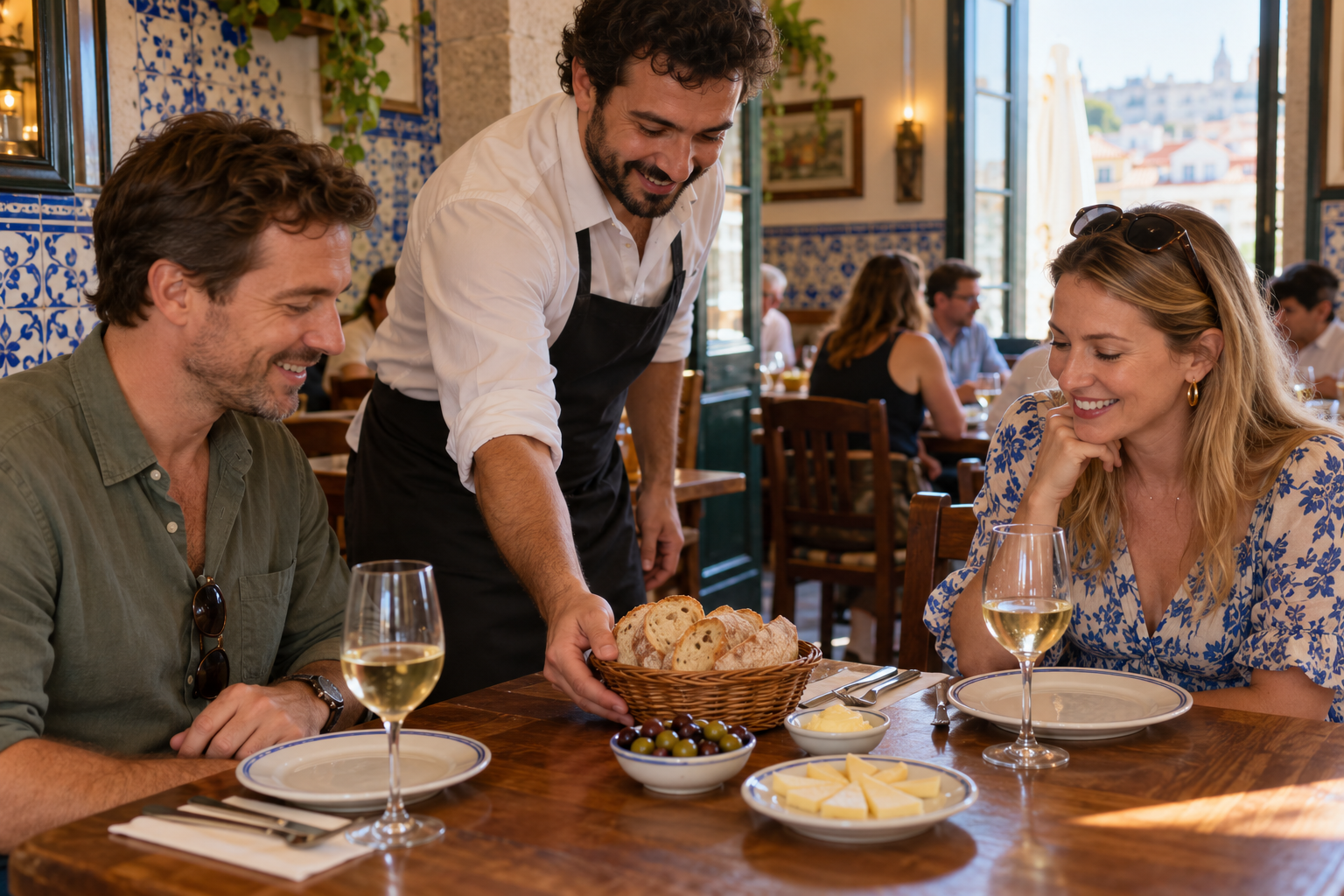
You sit down at a restaurant in Lisbon or Porto, and before you have so much as glanced at the menu, the waiter appears and sets down a little spread: a basket of good bread, a dish of olives, perhaps some butter, a wedge of cheese, maybe a small bowl of tuna pate. It looks like a warm, generous welcome, a lovely gesture from the house, exactly the sort of complimentary bread basket an American expects at a nice restaurant back home. So you dig in happily while you decide what to order.
And then the bill comes, and there it is, a line you did not expect: couvert. Because here is the thing that catches so many American visitors off guard: in Portugal, that bread and those olives are not free, and you have just paid for every bit you touched. Here is what the couvert actually is, why Portugal does it this way, why it stings tourists twice, why it is not the scam it feels like, and the one simple rule that saves you from ever being surprised by it again. It is one of the most common little culture shocks of eating out in Portugal, and one of the easiest to master.
What follows is the bread that is not free, why it costs tourists twice, why it is a custom and not a scam, the one rule that saves you, and how to handle it like a local.
The Bread That Is Not Free
The couvert is a Portuguese restaurant tradition in which an assortment of small starters, most commonly bread, olives, butter, and sometimes cheese, pate, or even little seafood snacks, is brought to your table automatically, without you ordering it, shortly after you sit down. To an American eye it is indistinguishable from the free bread basket or the complimentary chips and salsa that are standard at home, and that is precisely the problem, because it is not free. Those items are charged to your bill, typically somewhere in the range of a euro and a half to five euros per item or per person, and the total appears at the end under the heading couvert.
The confusion is entirely understandable, because nothing about the presentation signals that it costs money. No one asks if you want it, no one mentions a price, it simply arrives, looking for all the world like hospitality. In American dining culture, anything placed on your table that you did not order is a gift, so the instinct to tuck in without a second thought is deeply ingrained. But in Portugal, and in various forms across southern Europe, the logic is different: the restaurant provided food, you ate it, so you pay for it. The amounts are usually modest, just a few euros, and the items are frequently genuinely good, but the surprise of being charged for what looked for all the world like a freebie is what turns a trivial line item into a sour, slightly indignant note at the end of an otherwise lovely meal. It is never really about the money; it is about the feeling of not having known.
Why Portugal Does It This Way
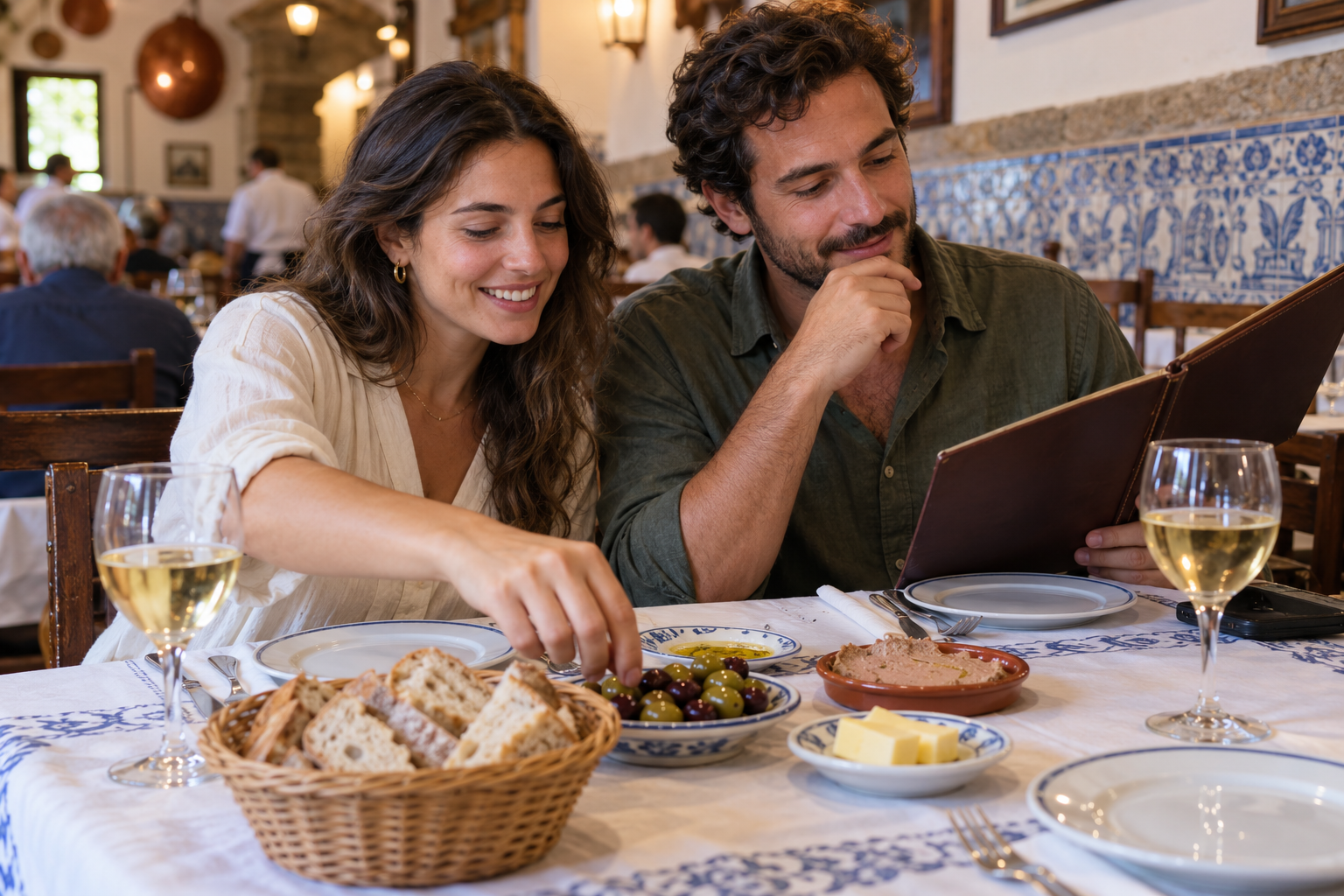
It helps to understand where the custom comes from, because once you do, it stops feeling like a gotcha and starts making a certain sense. Portuguese meals are famously unhurried affairs, long and sociable, and the couvert exists in part to bridge the gap between sitting down and the food arriving, giving you something to nibble and a glass of wine to sip while you study the menu, talk, and settle in. It is a small piece of the leisurely rhythm of Portuguese dining, a soft landing into the meal rather than an aggressive upsell.
There is also a simple economic logic to it that fits the broader culture. Rather than baking the cost of bread and nibbles invisibly into higher menu prices for everyone, the Portuguese approach puts the small extras out on the table and charges only those who actually want them, which is arguably more honest than the American model where the “free” bread is really paid for by everyone through the overall prices. The restaurant provides the extras, the diner freely chooses whether to partake, and the final bill reflects only what was actually eaten, which when you say it plainly is a perfectly reasonable and even admirably transparent way to run things. Looked at that way, the couvert is less a trap than a transparent little transaction that happens to run on rules an American has never had to learn. The friction comes entirely from the clash between two different, each internally sensible, ways of handling the bread basket, and the moment you understand the Portuguese way, the friction disappears.
Why It Costs Tourists Twice
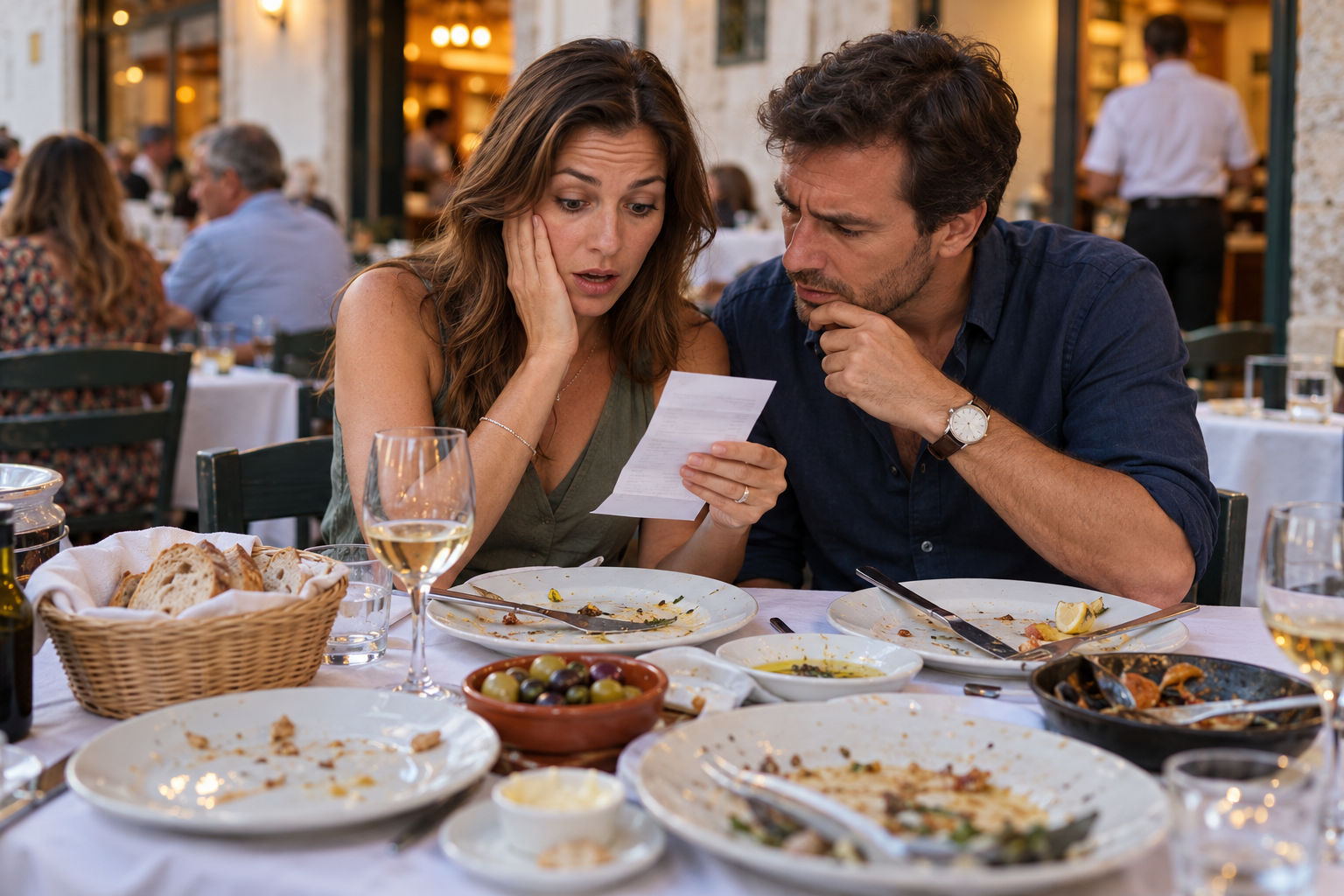
The reason the couvert stings the unprepared tourist twice is that it hits them in two places at once, the wallet and the pride. The first hit is the simple, unexpected charge, the few euros you did not plan to spend appearing on a bill you thought you understood. On its own that is minor. But the second hit is the one that really rankles: the feeling of having been tricked, of having eaten something presented as a kindness only to discover it was a sale all along. That sense of a hidden charge, of a trap sprung on an unsuspecting visitor, is what makes people genuinely cross about what is, in money terms, a tiny sum.
There is a second, more literal way it can cost you twice, too. Because the couvert arrives before you order and you eat it while you are hungry and waiting, you fill up on bread you are paying for, then pay again for the meal you order on top of it. In the most tourist-heavy districts, it is fair to say that some restaurants are well aware of all this and quietly count on visitors not knowing the rule, bringing out a generous, tempting, hard-to-resist couvert and letting human nature and an empty stomach do the rest. That is the one genuinely cynical edge of the custom, and it is exactly the edge that a little advance knowledge blunts completely. It is not illegal and it is not quite a scam, but it does mean that the uninformed tourist reliably ends up paying more than they meant to, which is exactly why knowing about the couvert in advance is one of the most useful small pieces of knowledge you can carry into a Portuguese restaurant.
It Is Not a Scam, It Is a Custom
Here is where fairness is important, because it would be easy to walk away thinking Portuguese restaurants are trying to cheat you, and that is not the right conclusion at all. The couvert is a legitimate Portuguese tradition, not a trick invented to fleece foreigners. By the local rules, you are charged only for what you actually consume, the prices are usually listed on the menu if you look, and crucially, you are completely free to decline it. It only feels like a trap because it is unfamiliar, and unfamiliarity is not the same as dishonesty.
In fact, the couvert is often worth the few euros it costs. Portuguese bread is excellent, the olives and local cheeses can be wonderful, and the pate can be a real pleasure, so plenty of visitors who understand the system happily accept the couvert as a nice little first course for a very reasonable price. It is also worth knowing that Portugal is not alone in this: across southern Europe, the idea that bread and table snacks carry a charge is common, from the bread you will often be billed for in Spain to Italy’s coperto, a flat per-person cover charge added to the bill as a matter of course. Seen in that light, the couvert is not some uniquely Portuguese swindle at all but simply one local version of a widespread European custom that has no equivalent in the United States, which is precisely why Americans, more than almost any other travelers, get caught out by it. If you had grown up with it, you would no more be surprised by it than by being charged for your main course. The problem was never the couvert; it was only ever not knowing the rule.
The One Rule That Saves You
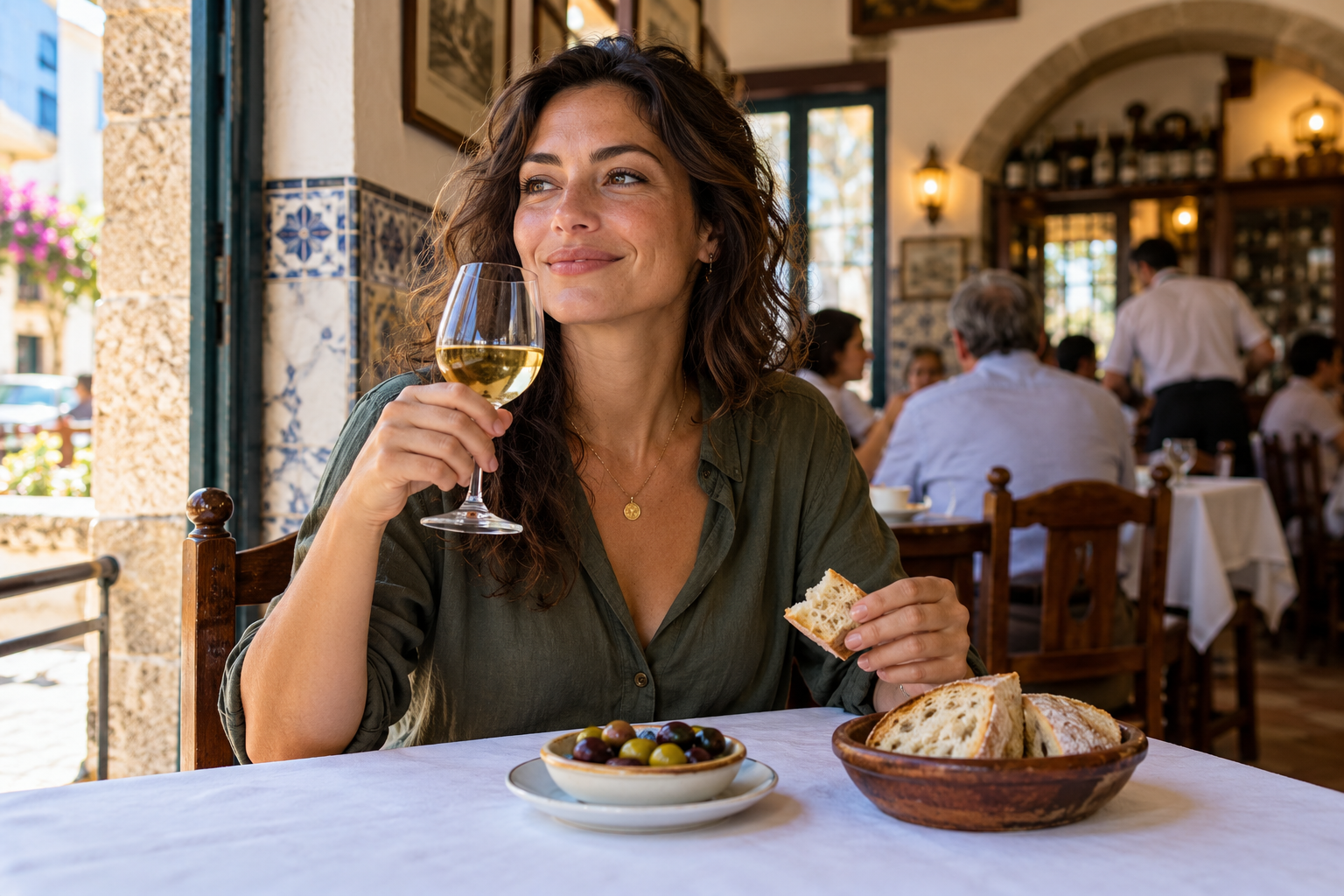
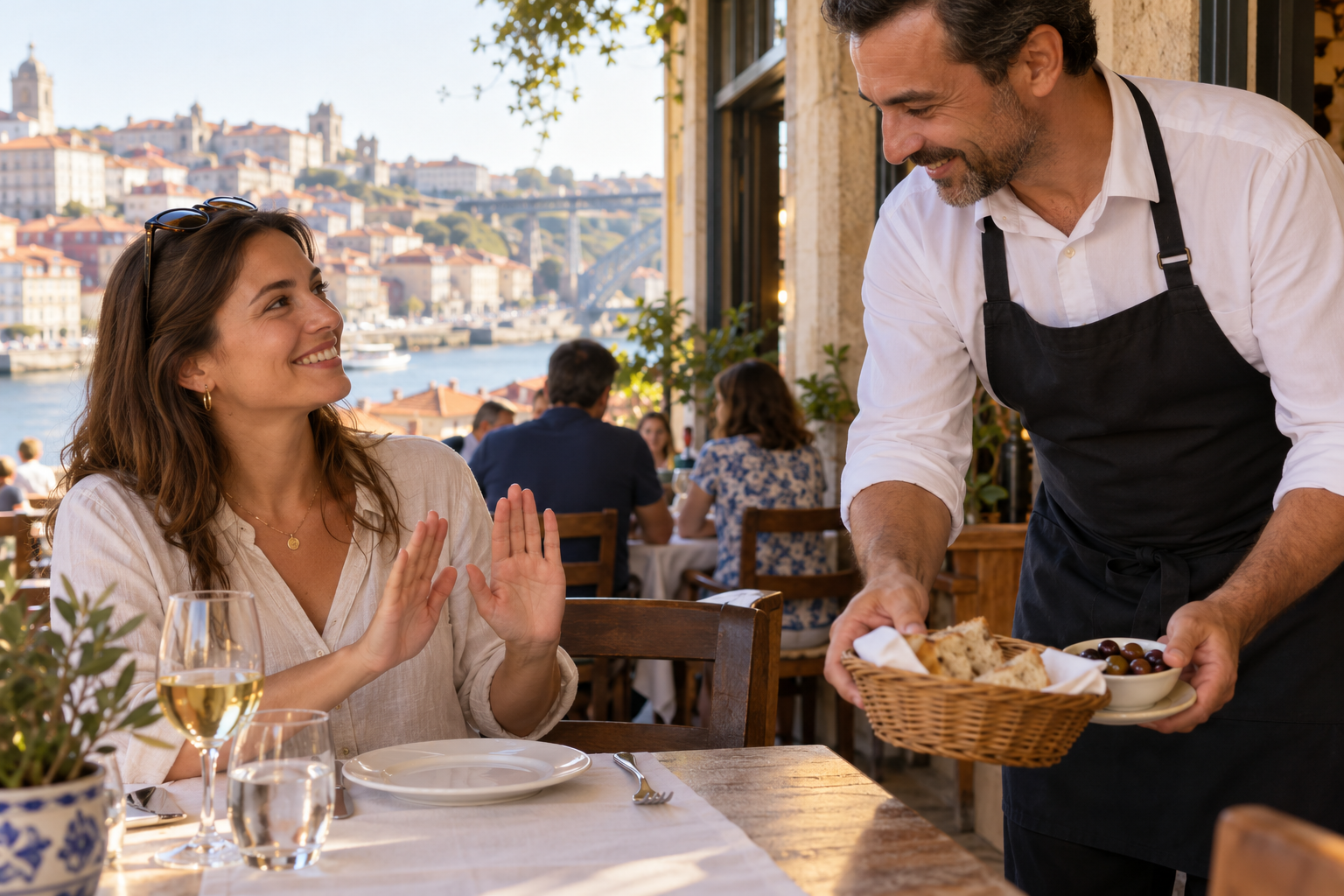
So here is the single rule that turns the whole thing from a trap into a non-issue: you only pay for what you touch, so decide before you eat. When the couvert arrives, you have a simple choice to make. If you do not want it, you politely decline, and say Nao, obrigado (no, thank you), meaning no, thank you, at which point the waiter will simply take it all away with no offense whatsoever. Declining the couvert is not rude in the slightest; it is a completely normal thing that locals do all the time, and no self-respecting Portuguese waiter will bat an eye.
If, on the other hand, you would like some of it, you can accept it, knowing it will cost a few euros, and enjoy it as the pleasant little starter it is.
You can even pick and choose your way through it, keeping the warm bread and the good olives you want and sending back the cheese or pate you do not fancy, and you will be charged only for what stays on the table.
The couvert is a menu, not a package deal, and treating it that way puts you firmly in control of your own bill. The one thing you must not do is eat the couvert and then complain about being charged for it at the end. That is the move that is genuinely considered rude, because by local logic you consumed it and so you owe for it, and grumbling after the fact simply marks you as someone who did not understand the rules. Eat it knowingly, or decline it politely, and either way you are fine. It is also worth a quick glance at your bill when it arrives, because occasionally a couvert you declined and sent back still shows up by mistake, and a calm, polite word to the waiter gets it taken off without any fuss. Mistakes happen, and checking the bill is simply good practice anywhere, not an accusation.
Eating Out Without the Surprise
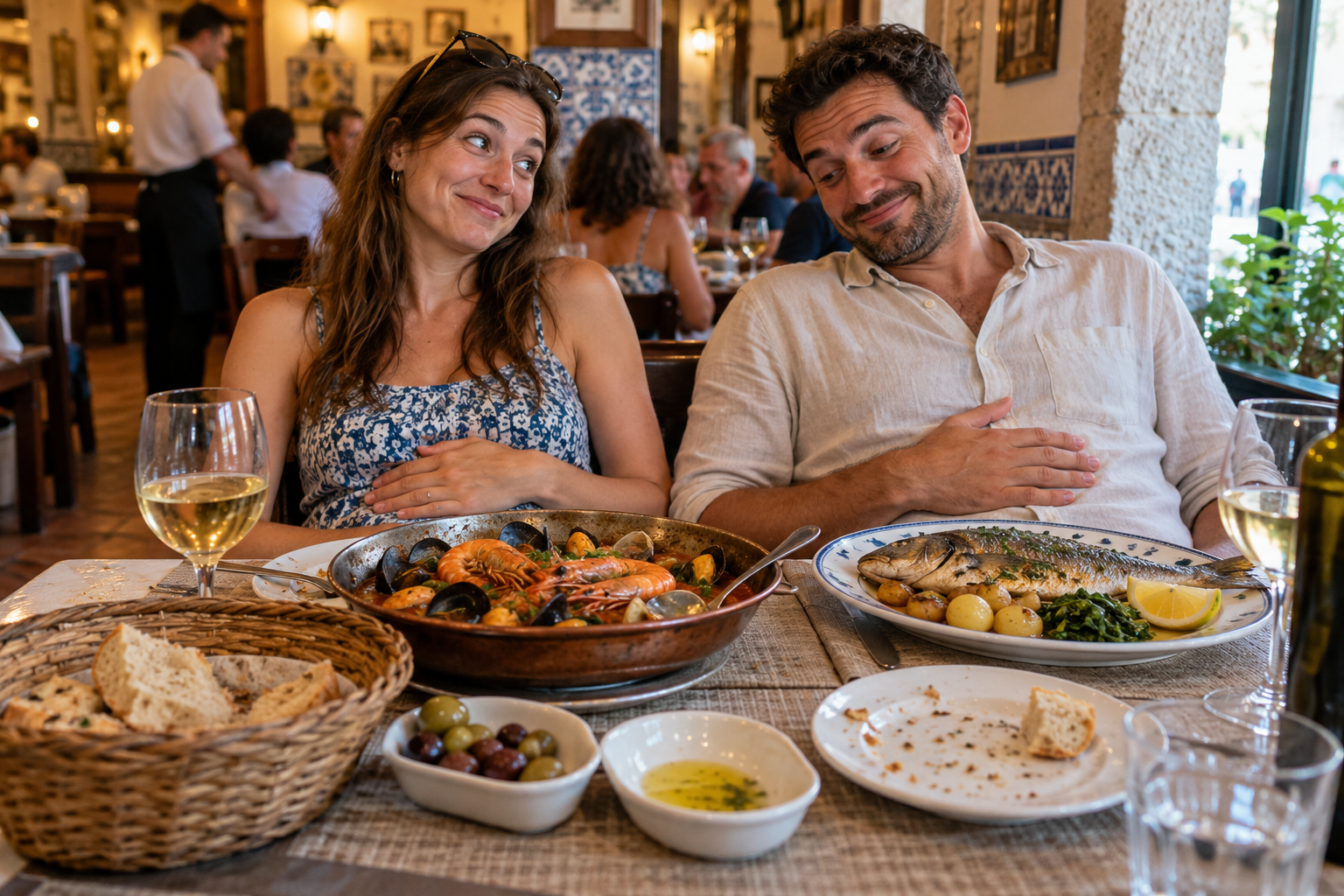
Put it all together and the savvy approach is almost embarrassingly simple. When the little spread of bread and olives lands on your table in Portugal, you no longer freeze or tuck in blindly; you make a quick, informed decision. Not hungry for it, or watching your budget? A friendly Nao, obrigado with a smile, and the whole spread is whisked away, costing you nothing and offending no one. The waiter has seen it a thousand times and will not think twice.
Fancy a nibble while you look at the menu? Enjoy it, and factor a few euros into your bill. That is genuinely the whole of it, and once you have internalized it, the couvert stops being a tourist trap and becomes just another small, pleasant part of eating out in Portugal.
The deeper lesson here is one that applies far beyond bread and olives: so many of the things that feel like tourist traps abroad are really just local customs that nobody explained, and knowing the custom turns the trap into an ordinary part of the meal. The couvert is not out to get you; it is simply how Portugal has always done things, and a visitor who understands it can relax and even enjoy it rather than feeling ambushed. And while you are learning your way around a Portuguese table, keep one more small courtesy in mind, because it pairs perfectly with the couvert rule: the Portuguese, like much of southern Europe, greatly appreciate a greeting, so walk in with a warm Bom dia or Boa tarde before you ask for anything, and you will find that the warmth comes right back to you. Learn those two small things, how to handle the couvert with confidence and how to greet the room with a warm Bom dia, and you will move through Portugal’s restaurants not as a bewildered, slightly suspicious tourist bracing for the bill, but as a relaxed, gracious, genuinely welcome guest. That shift, from guarded to at ease, is worth far more than the few euros the knowledge saves you.

About the Author: Ruben, co-founder of Gamintraveler.com since 2014, is a seasoned traveler from Spain who has explored over 100 countries since 2009. Known for his extensive travel adventures across South America, Europe, the US, Australia, New Zealand, Asia, and Africa, Ruben combines his passion for adventurous yet sustainable living with his love for cycling, highlighted by his remarkable 5-month bicycle journey from Spain to Norway. He currently resides in Spain, where he continues sharing his travel experiences with his partner, Rachel, and their son, Han.