
You arrive at a friend’s apartment in Stockholm or Berlin or Warsaw, they open the door with a warm smile, you step inside, and then you notice a few things all at once. There is a neat row of shoes lined up by the door. Everyone in the room is in socks or soft slippers. And your host, still smiling, has just given your feet the briefest, most fleeting glance.
In that small moment, an American guest freezes, because they have realized, a beat too late, that they have walked into someone’s home with their outdoor shoes on, and that this was apparently the wrong thing to do.
Nobody warned them. Nobody will quite say anything now. But the rule has been broken, and they can feel it. In much of Europe and across most of the world, shoes come off at the door, and it is one of those house rules nobody explains until the moment you have already broken it. Here is the custom, where it really applies, why it exists, what the gesture actually means, why Americans get it wrong, and how to never freeze in that doorway again. It is one of the most common and most quietly embarrassing culture clashes there is, and one of the easiest to fix.
What follows is the house rule nobody explains, where it actually applies, why shoes come off, why Americans keep them on, and how not to get it wrong.
The House Rule Nobody Explains

The thing that makes this custom so quietly treacherous for the unprepared American is precisely that it is unspoken. In the cultures where taking your shoes off indoors is the norm, it is so deeply ingrained and so obvious that nobody thinks to mention it, any more than they would think to tell you to breathe. It is simply what everyone does, automatically, the moment they cross the threshold, and so it is never announced as a rule because, to the people who live by it, it does not feel like a rule at all. It is just the natural, correct, obvious way to enter a home, as unremarkable to a Swede or a Pole or a Japanese host as using the door rather than the window. You do not explain the obvious, and to them this is simply obvious, which is exactly what leaves the unknowing visitor so exposed.
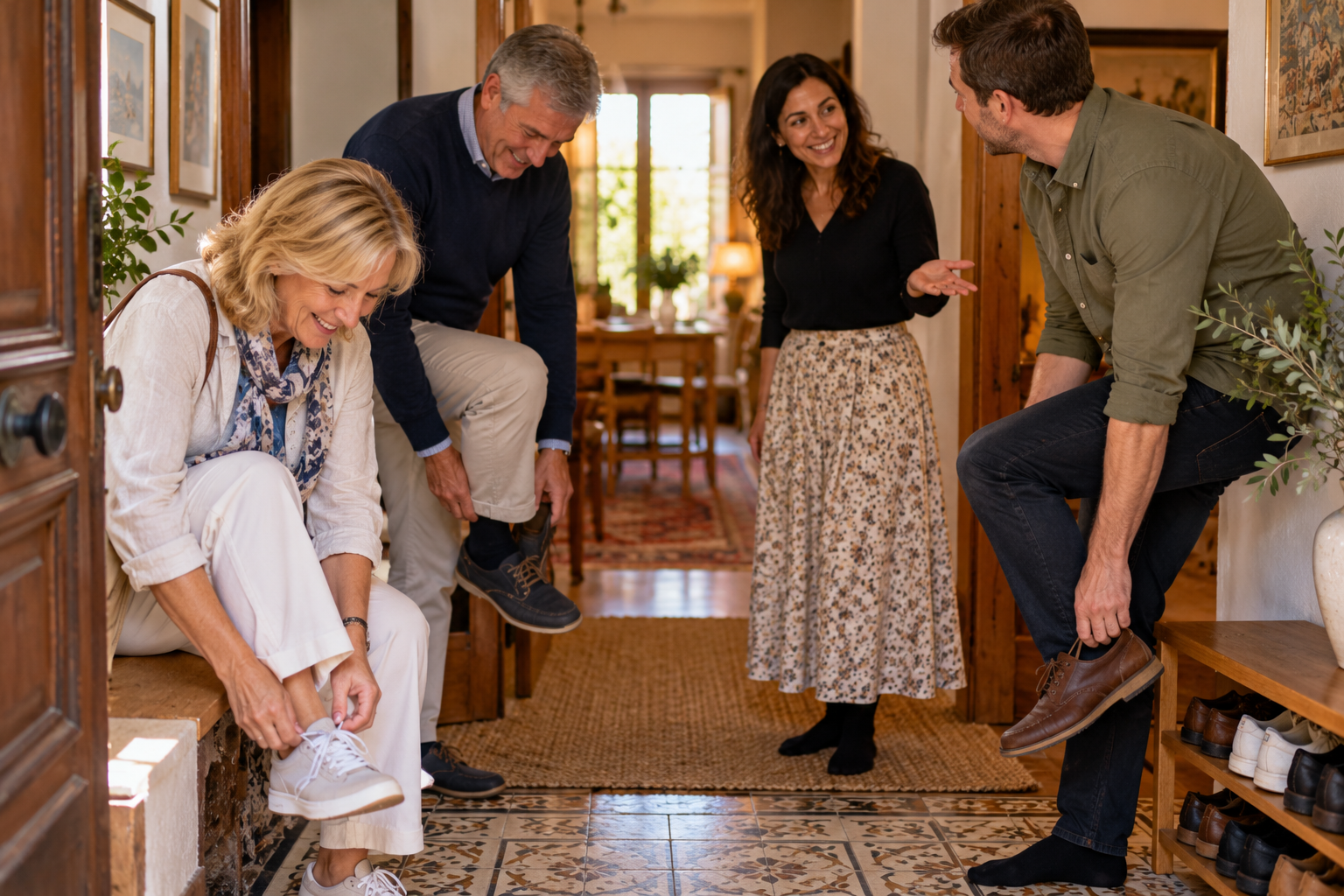
This is why the American guest is so often caught out. There is no sign on the door, no instruction from the host, just a set of silent cues, the shoes lined up in the hallway, the family padding around in socks, the slippers waiting by the mat, that everyone local reads instantly and a newcomer can miss entirely.
And here is the twist that makes it worse: the host, being polite, usually will not correct you. Faced with a guest who has tromped in with shoes on, most European hosts will simply say nothing, too gracious to make a fuss, and quietly absorb the minor transgression while you remain blissfully unaware that you have committed one. You find out you broke the rule not because anyone tells you outright, but because you slowly, creepingly notice that you are the only person in the entire house still clomping around in shoes, your soles the only ones touching the clean floor, and a small, cold wave of social dread washes over you as the realization lands. By then the damage, such as it is, is done, and all you can do is apologize and bend down to fix it. It is the rule nobody explains until you break it, because breaking it is the only way most visitors ever learn it exists.
Where It Actually Applies

Now an honest correction to the headline, because the custom is not quite as uniformly European as the stereotype suggests, and knowing the real geography saves you from both complacency and overcaution. The shoes-off rule is strongest in Northern, Central, and Eastern Europe. In Scandinavia it is close to sacred, and in Germany, Austria, Switzerland, the Netherlands, and across the Baltic states, Poland, Russia, and Eastern Europe generally, you should assume shoes come off unless clearly told otherwise. It is equally the firm norm across most of Asia, including Japan, Korea, the Philippines, and India, and much of the Middle East, so in truly global terms this is not a quirky little European habit at all but something much closer to the world’s default setting, practiced by a large majority of humanity. It is the shoes-on cultures, not the shoes-off ones, that are the real exception on the world stage, which tends to surprise Americans who assumed their way was the normal one.
Where it gets more variable is the Mediterranean. In Spain, Italy, France, and Greece, the custom is far less rigid, and in plenty of Southern European homes people keep their shoes on indoors without a second thought, though even there it varies household by household and is becoming more common. The real outlier, where shoes-on-indoors is genuinely normal, is the United States, along with parts of the United Kingdom. This is exactly why Americans are the ones who get caught out: they come from one of the few cultures where shoes-on-indoors is standard, and they carry that assumption into a world where, more often than not, it is not. The safe traveler’s rule, then, is to assume shoes come off almost everywhere outside the US and to watch for the local cues, rather than assuming your home habits travel with you.
Why Shoes Come Off
Once you understand the reasoning, the custom stops seeming like a fussy imposition and starts seeming like plain common sense, which is roughly how the rest of the world sees it. The core reason is hygiene. Think, for a moment, about everywhere your shoes have been on an ordinary day: city pavements, public restrooms, train stations, streets where who knows what has been spilled or dropped or walked through. The soles of your shoes are, bluntly, filthy, carrying dirt, germs, and assorted urban grime, and the shoes-off cultures simply see no reason to track all of that across the floors where they walk barefoot, where children play, and where life happens. Leaving the outside world’s accumulated grime at the door, rather than grinding it into the carpet where the baby crawls, is, to them, an act of such obvious basic cleanliness that the alternative seems faintly shocking. Put that way, it is genuinely hard to argue the logic, which is part of why the custom is quietly spreading even into shoes-on strongholds.
Bound up with the hygiene is a deeper idea of the home as a clean and separate space, a sanctuary that you do not sully with the dirt of the street. In many of these cultures the home is kept scrupulously clean, often with carpets or fine floors, and removing your shoes is both a practical way to protect them and a quiet mark of respect for the household and the effort that goes into it. That is why so many of these cultures have a whole infrastructure around it: the German Hausschuhe, the house slippers that every family member has and that thoughtful hosts keep a spare pair of for guests, or the Japanese genkan, the dedicated sunken entryway built specifically for the ritual of changing out of your street shoes. Taking off your shoes is not an inconvenience to these households; it is a small, civilized act of keeping the clean world and the dirty world properly separate, and once you have lived with it, walking into a home in street shoes starts to feel faintly barbaric.
What the Gesture Really Means

Beyond the hygiene and the clean floors, there is a quieter, almost symbolic dimension to taking off your shoes that is worth noticing, because it explains why the custom feels so important to the people who keep it. The front door, in these cultures, is a real boundary, the line between the public world outside and the private, intimate world of the home, and shedding your shoes at that line is a small ritual of crossing over. You are, in a sense, leaving the street and all its armor behind and stepping into a softer, more trusting, more personal space. To pad around a home in your socks is to be, literally and a little bit figuratively, more relaxed, more unguarded, more at home.
This is part of why keeping your shoes on can register, to a host, as a subtle failure to fully enter the spirit of their home, as though you have kept one foot in the outside world and not quite let yourself be a guest. It is rarely conscious, and no decent host would hold it against a foreigner who did not know, but it is there in the feeling of the thing. Removing your shoes says, without a word, I trust you, I am comfortable here, I will meet your home on its own terms. That is a surprisingly warm message to send, and it is why, once an outsider understands it, the custom stops feeling like a petty rule about footwear and starts feeling like what it actually is: a small, graceful way of being truly welcomed in, and of accepting the welcome.
Why Americans Keep Them On
In fairness to the frozen American in the doorway, their habit is not rudeness but simply a different, coherent norm, and it helps to understand where it comes from. In much of the United States, keeping your shoes on inside the house is just how things have long been done, treated as normal and unremarkable, so the average American walks into any home, including a foreign one, with no instinct at all to remove their shoes, because in their own world there is nothing to remove them for. They are not flouting a rule; they genuinely do not know one exists.
There are real reasons the American habit developed as it did, from larger homes and a lot of hard, easily-mopped flooring, to a culture where shoes are often considered part of a put-together, ready-to-go outfit, to simple everyday rhythms of life that never built the ritual in the way other cultures did. It is a different accident of history and architecture, not a moral failing, and understanding that keeps everyone from feeling judged. None of it makes Americans dirty or disrespectful; it makes them products of a culture that drew the clean-and-dirty line in a different place. And the interesting footnote is that even in the US the tide is turning, with the shoes-off-at-home practice growing steadily more common as more Americans conclude that tracking street grime across the living room was perhaps never such a great idea after all. So this is less a story of right and wrong than of two perfectly reasonable cultures that simply settled on different defaults long ago, with most of the rest of the world on one side, the US increasingly and sheepishly drifting toward the middle, and a lot of surprised, sock-footed guests caught in the doorway in between. Nobody is the villain here; there is only a line drawn in a different place, and the small discomfort of discovering it the hard way.
How Not to Get It Wrong

Happily, never freezing in that doorway again is simple, and it comes down to paying attention and leading with respect. The moment you step into someone’s home, especially anywhere outside the United States, take half a second to read the room. Is there a pile or a neat row of shoes by the door? Is the family in socks or slippers? Is there a mat or a little bench right at the entrance that seems designed for exactly this? Any of those is your cue, and the polite move is to simply start taking your shoes off, or, even better, to ask, a cheerful should I take my shoes off? that instantly marks you as a considerate guest and dissolves the whole awkward possibility before it can form.
A couple of small habits make it painless. When you are visiting homes abroad, wear decent socks without holes, because you may well end up padding around in them, and it saves a second layer of embarrassment.
If you are staying with someone, consider bringing your own pair of slippers, which many hosts will appreciate and which keeps your feet happy. And above all, when in doubt, default to taking them off, because erring toward respect is never the wrong call. The deeper point is that this is not really about shoes at all; it is about the humility to notice that the way you do things at home is not the way the whole world does them, and the grace to adapt. Read the room, ask the question, slip off the shoes, and you turn a potential gaffe into a small, warm signal that you respect the home you have been welcomed into, which is, after all, the whole point of being a good guest anywhere on earth.

About the Author: Ruben, co-founder of Gamintraveler.com since 2014, is a seasoned traveler from Spain who has explored over 100 countries since 2009. Known for his extensive travel adventures across South America, Europe, the US, Australia, New Zealand, Asia, and Africa, Ruben combines his passion for adventurous yet sustainable living with his love for cycling, highlighted by his remarkable 5-month bicycle journey from Spain to Norway. He currently resides in Spain, where he continues sharing his travel experiences with his partner, Rachel, and their son, Han.