
Somewhere in the night, in millions of American bedrooms, the same small war is being fought. One person rolls over and takes the blanket with them. The other wakes up cold, tugs it back, and sets off a slow-motion tug of war that neither of them is fully awake for. One of them is too hot and throws a leg out into the cold air; the other is freezing under a cover chosen for someone else’s comfort and pulling it up to their chin. Neither of them is doing anything wrong. They are just two different people trying to share one blanket, which turns out to be a genuinely difficult thing to do.
It is such a familiar part of sharing a bed that most couples have simply accepted it as the unavoidable price of sleeping together, a tax on love that comes due every single night. And then they go to a hotel in Sweden or Denmark, pull back the covers, and find something that quietly rearranges their whole idea of what a bed is: not one big shared duvet, but two separate ones, one for each person. Here is the Scandinavian sleep method, why it ends the nightly cover war, what it fixes that most couples did not even know was fixable, and exactly how to try it at home tonight for the price of a second duvet.
What follows is the setup itself, how it ends the cover war, the temperature fix, the quieter nights it buys, why it is not a sleep divorce, and how to try it tonight.
The Setup: Two Duvets, One Bed

The idea could not be simpler, which is part of why it works. Instead of one large duvet or comforter stretched across a double bed and shared by two people, each person gets their own separate, single-size duvet, on their own side of the same bed. Same mattress, same bedroom, same closeness, but two covers instead of one. There is usually no shared top sheet to fight over either; each person simply wraps up in their own duvet and that is that.
The two duvets sit side by side and overlap a little in the middle, so from above the bed can still look like one, but underneath, each person has a world of their own. It is sometimes called the Scandinavian sleep method, and across Sweden, Denmark, and Norway it is just how couples make a bed, and have for generations. Nobody there thinks of it as a technique or a solution to anything. It is simply what a bed for two people looks like, the way a dinner table comes with more than one plate.
If you have stayed in a hotel anywhere in Scandinavia, you have probably already slept this way without even thinking about it, because most Scandinavian hotels default to the setup, two single duvets side by side on a double bed, and travelers often have the quiet realization mid-trip that they slept unusually well and cannot work out why. The arrangement went genuinely viral in late 2023, when a Swedish content creator showed it off and millions of people outside the Nordic countries discovered that the thing quietly solving their nightly bedroom friction was a standard piece of furniture-making an ocean away. For an American couple raised entirely on the one-big-comforter model, the two-duvet bed is a small revelation, the kind of obvious-in-hindsight fix you cannot quite believe you went decades without. It is not that the Scandinavians invented something clever; it is that the rest of us never questioned the single shared blanket we inherited.
How It Ends the Cover War
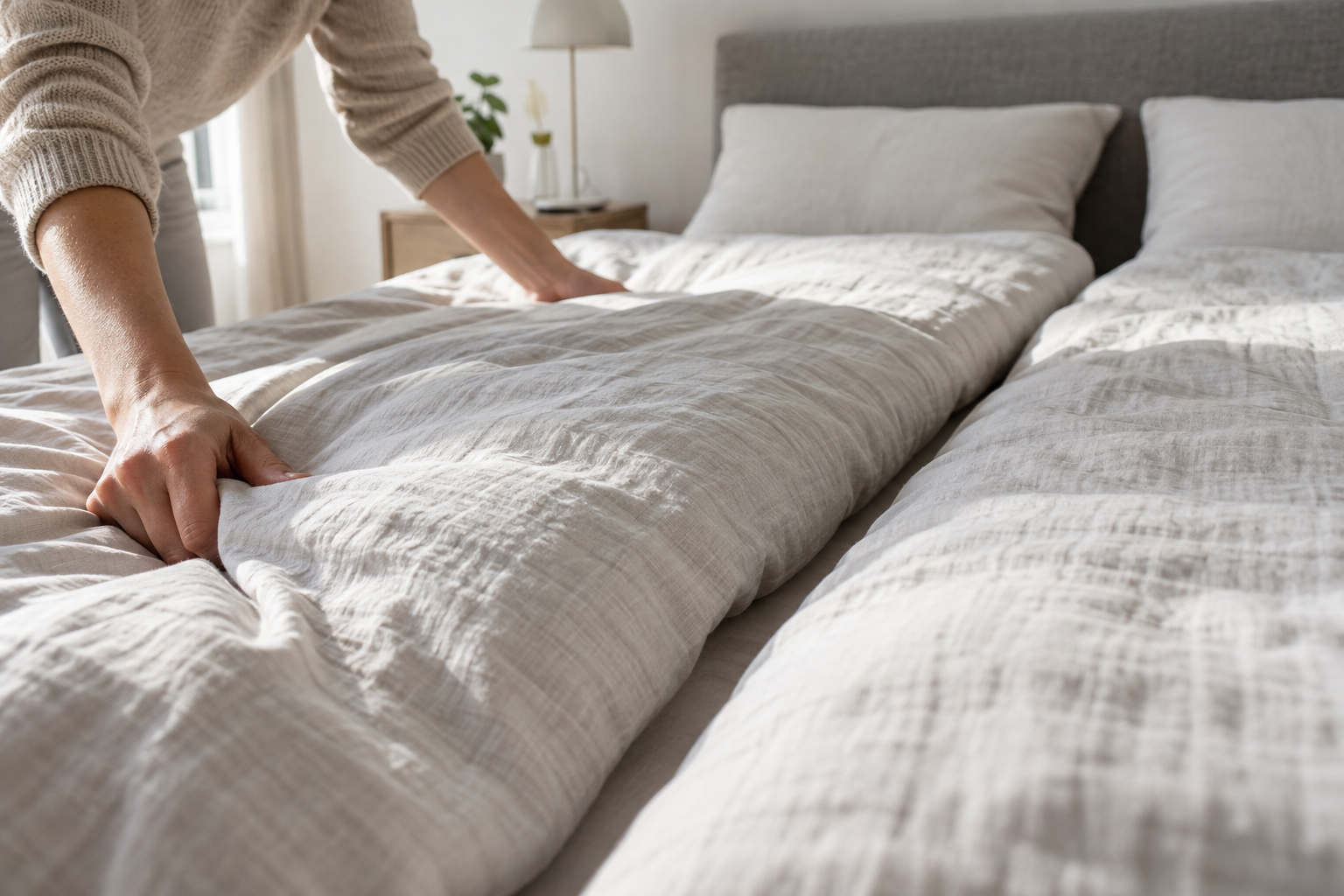
The most immediate thing the two-duvet method does is end, completely and permanently, the nightly battle over the covers. When each person has their own duvet, there is simply nothing to steal. The person who rolls over and cocoons themselves is only cocooning their own cover, leaving their partner’s entirely untouched. There is no tug of war, because there is no shared rope. The midnight cover grab, the waking up cold and exposed, the half-conscious reclaiming of territory, all of it just stops, not because both people have finally learned to be more considerate in their sleep, which is impossible anyway, but because the thing they were fighting over no longer exists. You cannot steal what was never shared.
This matters more than it sounds, because that cover war is not a trivial annoyance. It is a genuine, repeated, night-after-night disruption to sleep, the kind couples normalize until they have forgotten it is even happening. Every tug, every re-tuck, every cold-shouldered scramble back under the blanket is a small wake-up, and small wake-ups, repeated for years, add up to a real sleep debt for both people.
The beauty of two duvets is that it removes the problem at the root rather than relying on willpower. A considerate partner can still accidentally pull the covers in their sleep, no matter how much they love you; they cannot pull a cover that is not connected to theirs. You are no longer relying on two unconscious people to behave well all night, which was always a losing bet. The fix is structural, which is why it is permanent, and that is exactly the quality a tired couple is looking for.
The Temperature Fix Nobody Expected

The second thing the method solves is the one many couples did not realize was solvable at all: the temperature standoff. In almost every couple, one person sleeps hot and one person sleeps cold, one is kicking off the covers while the other is pulling them up to their chin, and a single shared duvet forces them into a permanent, unwinnable compromise. One cover, one weight, one warmth, for two bodies that want completely different things. Someone always loses.
Two duvets dissolve that compromise entirely, because each person chooses their own. The one who runs hot picks a light, cool, summer-weight duvet; the one who is always cold picks a thick, lofty, high-warmth one, and both of them, in the same bed on the same night, finally sleep at the temperature that suits them rather than the temperature they negotiated. Duvets come in warmth ratings for exactly this reason, and for the first time a couple can simply buy two different ones instead of arguing their way to a single unhappy middle. You can even go further and choose different fillings and weights, a heavier duvet for one and a lighter one for the other, tailoring each cover to the person under it rather than splitting the difference and leaving them both slightly unhappy. For the many couples whose real sleep problem was never really about blankets but about being two different thermostats trapped under one, this alone is worth the switch, and it is the benefit people tend to be most surprised and delighted by.
The Quieter Nights It Buys
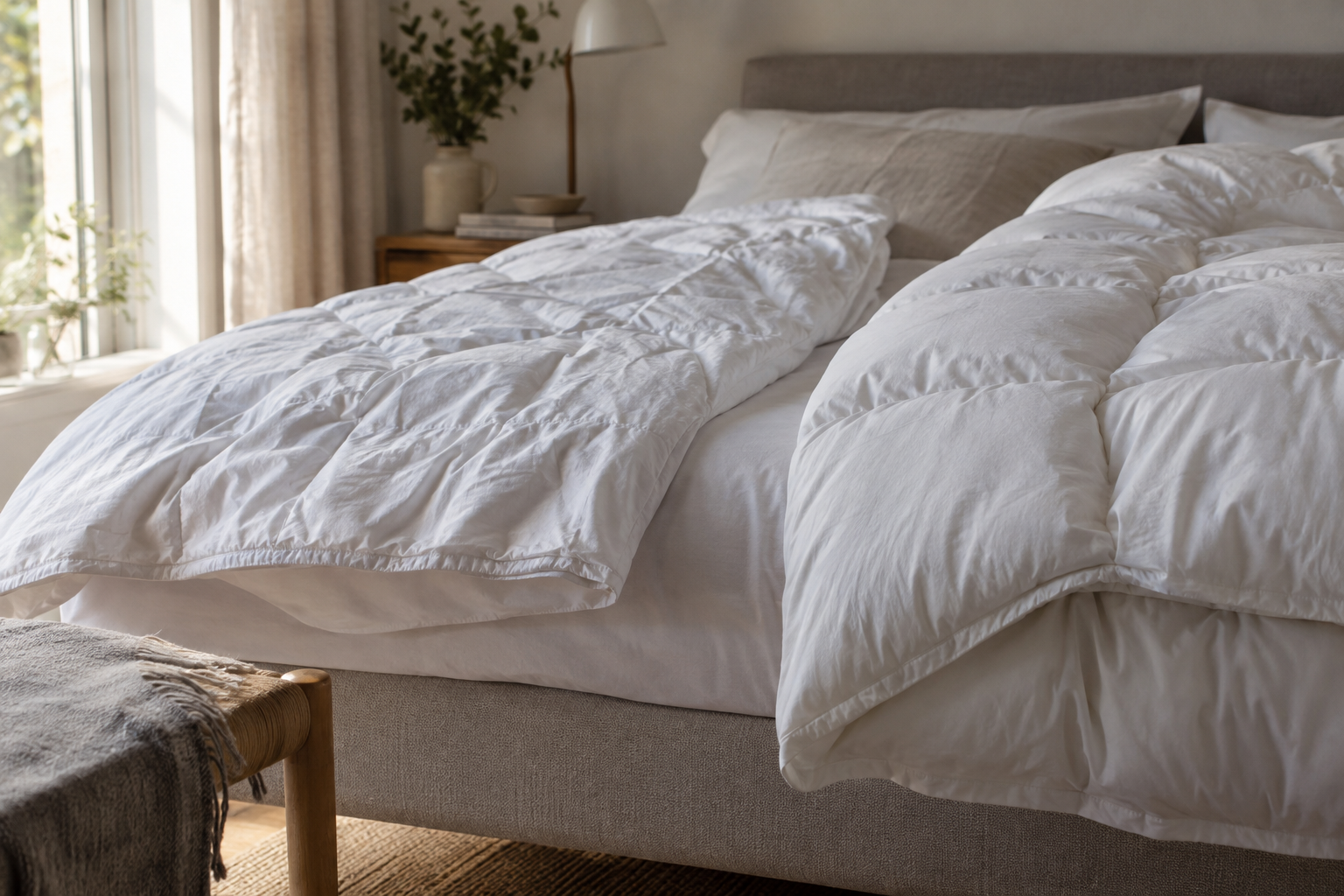
Beyond the covers and the temperature, there is a subtler gift, which is that two duvets make the whole bed quieter and steadier through the night. With one shared cover, every movement one person makes travels straight across to the other. A toss, a turn, a getting-up-for-water, a restless half-hour of not being able to settle, all of it tugs and lifts the shared duvet and ripples across to the sleeping partner, letting in cold air and nudging them toward waking whether they realize it or not. A light sleeper married to a restless one knows this tax intimately. With separate duvets, that transmission is largely broken. One person can turn over, or climb out of bed and back in, without dragging their partner’s cover, and therefore their partner’s sleep, along with them.
This has a lovely practical side for couples who keep different hours. If one of you goes to bed at ten and the other at one, the late one can slip under their own duvet without disturbing the cocoon of the one already asleep, instead of lifting a shared cover and letting in a draft of cold air and wakefulness.
The same is true at the other end of the night, when an early riser can get up and out for work without stripping the bed of warmth and leaving their partner suddenly exposed to the cold at six in the morning. For couples on mismatched schedules, this one change can be worth the whole experiment on its own. Add it all up, fewer cover-tugs, fewer temperature wakes, fewer disturbances from a partner’s movement, and you have a bed engineered for two people to sleep through the night rather than to keep nudging each other half-awake until morning. The couples who try it most often report the same thing: not one dramatic change, but a whole pile of small nightly irritations that simply vanished at once. They do not always know exactly why they are sleeping better; they just notice that they are, and that the bed feels calmer than it used to.
Why It Is Not a Sleep Divorce

It is worth clearing up the biggest misunderstanding, because at first glance an American might hear two duvets and think this is a soft version of a couple drifting apart. It is not, and the distinction matters. A sleep divorce means sleeping in separate beds or even separate rooms, physically apart for the night.
The Scandinavian method is the opposite: it keeps you in the same bed, on the same mattress, side by side, close enough to reach over and touch. All that changes is the cover. You are sharing everything you were sharing before, the bed, the room, the warmth, the proximity, except the one small thing that was quietly waking you up all along. It is less a separation than a subtraction, removing the single source of friction while leaving the whole relationship intact.
And it does not cost you the closeness, either. Couples who sleep this way still cuddle, still start the night tangled together if they like, still share the warmth and comfort and intimacy of a shared bed.
Many pull the two duvets together or share one at the start of the evening, reading or talking or more, and then separate into their own as they drift off, getting the best of both worlds, the closeness going to sleep and the undisturbed rest once asleep. Nothing about the arrangement asks you to be less close; it only asks the blanket to stop coming between you at three in the morning. Sharing a bed and sharing a duvet are two different things, and separating them tends to bring couples closer rather than push them apart, because two people who are both sleeping well are simply kinder to each other than two people quietly resenting a stolen blanket at three in the morning. Better sleep is good for a relationship, full stop, and this is one of the gentlest and cheapest ways to get it without anyone leaving the room or the marriage changing in the slightest. You wake up next to the same person; you just both wake up having actually slept.
How to Try It Tonight

The best part is how easy and cheap it is to test, because you do not need new furniture or a new mattress, just bedding. On a standard double, queen, or king bed, you use two single-size duvets, one for each sleeper, each with its own cover so they can be moved and washed independently. On a larger king or super king, two singles still work, though some people prefer a slightly bigger duvet each for more generous coverage; the principle is the same whatever the bed size. The two duvets naturally overlap a little in the middle once you are both in bed, so there is no cold gap down the center. Skip the shared top sheet; it is not part of the system. That is genuinely the whole setup.
A few honest notes so you go in clear-eyed. It does mean a little more laundry, two covers to wash instead of one, and making the bed in the morning takes a touch longer, since you are squaring away two duvets instead of smoothing one, and that is honestly the main complaint people raise. It is a small price, but it is a real one, and worth knowing before you expect perfection. If you want your bed to still look like one neat shared cover rather than two, simply buy both duvet covers in the same colour and pattern, make the bed with them lying flat and overlapping, and no guest will ever know there are two duvets under there at all. The whole system can be completely invisible if you want it to be.
And be realistic about what it does and does not fix: it ends cover-stealing and temperature clashes and movement disturbance, but it will not cure snoring, sleep talking, or restless legs, which are separate problems that two duvets cannot touch.
For those, the honest answer may be a doctor rather than bedding. But for the enormous number of couples whose nightly misery is really just a stolen blanket and a temperature mismatch, the fix costs the price of a second duvet and can be tried tonight. Run it for a week, then switch back to the single shared duvet for a week if you want a fair comparison, and let your own sleep, and your own mornings, tell you the answer. It is a reversible, low-stakes experiment, which is exactly why it has spread so fast once people hear about it. Most couples, once they have tried it, quietly never go back.

About the Author: Ruben, co-founder of Gamintraveler.com since 2014, is a seasoned traveler from Spain who has explored over 100 countries since 2009. Known for his extensive travel adventures across South America, Europe, the US, Australia, New Zealand, Asia, and Africa, Ruben combines his passion for adventurous yet sustainable living with his love for cycling, highlighted by his remarkable 5-month bicycle journey from Spain to Norway. He currently resides in Spain, where he continues sharing his travel experiences with his partner, Rachel, and their son, Han.