
There is a very specific moment that happens to American visitors at a German spa, and it happens right at the door of the sauna, usually about three seconds after they look through the glass. They have showered, they have their towel, they are ready to relax, and then they look through the glass and see men and women sitting together on the wooden benches, all of them completely undressed, nobody wearing a stitch, nobody remotely bothered, chatting quietly or just sweating in peace.
And the American freezes. The swimsuit they are wearing, the one that felt like the obvious, modest, correct choice, is suddenly the thing that marks them out, because in a German sauna the swimsuit is not just unnecessary, it is against the rules. For the German sitting inside, there is nothing to see here and nothing to discuss, no event occurring at all, just another evening at the spa. For the American at the door, the ground has just shifted. Here is the rule that causes the freeze, why it exists, why Europeans genuinely cannot understand the panic it produces, and how to walk through that door like you belong there. It is one of the great culture shocks of European travel, and also one of the most quickly survivable.
What follows is the rule itself, why Europeans do not get the American reaction, the hygiene logic underneath it all, the etiquette nobody warns you about, how to actually do it without panicking, and what the whole thing reveals.
The Rule That Stops Americans at the Door
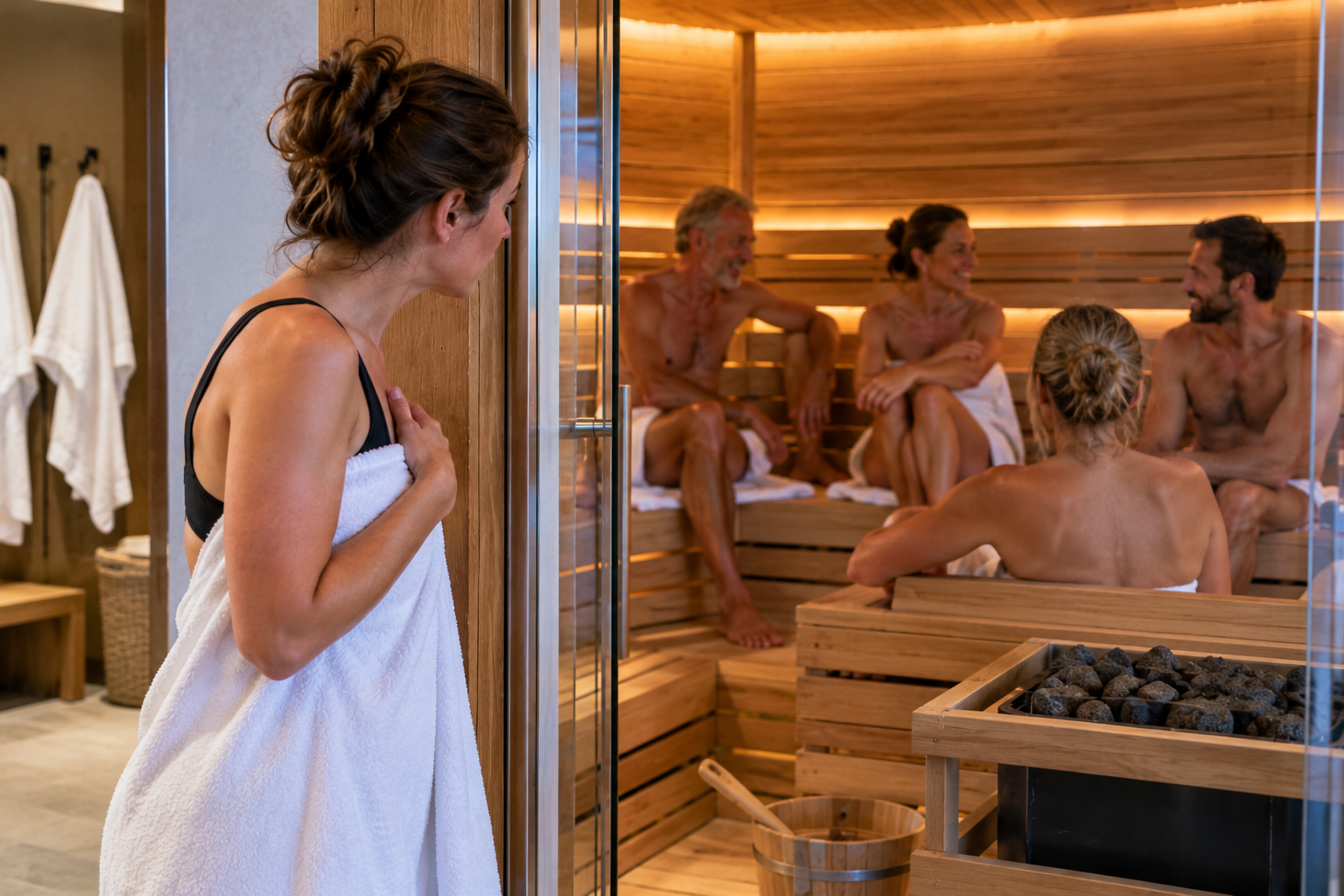
The rule is simple to state and startling to an American: in a traditional German sauna, you are nude, and the sauna is mixed. Germans call it textilfrei, textile-free, and it means exactly that. Inside the hot room, swimwear is not worn, and in most places it is explicitly forbidden, treated as a genuine breach of the rules rather than a personal choice. This is not a fringe practice at a few edgy spas on the margins of the country. It is the standard across the German-speaking world, Germany, Austria, and Switzerland, the region sometimes called the DACH, where the default public sauna runs mixed-gender and clothing-free, with people of all ages and body types sitting together as a matter of course.
Americans tend to arrive assuming the opposite, that a sauna means a swimsuit, single-sex rooms, and eyes firmly down, which is roughly how it works in much of the United States, where even a same-gender locker room makes some people uncomfortable. So the German version lands not as a small adjustment but as a reversal of the ground rules. So the German version lands as a double shock, the nudity and the mixing both at once.
Walk into a public sauna in Munich, Vienna, or Zurich expecting to keep your swimsuit on, and you are in for an awkward moment, because the swimsuit is the thing that does not belong, not your body. Many facilities do also offer women-only hours or sessions for people who want to ease in, which is genuinely worth knowing and takes the pressure off a first visit. But the main sauna, the one with the rituals and the atmosphere and the Aufguss, is textile-free and mixed, and that is simply how it is done, with no apology and no sense that it needs one. The freeze at the door comes from discovering, in real time, that every assumption you brought with you is backward, that the careful, modest, correct thing you did, putting on a swimsuit, is the one wrong move in the room.
Why Europeans Cannot Understand the Panic
Here is the part that is hardest for an American to absorb and most important to understand: to the Germans in that room, there is no drama happening at all. The panic an American feels is, to them, almost incomprehensible, because the entire framework they are operating in is different. In Germany there is a long tradition called Freikorperkultur, or FKK, which translates roughly as free body culture, a decades-old current in German life that treats the unclothed human body as natural rather than shameful or inherently sexual. Nudity in the right context, a sauna, a designated beach, a park area, a changing room, simply does not carry the charge it carries in America. German children grow up seeing it treated as ordinary, so the association between an undressed body and either shame or sex, which runs so deep in American culture, was never wired in the same way.
That is the whole difference in a sentence: in the United States, undressing tends to be linked with vulnerability, modesty, or sex, while in German sauna culture it is linked with hygiene, health, and relaxation, and nothing else.
The German sitting across from you is not being brave or bohemian or making any kind of statement. They are just at the sauna, the way they have been since childhood, in a setting where everyone shares the same unspoken understanding that the body is not a spectacle and the sauna is not a stage.
To them, asking why everyone is naked is a bit like asking why everyone at the pool is wet. This is why Europeans cannot understand the panic. From inside the culture, there is nothing to panic about, no transgression occurring, no one looking, no meaning being made. The American brings a whole apparatus of embarrassment into a room where, for everyone else, that apparatus was quietly set down at the door years ago, if it was ever picked up at all. The panic is real, but it is imported; it did not come from anything actually happening in the sauna.
It Is Really About Hygiene
If you want the single most useful key to the whole thing, it is this: the German objection to swimwear is, at its root, about hygiene, not nudity for its own sake. In German sauna logic, a swimsuit is a piece of fabric that has been in a chlorinated pool, that traps sweat and bacteria against the skin, and that then sits on a shared wooden bench in a hot, humid room. To a German, that is the unhygienic option, the genuinely off-putting one, which turns the American instinct completely on its head. The thing the American reaches for in the name of cleanliness and propriety is, to the German, the grubby import nobody wants pressed against the bench they are about to sit on. The naked body, showered and on a clean towel, is the clean choice. The swimsuit is the dirty one.
This reframes everything, and it explains the rules that go with it. You shower thoroughly before you enter, always. You bring a large towel, and its job is to go underneath you, so that no part of your body touches the shared bench directly and no sweat soaks into the wood. The towel is for hygiene, not for modesty, which is a distinction that takes an American a minute to absorb.
Once you understand that the whole system is organized around keeping a communal hot room clean, the pieces fall into place and the nudity stops seeming like the point. It is a byproduct of a hygiene philosophy, not an exhibition. The Germans worked out long ago that the cleanest way to share a sauna is showered, bare, and sitting on your own towel, and the entire etiquette flows from there. Seen that way, the rule that shocks Americans most is not a rule about nudity at all. It is a rule about keeping a shared space clean, and the nudity is just what that rule happens to require.
The Etiquette Nobody Warns You About
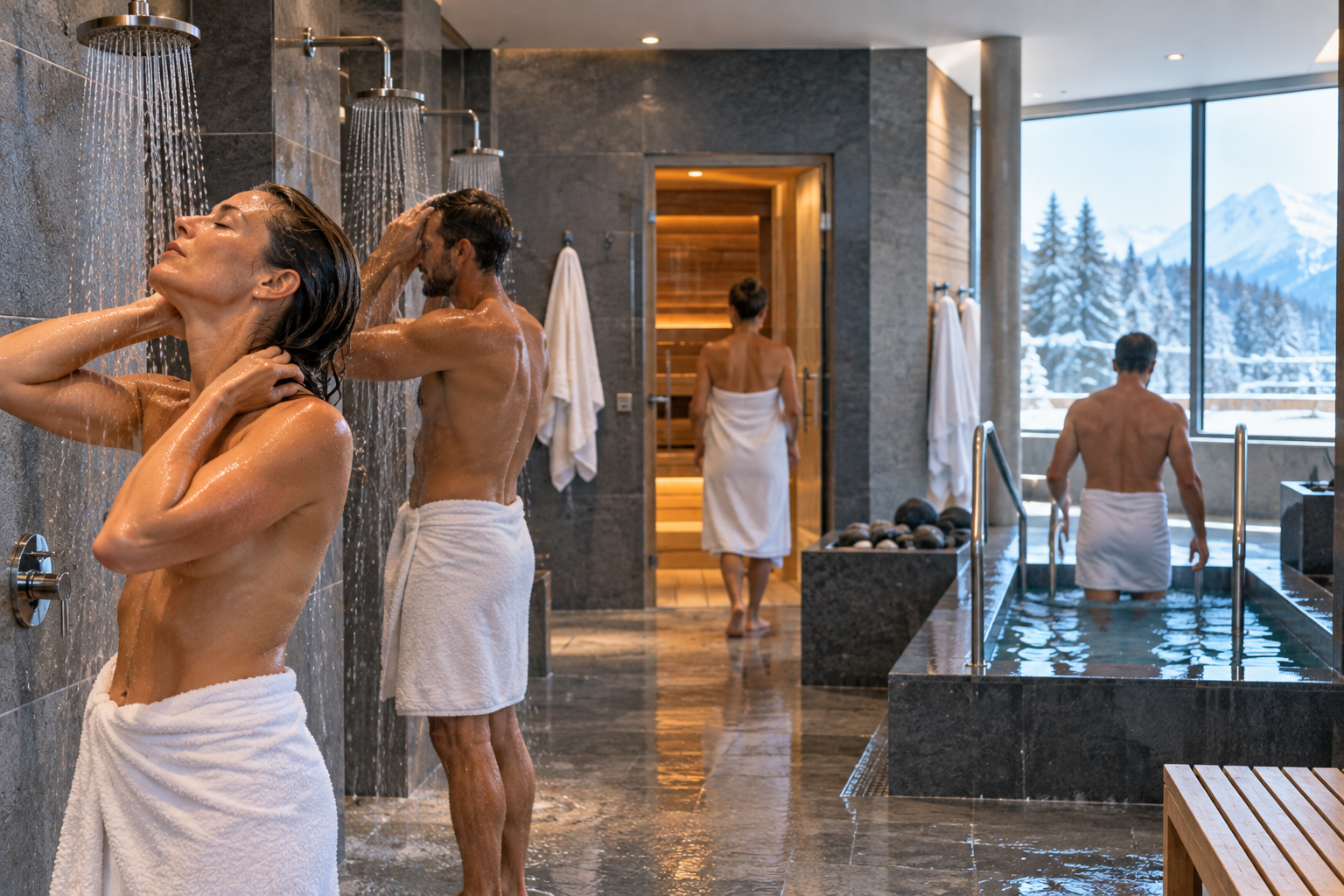
Beyond the central rule, a German sauna runs on a set of customs that no one tends to explain to a first-timer, and quietly breaking them is a faster way to stand out than your body ever will. Showering before you enter is non-negotiable, both for hygiene and as a courtesy to everyone else in the room. You carry a towel to sit or lie on, large enough that all of you, feet included, rests on the fabric rather than the wood. You keep quiet, because the German sauna is a place of calm and low voices, not chatter, and loud conversation earns disapproving looks.
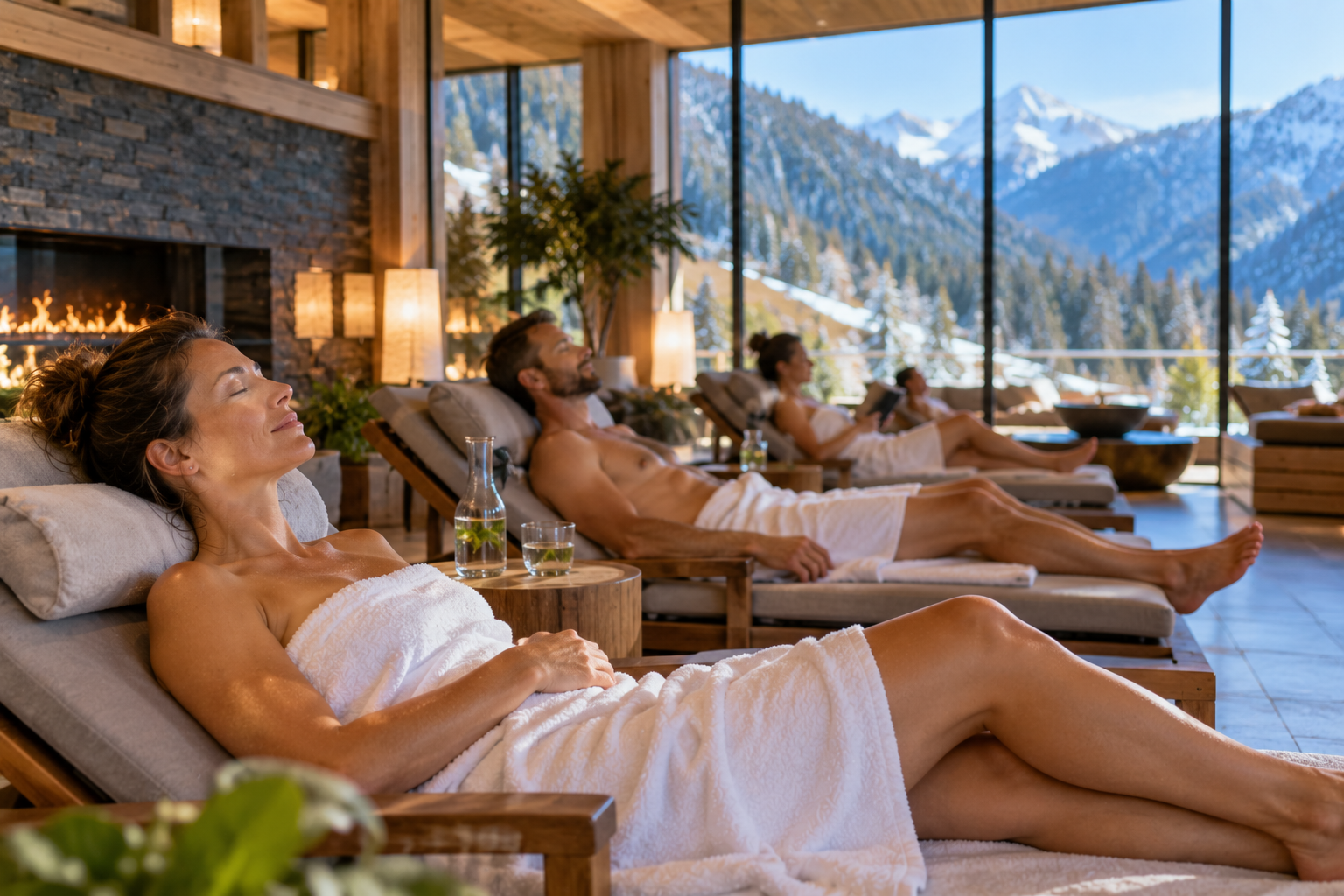
You wear flip-flops or slippers around the wet areas, and a robe or a wrapped towel in the lounges and corridors, where full nudity is not expected even at a textile-free facility. And you do not stare, which is the easiest rule of all once you realize no one is staring at you either. The German sauna runs on a kind of shared, polite non-looking, an agreement that everyone is here to get warm and relax, not to be looked at or to look, and that agreement does more to put people at ease than any amount of towel ever could.
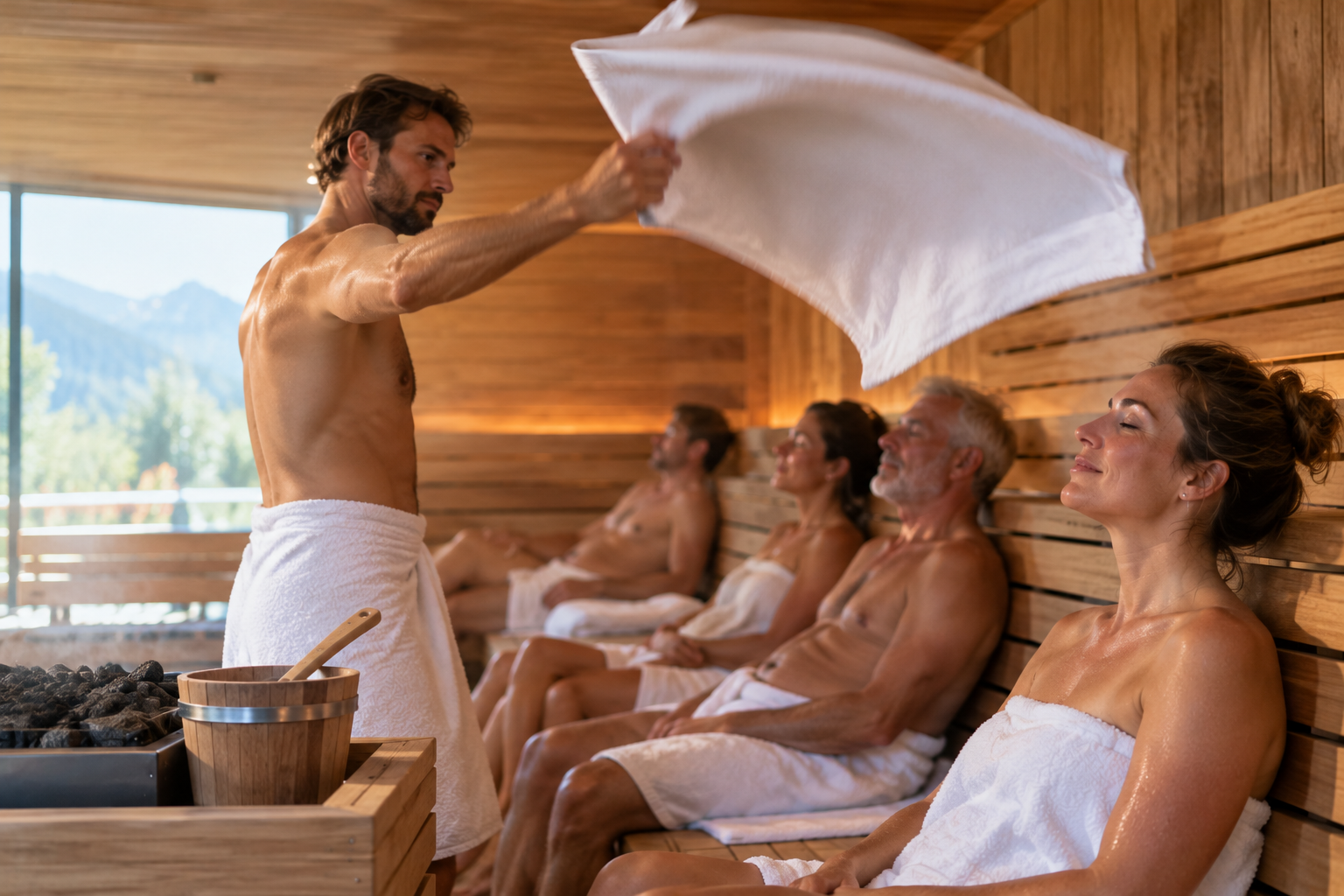
Then there is the Aufguss, the ritual that surprises people most. At set times a trained sauna master, the Saunameister, enters and ladles water, often infused with essential oils, onto the hot stones, then uses a large towel to wave the fragrant steam through the room in theatrical sweeps, intensifying the heat in waves. It is a genuine event, sometimes applauded at the end, and it is one of the things that makes German sauna culture distinct from the casual, grab-a-towel-and-sit version elsewhere. People plan their visit around the Aufguss times, and once you have sat through a good one, with the heat rolling over you in scented waves, you understand why. Sessions tend to run eight to fifteen minutes in heat around eighty to a hundred degrees Celsius, followed by a cold plunge or shower and a rest, repeated a few times. None of this is complicated, but all of it is expected, and knowing it in advance is the difference between feeling like an intruder and feeling like a guest who simply reads the room.
How to Actually Do It Without Panicking
So how does an American actually walk through that door. The first and most reassuring thing to know is that the discomfort is almost entirely in the anticipation, and it fades remarkably fast once you are inside.
Within a few minutes, the thing you dreaded becomes unremarkable, because the room really is as matter-of-fact as it looks, and the sheer ordinariness of everyone else is contagious. Nobody is looking at you. Nobody is thinking about your body, because they are not thinking about bodies at all. The self-consciousness you carried in has nowhere to attach itself, and it quietly dissolves, usually faster than you would ever believe from the other side of the glass. People who dreaded it for an hour beforehand are often, twenty minutes later, completely at ease, wondering what the fuss was about.
A few practical moves make the first time easier. If mixed nudity is a bridge too far at the start, seek out a women-only session or day, which many spas offer, and ease in there. Use your towel the way everyone else does, under you in the sauna and wrapped around you in the common areas, so you always have a cover within reach when you want one. Keep your eyes relaxed and your voice down, follow what the person next to you does, and let the Aufguss, if there is one, give you something to focus on. And hold onto the honest truth underneath all of it, which is that this etiquette works because everyone in the room has agreed to it, so the kindest and easiest thing you can do is simply join the agreement rather than fight it. You do not have to love it, and you are allowed to keep a towel close for comfort, but the moment you stop treating it as a crisis, it stops being one.
What the Whole Thing Reveals
In the end, the sauna door is a small, steam-fogged window onto a genuinely different relationship with the body, and that is why it is worth walking through rather than around. The German at ease on that bench is not more exposed than you are; they are simply carrying less shame about being a person with a body, in a specific context where that shame was never installed in the first place. The freeze an American feels at the door is not really about nudity. It is about running headlong into a culture that quietly decided, generations ago, that the undressed body in a sauna is clean, natural, and nobody’s business, and then built calm, orderly, deeply relaxing institutions on top of that decision.
You do not have to adopt the philosophy to benefit from the experience, and plenty of visitors keep a towel handy and their own comfort level intact the whole time, which is perfectly fine. But there is something worth taking home even if you never fully shed the self-consciousness, which is the reminder that the embarrassment you brought to the door was learned, not inevitable, and that a whole continent of people walk through that same door every week and feel nothing but the pleasant prospect of getting warm. Understanding why they cannot understand your panic is, strangely, the thing that cures it, because once you see that the whole room is running on calm, hygiene, and a quiet agreement to leave the body alone, there is simply nothing left to be afraid of at the door.

About the Author: Ruben, co-founder of Gamintraveler.com since 2014, is a seasoned traveler from Spain who has explored over 100 countries since 2009. Known for his extensive travel adventures across South America, Europe, the US, Australia, New Zealand, Asia, and Africa, Ruben combines his passion for adventurous yet sustainable living with his love for cycling, highlighted by his remarkable 5-month bicycle journey from Spain to Norway. He currently resides in Spain, where he continues sharing his travel experiences with his partner, Rachel, and their son, Han.