
Walk down the cereal aisle in an American supermarket and the colors are almost violent: electric reds, fluorescent yellows, blues that do not occur anywhere in nature. Walk down the same aisle in Europe and the equivalent products are noticeably softer and duller in color, tinted with beet juice or turmeric or paprika extract, or left plain, and no child seems to mind in the slightest.
The reason is a quiet regulatory difference most people have never heard of, and it became the start of a small experiment in our household. The European Union decided, years ago, that a group of synthetic food dyes common in American snacks deserved a warning label about their possible effect on children, and that single decision effectively pushed those dyes off European shelves. So, as a composite family drawn from many readers who have asked us about this, we cut those same dyes from the kids’ diet for thirty days to see what, if anything, would happen. What happened was genuinely interesting, and also more complicated and more honest than a tidy before-and-after story. Here is the real regulatory difference, what the science actually says, why two continents disagree about it, what we did, what we noticed, and what any of it is honestly worth. It is a better story with the complications left in than without them.
What follows is why “banned” is the wrong word, what the research honestly shows, how the experiment worked, what we noticed and the several things it might mean, and the honest bottom line.
“Banned” Is the Wrong Word
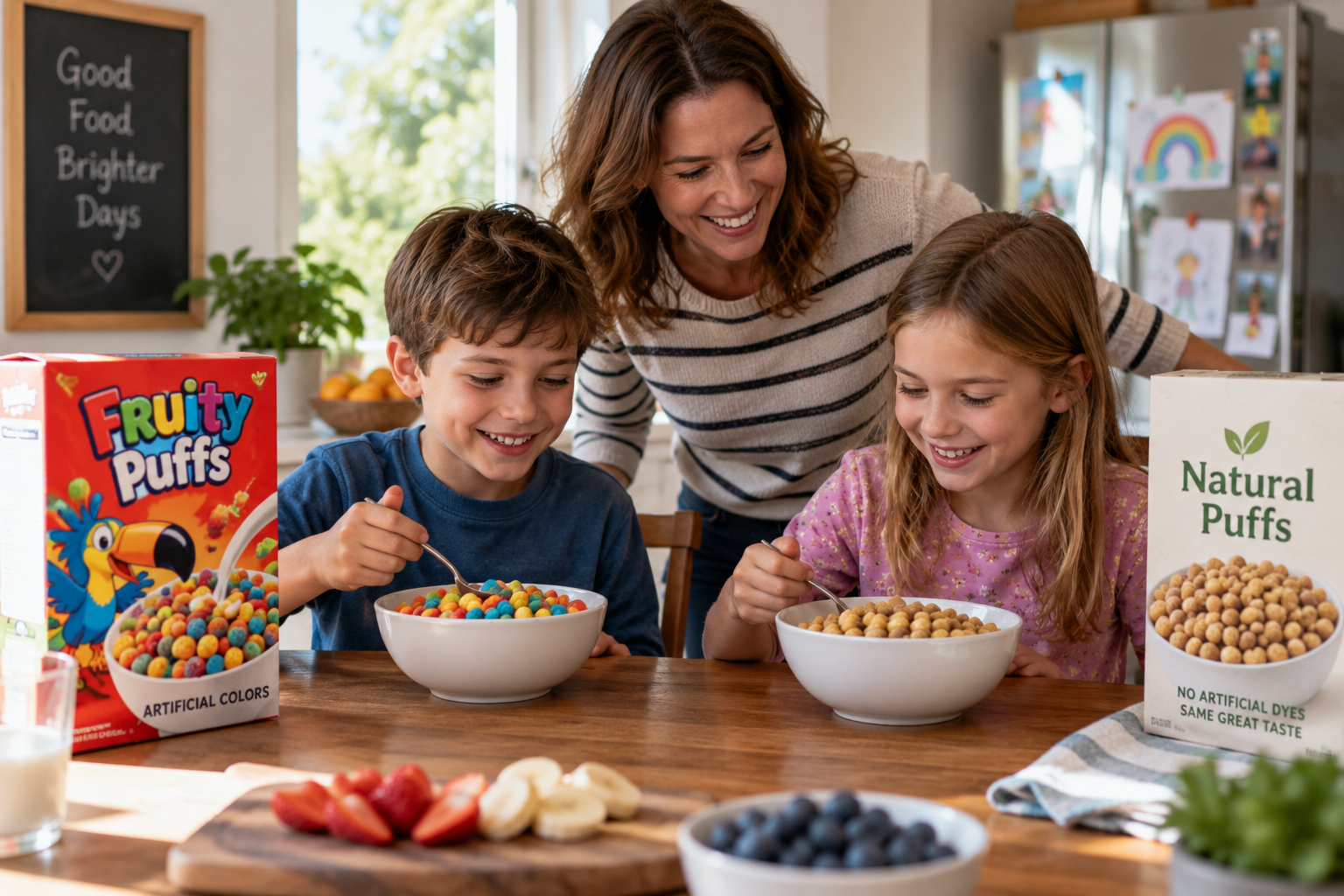
The first thing to get straight, because it is almost always reported wrong, is that the EU did not ban these dyes. What it did, back in 2010, was require a warning label.
Under European regulation, any food containing one of six specific synthetic dyes, the ones researchers had flagged, must carry the words: may have an adverse effect on activity and attention in children. That is it. The dyes remained legal; they just had to wear a warning. But the warning turned out to be more powerful than a ban, because no cereal company wants a sentence about harming children’s attention printed on its brightly colored box, so most European manufacturers quietly reformulated their products with natural colorings instead. The dyes vanished from European shelves not because they were outlawed but because the label made them commercially radioactive, which from the outside looks exactly like a ban and is why so many articles, and so many confident posts online, call it one. The distinction matters, because a warning label and a ban say very different things about how sure the regulators actually were.
The six dyes, often called the Southampton colors after the study that flagged them, include several an American will recognize under different names: Red 40, also called Allura Red, the single most used food dye in America; Yellow 5, or tartrazine; and Yellow 6, or sunset yellow, plus three others. In the United States, these same dyes remain fully legal with no warning label at all, which is the heart of the contrast. A box of candy that would need a child-attention warning in Europe sits on an American shelf with nothing, often the very same brand having two different recipes, the dye-free version for Europe and the cheaper dyed version for the US. It is worth noting the picture is shifting: a couple of European countries like Norway and Austria have gone further and restricted synthetic dyes more heavily, and in the United States the FDA moved in 2025 to begin a voluntary phase-out of several petroleum-based dyes over the following couple of years, and banned one, Red 3, outright. But as things stand, the dyes that carry a warning in Europe still color much of the American snack aisle freely.
What the Research Honestly Shows

This is the part that gets oversimplified in both directions, so it is worth laying out carefully, because the honest picture is neither “these dyes are proven poison” nor “there is nothing to it at all.” The pivotal study came from the University of Southampton in 2007, a proper randomized, controlled trial published in a major medical journal, and it found that mixtures of six artificial dyes combined with a common preservative, sodium benzoate, were associated with increased hyperactivity in some children. That finding is real and it is what prompted Europe to act. But it comes with heavy caveats that honesty requires stating plainly.
The study tested mixtures of dyes together with the preservative, not any single dye on its own, so it cannot tell you that Red 40 specifically does anything. The effect it found was modest, it appeared in some children and not others, and crucially, when Europe’s own food safety authority and the US FDA reviewed the study, both judged the evidence limited and not strong enough to prove a causal link, with the FDA’s advisory committee later voting that the available evidence did not support such a link in the general population. No study has shown that these dyes cause hyperactivity in all children, and plenty of children are entirely unaffected. The honest summary is this: there is suggestive evidence that these dye mixtures may worsen attention or activity in some sensitive children, enough that a precautionary Europe required a warning, but not the conclusive proof a more evidence-demanding United States required before acting. Europe erred on the side of caution; America erred on the side of certainty. Which instinct you find more reasonable is genuinely a matter of judgment and temperament, not a matter the science has resolved, and anyone who tells you the question is settled in either direction, that the dyes are proven dangerous or proven harmless, is overstating what is actually known.
Why the Two Sides Disagree

The more I looked into it, the more the genuinely fascinating story turned out to be not the dyes themselves but why two sophisticated, well-resourced regions looked at the identical evidence and reached opposite conclusions. It comes down to two different philosophies of regulation, and neither is obviously foolish. Europe tends to follow what is called the precautionary principle: if there is credible suspicion that something might harm people, especially children, the burden shifts toward caution, and a regulator can act, by labeling or restricting, before the harm is conclusively proven. Suggestive evidence of possible harm was enough for Europe to require a warning and let consumers and manufacturers decide from there.
The United States works the other way around. American regulators generally require solid, conclusive evidence that a substance causes harm before they will restrict it, placing the burden on proving damage rather than on proving safety. Faced with the same limited, suggestive Southampton evidence, the FDA concluded it did not meet that bar and took no action, leaving the dyes legal and unlabeled.
You can argue this either way. The European approach risks over-reacting to weak evidence and depriving people of harmless things on a hunch; the American approach risks under-reacting, leaving a possibly harmful thing in the food supply for decades while it waits for proof that may be slow or impossible to gather. Food dye is a near-perfect illustration of the trade-off, a low-stakes substance where the cost of caution is small and the cost of waiting is uncertain, which is perhaps why it has become such a flashpoint. Understanding that the disagreement is about regulatory philosophy, not about one side ignoring the science, is the single most clarifying thing in this whole debate.
How the Experiment Worked
With all that honestly on the table, cutting the dyes is a low-stakes thing to try, which is exactly why we did it. The method was simple: for thirty days, we read labels and kept the six flagged synthetic dyes, the Red 40, the Yellow 5 and 6, and the others, out of the kids’ food entirely. In practice this meant swapping the obvious culprits, the neon breakfast cereals, the brightly colored candy and fruit snacks, the lurid sports and fruit drinks, the frosted and sprinkled baked goods, for versions colored naturally or not colored at all, which are genuinely easy to find once you start reading the backs of packages instead of the fronts. The dye is almost never the point of the food; it is just decoration, which makes it easy to drop.
It was more of an adjustment than a hardship. A great deal of the dye in a child’s diet comes from a relatively small number of heavily processed, heavily marketed products, so cutting it is largely a matter of reading ingredient lists and choosing differently on a few items rather than overhauling every meal. We did not change anything else on purpose, no new exercise regime, no other dietary crusade, precisely because we wanted to see what cutting the dyes alone might do. That said, and this matters for honesty, cutting dyed products inevitably meant cutting a lot of ultra-processed junk along with them, because the two travel together, and that is a point we will come back to, because it complicates any simple conclusion in an important way.
What We Noticed, and What It Might Mean

Here is the part people want, and here is where I have to be most careful. Within a couple of weeks, the kids seemed calmer and more focused, or at least we thought so, and the detail that made us sit up was that one of their teachers, who knew nothing about the experiment, mentioned unprompted that one of them seemed more settled and attentive in class than before. A comment from someone with no stake in the outcome lands differently than your own hopeful observation. That is a genuinely striking thing to hear from a neutral observer who had no idea anything had changed, and it is the moment that makes a story like this feel conclusive. But it is not conclusive, and pretending it were would be dishonest, so let me lay out, fairly, the several things that teacher’s comment might actually mean.
It might mean the dyes really were affecting these particular children, who happen to be among the sensitive minority the research describes, in which case cutting them genuinely helped.
It might mean something else entirely. Remember that cutting the dyes also meant cutting a pile of sugary, ultra-processed snacks, so any improvement could be down to a better overall diet rather than the dyes specifically.
It might be partly the observer effect, where parents who expect a change start noticing calm they would otherwise have missed, and where a teacher’s offhand remark gets more weight than a single comment deserves. It might be ordinary variation, since children’s focus swings week to week for a hundred reasons. Most likely of all, it is some tangled combination of all of these at once, impossible to tease apart in a household of two kids over a single month with no control group and a mother paying unusually close attention. Real science controls for exactly the things our kitchen could not. The honest truth is that our little experiment proves nothing about food dyes in general; it is one family’s anecdote, shaped by all the things that muddy an anecdote, and it should be read as exactly that and nothing more.
The Honest Bottom Line

So what is a reasonable person actually to do with all this? The reassuring answer is that the decision is easy precisely because the downside is nearly zero.
Whatever the truth about the dyes, cutting the brightly colored ultra-processed snacks they live in means your kids eat fewer of those products and more real food, which is unambiguously good for them regardless of whether the dye theory holds up. You do not have to believe the dyes are harmful to benefit from cutting them, because you are really just swapping junk for better food and losing nothing nutritionally in the process. It costs nothing beyond a little label-reading, it carries no nutritional risk whatsoever, and if your child happens to be one of the sensitive ones the research describes, you may see a real improvement; if not, you have still quietly upgraded their diet and lost nothing. There is no version of this experiment where your child ends up worse off. That is a trade worth making on its own terms.
What it is not is a diagnosis or a cure. If your child has genuine, persistent problems with attention or behavior, the answer is a pediatrician, not a cereal swap, because attention and behavior have many causes and food dye is at most a small and uncertain one, and treating a real concern with a dietary tweak alone would be a mistake. The most honest and durable takeaway from the whole thirty days was not about our kids at all, who are an unreliable sample of two, but about the striking fact that two wealthy regions looked at the same evidence and made opposite calls, Europe labeling the dyes out of caution and America allowing them while demanding proof. That difference, playing out quietly on supermarket shelves across the Atlantic, in two different recipes for the same candy, is the real and solid story here, the one that does not depend on a sample of two children and a mother’s attention. Our family’s experience is just the small, honest, inconclusive anecdote that sent us looking into it.

About the Author: Ruben, co-founder of Gamintraveler.com since 2014, is a seasoned traveler from Spain who has explored over 100 countries since 2009. Known for his extensive travel adventures across South America, Europe, the US, Australia, New Zealand, Asia, and Africa, Ruben combines his passion for adventurous yet sustainable living with his love for cycling, highlighted by his remarkable 5-month bicycle journey from Spain to Norway. He currently resides in Spain, where he continues sharing his travel experiences with his partner, Rachel, and their son, Han.