
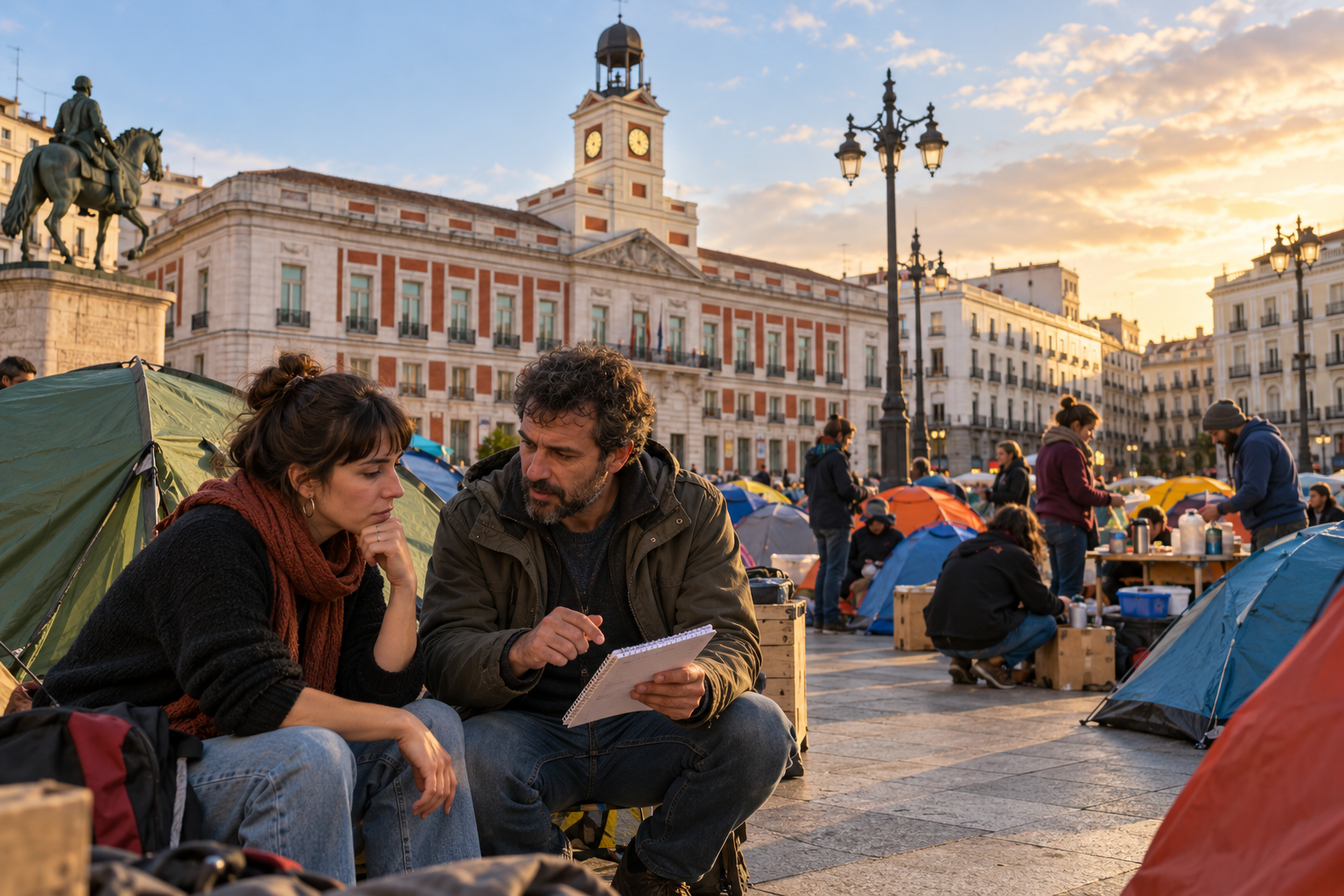
If you walked into Puerta del Sol in the heart of Madrid this week, the city’s most famous square, its symbolic center, the spot from which all of Spain’s road distances are officially measured, its so-called Kilometer Zero, you would find it carpeted with tents. Not a handful, but hundreds, well over a thousand by some counts, pitched across the plaza in neat rows, with people cooking, organizing, holding assemblies, and sleeping in shifts in the very heart of the capital, right where the tourist crowds usually thickest. It is one of the most striking sights in Spain right now, and for a visitor who stumbled upon it without context, it would be genuinely bewildering, a tourist postcard suddenly overtaken by something urgent and real. This is a housing protest, one of the largest Spain has seen in years, and it has become a flashpoint in a national argument about who can afford to live in Spanish cities. So here is what is actually happening in Sol right now, why people are camping there, the political drama it has collided with, and what it means, whether you are visiting Madrid or watching Spain from afar. It is a genuine piece of living history, and worth understanding rather than just photographing.
What follows is the scene in the square, the housing crisis behind it, the political flashpoint it has become, the bigger picture of Spain’s rents, and what it means if you are planning a visit.
What You Would See in Sol Right Now
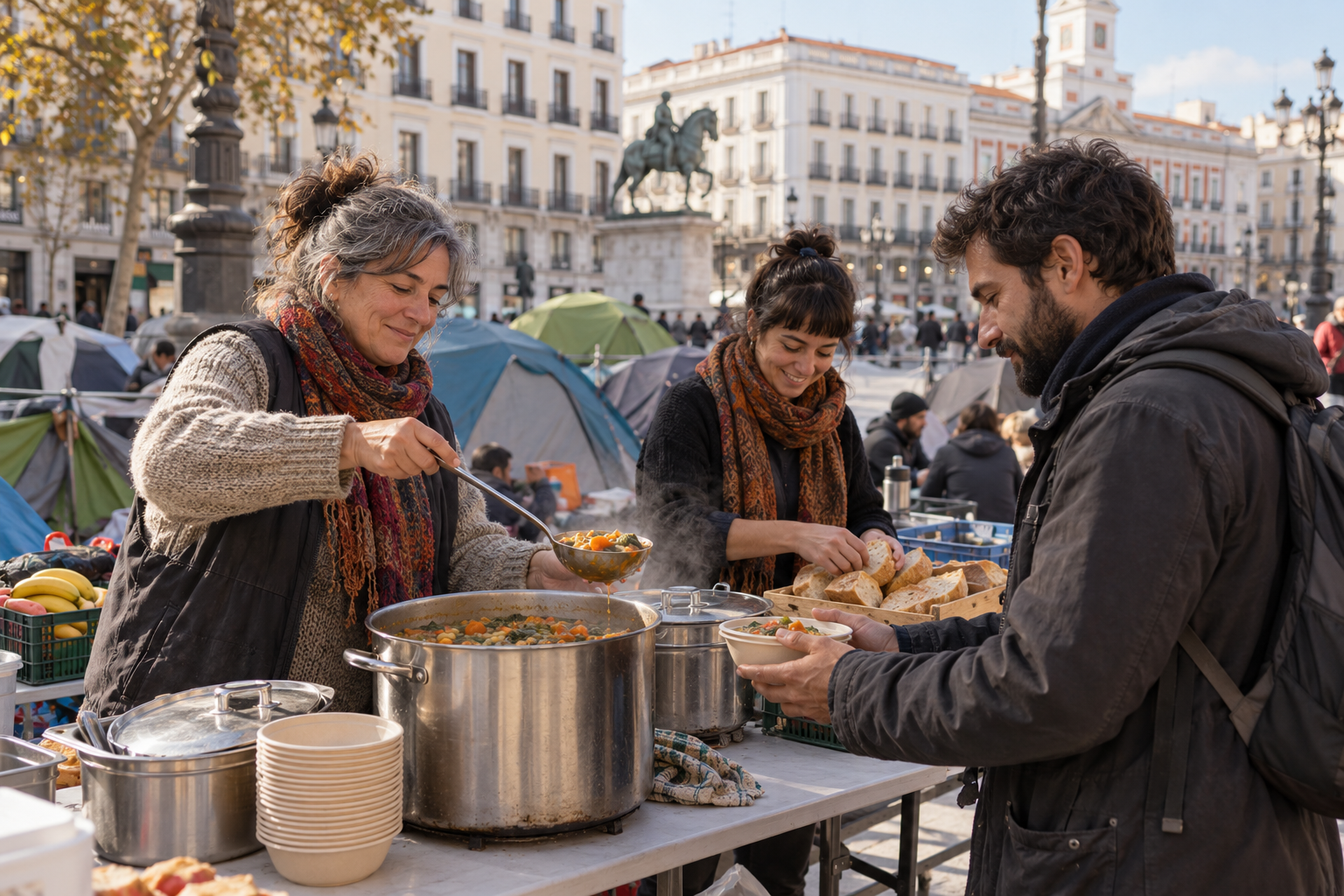
The scene is extraordinary. Puerta del Sol, normally a churning crossroads of tourists, shoppers, buskers, and the famous bear-and-strawberry-tree statue, has been transformed into a tent city, organized by Madrid’s Tenants’ Union. Row upon row of tents fill the plaza, reaching toward the streets that feed into it, and the encampment has taken on a life of its own, with daily assemblies, collective kitchens and spaces, and a rotating population of people who camp overnight and then head off to work or study in the morning before returning. It is less a chaotic sit-in than a small, functioning, self-governing village that happens to occupy the most famous pavement in the country. Some who cannot stay have friends who work from home mind their tents during the day.
For anyone who remembers it, the sight carries a powerful echo. In 2011, this same square was the epicenter of the Indignados movement, the mass anti-austerity occupation that filled Sol with tents and captured the world’s attention, and the current encampment is consciously reminiscent of that moment, down to the location.
The organizers have counted well over a thousand tents, and as of early October the camp was entering its second week with no announced end date, its participants organizing shifts and supplies to sustain it, even through rain, for as long as it takes. It is peaceful and highly organized, a deliberate, sustained act of protest rather than a chaotic one, and it has drawn people from various parts of Spain, not just Madrid, to the square. That reach beyond the capital is part of the point, a signal that the housing anger is national, not local. For a visitor, it is an arresting thing to walk into: the ceremonial heart of Spain, occupied, turned into a living argument about the cost of a home. The contrast between the tents and the tourists photographing the famous clock tower a few steps away captures, in a single glance, the two Spains the whole protest is about.
Why They Are Camping
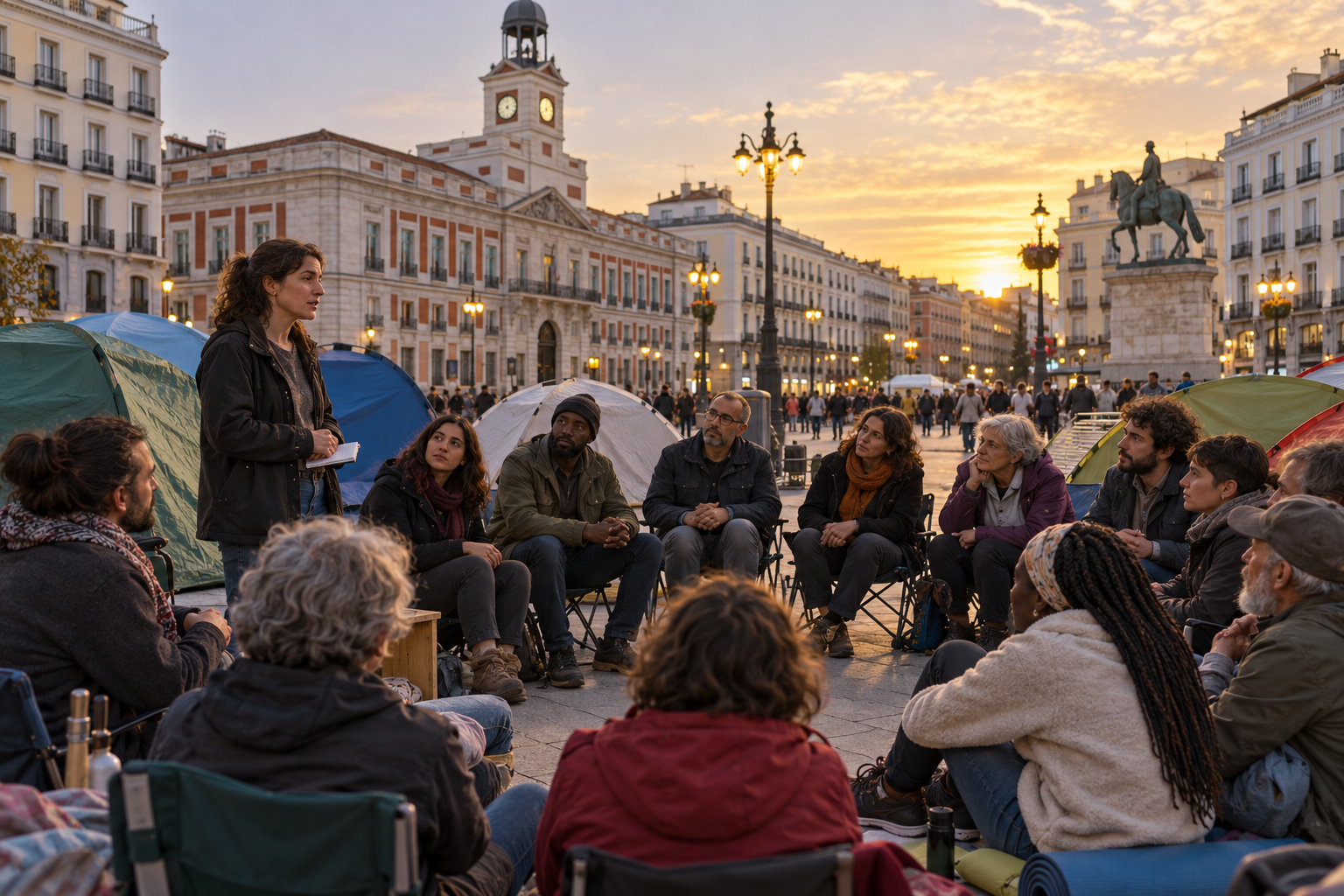
The reason behind the tents is Spain’s housing crisis, which has become one of the most urgent issues in the country, and the encampment crystallized around a single galvanizing cause: evictions. The protest grew out of a housing demonstration under a slogan protesting evictions, built around the case of a woman facing the loss of her home, and it swelled from a march into an occupation as participants decided to stay in the square to keep up the pressure. One person’s eviction became a stand-in for thousands, and the march that might have ended at dusk instead put down roots and stayed. The Tenants’ Union, which organized it, is demanding stronger protections for renters in a country where, for many, affording a place to live has become genuinely difficult. Their core demand is simple to state even where the solutions are contested: that renting a home in Spain should not be a source of constant insecurity.
The grievance is real and widely felt. Rents in Spain’s major cities, Madrid and Barcelona above all, have risen sharply in recent years, outpacing wages and pushing housing costs to levels that many ordinary Spaniards, and especially the young, struggle to meet.
Evictions, the sharp end of the crisis, have become a potent symbol of a system many feel is stacked against tenants, and the encampment’s focus on stopping them taps into a deep well of frustration. A family put out of its home is a story everyone understands at once, and it gives an abstract crisis a human face the movement can rally around. The campers are not a fringe; the housing squeeze is a mainstream concern in Spain, discussed constantly in the media and in politics, and the tents in Sol are the most visible expression of a discontent that runs far wider than the square. They are there, in short, because a great many people in Spain feel that housing has become unaffordable and insecure, and because the square at the center of the capital is the loudest place in the country to say so. To camp in Sol is to make a problem impossible for the country, and its politicians, to look away from.
The Political Flashpoint

The encampment did not stay a protest in a square; it collided directly with national politics, which is what has turned it into front-page news. The timing was dramatic. As the camp grew, the Spanish Congress was considering government decrees aimed at the housing crisis, measures intended to curb evictions and extend rental protections, and the protesters watched the vote closely, seeing it as a test of whether their demands would be met. In early October, Congress struck the measures down, with opposition parties combining to defeat them, a result the campers greeted with anger and dismay.
Rather than ending the protest, the parliamentary defeat hardened it. The Tenants’ Union declared that the encampment would continue indefinitely, vowing not to back down, extending the protest to neighborhoods, and raising calls for broader action including a general strike.
The defeat transformed the camp from a demonstration with a specific ask into an open-ended stand, and it sharpened the political lines around it, with the city’s authorities raising concerns about the camp and the protesters digging in. What might have ended in a negotiated win instead became a confrontation with no obvious exit, which is often how protests grow rather than fade. This is where a visitor should tread carefully in their own understanding, because housing policy in Spain is a genuinely contested political question, with serious arguments on more than one side about what actually helps renters and what might backfire, about the balance between protecting tenants and encouraging the supply of housing. The point here is not to adjudicate that argument but to report that it is live, fierce, and currently playing out, quite literally, in tents in the middle of Madrid. Reasonable people in Spain disagree sharply about the remedies, even as most agree there is a real problem to solve.
The Bigger Picture of Spain’s Rents

To understand why this resonates so powerfully, it helps to step back to the broader forces behind Spain’s housing squeeze, because the encampment is a symptom of pressures that have been building for years. Several things have combined to push Spanish rents up. Wages have not kept pace with housing costs, leaving a widening gap between what people earn and what they must pay for a home. The supply of affordable housing has lagged demand, especially in the big cities. And the explosion of tourism and short-term holiday rentals has, in the most sought-after neighborhoods, pulled housing out of the long-term market and into the far more lucrative business of renting to visitors, squeezing locals further.
The result is a country where, in its most desirable cities, a decent home at an affordable rent has become hard to find, and where the gap between the Spain that tourists and newcomers experience and the Spain that young locals struggle to afford has grown painfully wide. This is the deeper context that makes the tents in Sol more than a passing protest, because they speak to a tension that anyone paying attention to Spain, including the many foreigners drawn to live there, should understand. the very desirability that makes Spanish cities appealing is part of what has driven their housing costs up, a connection that is uncomfortable but real, and the encampment is, in part, a protest against the consequences of that desirability. It is a reminder that the sunny, affordable Spain of the expat imagination coexists with a harder Spain of rising rents and housing insecurity for many of the people who actually live there. Both are real, and a fair picture of the country holds them together rather than seeing only the first.
How Long Will It Last
The question hanging over the square is how long the camp can hold, and here the 2011 precedent is instructive, if not perfectly predictive. The Indignados encampment that occupied this same plaza fifteen years ago did eventually come down, cleared after weeks as such occupations tend to be, but its influence long outlasted the tents, feeding a wave of activism and reshaping Spanish politics for years afterward. An encampment, in other words, can disperse and still win, if it shifts the conversation, and the organizers of the current protest plainly have that longer game in mind, talking of spreading the movement to neighborhoods and of broader action rather than pinning everything on the square itself.
Against that, there are real pressures working to bring the camp down. City authorities have raised concerns about the occupation, the practical strains of sustaining a tent city in a working plaza mount with each passing day and each spell of rain, and the energy of any protest is hard to maintain indefinitely. Whether the camp is cleared, winds down on its own, or hardens into a longer standoff is genuinely uncertain as of this writing, and it may well be resolved, one way or another, soon after you read this. What seems more durable than the tents themselves is the grievance that raised them, because even if this particular encampment ends, the housing pressures behind it are not going away, and the issue it has forced to the center of national attention is likely to keep returning, in Sol or elsewhere, for as long as the underlying problem persists. Movements like this rarely end cleanly; they recede and resurface, each time a little harder to ignore. The camp is a moment; the housing crisis is the condition, and the condition will outlast the moment.
What It Means If You Are Visiting
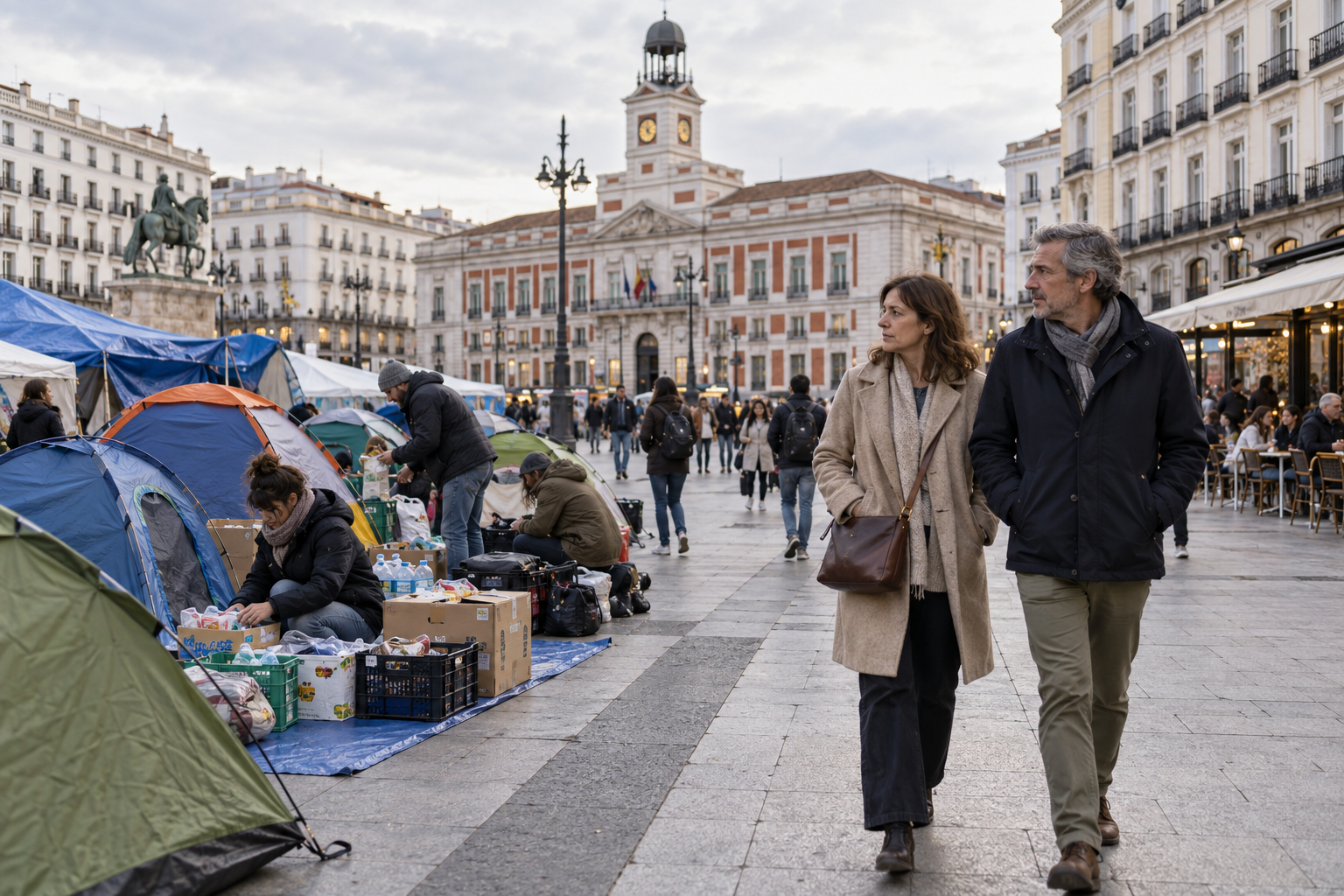
So what should you do with all this if you are headed to Madrid, or watching Spain with an eye to living there one day? If you are visiting, the first thing to know is that the encampment is peaceful and the city around it is functioning normally, so there is no reason to avoid central Madrid or to feel unsafe; you can walk through the area, though the square itself is occupied and busier and more charged than usual, and the usual flow of foot traffic routes around the tents. Life in the surrounding streets, the shops, cafes, and sights, carries on much as always. The sensible and decent approach is simply to be respectful: this is a serious protest by people in real difficulty, not a spectacle staged for tourists, so it is a place to observe thoughtfully rather than to treat as a photo opportunity. A quiet walk through with your eyes open will teach you more about contemporary Spain than an hour in most museums. Seen rightly, it is a remarkable window into a real and important Spanish debate, the kind of thing that gives a visit more meaning than another monument.
For anyone thinking more seriously about Spain, as a place to move to or retire in, the encampment carries a more substantial lesson, which is that the housing crisis is real and worth factoring into your picture of the country. The affordability that draws so many to Spain is under genuine strain in the big cities, and understanding that, rather than assuming the cheap, easy Spain of the brochures, is part of planning realistically. It is also, for what it is worth, part of why many newcomers end up looking beyond Madrid and Barcelona to smaller cities and regions where the housing math still works.
None of this should put anyone off Spain, a country with much still to recommend it, but it should be seen clearly. A final, honest caveat: this is a fast-moving situation, and the details, the size of the camp, its fate, the political response, are changing by the day, so anything specific here is a snapshot of early October and should be checked against the latest news before you rely on it. What will not change as quickly is the underlying story the tents are telling, about a country wrestling, in its most famous square, with the simple and enormous question of who gets to afford a home.

About the Author: Ruben, co-founder of Gamintraveler.com since 2014, is a seasoned traveler from Spain who has explored over 100 countries since 2009. Known for his extensive travel adventures across South America, Europe, the US, Australia, New Zealand, Asia, and Africa, Ruben combines his passion for adventurous yet sustainable living with his love for cycling, highlighted by his remarkable 5-month bicycle journey from Spain to Norway. He currently resides in Spain, where he continues sharing his travel experiences with his partner, Rachel, and their son, Han.