
There is a form that every single American with a foreign bank account is supposed to file once a year, that most of them have simply never heard of, and and that carries penalties frightening enough to make people go visibly pale the moment they finally learn about it. It is called the FBAR, and the gap between how scary it sounds and how genuinely simple it actually is may well be the very widest of any single requirement in the entire expat world.
New expats often stumble onto it in a genuine panic, convinced they are already in serious trouble, when in reality, for an ordinary honest person, the FBAR is a completely free, quick, online formality with nothing to fear in it at all. The panic comes almost entirely from not understanding it, and it dissolves the very moment you do. So here is what the FBAR actually is, who has to file it, why the penalties look so alarming, and why, handled properly, it is genuinely nothing to lose sleep over. It belongs firmly in the category of things that are frightening only until you understand them, at which point they turn out to be routine.
What follows is the form nobody told you about, the low threshold almost everyone crosses, the penalties that cause the panic, why it is not actually scary, and how to fix it if you have fallen behind.
The Form Nobody Told You About
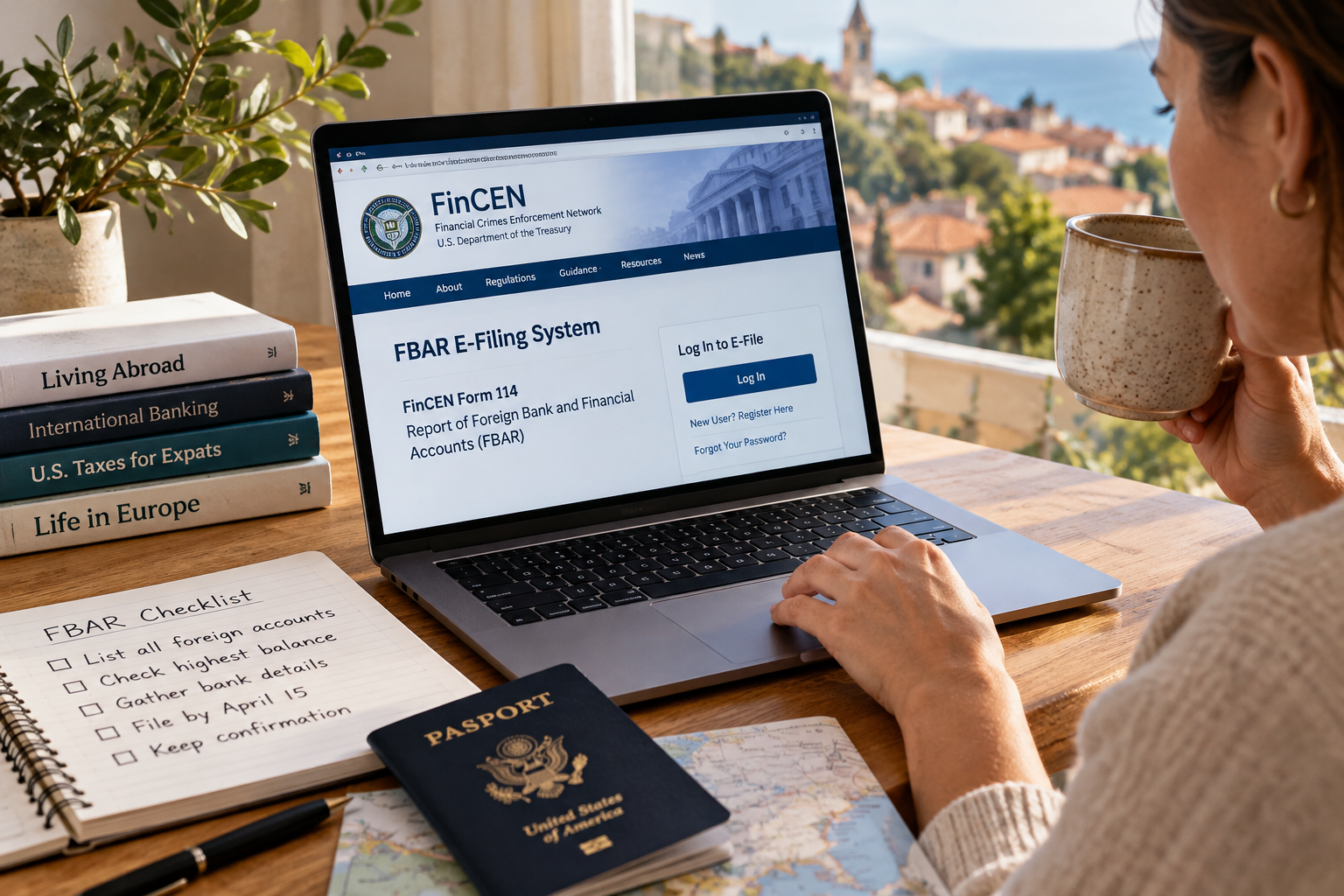
The FBAR is the Foreign Bank Account Report, officially FinCEN Form 114. The first thing to understand, and the source of much of the confusion, is that it is not really a tax form at all. It is filed not with the IRS but with a different part of the US Treasury, the Financial Crimes Enforcement Network, and it is filed separately from your tax return, on its own, through an online system. It collects no money and calculates no tax; it is purely an information report, a disclosure telling the US government which foreign financial accounts you hold.
That is its entire purpose: not to tax you, but to know. The government simply wants a running record of where Americans are holding their money abroad. Nothing about filing it costs you a cent.
Because it lives outside the ordinary tax return and is filed with an agency most people have never heard of, the FBAR slips under the radar of almost every new expat. Nobody encounters it in the course of a normal American tax life, since you only need it once you have foreign accounts, so it simply is not on anyone’s mental checklist when they move abroad. An American opens a local bank account in their new country, as everyone must, and has no idea that this ordinary, sensible act has just triggered a US filing requirement they have never been told about.
You cannot really live abroad without a local account, so in practice the requirement attaches to almost everyone the moment they settle in. This is why the FBAR is the classic expat surprise, discovered late and by accident, and why understanding it up front spares you the fright. Learn about it before you open that first foreign account, and it becomes a routine annual task instead of a horrifying discovery three years in. It is not a tax, it is not filed where you would expect, and it exists purely so the US Treasury has a record of Americans’ accounts abroad, which is a much less menacing thing than the name and the penalties suggest.
The $10,000 Line Almost Everyone Crosses

The reason the FBAR catches so many people is that the threshold for having to file it is startlingly low, low enough that almost any American living abroad crosses it without trying. You must file an FBAR if the combined value of all your foreign accounts exceeded ten thousand dollars at any point during the year. The key words there are combined and at any point. It is not ten thousand dollars in a single account; it is the total across every foreign account you hold added together, so three accounts with a few thousand dollars each can easily push you over the line. And it is not your year-end balance; it is the highest the total reached at any moment during the year, even for a single day.
That threshold sweeps in a huge share of expats, because anyone living abroad needs a local bank account, and a normal salary, pension, or savings balance flowing through it will routinely exceed ten thousand dollars combined. Move money over to buy a car or put down a deposit, and even a brief spike over the line counts. The accounts that must be reported are broad, too: not just checking and savings but foreign investment and brokerage accounts, many foreign pension accounts, and even accounts you do not own but have authority over, such as a business or a family member’s account you can direct. A jointly held account counts in full, not just your share. In short, if you live abroad and have any real financial life there, you almost certainly cross the threshold, which is exactly why the FBAR applies to so many more people than realize it.
The low bar is not an accident. It is designed to capture essentially anyone with meaningful money offshore, which, unavoidably, means almost every expat. The low bar is the whole reason this is a near-universal expat requirement rather than a niche one.
What Actually Counts as an Account

Part of why the FBAR catches people is that the accounts it reaches are broader than most assume, so it is worth being clear about what actually has to go on it. The obvious ones are your foreign checking and savings accounts, but the requirement extends to foreign investment and brokerage accounts, many kinds of foreign pension and retirement accounts, and even money held on a foreign cryptocurrency exchange if it also holds ordinary currency. If it is a financial account at a non-US institution, it very likely counts.
Two categories in particular trip people up. The first is accounts you do not own but have authority over: if you can direct the money in an account, whether it belongs to your employer, your business, or a family member, that account can land on your FBAR even though the funds are not yours.
The second is joint accounts, which count at their full value toward your threshold, not just your half, so a couple with a shared account both report the whole balance. On the other side, some things do not count in the ordinary way, and the rules have their nuances, which is part of why people with complicated finances get professional help. But the practical takeaway is simple and worth internalizing: almost any financial account you hold or control outside the United States is potentially reportable, and the safe assumption for an ordinary expat is that your foreign accounts, taken together, need to be on the form. It is far better to over-include and disclose than to guess something out and be wrong, since the FBAR costs nothing and disclosure is the entire point. There is no downside to listing an account that might not have needed to be there, and a real downside to leaving off one that did.
The Penalties That Cause the Panic
Now for the part that turns discovery into dread, because when people look up the FBAR and see the penalties, their stomach drops. On paper, the numbers are genuinely alarming. A non-willful failure, meaning an honest mistake, can in theory carry a penalty of many thousands of dollars per violation, in the region of sixteen thousand dollars. A willful failure, meaning deliberate concealment, is far worse, running to the greater of a six-figure sum or half the entire balance of the account. Seeing figures like that attached to a form you did not know existed, and may have failed to file for years, is understandably terrifying, and it is what sends newly-aware expats into a spiral.
But context is everything here, and the raw penalty figures badly misrepresent the reality for an ordinary person. Those maximums are worst-case ceilings, aimed above all at the willful end of the spectrum, the people deliberately hiding money offshore to evade tax, which is what the whole reporting regime was built to catch. The eye-watering willful penalties, the half-your-balance ones, are for genuine tax cheats, not for a retiree who did not know they had to report their Spanish checking account. There is a world of difference between hiding a secret Swiss account from the government and forgetting to disclose the ordinary account your pension lands in, and the penalty regime knows it.
Even the non-willful penalties are not automatically imposed on anyone who files late; whether any penalty applies at all depends on the facts, and an honest person who comes forward and fixes the problem is in a completely different position from someone caught concealing. The scary numbers are real, but they are the far edge of the range, and reading them as if they apply to your innocent oversight is the single biggest cause of unnecessary FBAR panic. It is a little like reading the maximum prison sentence for a traffic offense and assuming you are going to jail for a parking ticket; the ceiling exists, but it is not aimed at you. The system reserves its teeth for hiders, not for the honestly unaware.
Why It Is Not Actually Scary

Strip away the misunderstanding and the FBAR is, for the ordinary compliant person, about as low-stress as a government filing gets. It costs nothing to file. It is done online, through the Treasury’s e-filing system, and for most people it takes very little time, since all you are doing is listing your foreign accounts and the highest balance each reached during the year. There is no tax to calculate and nothing to pay, because it is a report, not a bill. You are simply telling the government what it wants to know, and once you have, you are done for the year.
There is no bill in the mail afterward, no negotiation, no lingering exposure. You filed the report, the government has its record, and that is the end of it until next year.
The deadline is easy too. The FBAR is due in April, alongside the tax deadline, but it comes with an automatic extension all the way to October with no need to request anything, so in practice you have until the autumn to get it in.
Do it on time, list your accounts honestly, and there is genuinely nothing to fear, because the penalties that look so frightening simply do not come into play for someone who files a complete and honest report.
The whole terror of the FBAR evaporates the moment you actually file one and realize it was a ten-minute task with no money attached. For the honest expat, it is not a threat but a chore, and a minor one at that. Most people, having dreaded it, are faintly deflated by how anticlimactic the actual filing turns out to be. The trick is simply to know it exists and to build it into your yearly routine alongside your tax return, so it never becomes the frightening backlog that ambushes people who did not know. Filed one year at a time, it is trivial. Left to pile up over years of ignorance, it becomes the scary thing, not because any single filing is hard but because the backlog feels overwhelming.
How to Fix It If You Have Fallen Behind
Of course, many people reading this will realize they should have been filing FBARs for years and have not, and the important message for them is: do not panic, and do not keep ignoring it. This is a common and fixable situation, not a catastrophe, and the IRS has a specific program designed for exactly it. For those living abroad whose failure to file was non-willful, an honest not-knowing, the Streamlined Foreign Offshore Procedures let you get current by filing the past six years of FBARs, along with a few years of amended tax returns, with no penalty for the delinquent FBARs.
You catch up, you become compliant, and the frightening penalties never materialize, because the whole point of the program is to bring the honestly-unaware back into the fold without punishment. The worst thing you can do is discover the problem and then sit on it, since coming forward voluntarily is exactly what the program rewards, and waiting to be found is what it does not.
Two last things are worth knowing. First, the FBAR is not the only foreign-account form; there is a separate form, filed with your tax return, that kicks in at much higher balances, so people with larger holdings may need both, and it is worth checking which apply to you.
Second, because the penalties for getting it genuinely wrong are severe and the catch-up program has to be done correctly, this is an area where paying a professional who handles expat filings is often money well spent, especially if you are behind. But none of that changes the basic, reassuring truth: the FBAR is a free, simple, online report that most Americans abroad must file, that exists to disclose rather than to tax, and that holds no terror at all for the honest person who understands it and files it on time. Know it exists, keep a note of your account balances through the year, and file it each autumn, and it never becomes a problem at all. The only people the FBAR should frighten are the ones deliberately hiding money, and if that is not you, it never was as scary as it looked.

About the Author: Ruben, co-founder of Gamintraveler.com since 2014, is a seasoned traveler from Spain who has explored over 100 countries since 2009. Known for his extensive travel adventures across South America, Europe, the US, Australia, New Zealand, Asia, and Africa, Ruben combines his passion for adventurous yet sustainable living with his love for cycling, highlighted by his remarkable 5-month bicycle journey from Spain to Norway. He currently resides in Spain, where he continues sharing his travel experiences with his partner, Rachel, and their son, Han.