
Every autumn, Spanish markets fill with a glossy, tomato-orange fruit called the caqui, the persimmon, kaki in some spellings, piled up in gorgeous glowing heaps from October right through December. And every autumn, the caqui confuses people, locals and visitors alike, because it is one of those fruits that will reward you beautifully or punish you cruelly depending on one thing you cannot tell just by looking at it. It is beloved and dreaded in almost equal measure, which is a strange thing to be able to say about a piece of fruit.
Bite into the wrong kind at the wrong moment and your mouth fills with a dry, furry, puckering astringency so unpleasant that many people quietly swear off persimmons forever after a single bad experience. But get it right and it is one of the great sweet pleasures of the whole season, honeyed and rich and quite unlike anything else in the fruit bowl. The whole confusion comes down to the fact that there are really two kinds of caqui, which must be eaten in opposite ways, plus one simple rule that sorts the entire thing out. So here is what that fruit actually is, why it bites back, and the one rule that makes it a joy. It is the rare case where a single piece of knowledge transforms a fruit from a gamble into a reliable pleasure, and it takes about a minute to learn.
What follows is the astringency that ambushes first-timers, the two kinds of caqui that look almost alike, the single rule that tells them apart, Spain’s own bright-red star variety, and how to actually eat each one.
The Fruit That Bites Back
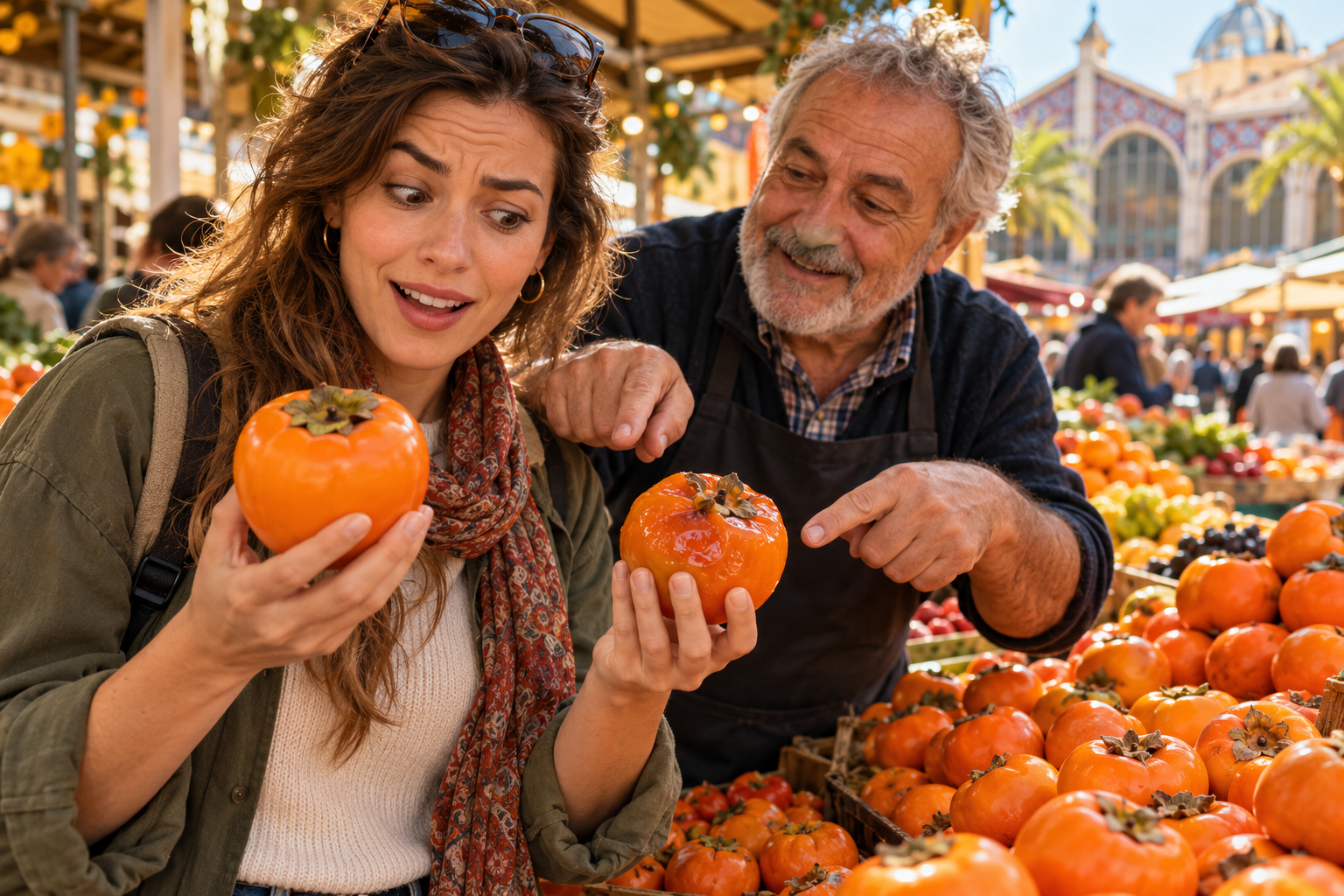
To understand the caqui you first have to understand its trick, which is astringency, because it is the source of every bad persimmon experience anyone has ever had. Persimmons contain tannins, the same compounds in strong tea and young red wine, and in an unripe or untreated persimmon those tannins are present in such quantity that eating the fruit is genuinely unpleasant, leaving your mouth feeling dry, furred, and puckered in a way that is hard to forget and easy to resent. This is not the fruit being bad or spoiled; it is simply the tannins doing what tannins do, and it is entirely a matter of which fruit you have and when you eat it. It is a bit like biting into a rock-hard, green banana and blaming bananas; the fruit is fine, the timing was wrong.
The cruelty is that a tannin-heavy caqui can look perfectly ripe and inviting, a beautiful glossy orange, while being a mouthful of pucker waiting to happen, so there is no way to tell from the outside alone. This is exactly why so many people are wary of persimmons, having bitten into a firm, gorgeous-looking one expecting apple-like crispness and gotten instead that horrible dry-mouth astringency, and concluded that they simply do not like the fruit. In fact they had the wrong kind, or the right kind at the wrong moment, which is a very different problem from disliking persimmons, and one that is completely solvable once you understand what is going on. Some of the most devoted persimmon lovers are converts who spent years avoiding the fruit after one bad childhood bite, until someone finally handed them a properly ripe or properly treated one. The astringency is not a flaw to be endured but a signal to be read, and reading it correctly is the whole art of the caqui. Once you stop taking the pucker personally and start treating it as information about ripeness and type, the fruit becomes entirely predictable.
Two Kinds That Look Almost Alike
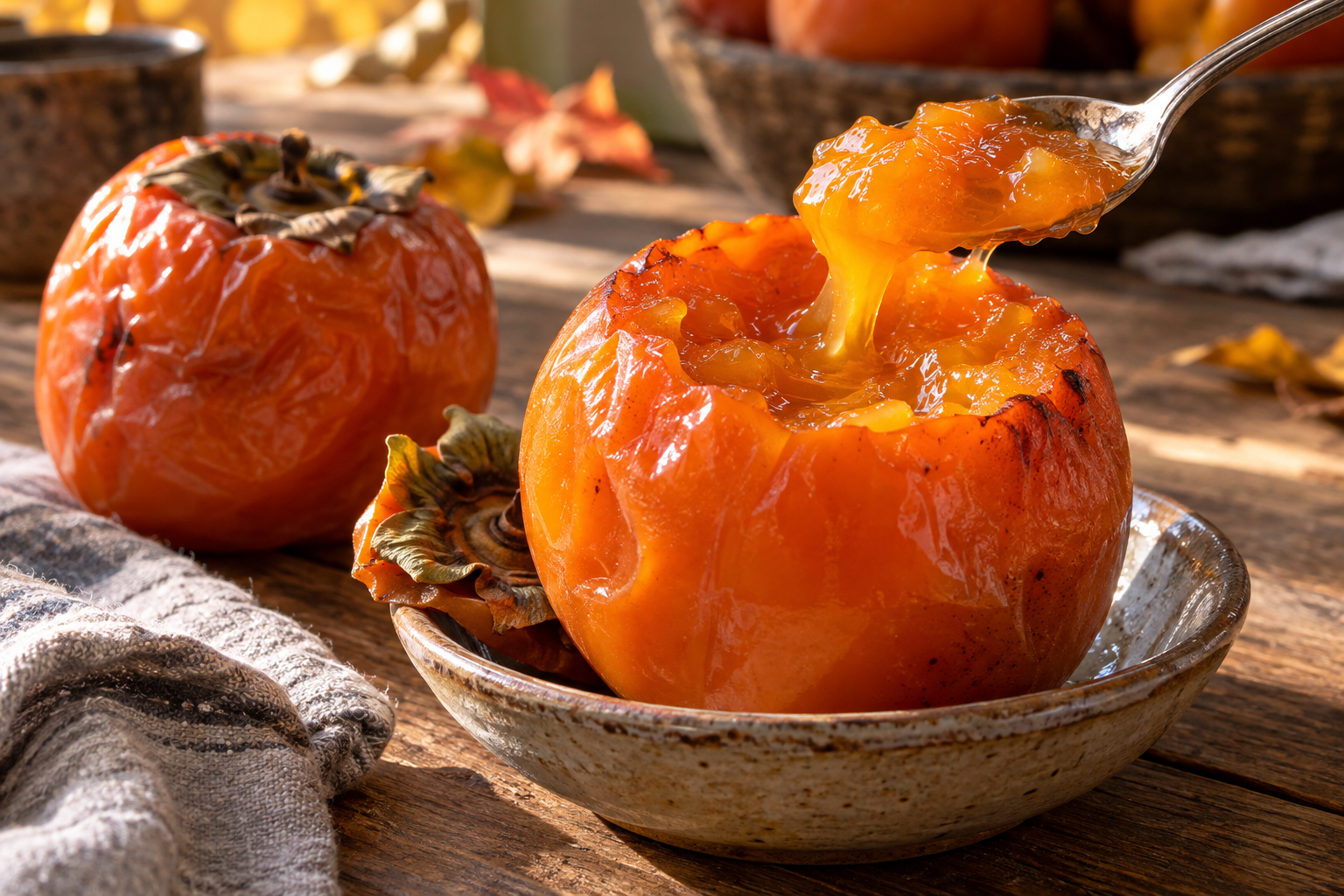
The key to it all is that the caquis in the market are really being sold in two different states, which must be treated as two different fruits even when they are, confusingly, sometimes the very same variety underneath. The first is the traditional, soft caqui: a persimmon that has been left to ripen fully until its flesh turns soft, almost liquid, like a jelly or a custard inside its skin. In this fully ripe state, the astringent tannins have naturally broken down and mellowed away, leaving the fruit intensely sweet and smooth, meant to be scooped out with a spoon. At its peak it barely holds together, a taut skin around a pocket of sweet orange pulp, and it looks, to the untrained eye, alarmingly overripe at exactly the moment it is perfect.
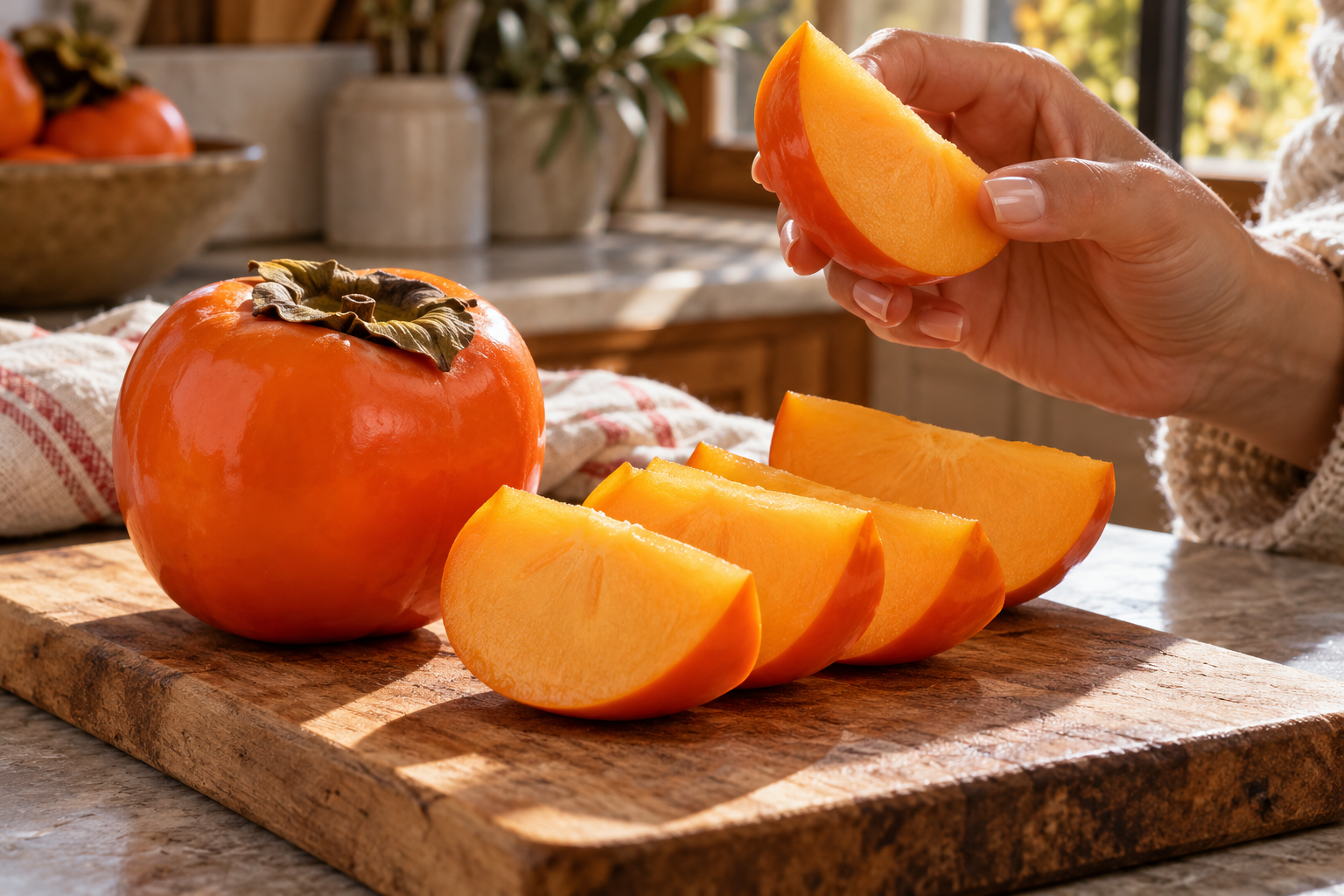
The second is the firm caqui, sold as Persimon, eaten hard and crisp like an apple, with no waiting required. This kind has had its astringency removed by a post-harvest treatment, so that the fruit stays firm and sliceable while losing the pucker, giving you a crunchy, sweet fruit you can bite straight into. The confusion, and it is a real one even for Spaniards, is that these two things can look very similar on the shelf, both glossy and orange, yet demand to be eaten in completely opposite ways: one soft and spooned, the other firm and bitten. Buy the soft kind and try to eat it firm, or the firm kind and leave it to rot waiting for a softness that has already been dealt with, and you get it wrong. Knowing that the two states exist, and that appearance alone will not always tell them apart, is the beginning of caqui wisdom. The glossy orange skin is the same on both; it is the give of the flesh under your thumb, and the label on the box, that tell you what you are really holding.
The One Rule
All of this resolves into a single, simple rule that, once you have it, takes the fear out of the fruit entirely: match how you eat it to how firm it is, and if in doubt, wait for soft. In practice this means two things. If your caqui is firm, hard to the touch like an apple, then either it is the treated Persimon kind meant to be eaten firm, in which case slice it and enjoy it crisp, or it is an untreated astringent kind that is not ready, in which case eating it firm will punish you. Since you cannot always be sure which, the safe move with any firm caqui you are unsure about is to check whether it is labeled as a firm-eating type, and if it is not, to let it ripen until soft before eating. A moment spent reading the label or asking the greengrocer saves you the far worse moment of a mouthful of tannin at the kitchen counter.
If your caqui is soft, yielding to a gentle press, then it is ripe and ready whatever kind it is, and you eat it soft, with a spoon, as a sweet jelly-like treat. That is the whole rule: firm caqui only if you know it is a firm-eating variety, otherwise wait until it is soft, and soft caqui is always safe to eat. Commit that one sentence to memory and you have solved the caqui for good, in any market, in any country, for the rest of your life. Follow it and you will never again get the astringent ambush, because the tannins that cause it are only a problem in a firm, untreated, unripe fruit, and the rule steers you away from exactly that. Every horror story you have ever heard about persimmons traces back to that one combination, firm and untreated and eaten too soon, and the rule exists precisely to keep you from repeating it.
When genuinely unsure, patience is your friend: leave the caqui on the counter for a few days until it softens right down, and a fruit that would have puckered your mouth becomes a spoonful of sweetness. Ripeness, for the astringent kind, is not optional but the entire point. Rushing it is the one mistake that turns people off persimmons for life, and patience is the one habit that keeps them coming back.
Spain’s Bright Red Star
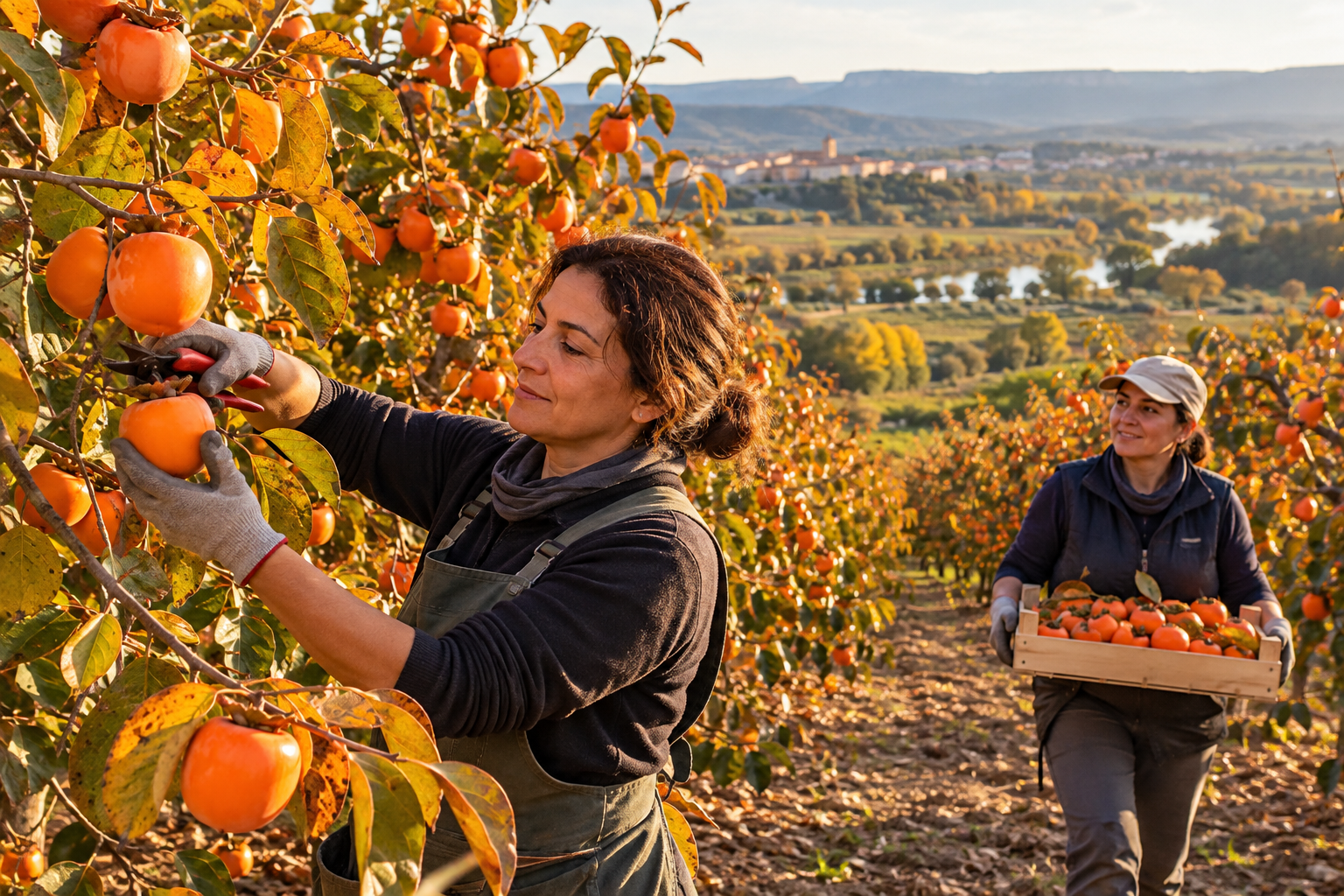
Behind the everyday confusion sits a genuine Spanish success story worth knowing, because Spain has become one of the world’s great persimmon producers on the strength of one particular variety. That variety is the Rojo Brillante, meaning bright red, though the fruit is actually a deep orange, which arose by a natural mutation in the Valencia region in the mid-twentieth century and turned out to be exceptional: large, handsome, sweet, and reliably seedless. It is grown above all in the Ribera del Xuquer area of Valencia, has its own protected designation of origin, and has made Spain a major exporter of persimmons across Europe. What was, a lifetime ago, a minor local fruit is now a serious agricultural industry, with the bright-orange caqui a familiar autumn sight far from the Valencian groves where it grows.
The clever twist, and the source of much of the two-kinds confusion, is that the Rojo Brillante is naturally astringent, yet sold both ways. Left to ripen fully, it becomes the soft, spoonable, traditional caqui. But growers also discovered they could treat the fruit with carbon dioxide to strip out the astringency while leaving the flesh firm, and sell that as the crisp, apple-like Persimon, the branded, premium, eat-it-firm version that has conquered supermarket shelves. So the same Valencian fruit reaches you as either a soft spoon-fruit or a firm slice-fruit depending on how it was handled after picking, which is precisely why you cannot always judge by variety name alone and must go by firmness. It is a genuinely ingenious bit of food science, taking a fruit that was traditionally only edible when squishy-ripe and making a whole second, convenient product out of it, and it is a large part of why persimmons have become so much more common on tables far beyond Spain. A soft, jelly-ripe fruit that bruises if you look at it does not travel or sell well; a firm one you can stack, ship, and bite into does, and that single innovation turned a fragile local delicacy into a global supermarket staple.
The Same Split, Worldwide

It is worth knowing that this two-kinds business is not peculiar to Spain, because once you understand it you can navigate persimmons anywhere in the world, under whatever name they go by. The same fundamental division, between astringent varieties that must be eaten soft and non-astringent ones that can be eaten firm, runs right through the global persimmon family. In the Japanese tradition, which shaped how much of the world grows and eats them, the astringent Hachiya type is the one you must wait to soften into sweetness, while the squat, non-astringent Fuyu is bred to be eaten firm and crisp straight away, the two sitting side by side in Asian markets exactly as the soft and firm caquis do in Spanish ones.
You will meet the same fruit under other names too. The Sharon fruit, originally from Israel, is a persimmon that has had its astringency removed so it can be eaten firm, essentially the same idea as the Spanish Persimon, and it turns up in supermarkets across Europe and beyond. The lesson in all of this is that the specific name matters less than the principle, which is universal: every persimmon is either a soft-when-ripe astringent kind or an eat-it-firm non-astringent kind, and your one job as the eater is to work out which is in front of you. Learn that once, with the Spanish caqui, and you have learned it for the Japanese Fuyu, the Israeli Sharon fruit, and every other persimmon you will ever pick up, anywhere.
How to Actually Eat Each One
With the rule understood, the pleasure of the caqui opens up, and each kind has its own lovely way of being eaten. The soft, ripe caqui is best treated almost like a dessert in its own skin: cut off the top and scoop out the jelly-like flesh with a teaspoon, discarding the skin, the way you might eat a very ripe, very sweet pudding. It is rich and honeyed and a little exotic, wonderful on its own, and lovely spooned over yogurt or ice cream or alongside cheese, and it is at its best when it looks almost too ripe to bother with, wrinkled and soft and giving. Learning to trust that near-collapse, to reach for the ugliest, softest fruit in the bowl rather than the firm handsome one, is the last step in making peace with the caqui.
The firm Persimon kind is handled completely differently, exactly like an apple: you can bite straight into it, skin and all, or peel and slice it into wedges or cubes.
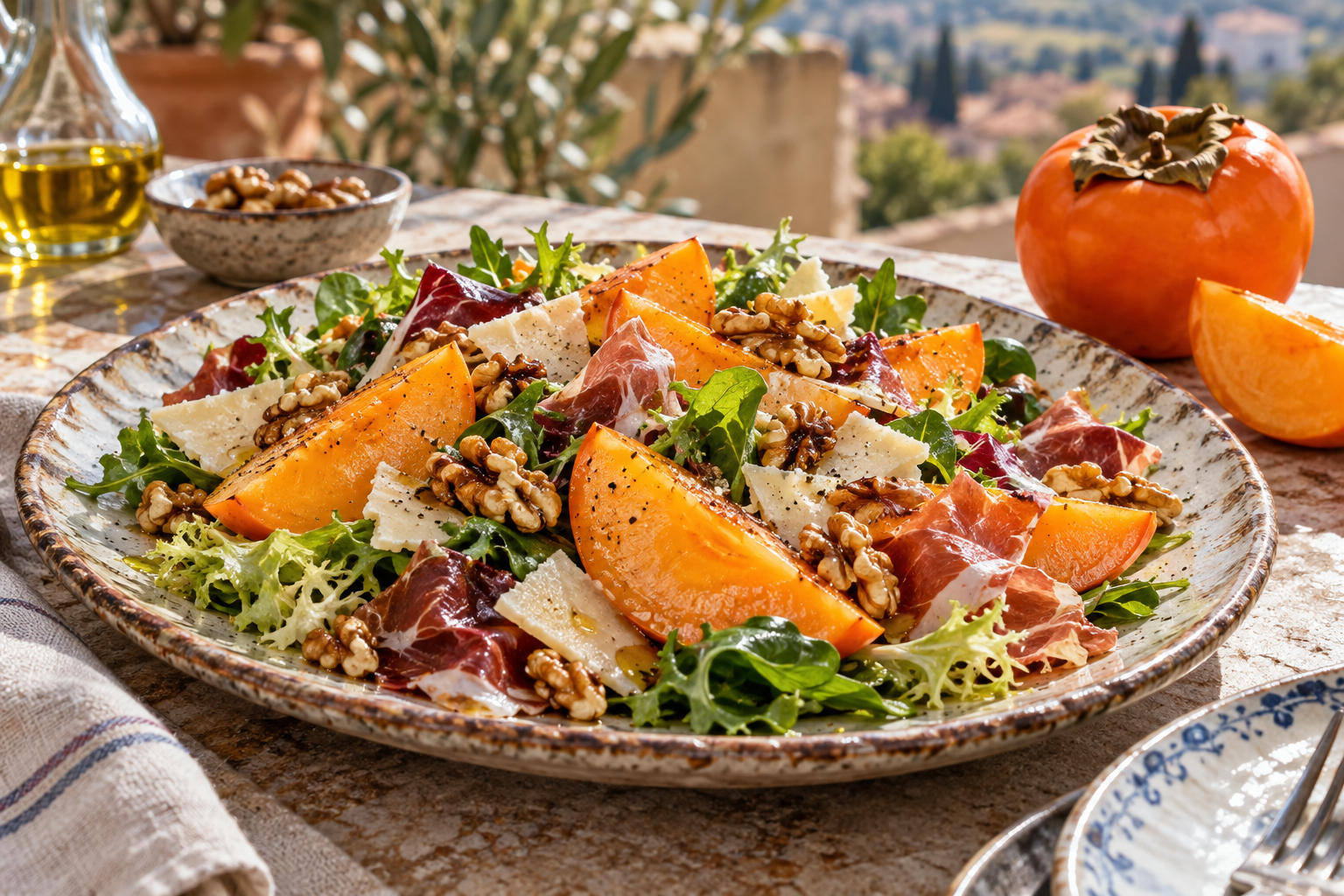
Because it holds its shape, the firm kind is the one to use in salads, where it pairs beautifully with things like cured ham, cheese, nuts, and bitter leaves, adding sweetness and crunch, and it travels and keeps far better than the fragile soft kind. It is the one to slip into a lunchbox or a picnic, where a soft caqui would simply become a sticky orange disaster. Both are in season through the autumn and into December, so this is very much a fruit of the cooler months, and both are worth seeking out once you know which is which. They arrive just as the summer fruit is fading, a burst of intense sweetness and vivid color exactly when the markets might otherwise turn dull, which is part of why Spain looks forward to caqui season at all.
Master the simple firmness rule, learn to scoop the soft ones and slice the firm ones, and the caqui stops being the fruit that ambushed you once and becomes one of the real seasonal treats of a Spanish autumn, glowing orange in the markets and, at last, entirely on your side. Few fruits reward a little knowledge so generously, turning from a one-time betrayal into an annual pleasure the moment you understand the single trick behind them.
A Recipe to Try: Persimmon and Serrano Ham Salad
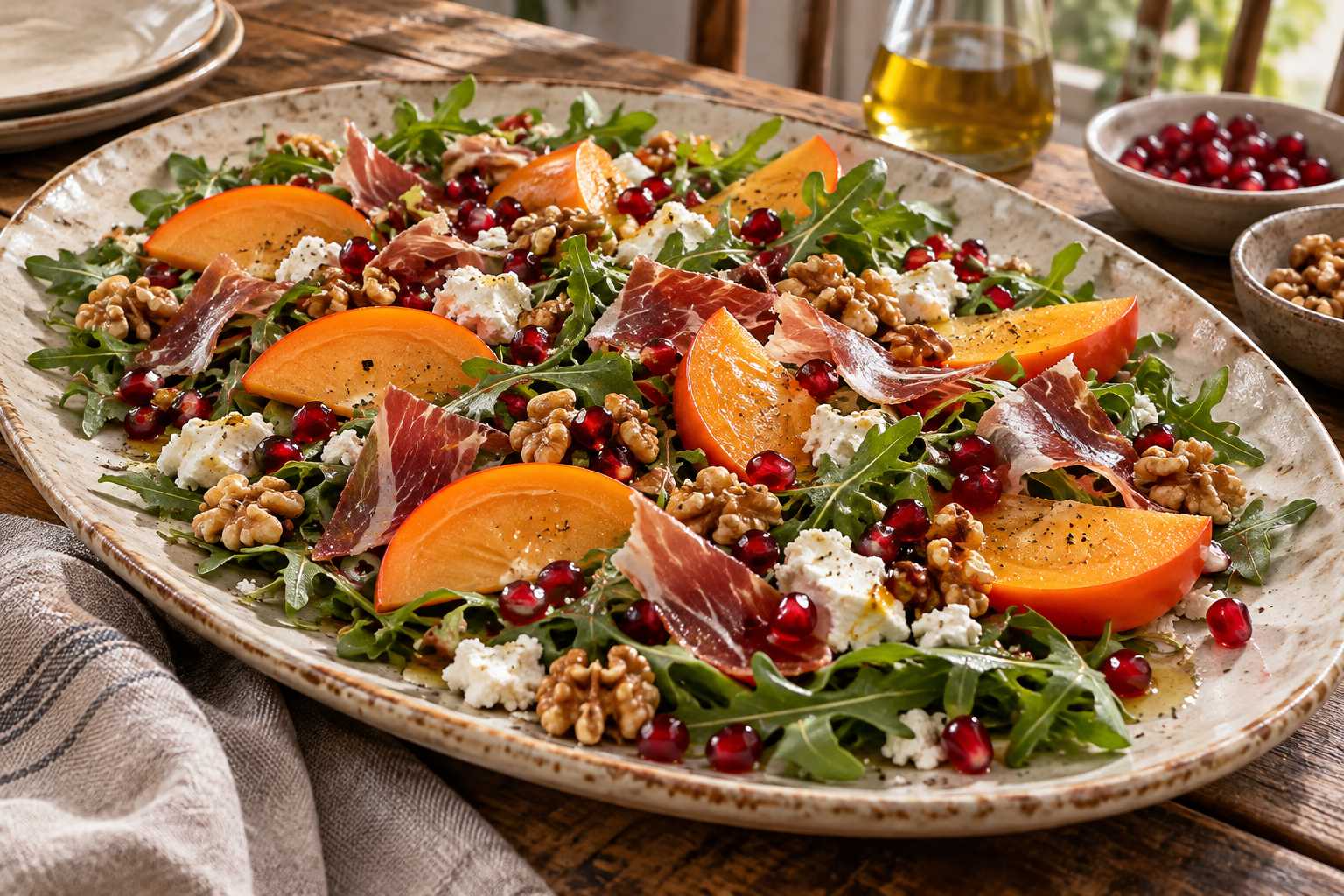
This is where the firm caqui earns its keep. A ripe, jelly-soft persimmon would collapse the moment you tried to toss it, but the crisp Persimon kind slices into neat wedges that hold their shape and bring a honeyed sweetness against the salt of the ham and the bite of the leaves. It is about as easy as a recipe gets, needs no cooking, and tastes like a Spanish autumn on a plate.
Serves 4 as a starter. Ready in about 15 minutes.
For the salad:
- 2 firm Persimon persimmons (the crisp kind, not the soft jelly kind)
- 100 g (about 3.5 oz) serrano ham or jamon iberico, torn into pieces
- 80 g (a few large handfuls) rocket, arugula, or mixed bitter leaves
- 80 g (about 3 oz) soft goat cheese, crumbled, or manchego shaved into thin slivers
- 50 g (about half a cup) walnuts or Marcona almonds
- Seeds of half a pomegranate, optional but lovely in autumn
For the dressing:
- 3 tablespoons extra virgin olive oil
- 1 tablespoon sherry vinegar
- 1 teaspoon honey
- Salt and black pepper
Instructions
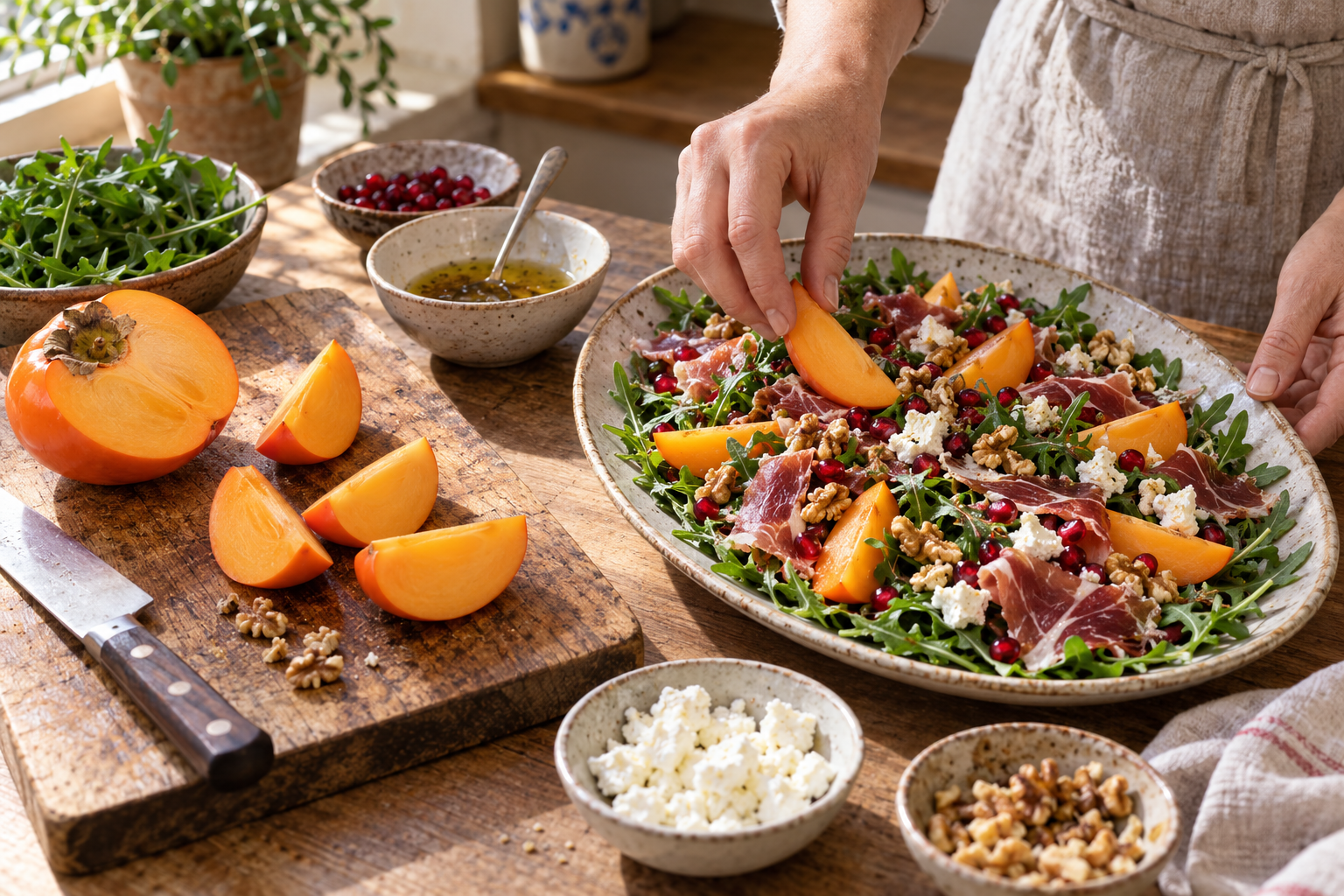
- First, make sure your persimmons are the firm, crisp kind, since this salad needs fruit that holds its shape rather than the soft kind you would eat with a spoon. Slice them into thin wedges, and there is no need to peel them if the skin is thin and clean.
- Toast the walnuts or almonds in a dry pan over medium heat for a couple of minutes until fragrant, then tip them out and chop them roughly.
- Whisk the olive oil, sherry vinegar, honey, and a little salt and pepper together into a light dressing, tasting and adjusting until the sweet and sharp are balanced.
- Spread the leaves over a platter, then scatter over the persimmon wedges and the torn ham, tucking them among the greens rather than piling them up.
- Add the cheese, the toasted nuts, and the pomegranate seeds if you are using them.
- Drizzle the dressing over everything just before serving, finish with a little flaky salt and a grind of black pepper, and bring it to the table straight away, while the leaves are still crisp.
And this is the whole argument of the persimmon in one plate: reach for the firm Persimon here, never the soft kind, because the point of the dish is those clean, sweet, apple-crisp wedges holding their own against the ham, and a jelly-ripe caqui, wonderful as it is with a spoon, would simply melt into the dressing and disappear.

About the Author: Ruben, co-founder of Gamintraveler.com since 2014, is a seasoned traveler from Spain who has explored over 100 countries since 2009. Known for his extensive travel adventures across South America, Europe, the US, Australia, New Zealand, Asia, and Africa, Ruben combines his passion for adventurous yet sustainable living with his love for cycling, highlighted by his remarkable 5-month bicycle journey from Spain to Norway. He currently resides in Spain, where he continues sharing his travel experiences with his partner, Rachel, and their son, Han.