
It might be the oldest piece of diet advice there is, the one your grandmother probably gave you and every weight-loss program has repeated for decades: drink a big glass of water before you eat, and you will fill up and eat less. It costs absolutely nothing, it could not possibly be simpler, and it sounds almost too easy to be true. So for thirty days I actually did it, drinking a full glass, about two cups, roughly half an hour before every single meal, and paid honest attention to what happened. The truth turned out to be more interesting than either the breathless claims or the cynical dismissals, a real effect that is also a modest one, and one that depends a great deal on who you are. This is one person’s month and not medical advice, but the honest version of this old trick is worth telling. So much health writing pushes you to either believe everything or dismiss everything, when the truth of most simple habits sits quietly in between.
What follows is where the advice comes from, what the research genuinely shows, why it works for some people and barely at all for others, what my own month felt like, the bigger water win almost nobody mentions, and the honest verdict.
The Oldest Trick in the Book

The idea behind pre-meal water is beautifully simple and very old. Your stomach has a rough sense of how full it is, the logic goes, so if you put something in it before the food arrives, you will feel satisfied sooner and eat a little less without any willpower or deprivation involved. Water is the obvious candidate, since it has volume but no calories at all, filling space in the stomach while adding nothing to the meal. It is the kind of folk wisdom that has been passed around kitchens and diet books for generations precisely because it is so cheap, so harmless, and so easy to try. Every era of dieting, however faddish, seems to circle back to it, which is usually a sign that a piece of advice has at least something real at its core rather than being pure invention.
What makes it appealing, and what made me want to test it, is that it asks nothing difficult of you. There is no food to give up, no calories to count, no plan to follow, just a glass of water before you sit down, which is about the lowest-effort health habit imaginable. Advice this old and this widespread usually has at least a grain of truth in it, but it also tends to get exaggerated with every retelling until a modest, sensible tip becomes a miracle cure. That is the pattern with almost all folk health advice, a small real effect inflated over the years into a promise it was never able to keep, and the interesting work is always in finding the original, honest size of the thing. I wanted to know where on that spectrum the real effect actually sits, so I went looking at what the studies say and then tried it on myself.
It is the kind of claim that is genuinely easy to test, since the intervention is free and harmless and the timescale is short, which is exactly why it made such a good thing to try honestly for a month.
What the Research Actually Shows

Here is the encouraging part: unlike a lot of folk diet advice, this one genuinely has real research behind it. The most-cited study, a twelve-week trial from Virginia Tech, took a group of older overweight adults, had some of them drink about two cups of water half an hour before each main meal, and found that those who did ate meaningfully less and lost somewhat more weight over the three months than those who did not. A separate British trial found something similar, with the water-before-meals group losing a little more than the group that did not. Two independent studies pointing the same way is more than most diet tips can claim, and it is why this one deserves to be taken seriously even as we keep its effect in proportion. These are real, controlled studies with a clean, simple protocol, not just kitchen lore.
That alone sets pre-meal water apart from most of the diet folklore floating around, the vast majority of which has never been tested at all and simply gets repeated until it sounds true.
But the honest reading of that research also deflates the hype, because the effect, while real, is modest. In those studies the water drinkers ate on the order of seventy or so fewer calories at each meal, a genuine reduction but a small one, and the extra weight loss over three months was measured in a pound or two, not a transformation.
Just as importantly, the mechanism turns out to be entirely mundane. There is no metabolic magic here, no meaningful calorie-burning from your body heating the water, an idea that sounder recent studies have largely dismissed. It is simply that half a litre of water takes up real space in your stomach and nudges the fullness signals a little earlier. Those same stretch receptors in the stomach wall are what a meal itself triggers, so the water is borrowing a real biological signal rather than tricking the body with anything artificial. The catch is that water leaves the stomach far faster than food, which is why the timing and the person matter so much. Real, useful, and small is the honest summary, which is a far cry from the miracle the internet sometimes promises.
Understanding that in advance is what keeps you from being disappointed, since a trick that quietly helps a little is worth doing, while a trick you expected to change everything only sets you up to quit in frustration.
Why It Works for Some and Not Others

The most important thing the research revealed, and the thing that best explains why people argue about whether this trick works at all, is that it depends enormously on who you are. The clearest finding across the studies is an age effect. The pre-meal water made a real difference for middle-aged and older adults, but had little to no measurable effect on how much younger adults ate. If you are in your twenties or thirties, in other words, this trick may do almost nothing for your appetite, while for someone older it may genuinely take the edge off. That is worth knowing before you judge it, because a young person who tries it, feels nothing, and declares it useless is not wrong about their own experience, only about everyone else’s.
The reason is a small piece of plumbing. As we age, the stomach tends to empty more slowly, so a preload of water lingers longer and keeps signaling fullness through more of the meal, whereas in a young person the water drains away quickly and the effect is gone before it matters. This single fact resolves most of the contradiction you see online, where one person swears by the trick and another insists it does nothing, because both may be right for their own body. It also means that whether it works for you is genuinely individual, not a matter of doing it correctly, and that the only way to know your own response is to try it honestly and pay attention, which is exactly what I set out to do.
Averages from a study tell you what happened to a group; they cannot tell you what will happen to you, which is the quiet limitation of every piece of health advice ever given.
What the 30 Days Felt Like

In practice, the habit was as easy as it sounds, and that ease was the best thing about it. Remembering the glass of water took a few days to become automatic, but once it did it required no effort or discipline at all, which is more than can be said for almost any other change to how you eat. I kept a filled glass by the tap as a simple reminder, and within a week reaching for it before sitting down had become as automatic as washing my hands. There was nothing to resist and nothing to give up, just a small, pleasant ritual before each meal, and that alone makes it a habit worth having regardless of any effect on appetite.
There is even something faintly calming about the pause it creates, a small moment of settling before you eat rather than falling on the food the instant it arrives, which may do as much good in its own quiet way as anything the water itself accomplishes. That is genuinely rare among things filed under diet advice, almost all of which run on denial and discipline, the two forces most likely to make a habit collapse within a week. A change you barely notice making is a change you might actually keep.
As for the effect itself, it was gentle but real. I did notice, particularly before dinner, that arriving at the table with a stomach already holding a glass of water took a little of the ravenous edge off, and I tended to slow down slightly and feel content a touch sooner. It was never dramatic, and on plenty of days I could not honestly say it changed how much I ate at all. Some meals I sat down hungry and ate exactly as I would have anyway, water or no water, and pretending otherwise would be the kind of wishful reporting that makes so much of this advice untrustworthy in the first place.
The most useful thing I noticed had nothing to do with weight: more than once, reaching for water before a meal made me realize I had been mildly thirsty rather than truly hungry, a confusion that is apparently common, and simply being better hydrated across the day left me feeling a bit steadier and clearer. The appetite effect was subtle and came and went; the hydration was the part I could feel every day. By the end of the month I had stopped thinking of it as a diet trick at all and started thinking of it simply as a decent way to make sure I drank enough water, which is something a great many of us quietly fail to do.
The Real Win Nobody Mentions
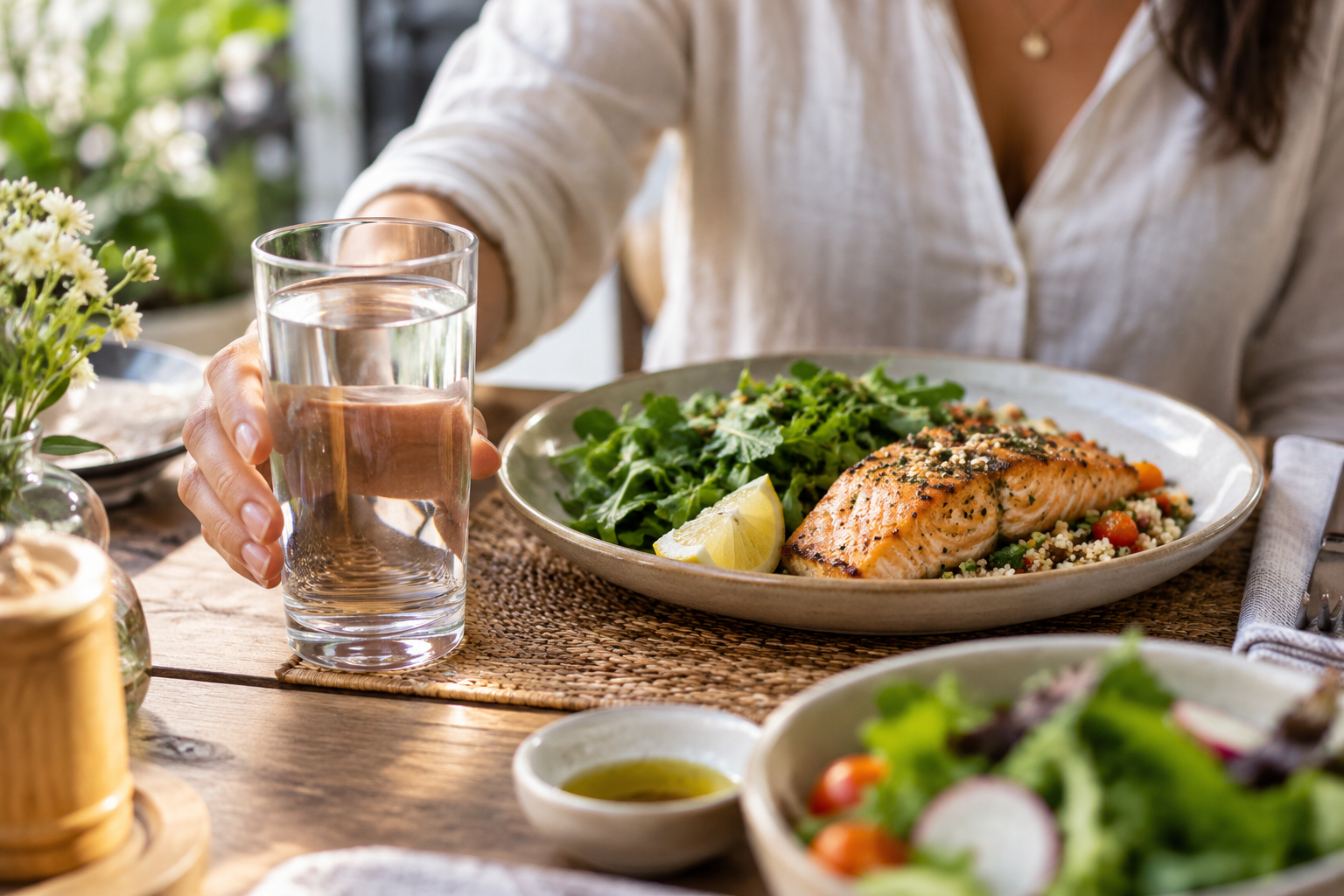
Buried in all the research about pre-meal water is a related finding that is actually far more powerful than the trick itself, and it deserves more attention than it gets. The clearest, largest benefit of drinking more water is not what it does before a meal but what it replaces the rest of the time. When plain water takes the place of sugary drinks, sodas, juices, sweetened coffees, the effect on what you consume is much bigger and much more reliable than any subtle appetite nudge, because those liquid calories are substantial and, crucially, they barely register as fullness at all.
This is the quiet, genuinely useful lesson hiding inside the old advice. You can drink several hundred calories of sweetened beverages in a day and feel no more full for it, whereas swapping them for water removes those calories entirely while leaving your hunger for actual food untouched. The body, for whatever evolutionary reason, simply does not account for drunk calories the way it accounts for eaten ones, which is why liquid sugar is such an easy and invisible thing to overdo. If the goal is to eat and drink a little more sensibly without misery, replacing sweet drinks with water is a far surer bet than timing a glass before meals, and it happens to keep you better hydrated too.
It is also, unlike so much dietary advice, a change that adds rather than subtracts, since you are not being told to go without but simply to reach for a different glass. That framing, doing more of a good thing rather than less of a bad one, tends to stick far better than any rule built on restriction. The pre-meal ritual is a pleasant, modest bonus; the beverage swap is the real prize, and I finished the month more convinced of the second than the first.
The Honest Verdict

So, after thirty days, is the oldest diet trick worth doing? My honest answer is a gentle yes, with the emphasis firmly on gentle. Drinking a glass of water before meals is free, effortless, entirely harmless, and backed by real if modest evidence, and it kept me better hydrated as a happy side effect, so there is very little reason not to do it and a few small reasons to bother. Just do not expect it to transform anything on its own, because it will not, and anyone selling it as a weight-loss miracle is stretching a small, sensible effect well past what it can bear. The honest and the exaggerated versions of this tip lead to very different places, one to a quiet, kept habit and the other to disappointment.
The truest thing I can say is that this is a minor helpful habit rather than a solution to anything, most useful for older adults, most powerful when it nudges you toward water over sugary drinks, and best understood as one small piece of eating and drinking a little more thoughtfully. I have kept the habit, not because it changed my body in any dramatic way over a month, but because it is easy and pleasant and leaves me better hydrated, which is reason enough. Not every habit has to earn its place with dramatic results; some are worth keeping simply because they cost nothing and do a small, quiet good, and this is one of those. As always, this is just one person’s experiment and not medical or dietary advice, and anyone with real concerns about their eating, their weight, or their health should talk with a doctor or a dietitian who can give guidance suited to them rather than take a cue from a blog and a glass of water.

About the Author: Ruben, co-founder of Gamintraveler.com since 2014, is a seasoned traveler from Spain who has explored over 100 countries since 2009. Known for his extensive travel adventures across South America, Europe, the US, Australia, New Zealand, Asia, and Africa, Ruben combines his passion for adventurous yet sustainable living with his love for cycling, highlighted by his remarkable 5-month bicycle journey from Spain to Norway. He currently resides in Spain, where he continues sharing his travel experiences with his partner, Rachel, and their son, Han.