
When she landed in Lisbon two years ago, newly divorced, fifty-three years old, with $48,000 to her name and no clear plan beyond a conviction that she could not stay where she was, almost everyone in her life asked her the same thing. Not how would she manage the language, or the visa, or the loneliness, though those questions came too. The question they all circled back to, the one that seemed to trouble them most, was some version of: aren’t you afraid? Afraid of running out of money, of being alone, of having made an irreversible mistake at an age when you are supposed to be settling down rather than blowing your life up.
A year in, she had answers that were mostly hopeful but still tentative. Now, two years on, her answer to that question has hardened into something clearer and more settled, and it is worth hearing, because it upends the assumption the question was built on. Her story here is a composite, drawn from the many women who have made a bold solo move at midlife, but the shape of it is true, and so is the question.
What follows is the leap she took, what forty-eight thousand dollars actually stretches to in Lisbon, how year two differed from year one, and the answer she finally settled on to the question everyone asked.
The Leap She Took

The decision, from the outside, looked reckless, and she knew it. A woman in her early fifties, freshly divorced, with a modest divorce settlement of $48,000 and not a fortune behind it, choosing to leave her country, her language, and everything familiar for a city she had visited exactly once. To the people around her, it read less like a plan than a flight, the kind of thing you do in a crisis and regret at leisure. Friends and family meant well, but their concern carried an unspoken judgment, that a sensible woman her age ought to be battening down rather than setting sail, ought to be minimizing risk rather than choosing it. But she had done more thinking than they credited, because the life she was leaving was not one she wanted to preserve, and the math of staying, of trying to rebuild a whole separate American life on that same modest sum, was in its own way far more frightening than leaving.
That is the part the worried questions missed. Lisbon was not an escape from a good situation but a bet that a smaller amount of money could buy a far larger life somewhere cheaper and gentler than the expensive country she was leaving. Forty-eight thousand dollars is not much to start a new life on in America, barely a cushion, but in a city where the cost of living runs a fraction of an American metro’s, it could be something else entirely: not a retirement fund, since she was far too young and too broke to retire, but a bridge, a runway long enough to land a new life on. The number that felt like poverty in one country felt like possibility in another, and recognizing that was the whole insight her worried friends had missed. The move was not a rejection of planning but a different, braver plan. Where her friends saw a woman running away, she saw a woman running the only sensible calculation available to her, which was that the same modest sum would buy a cramped, anxious existence in America or a spacious, hopeful one abroad.
What Forty-Eight Thousand Buys in Lisbon

To see why the bet was not as mad as it looked, you have to look at the numbers, because Lisbon, for all that it has grown pricier, remains dramatically cheaper than the American life she left. A small studio or one-bedroom in a decent Lisbon neighborhood rents for something like €700 to €950 a month, roughly seven hundred and fifty to a thousand dollars, with the trendier central districts sitting at the top of that range and the outer neighborhoods a good deal kinder on the budget. Utilities add perhaps €100 to €180, groceries for one run around €200 to €280, and eating out stays genuinely affordable, a simple restaurant meal often just €11 to €14. None of these numbers is exotic or hard to verify, which was part of the reassurance; she had run them all before she left, and they held up once she arrived.
Run the arithmetic and a careful single person can live in Lisbon on somewhere between €1,300 and €1,800 a month, well under what the same modest life would cost in most of the United States. Live a little further from the center, cook at home more, and the lower end is realistic; want the fashionable neighborhoods and frequent dinners out, and you drift toward the top, but either way it is a fraction of an American city. That still meant her forty-eight thousand would not last forever on its own, not close, so the money was never meant to be the whole answer. It was runway, a cushion of a year or two while she found her feet and, crucially, found ways to keep earning, and understood correctly as a bridge rather than a nest egg, it was enough to make the leap survivable in a way it never could have been at home. The same forty-eight thousand that looked like almost nothing in an American context looked, in a Lisbon one, like time, and time was exactly what she needed to build the rest.
How She Made the Money Work
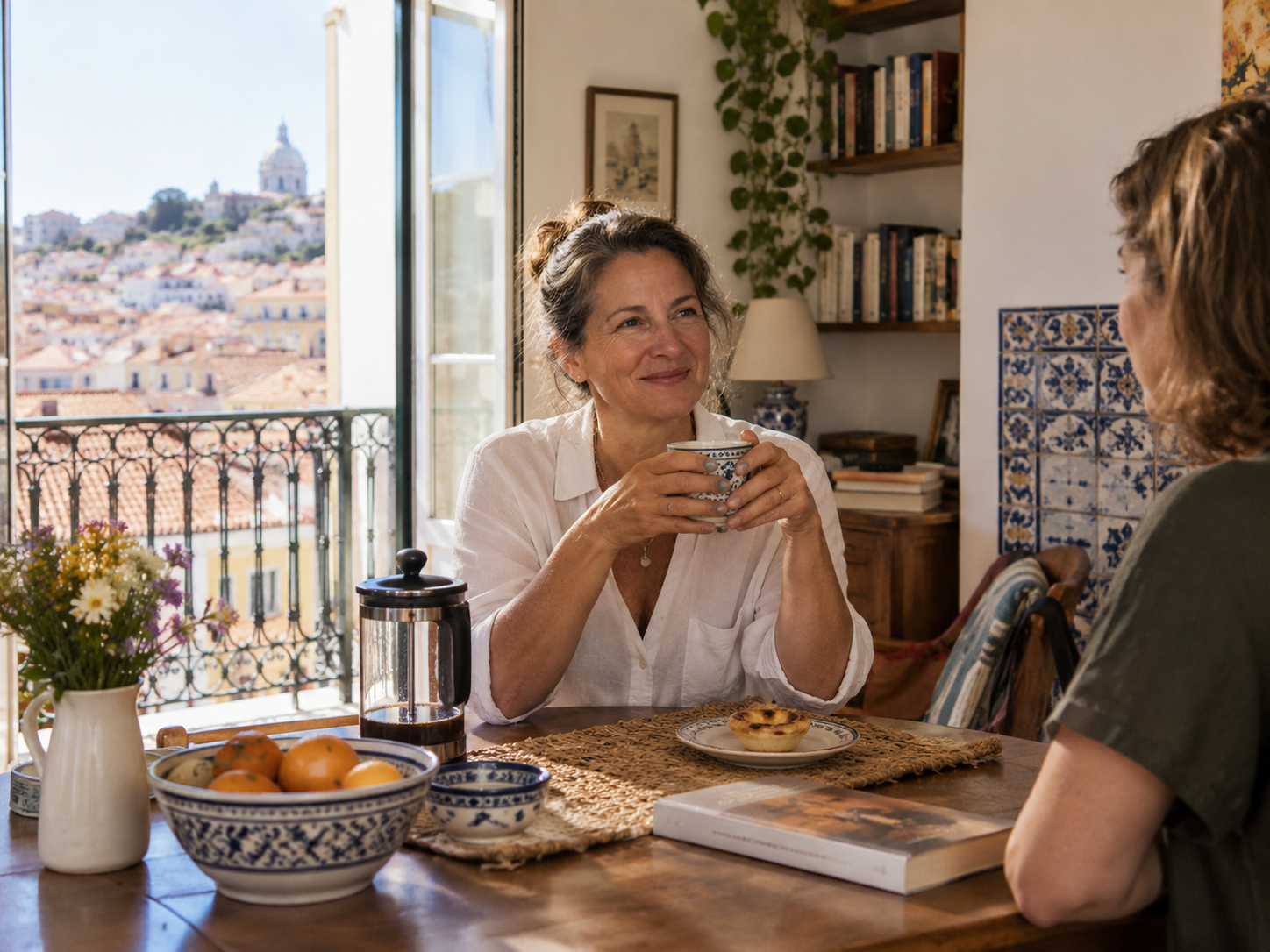
The forty-eight thousand alone would have run out, and she knew it, so year one was as much about building an income as about spending down savings. Like many who make this move at her age, she leaned on remote and freelance work that could be done from anywhere with good wifi, the kind of location-independent earning that has made midlife moves like hers possible in a way they simply were not a generation ago. She did not need a Lisbon salary, only enough dollars trickling in from abroad to slow the drain on her savings, and in a low-cost city even a modest freelance income goes a remarkably long way. What would have been part-time pocket money in her old life became, in Lisbon, something close to a living, and that arithmetic was the hinge the whole plan turned on.
This is the piece the frightened onlookers never factored in, because they pictured her simply spending down a finite pot until it hit zero. In reality the low cost of living did something more powerful than stretch her savings, it lowered the bar for what counted as enough income, so that work which would have left her scraping in an expensive American city was comfortably sufficient in Lisbon. The city did not just make her money last longer, it made a modest income feel like a decent one, which changed the whole calculation from a countdown to something closer to sustainable. This is the quiet magic of moving to a lower-cost country with income from a higher-cost one, that the same dollars simply do more, and a life that would be a struggle in one place becomes comfortable in another.
How Year Two Was Different

If year one was frightening and exhilarating in equal measure, year two was quieter, and the quiet turned out to be the point. The first year is all adrenaline and paperwork, the visa, the apartment, the bank account, the language app, the constant low thrum of everything being new and uncertain, and she spent much of it not quite believing she had done it. Year two was when it stopped being an adventure she was having and started being simply her life, the newness wearing off into routine, the routine settling into something that felt, unmistakably, like home. There is a particular milestone in any move abroad when you stop narrating it to yourself as a big brave thing you are doing and simply start living it, and for her that shift arrived somewhere in the second year.
The practical anxieties eased too. By the second year she had a rhythm to her freelance work, a real if small circle of friends, a neighborhood that knew her, a doctor, a favorite cafe, the thousand small anchors that turn a place you have moved to into a place you live. The money, which had felt terrifyingly finite in year one, felt steadier once she could see that her income and her low costs roughly held the line, that the savings were being sipped rather than gulped. The fear did not vanish, but it shrank from a roar to a background hum, and in its place grew something she had not expected to find at fifty-four, which was a settled, quiet contentment. She had braced for survival and found, to her surprise, something closer to flourishing, which is not at all the story the frightened questions had predicted for her.
The Loneliness Question, Honestly
Of all the fears the worried onlookers raised, the one that deserved the most respect was loneliness, because a solo move at midlife to a country where you know no one and barely speak the language is a genuine test of a person’s capacity to build a life from scratch. She will not pretend the first months were not lonely, because they were, with evenings that stretched long and quiet and moments when the sheer aloneness of what she had done pressed in hard. Anyone considering a move like hers should go in expecting this rather than blindsided by it, since the loneliness is real and it is the part the sunny relocation stories most often gloss over.
But loneliness, she found, is not a fixed condition so much as a stage, one you pass through if you do the deliberate, sometimes awkward work of building a community. She made herself say yes to invitations, joined a language class as much for the company as the Portuguese, became a regular somewhere so that faces grew familiar, and slowly, unglamorously, assembled the kind of small human network that makes anywhere feel like home. None of it happened by accident, and none of it happened fast, but each small effort compounded, a coffee here, a dinner there, until one day she realized she had people, and a place among them. By year two the acute loneliness of the early months had largely lifted, replaced by a modest but real circle of friends and acquaintances, and she had learned something worth knowing, that the solitude of such a move is not a life sentence but a passage, hard at first and then, with effort, outgrown. She would tell anyone considering the same leap to expect the lonely months and to plan for them actively, treating friendship as something to be built rather than waited for.
The Answer She Settled On

So, to the question everyone asked, the aren’t-you-afraid that trailed her across an ocean: her year-two answer is that yes, she had been afraid, and that the fear had been worth walking straight through. She does not pretend the move was without risk or that everything went smoothly, because the money is still finite, the work is not guaranteed, and a solo life in a foreign country carries real uncertainties she has simply chosen to live with. Honesty demands acknowledging that it could still go wrong, that a run of lost work or a health crisis or a visa complication could yet test everything, and she does not wave those possibilities away. What she pushes back on is the assumption buried inside the question, that the safe choice would have been to stay.
Because staying, she came to see, carried its own risks that no one thought to name, the risk of a life quietly shrinking, of spending her fifties preserving a diminished version of the old life rather than building a new one, of letting fear of the unknown lock her into a known unhappiness. That kind of risk is invisible precisely because it looks like safety, a slow settling for less that no one around you ever thinks to warn against.
The question everyone asked was always about the danger of leaving, and never about the danger of staying, and her whole answer, two years on, is that she weighed both and chose the braver one, and would do it again without hesitation. She had come to believe that the real gamble would have been to let fear make the decision for her, and to spend the second half of her life quietly wondering what the braver version of herself might have done. She is not rich, not settled in the way a pension and a paid-off house would settle a person, and the future is not guaranteed. But she is, by her own account, more alive and more herself than she has been in decades, living a full life in a beautiful city on a modest sum, and to the people still asking whether she was afraid, she has a simple reply: of course she was, and it was the best thing she ever did. The fear, it turned out, was not a reason to stay put but the toll on the bridge to a better life, paid once and then behind her. Two years on, standing in a city she now calls home, she finds the question that once frightened everyone almost quaint, a question from a version of her life she is very glad she left.

About the Author: Ruben, co-founder of Gamintraveler.com since 2014, is a seasoned traveler from Spain who has explored over 100 countries since 2009. Known for his extensive travel adventures across South America, Europe, the US, Australia, New Zealand, Asia, and Africa, Ruben combines his passion for adventurous yet sustainable living with his love for cycling, highlighted by his remarkable 5-month bicycle journey from Spain to Norway. He currently resides in Spain, where he continues sharing his travel experiences with his partner, Rachel, and their son, Han.