
They had done everything right. Two careers in Ohio classrooms, decades of showing up before the first bell, summers spent grading and planning, and at the end of it two teachers’ pensions that were supposed to carry them through a comfortable retirement. And yet, as they sat with their numbers in the town where they had raised their family, the arithmetic kept coming up short. Their pensions, respectable on paper, did not stretch to the retirement they had earned they had spent a lifetime earning. So they did something their neighbors and old colleagues found slightly mad, and to a few of them, even a little reckless. They took those same two pensions, the ones that felt inadequate in Ohio, and moved to a town in the province of Valencia, on Spain’s eastern coast, where the very same money bought the life they had almost given up on. This is the story of how two American teachers made a comfortable retirement out of what their home state had quietly told them was impossible. They are a representative composite drawn from the real experiences and real numbers of American teachers who have retired to Spain, not a specific couple, and their ledger shows how the same pension can mean two entirely different lives depending on where it is spent.
What makes their story worth telling is that it lays bare a truth many retirees discover too late, that the value of a fixed income depends enormously on the cost of the place where you spend it, and that a pension which feels like a dead end in one country can be a comfortable living in another. Their teachers’ pensions did not change. What changed was the price of a decent life around them, and that single difference turned scarcity into sufficiency. Looking clearly at both sides of their ledger, the Ohio squeeze and the Valencia ease, shows just how much geography can rewrite the math of retirement.
Here is the honest account of their two pensions, why the numbers felt impossible in Ohio, how the province of Valencia changed the equation, and what their move really cost and gained. This is an illustrative overview rather than financial advice, and I am not a financial advisor, so the figures are examples that vary and change over time, but their ledger may help anyone wondering whether a modest pension could stretch further somewhere else.
The Pension That Felt Like a Dead End

To understand why two hard-earned teachers’ pensions felt insufficient, it helps to see the particular squeeze that Ohio educators face, which is harsher than many people outside the profession realize. The problem was not laziness or bad planning but a structural bind.
There was no Social Security behind them. Ohio public school teachers do not pay into or collect Social Security, so unlike most American retirees they had no second federal check arriving each month, which meant their pensions were the whole of their retirement income, not one piece of it. That single fact left them with far less cushion than neighbors who had spent their careers in other lines of work. It is a quirk of the system that surprises many people, since most Americans assume Social Security is universal, but a number of states keep their public teachers outside it entirely. For a working teacher it can seem a distant technicality. For a retired one it is the whole difference between a pension that is a supplement and a pension that is everything, and it left this couple leaning on their STRS checks with nothing behind them.
Inflation quietly ate the rest. On top of this, the cost-of-living increases meant to keep their pensions rising with prices had been frozen for years, so as the cost of everything around them climbed, their fixed pensions bought a little less each year. A pension that does not grow while prices do is a pension slowly shrinking in all but name, and they felt it in every trip to the store.
When the Numbers Stopped Working

The result of all this was a retirement that looked fine on paper but felt precarious in practice, and it was this gap between the appearance and the reality that finally pushed them to think differently. Their comfortable-sounding pensions simply did not deliver comfort.
The fixed income met rising costs. Against the climb of American housing costs, property taxes, and above all pre-Medicare healthcare, their unchanging pensions were fighting a losing battle, so what should have been their easiest years felt tight and anxious. They were not poor, but they were squeezed, watching careful work fail to buy the security they expected. The cruelty of it was that they had done everything the responsible playbook asked, saving steadily and serving faithfully, only to find the reward thinner than promised.
Healthcare loomed over everything. Like many Americans retiring before sixty-five, they faced the daunting cost of health coverage in the gap years, large enough to reshape a whole budget, so a huge share of their pensions was spoken for before anything else. This single looming cost did more than any other to make their retirement feel impossible on the income they had. Every plan they sketched came back to the same problem, a health-coverage bill so large it swallowed the freedom their pensions were supposed to provide. They found themselves calculating not what they could enjoy but what they could afford to risk going without, which is no way to spend the years you have worked your whole life to reach. It was, more than any luxury they lacked, the thing that made a comfortable American retirement feel just out of their grasp.
The Ledger That Changed in Valencia

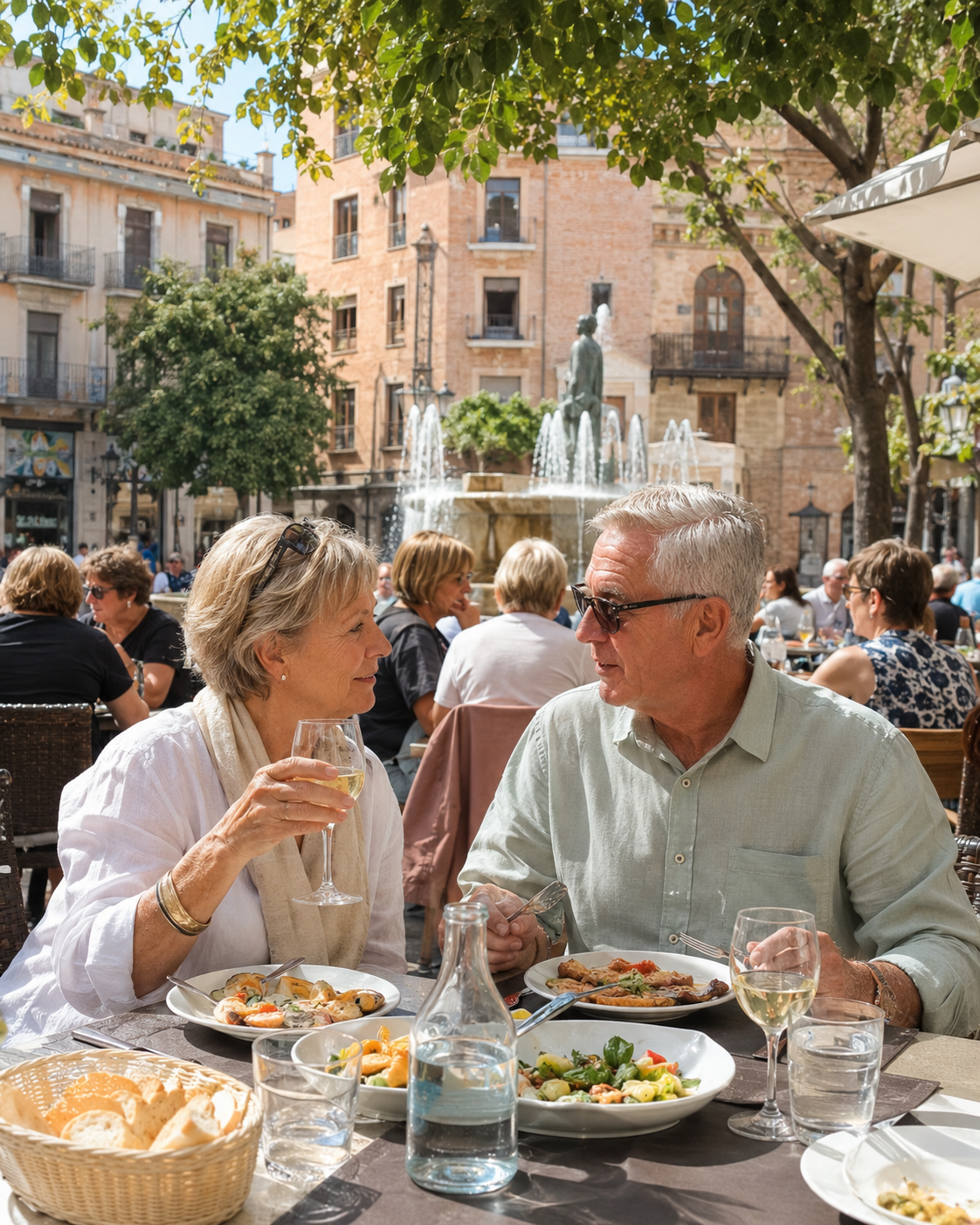
Everything shifted when they looked seriously at the province of Valencia, the towns and small cities outside the coastal capital, where the cost of a truly good life is dramatically lower than back in the United States. The same pensions suddenly did very different work.
Their money went much further. In a town in Valencia’s province, the essentials of a comfortable life cost a fraction of what they did back home, so their combined pensions comfortably covered a good life with room to spare. What had been a strained budget in Ohio became a relaxed one in Spain, because everything cost less.
The everyday math simply worked. Rent away from the priciest center, market shopping, a few-euro lunch out, all of it fit easily, so the daily anxiety of watching every dollar simply lifted. For the first time since retiring, they could live well and still set money aside, which in Ohio had felt out of reach. The change was not only financial but emotional, a lifting of the low, constant hum of worry that had shadowed their first years of retirement. They stopped carefully rationing small pleasures, stopped quietly dreading the monthly utility bill, and began to feel, for the first time in a long while, that they were comfortably rather than anxiously retired. That shift in feeling, from scarcity to enough, was in some ways the truest measure of what the move had bought them.
Healthcare, the Quiet Game-Changer
Of all the differences between the two countries, none mattered more to their sense of security than healthcare, which shifted from being their single greatest worry to something they barely had to think about. This change alone transformed their retirement.
Spain lifted an enormous weight. Spain’s respected healthcare system, whether through public provision or affordable private insurance, cost them a small fraction of what coverage had in the United States, so the expense that had loomed largest over their American retirement shrank to a manageable line in the budget. The relief of no longer facing crushing healthcare costs was, they said, worth the move on its own. For a couple who had spent years watching a single line item threaten their whole retirement, discovering that the same care could be had for a modest, predictable sum felt almost unreal at first. They kept waiting for a catch that never came. In its place grew a settled confidence that a health scare, whenever it arrived, would be a medical event rather than a financial catastrophe, which is a kind of security many Americans never feel at all.
Security replaced anxiety. Beyond the money, knowing good care was available and would not bankrupt them replaced constant fear with security, so their peace of mind improved as much as their finances did. This freedom from healthcare dread was a quality-of-life gain no spreadsheet fully captured.
The Visa and the Practical Path
None of this would have mattered if they could not legally settle in Spain, and here too the path proved navigable, though it required meeting real requirements that anyone considering the move should understand. The route existed and their pensions qualified them for it.
Their pensions met the income test. Spain’s non-lucrative visa, the standard route for retirees who will live on passive income rather than work, requires showing a certain level of steady income, and two teachers’ pensions together comfortably cleared the income threshold for a couple, so their retirement income became the very thing that unlocked the move. The income that felt insufficient in Ohio was more than enough to satisfy Spain.
The requirements were real but manageable. Alongside the income proof, the visa called for private health insurance and the usual paperwork, taking effort and patience but presented no insurmountable barrier, so with good preparation the legal path was open to them. It was a process to be worked through carefully rather than an obstacle that stopped them. They gathered their pension statements, arranged the required insurance, had documents translated and stamped, and worked through the appointments with the patience of people who had spent careers filling out forms. It took months and a certain tolerance for bureaucracy, but at no point did it feel impossible, and the sense of momentum as each piece fell into place carried them through. By the time the visa was granted, the hardest part had been the waiting rather than the doing.
The Trade-Offs, Honestly

For all its rewards, their move was not without real costs, and a full ledger has to weigh what they gave up alongside what they gained, because the decision was not a free lunch. They went in clear-eyed about the sacrifices.
Distance from home was the hardest part. The move put an ocean between them and their children, grandchildren and old friends, a genuine loss, so they had to weigh the comfort they gained against the closeness they surrendered. They felt it most on holidays and family milestones seen through a screen.
A new life takes effort. Building a life abroad, learning a language, and forming new friendships took real work, so the ease of their finances came with the challenge of starting over socially and culturally. They found it deeply rewarding, but they would not pretend it was effortless, and it demanded more of them than staying put ever would have. There were lonely stretches early on, days when the unfamiliarity of everything wore on them and the ocean between them and home felt very wide. Learning enough Spanish to feel at ease took humility and persistence, and building a circle of friends in their sixties asked a boldness they had not needed in decades. What carried them through was treating it all as an adventure they had chosen rather than a hardship imposed on them, and slowly the new place became simply home.
What Their Plan Really Proves
The lasting lesson of their two pensions and one bold plan is that a retirement’s security depends not only on how much you saved but on where you spend it, and that a fixed income which feels impossible in one place can be entirely comfortable in another. Their pensions did not grow. The world around those pensions simply got cheaper, and that made all the difference.
What makes their story genuinely encouraging is that it was not built on wealth or luck but on a willingness to question the assumption that retirement must happen where you spent your working life. By being open to a different and far more affordable setting, they turned a strained, anxious future into a relaxed and secure one, using the exact same income their home state had deemed inadequate. That is a lesson available to many more people than ever act on it. Most people never seriously question where they will retire, assuming it must be near where they already are, and so they measure their pensions only against local prices they treat as fixed. This couple’s real insight was to see those prices as a variable rather than a given, and once they did, a whole set of possibilities opened that had been invisible before. It took courage to act on that insight, but the insight itself is available to anyone willing to look at a map with fresh eyes.
So if you find yourself staring at a pension that seems too small for the retirement you hoped for, take their story not as a prescription but as a genuine possibility worth exploring. The number on your pension is only half the equation, and the other half, the cost of the life around it, is something you have more power to change than you might think. For two Ohio teachers, moving to the province of Valencia turned an impossible retirement into a comfortable one, and their ledger stands as proof that where you retire can matter as much as how much you have..

About the Author: Ruben, co-founder of Gamintraveler.com since 2014, is a seasoned traveler from Spain who has explored over 100 countries since 2009. Known for his extensive travel adventures across South America, Europe, the US, Australia, New Zealand, Asia, and Africa, Ruben combines his passion for adventurous yet sustainable living with his love for cycling, highlighted by his remarkable 5-month bicycle journey from Spain to Norway. He currently resides in Spain, where he continues sharing his travel experiences with his partner, Rachel, and their son, Han.