
They had planned the move together. The two of them had spent years imagining a later life somewhere warm and bright by the sea, poring over maps, saving carefully, picturing the mornings they would share. And then, before the plan could become real, her husband died, and she found herself at sixty-four holding a dream built for two, now hers alone to carry or abandon. Most people, in that situation, would have quietly let the dream go. She signed the lease in Cádiz anyway. This is the story of her first year alone in a new country, a year of grief and courage and slow, surprising renewal, told honestly and without either false cheer or despair. She is a representative composite drawn from the real experiences of people who have made such a move after loss, not a specific individual, and her story stands for something many people face, the question of whether to go on alone toward a life you had meant to share.
What makes a story like this worth telling is that it speaks to one of the hardest and most human of decisions, whether to pursue a shared dream after the person you meant to share it with is gone. It would have been entirely understandable to stay put, wrapped in the familiar and the safe. Choosing to carry the dream forward alone is neither foolish nor a betrayal of grief, but a quiet bravery, and the year that follows such a choice has its own hard truths and its own unexpected gifts. Looking at that year clearly, neither romanticizing it nor dwelling only on its pain, offers something real to anyone standing at a similar crossroads.
Here is the true shape of that first year alone abroad, the grief carried across the water, the practical mountains climbed alone, the slow building of a new life, and the hard-won renewal that can come. This is an illustrative and compassionate account rather than advice of any kind, and everyone’s grief and circumstances are entirely their own, so nothing here is a template, but one person’s first year may offer companionship to another facing the same road.
Carrying Grief Across the Water
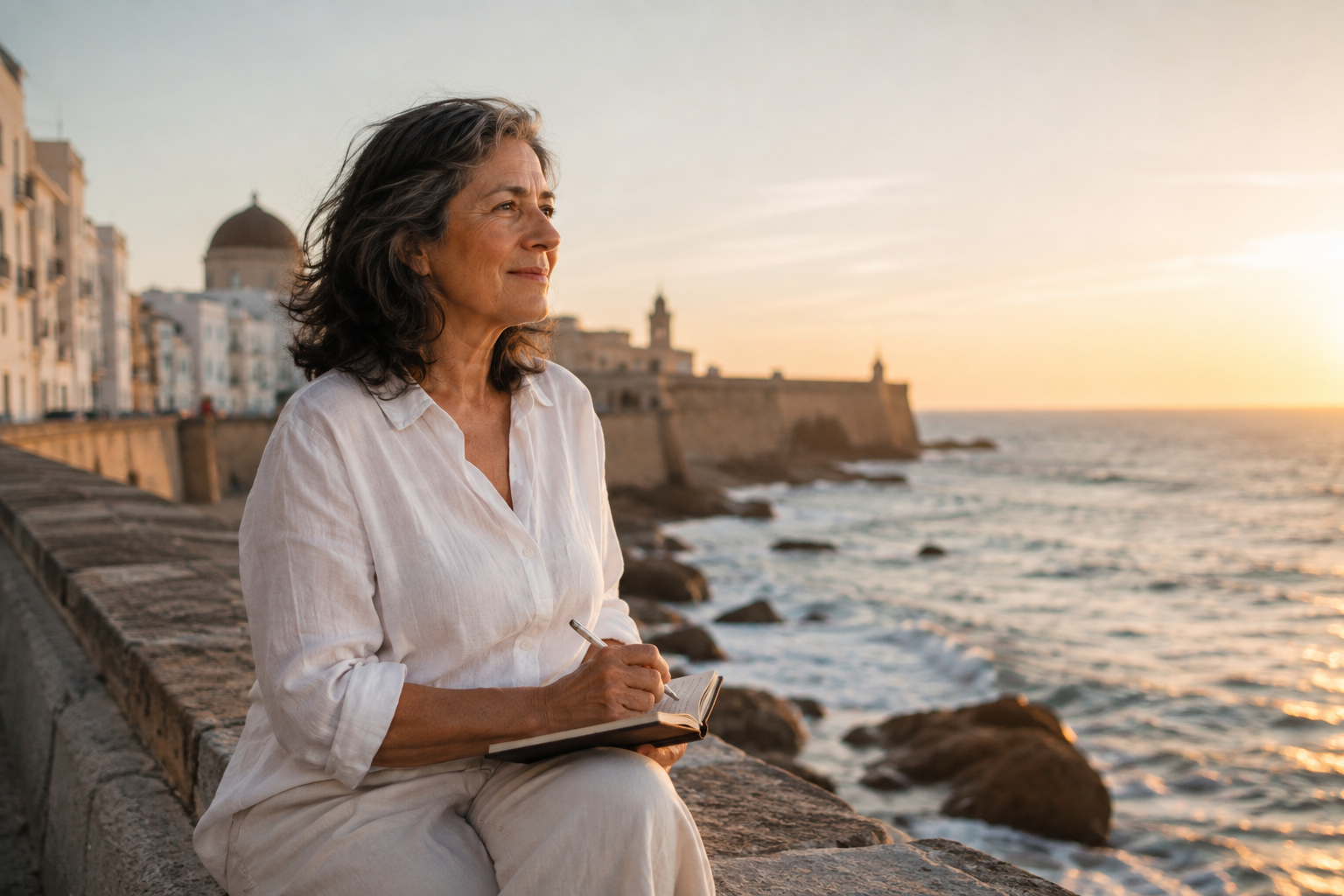
The first truth of that year is that moving does not leave grief behind, because grief travels with you, and anyone imagining a fresh start as an escape from loss finds the loss simply comes along. She did not move to outrun her sorrow, and it followed her faithfully.
Grief comes too, and that is not failure. Arriving in a new country did not lift her mourning, and there were mornings in Cádiz as heavy as any at home, so she had to learn that a change of place is not a cure for loss but the setting in which she would carry it, at least for now. Understanding this spared her the disappointment of expecting geography to heal what only time and grief could slowly ease. There is a common fantasy that a dramatic change of scene will wash away sorrow, and part of her had half believed it. What she learned instead was gentler and truer, that she had not come to Cádiz to leave her husband behind but to carry him with her into a new chapter. Once she stopped expecting the move to be a cure, she could let it be what it truly was, a kind and beautiful place in which to do the slow work of grieving and living at the same time.
A shared dream, pursued alone, holds him close. Yet there was something tender in living out the life they had planned together, for in walking the streets they had imagined, she felt near to him rather than far, so the dream became a way of keeping faith with their shared hopes rather than a painful reminder of his absence. Carrying the plan forward became, in its way, a form of love continued, a means of honoring what they had built together in imagination.
The Practical Mountains, Climbed Alone
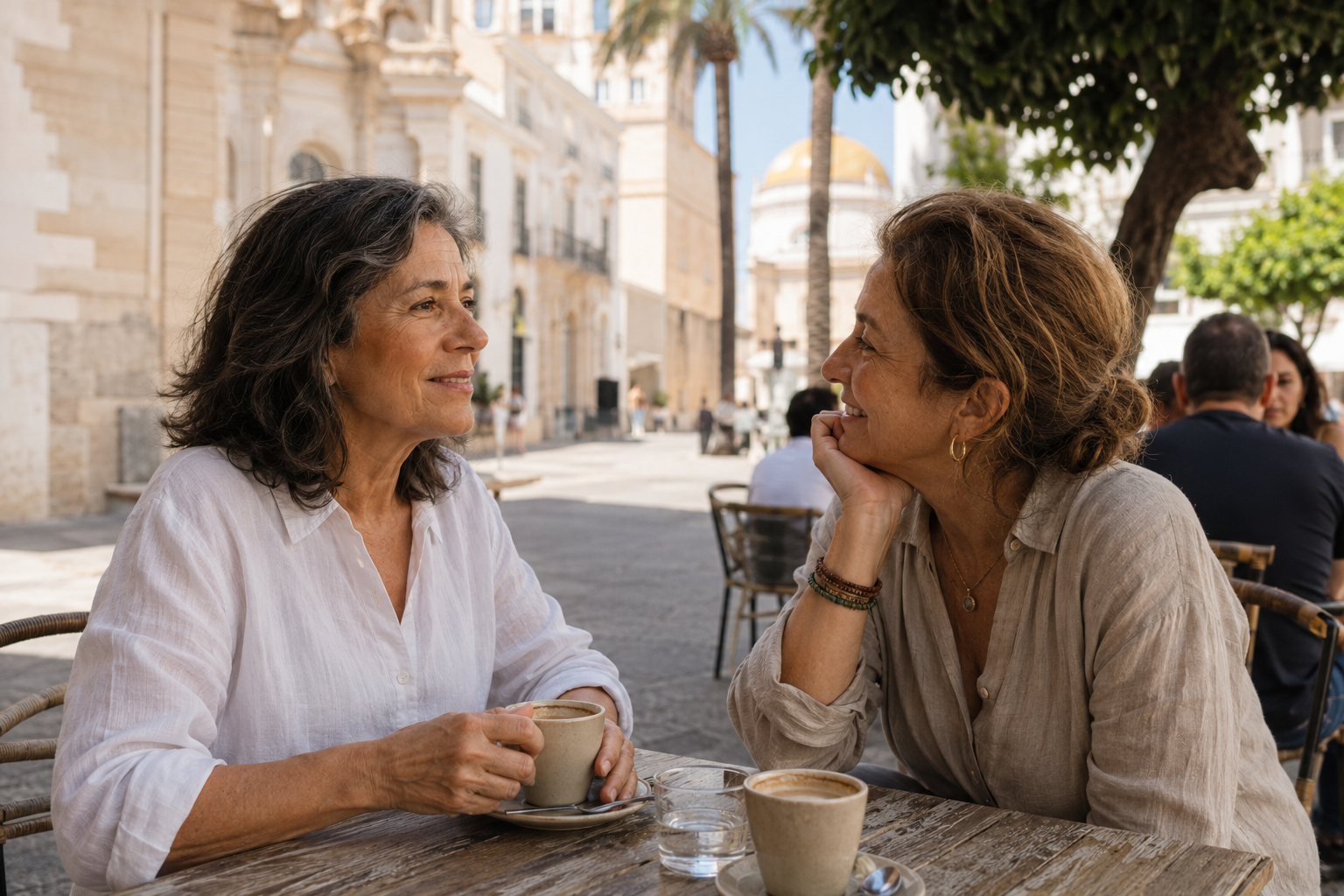
Beyond the grief lay the sheer practical weight of settling into a foreign country entirely on her own, every task that a couple would have shared now resting on one pair of shoulders. This was its own considerable challenge, and she felt it keenly.
Everything fell to her, and she rose to it. The paperwork, the banking, the language, the hundred small problems, all fell to her alone, without a partner to share the load or lighten the worry, so she discovered a competence and resilience she had not known she possessed. Meeting each challenge herself, though exhausting, slowly built a quiet confidence, the sense that she could in fact manage a life on her own. Each solved problem, each form filed and each phrase learned, added a small brick to a growing structure of self-reliance. She had spent a long marriage sharing every practical burden, and had quietly assumed she could not carry them alone. Discovering that she could, task by ordinary task, turned out to be one of the steadying revelations of the year, and it gave her a foundation of capability on which the rest of her new life could be built.
The hardest part was the absence of a witness. What she missed was not only help but companionship in the small victories, the person to turn to and say we did it when a difficulty was overcome, so the loneliness was as much about having no one to share the triumphs as no one to share the tasks. Learning to find satisfaction in her own accomplishments, without that witnessing presence, was a subtle lesson.
Learning to Be Alone Without Being Lonely
A central task of that first year was discovering the difference between being alone and being lonely, and slowly learning to inhabit solitude without being crushed by it. This did not come at once, but it did come.
Solitude and loneliness are not the same. She came to understand that being by herself did not have to mean being lonely, and that there could be peace, even richness, in a life lived quietly on her own terms, so she began to find moments of genuine contentment in her solitude. This was not a denial of her loss but a gradual widening of her life to include pleasures that were hers alone.
Small routines became anchors. In the shape of her days, the morning coffee, the walk along the seafront, the familiar greetings, gave her a structure that held her steady, so the rhythms of ordinary life became a quiet scaffolding for her grief and her healing alike. These small, repeated acts gave her days a reassuring form when everything else felt uncertain. In the early months, when grief could make a whole day feel formless and heavy, the simple obligation of a morning walk or a standing coffee gave her something to rise for and somewhere to be. The rituals asked little of her but returned a great deal, a gentle momentum that carried her through the hours when motivation was scarce. Slowly the routines stopped being a discipline she imposed on herself and became instead the comfortable furniture of a life she was, almost without noticing, beginning to inhabit fully.
The City That Held Her

Part of what made the year survivable, and eventually more than survivable, was the particular character of the place she had chosen, an old, warm, sociable Andalusian city that gently drew her into its life. Cádiz, it turned out, was a good place to be alone.
The city’s warmth met her halfway. Cádiz is an old, walkable city wrapped by the sea, its life lived in the streets and squares, so simply by stepping out of her door she was met by the warmth and bustle of a place that did not leave a solitary person isolated. The sociable, open character of Andalusian life meant that connection was available whenever she was ready for it, without her having to force anything.
Belonging grew quietly, without her forcing it. Over the months, the shopkeepers, the café regulars, the neighbors gradually became a gentle web of recognition and warmth, so she found herself slowly woven into the life of the city almost without trying. This ambient, undemanding companionship was exactly what she needed in a year when the effort of making grand new friendships would have been beyond her. Grief had left her with little energy for the exhausting work of building an entirely new social circle from scratch, and Cádiz asked no such thing of her. It offered instead a gentler kind of belonging, made of nods and greetings and small daily exchanges, that accumulated quietly into a feeling of being known. By the time she was ready for deeper friendships, the ground had already been prepared, and they grew naturally from the familiar faces the city had given her all along.
The Slow Return of Joy
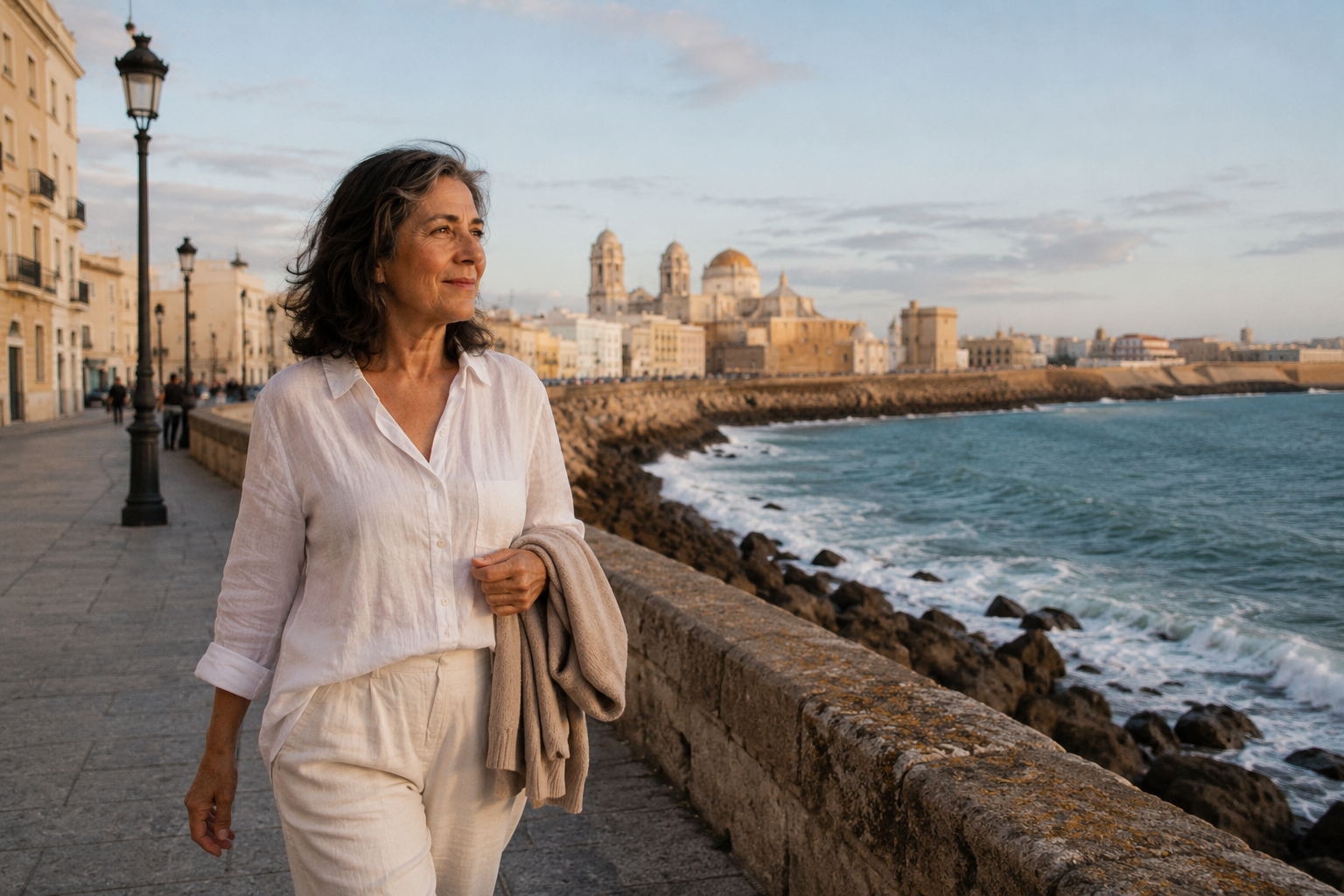
As the months passed, something unexpected began to happen, the slow, tentative return of pleasure and even joy to a life that had felt, for a time, defined only by loss. This did not arrive all at once, but it did arrive.
Small pleasures came back first. Long before any grand happiness returned, she noticed the small delights creeping back, the taste of good food, the sun, the light on the water, so life began, gently, to offer its ordinary gifts again. Allowing herself to enjoy these small things, without guilt, was an important part of her healing.
Joy did not mean forgetting. She learned that beginning to feel happy again was not a betrayal but a natural part of continuing to live, so she could hold both her sorrow and her returning joy together, without the one canceling the other. This reconciliation, that one can grieve and still gradually reach toward life, was perhaps the deepest lesson of her year. For a long time she had feared that happiness would feel like leaving him behind, and it was a quiet relief to discover that it did not. She could laugh at something in the market, or feel her spirits lift at the sight of the sea, and understand that this was not forgetting but living, the very thing he would have wanted for her. Holding grief and gladness together, rather than choosing between them, became the shape of her healing.
What the Year Taught
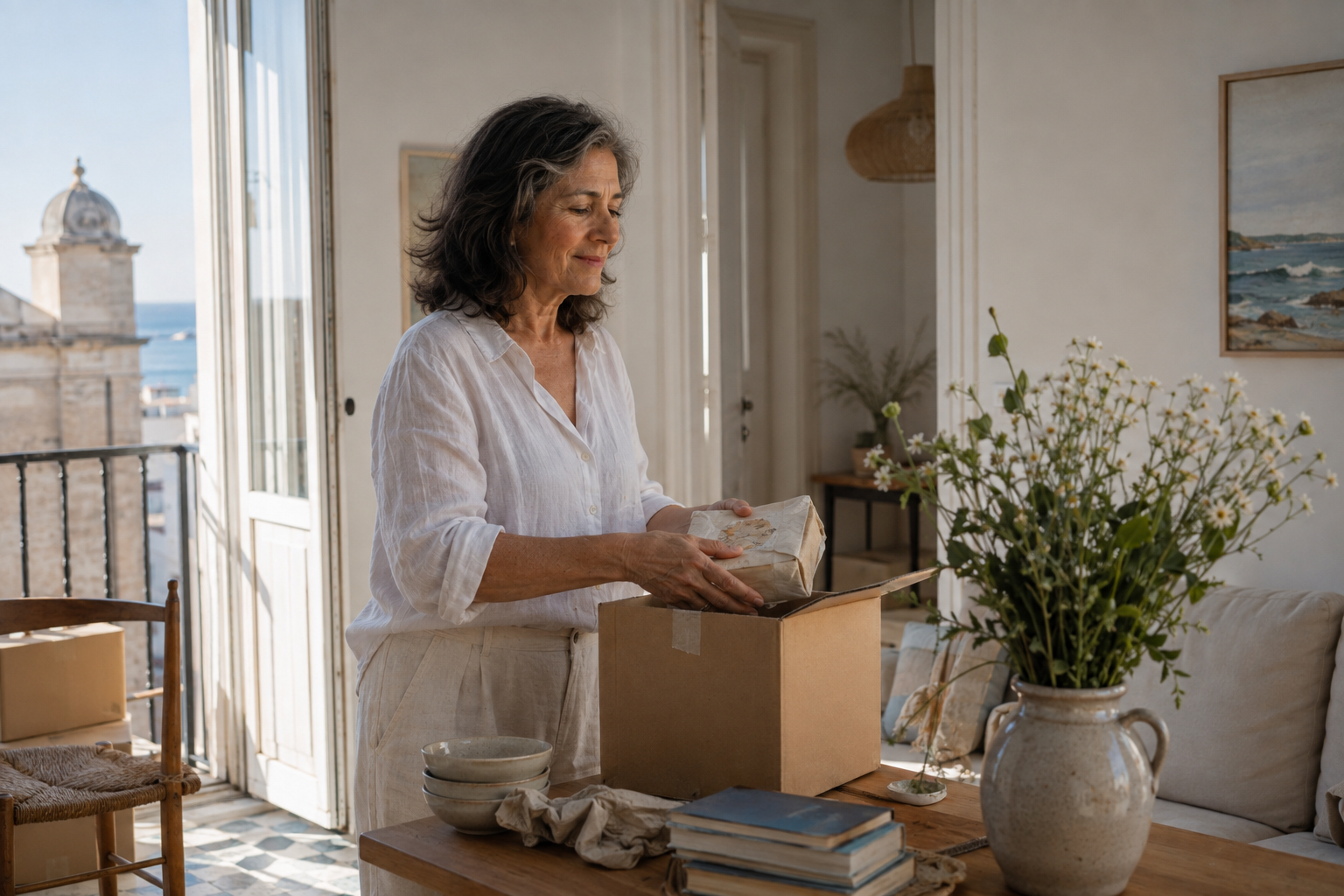
Looking back at the end of that first year, she could see how much she had changed and grown, and what the experience had given her along with what it had cost. The year had been one of the hardest of her life, and also, in its way, one of the most transformative.
She was more capable than she had believed. Having built a life alone in a foreign country, she emerged with a deep and hard-won confidence in her own resilience, knowing now that she could face great difficulty and not only survive but slowly flourish, so her sense of herself was permanently enlarged. This discovery of her own strength was a genuine gift wrested from a painful year.
Her grief had changed shape, not vanished. She did not finish the year over her loss, for such grief does not simply end, but she carried it differently, more gently, woven into a life with room for both sorrow and hope, so she had found a way to live fully while still loving and missing him. That, rather than any false closure, was the real achievement of her first year alone.
The Courage to Take the Lease
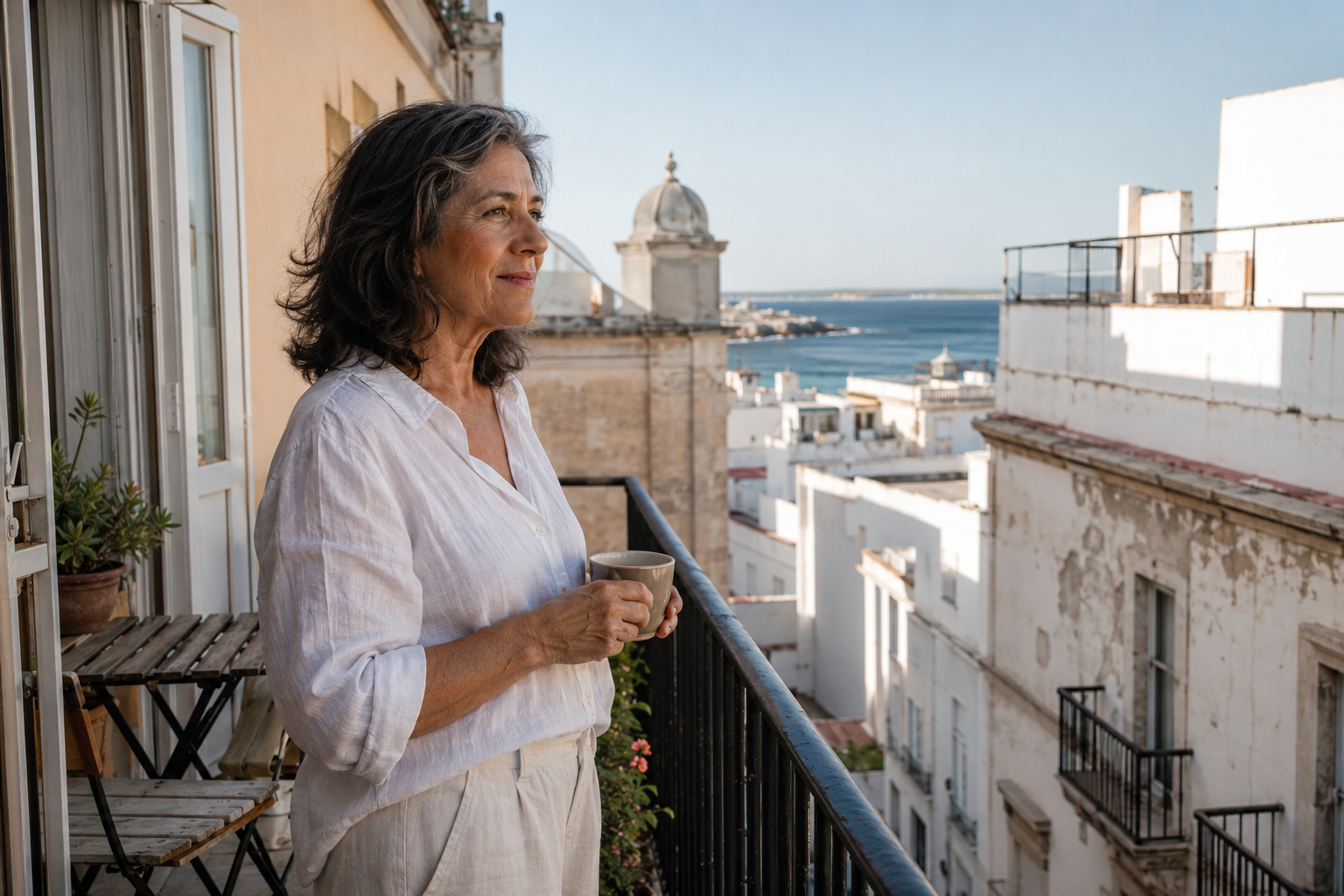
The lasting meaning of this story is that choosing to move forward with a cherished dream after devastating loss, though it demands enormous courage, can lead not to a diminished life but to an unexpectedly rich one, lived in honor of what was lost and open to what may still come. Taking the lease alone was an act of faith in her own future, and that faith was, in time, rewarded.
What her first year shows is that grief and renewal are not opposites but companions, that one can carry sorrow across the water and still build a life of meaning, connection and quiet joy on the far shore, and that the presence of loss does not preclude the return of life. The year asked everything of her, and in the asking, gave her back a self she had not known she still had. She had gone to Cádiz as a grieving widow uncertain whether she could manage alone, and she emerged from that first year as a woman who had built a life with her own hands in a place she had come to love. The grief remained, softened but real, and alongside it stood something new, a hard-won and durable sense of her own capacity to endure and even to flourish. That doubleness, sorrow and strength held together, was the truest portrait of who she had become.
So if you find yourself alone before a dream you had meant to share, and wondering whether to go on toward it, take from this composite story not a prescription but a small measure of courage. It can be done, and though it will be hard and grief will come along, a first year alone abroad can become the beginning of a life that honors your loss and still, gently, opens toward joy. Sometimes the bravest and most loving thing a person can do is to sign the lease anyway, and to carry the shared dream forward, alone but not defeated, into whatever life still holds.

About the Author: Ruben, co-founder of Gamintraveler.com since 2014, is a seasoned traveler from Spain who has explored over 100 countries since 2009. Known for his extensive travel adventures across South America, Europe, the US, Australia, New Zealand, Asia, and Africa, Ruben combines his passion for adventurous yet sustainable living with his love for cycling, highlighted by his remarkable 5-month bicycle journey from Spain to Norway. He currently resides in Spain, where he continues sharing his travel experiences with his partner, Rachel, and their son, Han.