
I will admit I was skeptical. Living in Europe, I had gradually started to notice that the people around me seemed to use far less deodorant, and far less of everything else, than I was used to. No overpowering clouds of scent following people down the street, no elaborate arsenal of products, just a lighter, simpler approach to daily grooming that somehow worked perfectly well. So rather than just wonder about it, I decided to test the whole thing properly, and to give it a fair and full month before drawing any conclusions. For thirty days I would follow the European approach, stripping my routine back to its essentials, using markedly less product, and see whether anyone noticed or whether the sky fell in. This is the honest account of what happened, and what I learned about how much of my old routine was habit rather than necessity. This account draws on a representative composite of common experiences rather than a single clinical case, and it is a light personal experiment rather than any kind of medical, dermatological or hygiene guidance.
What makes an experiment like this worth doing is that so much of daily grooming is inherited habit, absorbed from marketing rather than chosen deliberately, and we rarely stop to ask whether we need all of it. The culture you grow up in quietly sets your defaults, from how much deodorant is normal to how full a shelf should be, and those defaults can be surprisingly arbitrary. Testing them gently, and only for a limited time, is a harmless way to find out what truly serves you and what is just there out of routine. The worst that can happen is you go back to your old ways, and the best is that you simplify your life a little.
Here is what the European approach to deodorant and daily grooming really looks like, how my thirty days unfolded, what surprised me, and what I took away from the whole experiment. This is a light-hearted personal account rather than advice of any kind, and everyone’s body, skin and needs are entirely their own, so nothing here is a recommendation for you, but my little experiment might make you curious about your own habits.
The European Approach to Deodorant

Before starting, it helped to understand what I was truly adopting, because the European approach is less a strict method than a general sensibility, a lighter touch across the whole routine. The philosophy is simple.
Less is simply the default. In much of Europe, the norm leans toward smaller amounts and fewer products overall, favoring subtlety over heavy application, so restraint is the starting point rather than the exception. The aim seems to be to be clean and pleasant rather than noticeably scented, a quieter standard than the one I had absorbed.
Simplicity is prized over abundance. Rather than a crowded shelf of specialized products, the European tendency is toward a minimal kit of essentials used sparingly, so the whole routine is pared down to what is truly needed. This is less about any single rule and more about a general preference for doing more with less, which is exactly what I set out to try. What struck me most, once I started paying attention, was how unforced it all seemed. Nobody around me appeared to be depriving themselves or working hard at restraint. They simply used what they needed and no more, in a way that looked entirely natural to them and only looked like discipline to someone raised on abundance. That ease was part of what made me want to try it, since it suggested the lighter approach was not a sacrifice at all but simply a different and perfectly comfortable normal.
Setting the Rules of My Experiment
To make the test fair and meaningful, I needed some simple ground rules, a clear sense of what following the European approach would mean day to day. I kept it uncomplicated.
I would use much less, not nothing. The point was not to abandon hygiene but to dramatically reduce the amount of product, applying a fraction of my usual deodorant and cutting back on the extras, so the experiment was about restraint rather than neglect. I stayed just as clean, simply with far less product involved.
I would pay attention and stay honest. Throughout the thirty days I would notice how I felt, whether I stayed fresh, and crucially whether anyone around me reacted, so the test would have a real and clear measure of success. I resolved to be truthful with myself about any problems rather than forcing a tidy conclusion. If at any point I had felt truly unpleasant or noticed a real problem, I intended to stop and say so plainly, because an experiment that only ever confirms what you hoped is not worth running. I also kept it relaxed rather than obsessive, checking in with myself as a matter of ordinary attention rather than anxious monitoring, since the whole point was to feel more free, not to trade one preoccupation for another. A light touch seemed the only sensible way to test a lighter routine.
The First Awkward Days
The beginning, predictably, was where my anxiety concentrated, since decades of habit had taught me that more product meant more safety, so using less felt exposed at first. Those early days were a mental hurdle more than a practical one.
The worry was mostly in my head. In the first few days I felt self-conscious, convinced that using so little would surely lead to some embarrassment, so I spent a lot of mental energy monitoring myself for problems that never came. The discomfort was almost entirely psychological, born of breaking a long-held habit.
Nothing bad happened at all. To my great surprise, the disasters I braced for simply never came, and I made it through perfectly fresh and without any of the embarrassment I had feared, which began to shift my thinking. The gap between my anxiety and the reality was the first real lesson of the experiment. I had spent years assuming that heavy use was doing essential work, when in truth much of it had only been soothing a worry rather than solving a problem. Once I noticed that the feared consequences never arrived, the worry itself began to loosen its grip, and each uneventful day made the next one easier. By the end of the first week the self-consciousness had largely faded, replaced by a mild curiosity about just how little I really required to feel perfectly fine.
What My Body Actually Needed
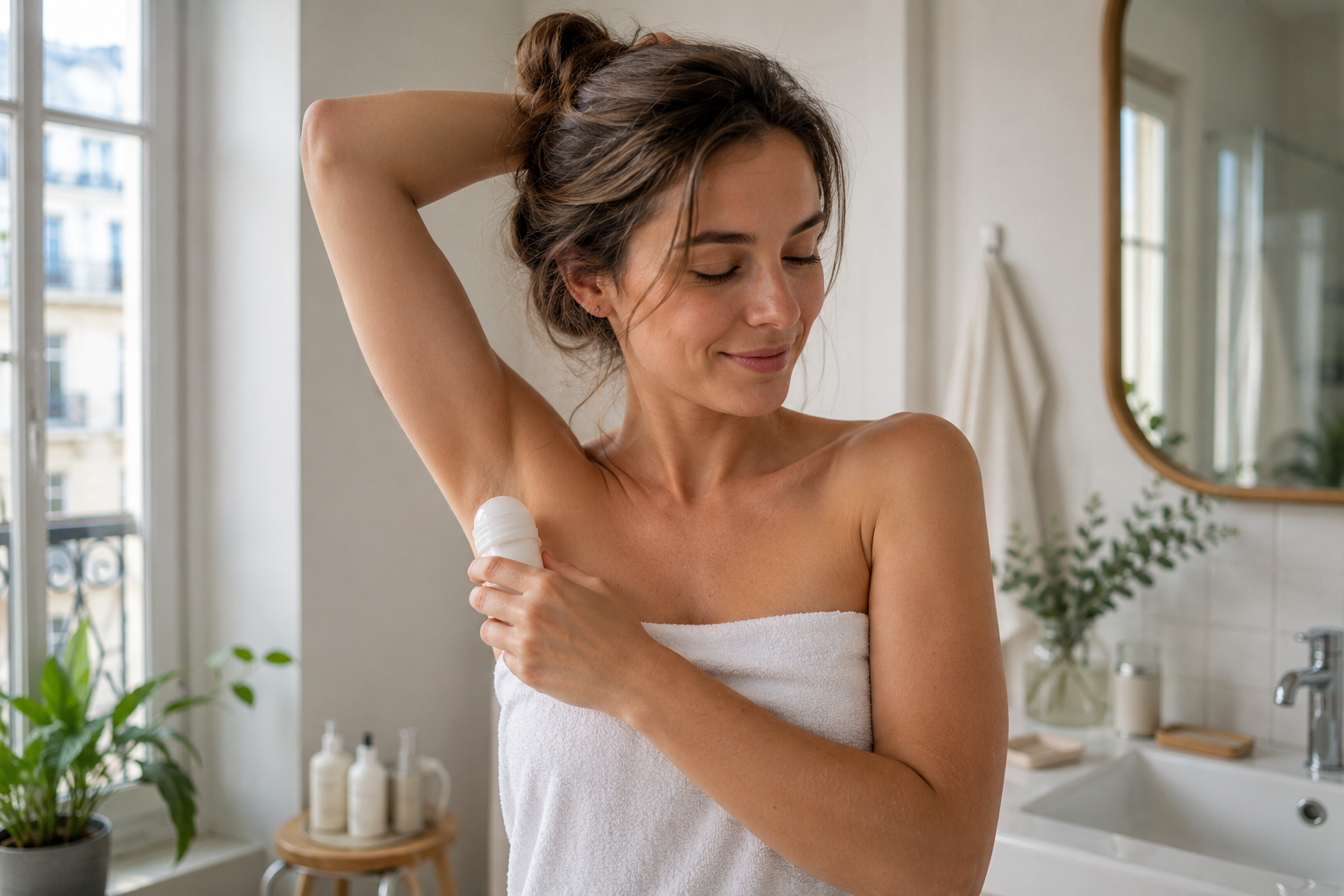
As the days went on, an interesting thing happened, one that many people report when they cut back on heavily scented products, as my sense of my own needs recalibrated. I began to understand my body’s actual requirements rather than the ones marketing had taught me.
My old routine was mostly excess. It became clear that the large amounts of product I had always used were far more than my body needed, and that a far smaller quantity did the job just as well, so most of my former routine had been simple overkill. What I had thought necessary turned out to be habit dressed up as necessity.
Freshness did not depend on heavy product. I learned that staying fresh had far more to do with basic cleanliness than with piling on scented product, so the foundation of feeling clean lay elsewhere than I had assumed. The product had been masking rather than doing the essential work. This was a truly useful thing to understand, because it reframed the whole question. I had always thought of deodorant as the main event, the thing standing between me and disaster, when in fact it was a finishing touch on a foundation built by ordinary washing and sensible clothing. Once I saw it that way, using a small amount felt entirely sufficient rather than risky, since I trusted the real work was already being done elsewhere. The heavy application had been insurance against a danger that good basic habits had already handled.
The Test of Other People

The real measure of the experiment was always going to be other people, since my own comfort mattered little if those around me noticed a difference, and this was the verdict I awaited most keenly. Their reaction, or lack of it, would tell the true story.
Nobody said a word. Across the whole thirty days, not one person remarked, wrinkled their nose, or gave any sign anything was different, so the great fear that drives heavy product use, that others will notice, proved unfounded. The silence was, in its way, the loudest possible result. It is worth sitting with how strange that is. So much of the anxiety around personal care is built on the assumption that everyone else is monitoring us closely, ready to judge the slightest lapse, when the reality is that people are mostly absorbed in their own lives and notice far less than we fear. A month of markedly reduced product passed entirely without comment, which quietly demolished the whole premise my old routine had rested on. The audience I had been performing for turned out not to be watching at all.
The people close to me confirmed it. When I finally asked those near me directly, they reported noticing nothing at all, which put to rest any lingering worry that they were simply being too polite to mention it, so the experiment passed its sternest test. No one had detected the dramatic reduction that had so worried me at the start. There was something freeing in that confirmation, a small release of a tension I had not fully realized I was carrying. For years a low hum of worry about this had run quietly in the background, and here was direct evidence that it had been unnecessary all along. Being told plainly by the people who would know that nothing had changed for them let me finally set that particular anxiety down, which felt like a larger relief than such a small experiment had any right to produce.
What Changed Beyond the Bathroom

By the end of the month, the effects had spread beyond my grooming routine into a broader and unexpectedly pleasant shift in how I thought about consumption and habit. The experiment turned out to be about more than deodorant.
I saved money and clutter. Using far less meant my supplies lasted longer and my shelf grew less crowded, so there were small but real benefits in cost and simplicity, entirely apart from anything else. These modest gains were a quiet, ongoing reward for the reduced routine. A tube or bottle that once vanished in a few weeks now stretched on for months, which added up over a year to a real if unglamorous saving. The emptier shelf was its own small pleasure too, a little less to store, to clean around, and to keep track of. None of this was dramatic, but there was a genuine satisfaction in watching a small corner of my life grow simpler and cheaper at the same time, with no cost to how I looked or felt.
I questioned my other habits too. Having discovered how much excess was hiding in this one small area, I found myself wondering where else I might be over-consuming out of pure habit, so the experiment sparked a wider and welcome reflection. One small change had opened a larger and rather freeing question. If a routine I had never once questioned turned out to be mostly excess, what else was I doing simply because I always had? I did not turn it into a grand project, but the experiment left me a little more willing to test my defaults elsewhere, to ask of other habits the same simple question of whether they were truly serving me or just occupying space. That gentle skepticism toward inherited habit felt like the most valuable thing the month had given me.
What the Thirty Days Taught Me
The lasting lesson of my month following the European approach is that a great deal of what I considered essential in my daily routine was in fact pure habit, and that using dramatically less changed nothing about how fresh I felt or how others saw me, except to make my life a little simpler and cheaper. The elaborate routine I had inherited turned out to be almost entirely unnecessary.
What made the experiment so satisfying was not any dramatic transformation but the quiet confidence it gave me, the freedom of knowing I did not need nearly as much as I had assumed, and that the fear driving so much of my old routine was baseless. That sense of doing perfectly well with less proved genuinely liberating, in a small and pleasant way. There is a quiet confidence that comes from testing a fear and finding it hollow, and it lingers long after the experiment ends. I did not become an evangelist or throw out my cabinet, but I carried forward a lighter, calmer relationship with the whole business of grooming, one based on what I had seen for myself rather than on what I had absorbed without thinking.
So if you have ever wondered whether you are using more than you need, out of habit rather than necessity, you might consider a gentle experiment of your own. Cut back for a while, pay attention, and see whether anyone notices, or whether, like me, you find the sky does not fall and that less really can be enough. You may find, as I did, that a lighter routine leaves you exactly as fresh, a little richer, and free of a habit you never needed in the first place.

About the Author: Ruben, co-founder of Gamintraveler.com since 2014, is a seasoned traveler from Spain who has explored over 100 countries since 2009. Known for his extensive travel adventures across South America, Europe, the US, Australia, New Zealand, Asia, and Africa, Ruben combines his passion for adventurous yet sustainable living with his love for cycling, highlighted by his remarkable 5-month bicycle journey from Spain to Norway. He currently resides in Spain, where he continues sharing his travel experiences with his partner, Rachel, and their son, Han.