
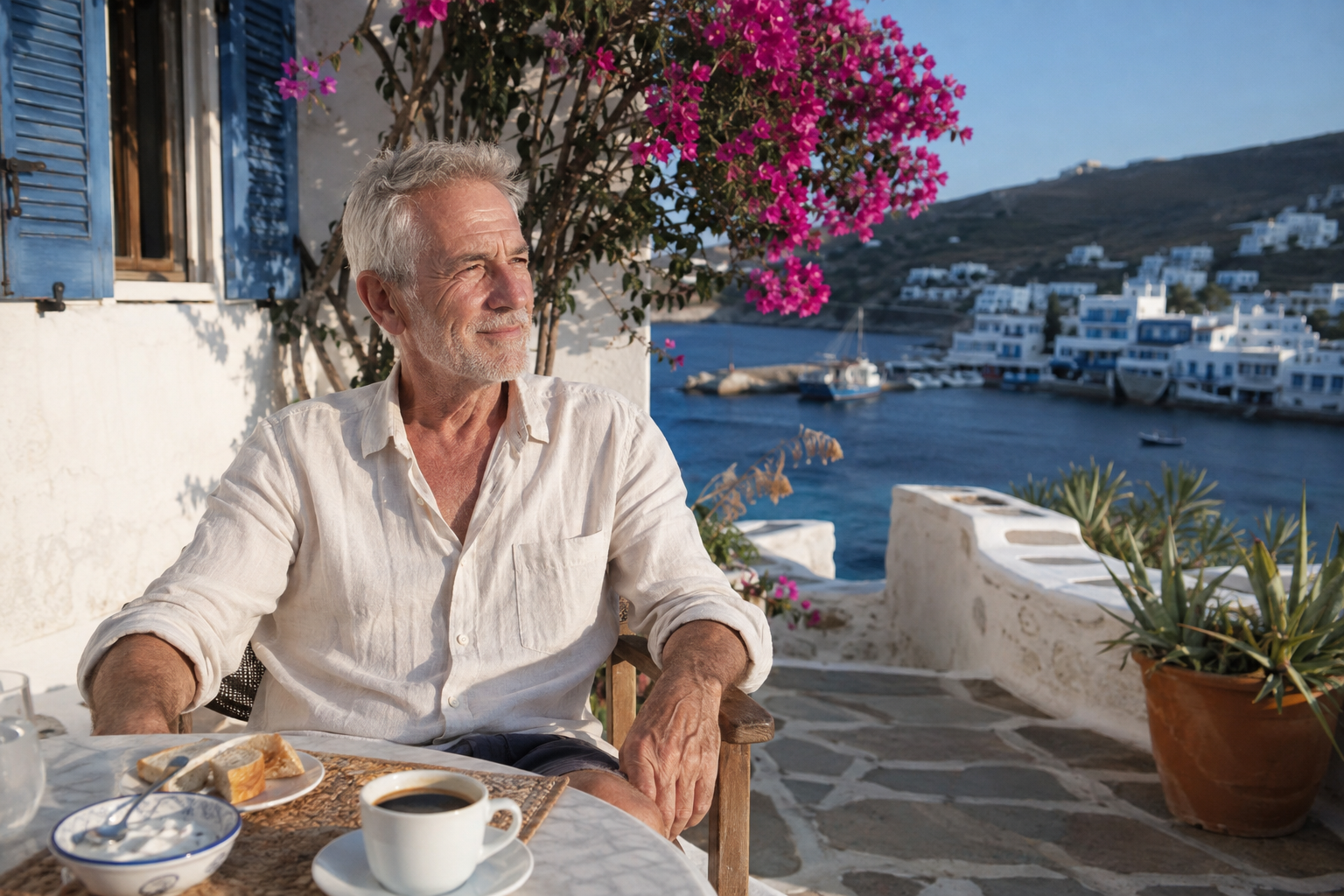
The first year on a Greek island is easy to romanticize, and easy to survive on the momentum of the dream. Picture a man who retired alone at sixty-three, with modest savings of around a hundred and ten thousand dollars and a small pension, and moved to a small Greek island to build the quiet, sun-and-sea retirement he had imagined for years. That first year was, by most measures, a success: the daily swims in the Aegean, the tavernas, the olive groves, the slow mornings, all of it every bit as lovely as he had long hoped it would be. But the true test of a move like his is not the first year, with its novelty and its holiday glow. It is the second, when the newness wears off and the first winter has come and gone, and the real texture of the life reveals itself. This is a candid account of that second year, of what a solo retirement on a Greek island truly feels like once the dream settles into daily reality, told without either the glossy exaggeration of the brochures or the grim warnings of the skeptics.
This man is a composite, a representative figure rather than a specific person, drawn to illustrate plainly what solo retirement on a Greek island tends to involve. His story matters not because every detail is literally true but because the arc it traces is real and common: the honeymoon of the first year giving way to the harder reckoning of the second, when a person discovers what they have truly gained and what they have really given up. It is a portrait meant to respect both the real rewards and the real difficulties of a choice like his, without flinching from either.
Here is what the second year of a solo Greek-island retirement really reveals, the rewards that deepen and the challenges that surface, how the question of community becomes central, and what the full ledger looks like once the dream has become a life. This is an illustrative and reflective look rather than financial advice, and every person’s experience differs, so anyone weighing such a move should research thoroughly and consult professionals, but the clear-eyed second-year view is the one worth having before you go.
The First Year Was the Easy Part
To understand the second year, you have to see the first one clearly, because its very success can obscure what is coming. The honeymoon is real, and also incomplete.
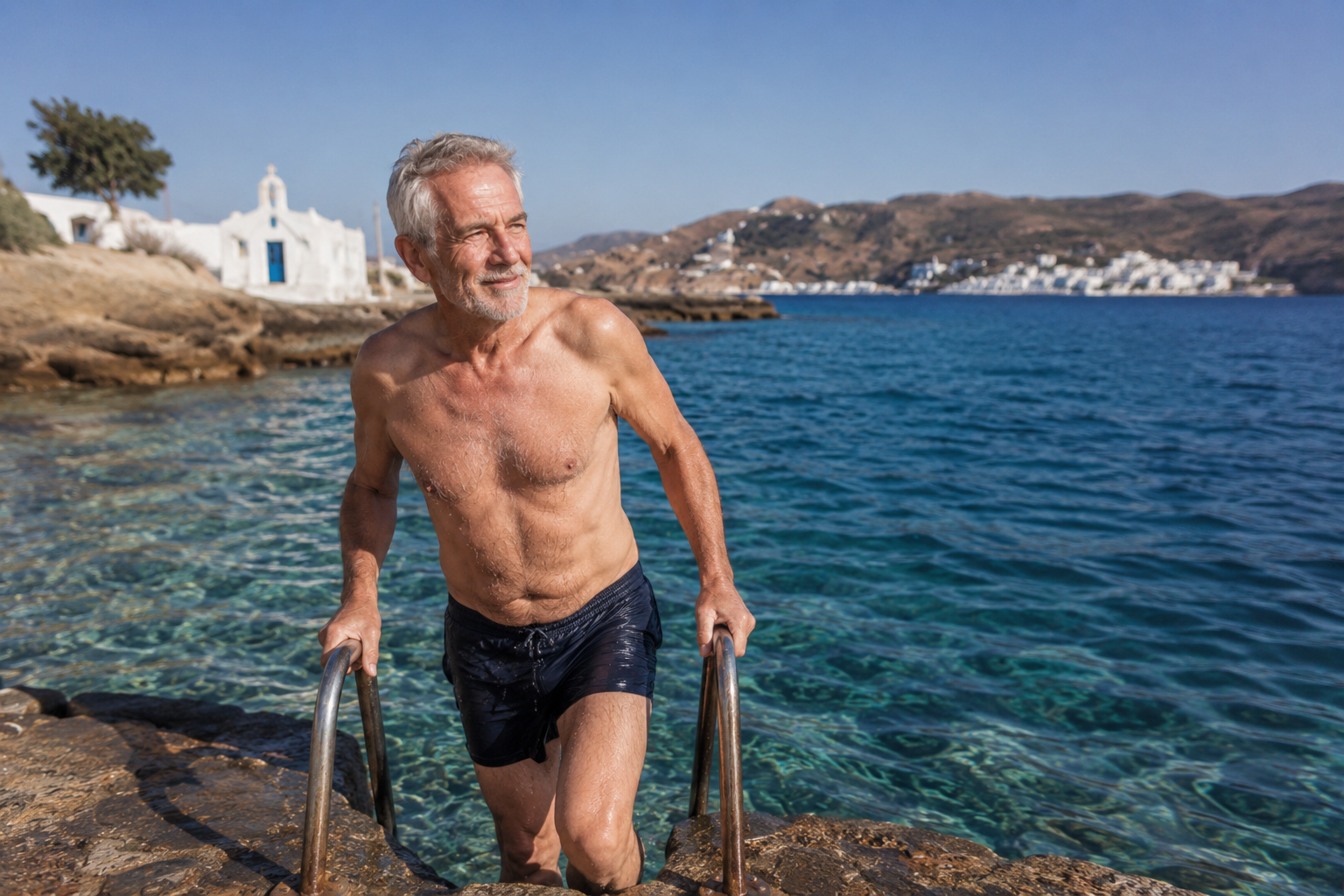
The dream delivered, at first. In his first year, the man found much of what he had come for, the beauty of the island, the warmth of the sea, the affordable ease of a life his modest savings could comfortably support, so the early months confirmed that the dream was not a fantasy but achievable. Everything felt like a holiday that happened to have no end date, and the sheer novelty carried him along. Every ordinary errand was still an adventure, every unfamiliar street a discovery, and the simple fact of waking up somewhere he had dreamed of for years lent even dull days a glow. That glow is real, and not to be dismissed, but it is also, by its nature, temporary. Novelty is a form of energy that a place spends down over time, and no destination, however beautiful, can run on it forever.
But novelty is not the same as a life. The trouble with a first year is that it runs on excitement and discovery, which inevitably fade, so the real question, whether the place can sustain not just a wonderful holiday but an ordinary daily life, only truly gets asked in the second year. The first year tests whether you can fall in love with a place. The second tests whether you can truly live there. That distinction is the one the brochures never make, because falling in love with a place on a visit, or even across a thrilling first year, tells you almost nothing about whether its ordinary rhythms will hold you for a decade. Plenty of people adore a place as visitors and would be restless living there, while a few discover the opposite, that somewhere they found merely pleasant becomes, in daily life, deeply and unexpectedly right. Only time in the ordinary weeks reveals which kind of place a person has chosen.
What the Second Winter Taught Him
If any single thing defines the second-year reckoning, it is the experience of the off-season, which reveals a side of island life the summer completely hides. Winter is the island’s truest face.
The island empties out. When the tourist season ends, many Greek islands grow dramatically quieter, with businesses closing and ferry schedules thinning, and the lively summer atmosphere giving way to a long, still, sometimes isolating off-season, so the vibrant place of July becomes a very different place in January. For a solo retiree, that emptiness can be the hardest thing to prepare for.
This is where solo retirement tests its foundations. Alone in a quiet off-season, without a partner to share the long evenings and with much of the social life of summer packed away, the man felt the isolation that island winters can bring, so the second winter became the real test of whether he had built enough of a life to sustain him through the quiet months. It was not misery, but it was a reckoning, the moment the romance of the island had to give way to the question of whether he could be content there in the stillness. He found, in the end, that he mostly could, but not by accident. The winters that worked for him were the ones he prepared for, with projects to occupy him, a routine to hold the shape of his days, and enough connection to keep the quiet from curdling into loneliness. The empty island did not defeat him, but it did demand something of him, a deliberate effort to fill the space that summer had filled on its own.
The Rewards That Deepened
It would be one-sided to paint only the difficulties, because the second year also revealed rewards that the first had only hinted at, the kind that grow rather than fade. Some things got better, not worse.
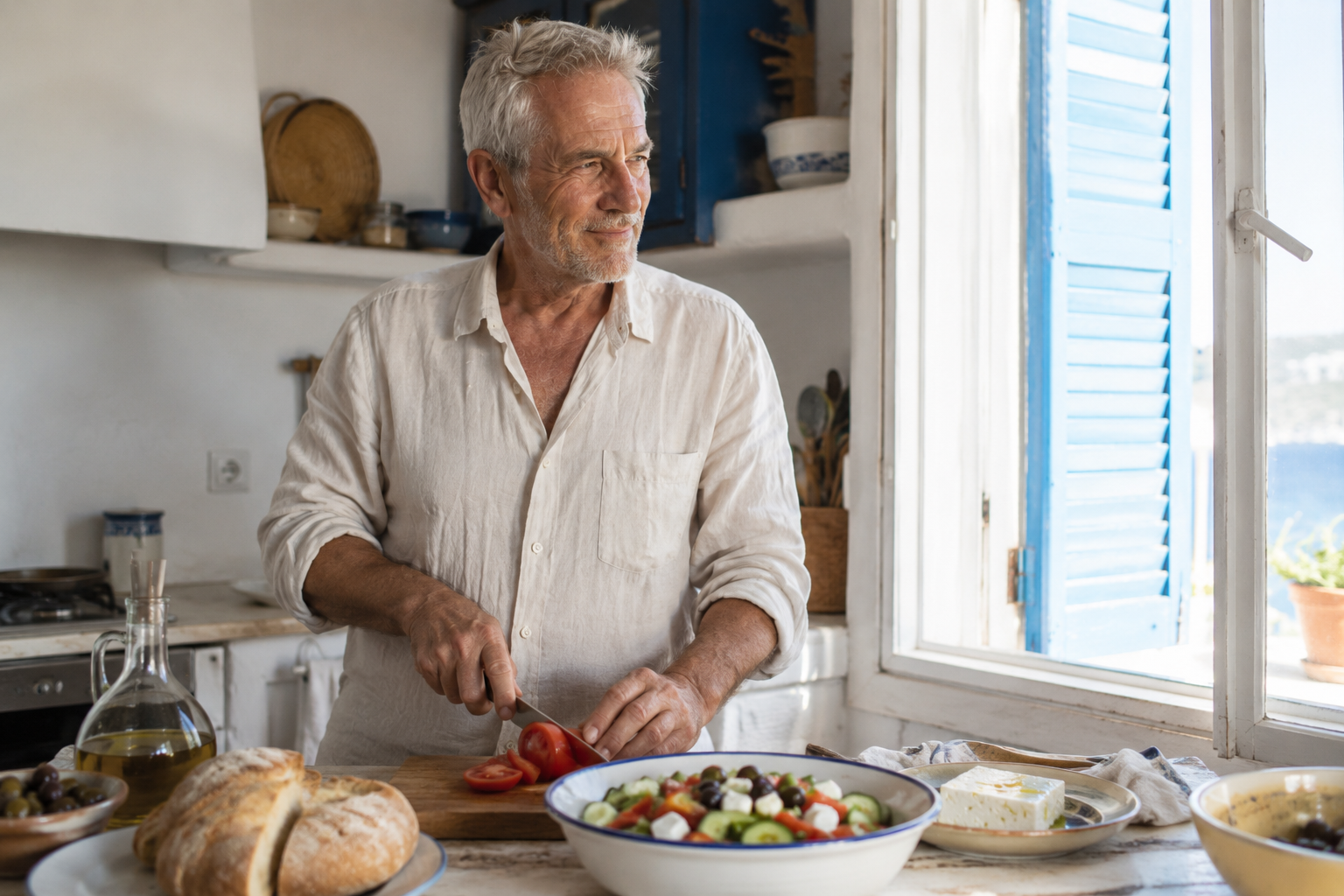
The daily goods became a real foundation. The genuine pleasures of the life, the extraordinary food and famous Mediterranean diet, the sea, and the slow, unhurried rhythm, did not fade with the novelty but settled into a sustaining daily texture, so what had been thrilling in the first year became quietly nourishing in the second. The swims and the simple meals and the olive-scented air stopped being a holiday and became, better still, simply his life.
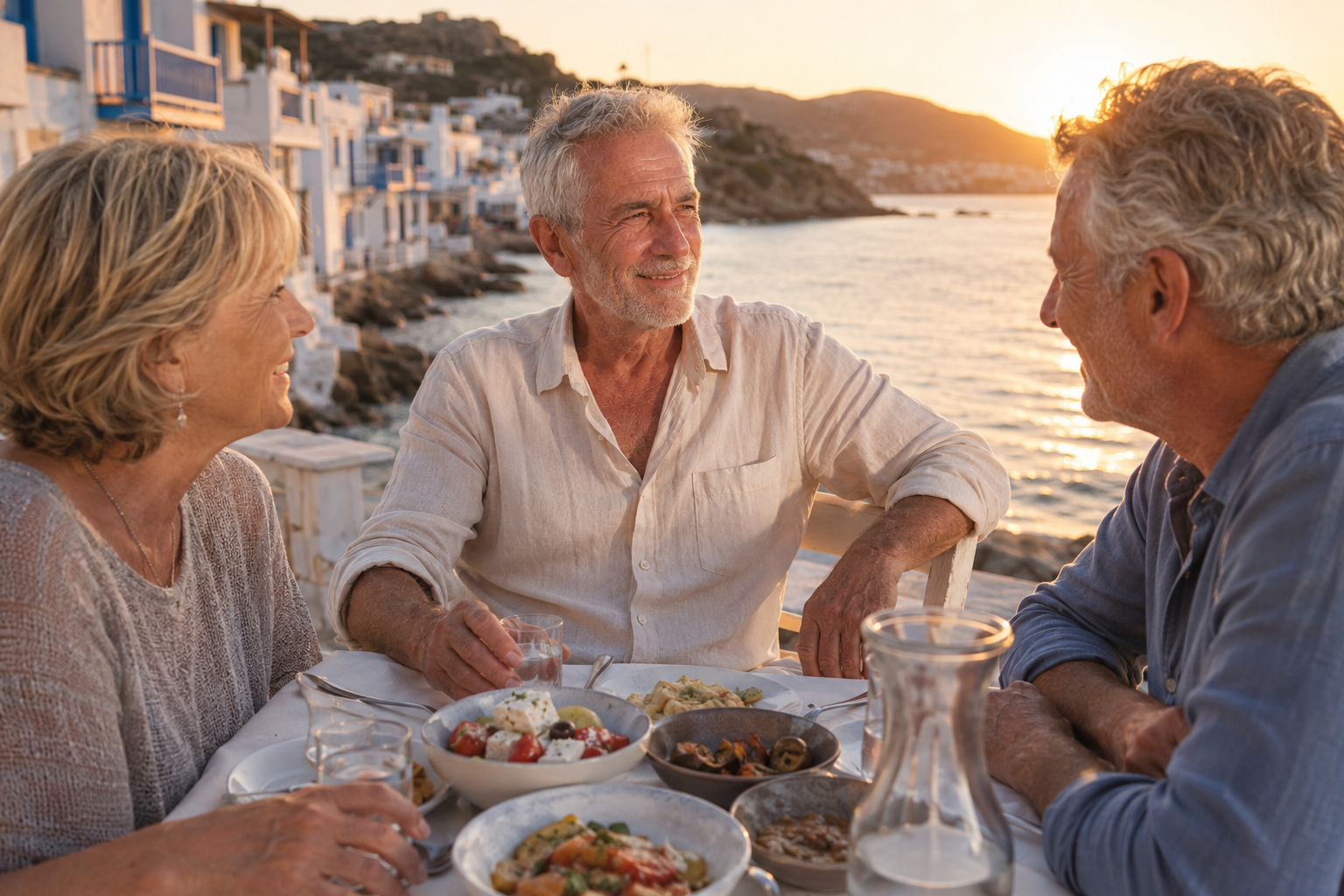
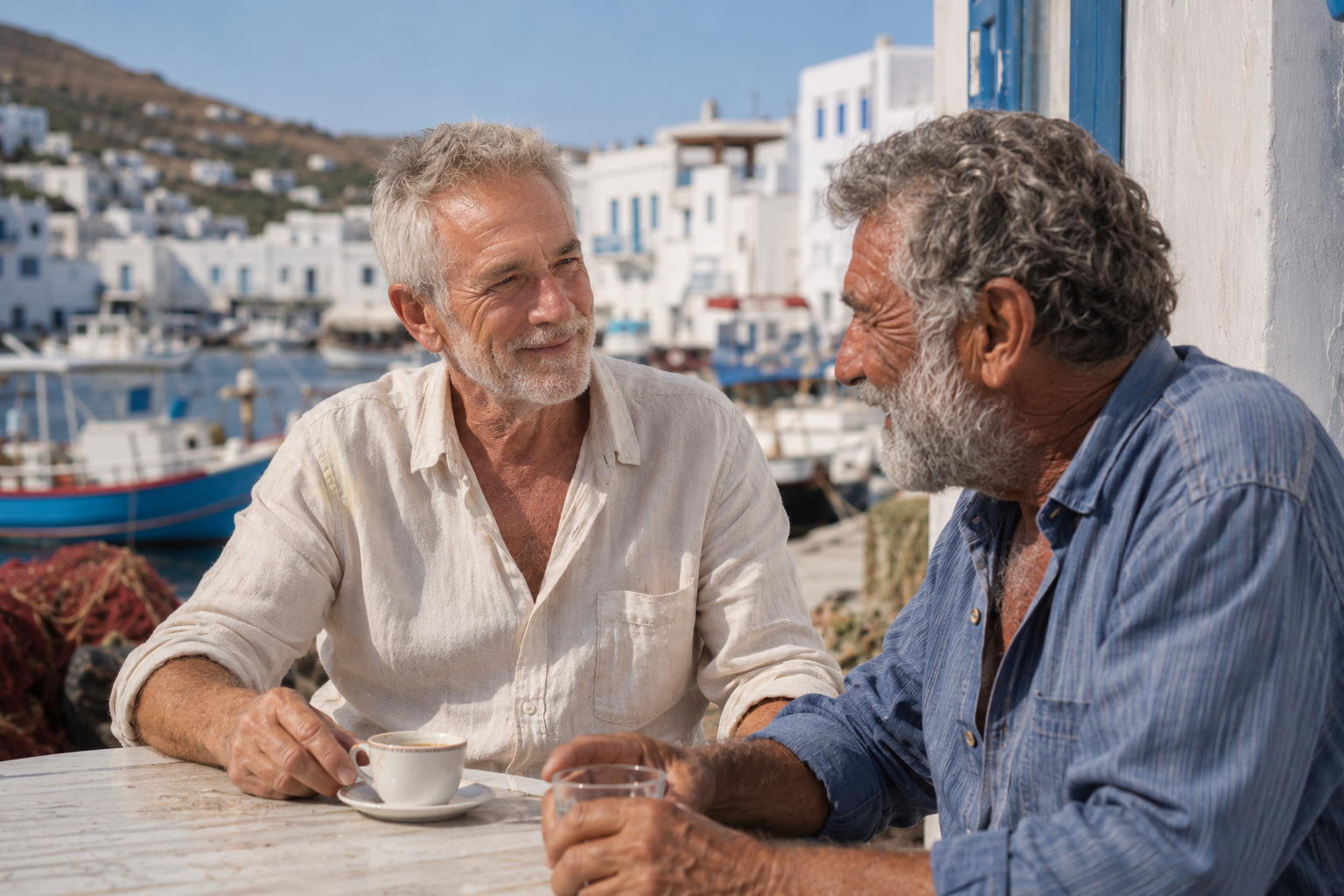
Belonging began to grow. Where the first year had been about discovery, the second brought the first real roots, familiar faces at the market, a few local acquaintances, a growing sense of being a resident not a tourist, so the beginnings of true belonging started to take hold. That slow shift, from visitor to something like a member of the community, was one of the quiet triumphs of the second year, and it could only happen with time.
Why Community Became the Whole Question

As the second year unfolded, it became clear that the entire success of the venture hinged on one thing above all others, the building of human connection, which for a solo retiree is both harder and more important. This is the crux of the whole story.
For a solo mover, connection does not come automatically. Without a partner built into daily life, and as a foreigner in a new place, the man could not rely on companionship simply arriving, so he had to actively build a social world, seeking out the expat communities, local acquaintances, and shared activities that turn an isolated existence into a connected one. The island offered the ingredients of community, but he had to do the work of assembling them.
And the effort was the difference between thriving and merely surviving. The solo retirees who flourish are the ones who deliberately build connection, joining groups, showing up, learning the language, and putting themselves out into local life, while those who stay isolated struggle, so the second year taught him that community was not a bonus but the foundation of a happy solo retirement. The place could be paradise, but without people it would not be enough. This is perhaps the single most important thing the second year taught him, and the one most worth passing on. Beauty and affordability draw people to a place, but they do not, by themselves, sustain a life there. What sustains a life is connection, the web of small relationships and shared moments that make a person feel known and at home, and for someone arriving alone in a foreign country, that web has to be woven deliberately, thread by thread, over time. No view from a balcony, however lovely, can substitute for it.
The Practical Realities He Learned to Manage
Alongside the emotional reckoning, the second year brought a clearer view of the practical realities of island life, the everyday logistics that the first year’s excitement had glossed over. These are the unglamorous truths worth knowing.
Island life has real limitations. He learned that a car was essentially necessary, that internet and services outside the main towns could be patchy, and above all that healthcare on a smaller island is limited, with serious needs often requiring travel to the mainland, so the practicalities demanded planning and acceptance. For a person aging alone, the healthcare question in particular was one he could not afford to treat lightly.
But the fundamentals held up. Against those limitations, the core promise proved sound: the cost of living stayed comfortably affordable, the tax treatment of foreign pensions was favorable, and the basic quality of daily life stayed high, so the practical ledger, while not without its debits, balanced clearly in favor of the life he had chosen. The limitations were real but manageable, the kind of thing a clear-eyed person adjusts to rather than a dealbreaker. He learned to keep the car maintained, to plan around the ferry timetable, to make the trip to the mainland for anything the local clinic could not handle, and to treat these things not as failures of the dream but as the ordinary texture of island life. Every place asks something of the people who live there, and the island’s demands, once he stopped resenting them, turned out to be a fair price for what it gave in return.
The Honest Ledger of Year Two
Setting the whole second year down plainly, what emerges is neither a fairy tale nor a cautionary tale, but a balanced human reckoning of a real life with real trade-offs. The truth sits in between the extremes.
The gains are genuine and the challenges are real. On one side sit the affordability, the beauty, the healthy and unhurried life, and the slow growth of belonging, while on the other sit the winter isolation, the practical limitations, and above all the constant need, as a solo person, to build and maintain connection, so the full picture holds both at once. Anyone imagining only the swims and the sunsets is missing half the story, and anyone imagining only the loneliness is missing the other half. The reality lived in the space between those two pictures, richer and more textured than either, made of good days and quiet days, of real belonging slowly earned and real solitude quietly felt.
What tips the balance is the person and the effort. For a solo retiree who is content in their own company, willing to do the real work of building community, and clear-eyed about the practical trade-offs, a Greek island can offer a genuinely rich and affordable later life, while for someone who underestimates the isolation or expects connection to arrive on its own, it can prove harder than the dream suggested, so the outcome depends enormously on the person and their preparation. The island does not make the retirement. The person does, with what they bring and what they build.
What the Second Year Really Teaches
The lasting lesson of this man’s second year is that a solo retirement abroad is neither the effortless paradise of the marketing nor the lonely mistake of the warnings, but a real life whose success depends on clear eyes, genuine effort, and above all the deliberate building of human connection. The beauty and affordability are real and worth having, but they are the setting, not the substance. The substance is the life a person builds within them.
What makes his story worth telling is precisely its candor, its refusal to pretend that a beautiful place alone guarantees a happy life, or that solitude is either romantic or doomed. The second year taught him that contentment comes from a combination of the place’s real gifts and his own willingness to reach out, to put down roots, to build the connections that turn a solo existence into a full one. That is a lesson that travels far beyond any island.
So if you are drawn to the idea of a solo retirement somewhere beautiful and affordable, take this composite man’s second year as the frank guide the glossy version never gives you. Go in loving your own company but ready to build community, clear about the winters and the practicalities as well as the sunsets, and understanding that the place will give you a great deal but cannot give you everything. Do that, and a life like his can be deeply rich and sustaining. The island offers the stage. What you make of the second year, and every year after, is up to you.

About the Author: Ruben, co-founder of Gamintraveler.com since 2014, is a seasoned traveler from Spain who has explored over 100 countries since 2009. Known for his extensive travel adventures across South America, Europe, the US, Australia, New Zealand, Asia, and Africa, Ruben combines his passion for adventurous yet sustainable living with his love for cycling, highlighted by his remarkable 5-month bicycle journey from Spain to Norway. He currently resides in Spain, where he continues sharing his travel experiences with his partner, Rachel, and their son, Han.