
Most comparisons of European and American food run in one direction. Someone moves to Europe, marvels at the shorter ingredient lists, and comes home convinced the American food system has failed them. I wanted to try the opposite experiment, to take Europe’s rules with me into an American supermarket and see what happened when I shopped by them there. For thirty days, I walked the aisles of an ordinary American grocery store and bought only what could sit on a European shelf under European labeling and additive rules. The question was simple, even if the answer would not be. With Europe’s rulebook in hand, what in an ordinary American supermarket could I not buy?
The answer surprised me, and not always in the direction I expected. Some things I assumed would be forbidden turned out to be perfectly fine, and some ordinary items I never thought twice about turned out to run afoul of European rules, usually not because they were dangerous but because of what Europe requires to be disclosed, restricted, or handled differently. The experiment became less a tale of American food being poison and more a detailed lesson in how two wealthy societies drew the lines of food regulation in very different places, and how much those quiet, invisible differences shape what ends up in the average person’s cart without their ever knowing it.
Here is what it was like to shop an American store by European rules, what I could and could not buy, where the real differences lie, and what the whole exercise taught me about food labeling on both sides of the Atlantic. This is a personal account and a look at regulatory differences rather than medical or dietary advice, and I am not claiming one system is simply right, but the experiment revealed the invisible architecture behind a grocery run, and that architecture is worth seeing.
Setting the Rules
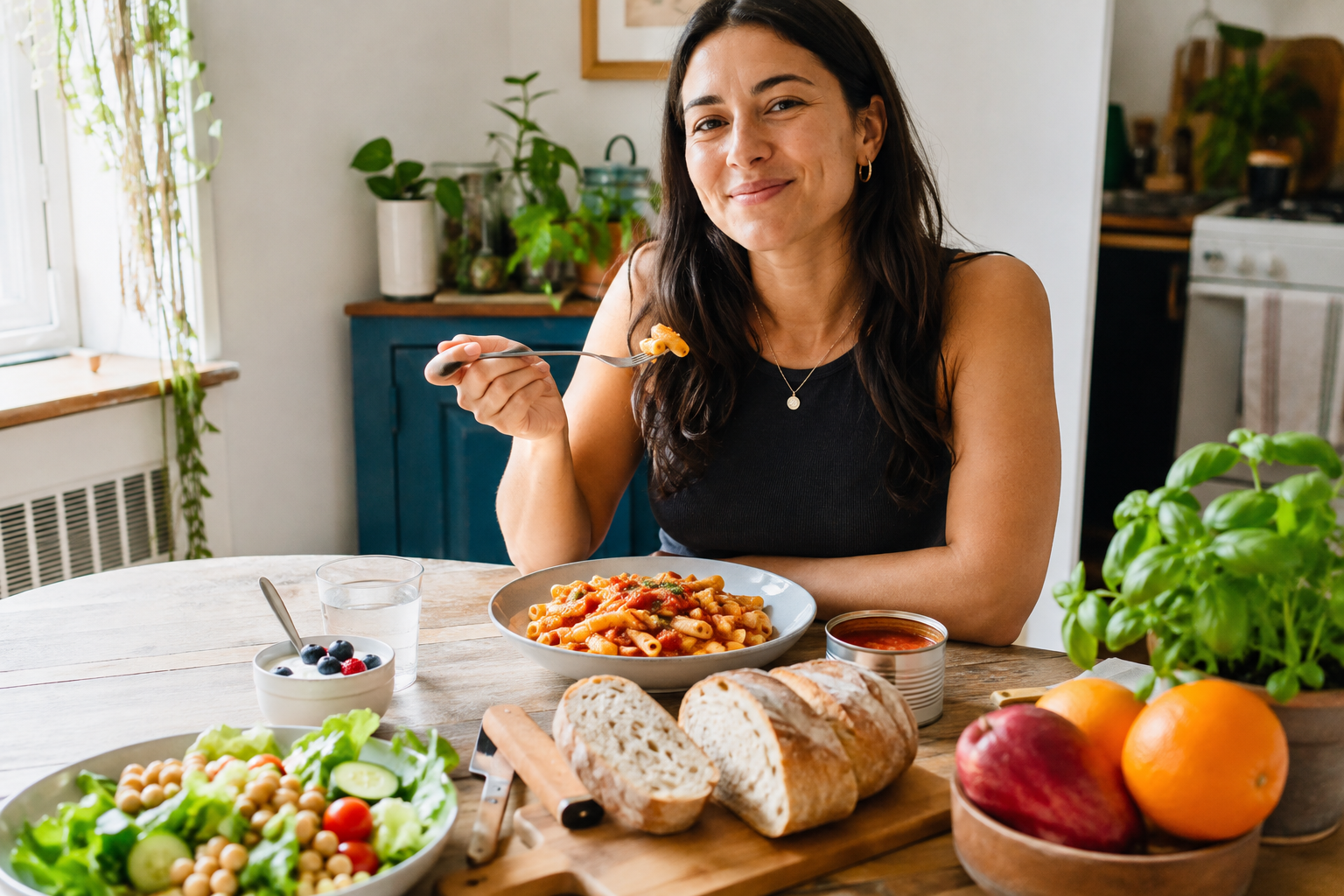
Before I could shop by European rules, I had to decide what those rules were, which meant translating the broad differences between the two systems into something usable while standing in an aisle. I built myself a working rulebook based on the main ways European food regulation diverges from the American approach, and I held myself to it strictly for the full month, no exceptions.
The core of my rulebook came down to a few principles. Europe bans or restricts a number of additives and colorings that America permits, requires certain warnings and clearer disclosures that America does not, and generally leans on a precautionary philosophy that treats an ingredient with more caution until it is shown to be safe, rather than permitting it until it is shown to be harmful. I turned these into practical shopping tests I could apply to any product I picked up.
In practice, that meant checking labels against a handful of questions. Did the product contain a coloring or additive that Europe bans or that triggers a mandatory warning label there, did it carry the kind of clear ingredient disclosure European rules demand, and would its labeling claims survive Europe’s stricter rules about what you can say on a package. Armed with these tests, I started shopping, curious about how much of a normal American store would be off-limits. I should say plainly that this was my own practical approximation, not a legal audit. Food law on both sides is vast and technical, full of exceptions and thresholds that a shopper cannot fully apply in an aisle, so I was capturing the spirit and the main lines of the European approach rather than every regulatory detail. The point was never bureaucratic precision but to see, in broad and honest strokes, how differently the two systems treat the same shelf of food.
The Colors That Stopped Me
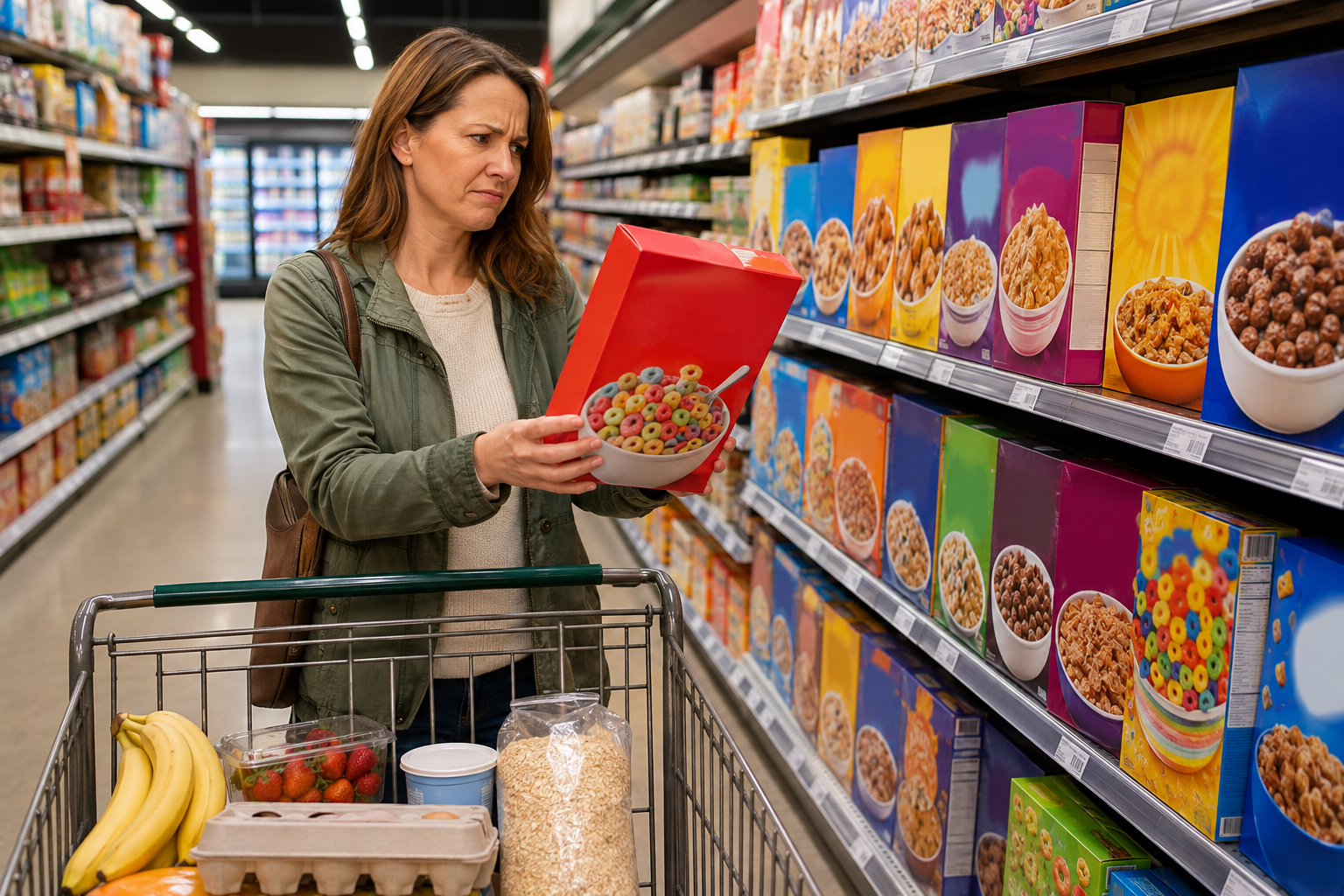
The most concrete differences showed up in food coloring, which turned out to be the clearest dividing line between the two systems. A number of the bright artificial dyes that appear in American candies, snacks, drinks and cereals are treated very differently in Europe, and this was where my rulebook bit hardest.
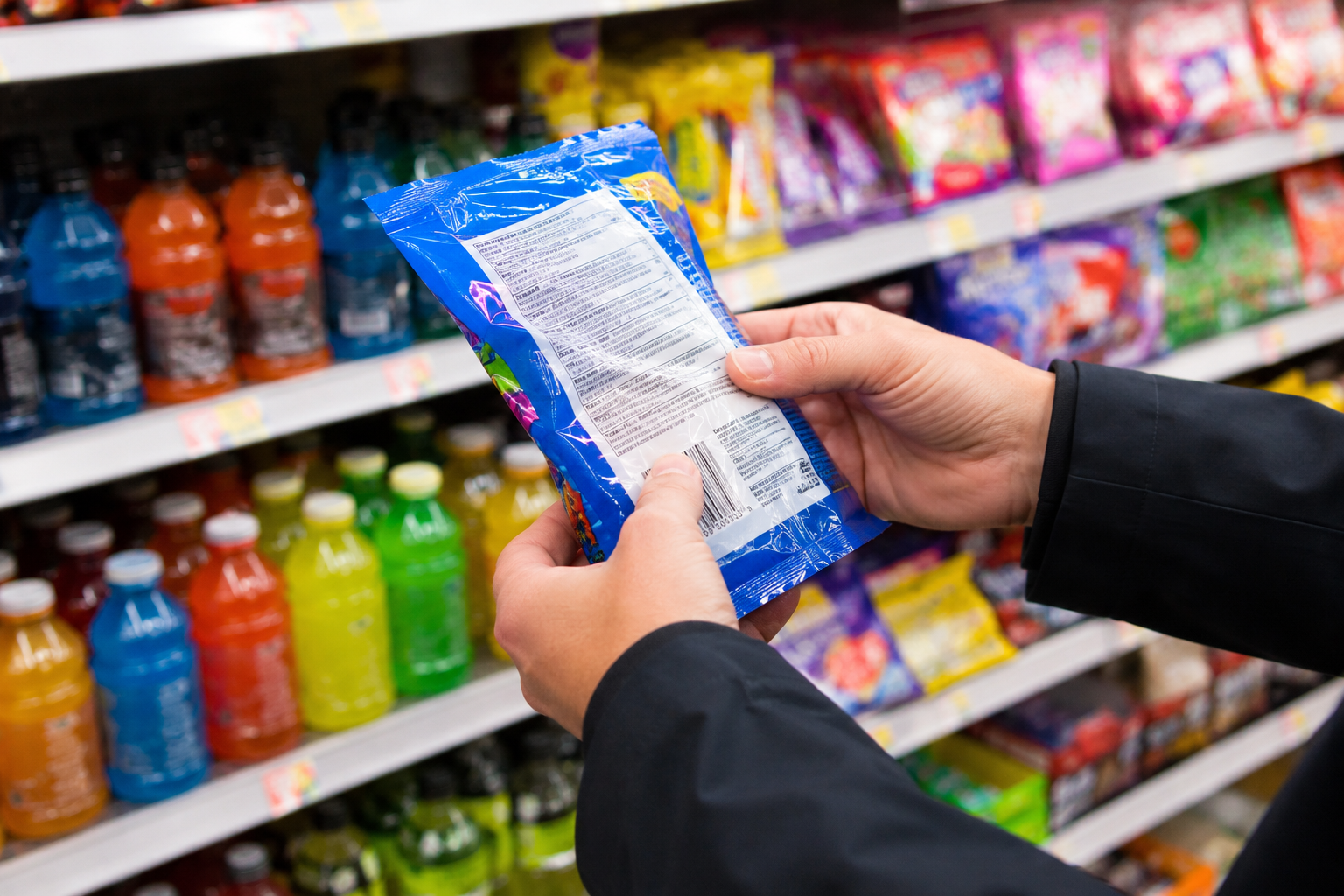
The specific issue is disclosure and restriction. Several synthetic dyes common in colorful American products are, in Europe, either restricted or required to carry a warning that the coloring may affect activity and attention in children, a warning that has effectively pushed many European manufacturers to reformulate with natural colorings instead. So a brightly colored American product that carries no such warning would, under European rules, either need reformulating or need that cautionary label.
This ruled out a surprising amount. Many of the most vividly colored candies, sports drinks, snack cakes and children’s cereals on the American shelves fell outside my European rulebook, not necessarily because the products are considered dangerous in any dramatic sense, but because Europe’s approach to those specific dyes is more cautious and more disclosure-heavy than America’s. Walking past the cereal aisle with European eyes, the sheer intensity of the artificial color suddenly looked less normal than it always had. It is worth being fair about what this does and does not mean. The warning Europe attaches to these dyes concerns a possible effect on children’s attention, not a claim that the colors are broadly toxic, and reasonable scientists differ on how strong even that evidence is. What struck me was not a sense of danger so much as a sense of contrast: Europe had decided the doubt was enough to warrant a label or a reformulation, and America had decided it was not, and the candy aisle is where that difference becomes visible to the eye.
What I Could Still Buy
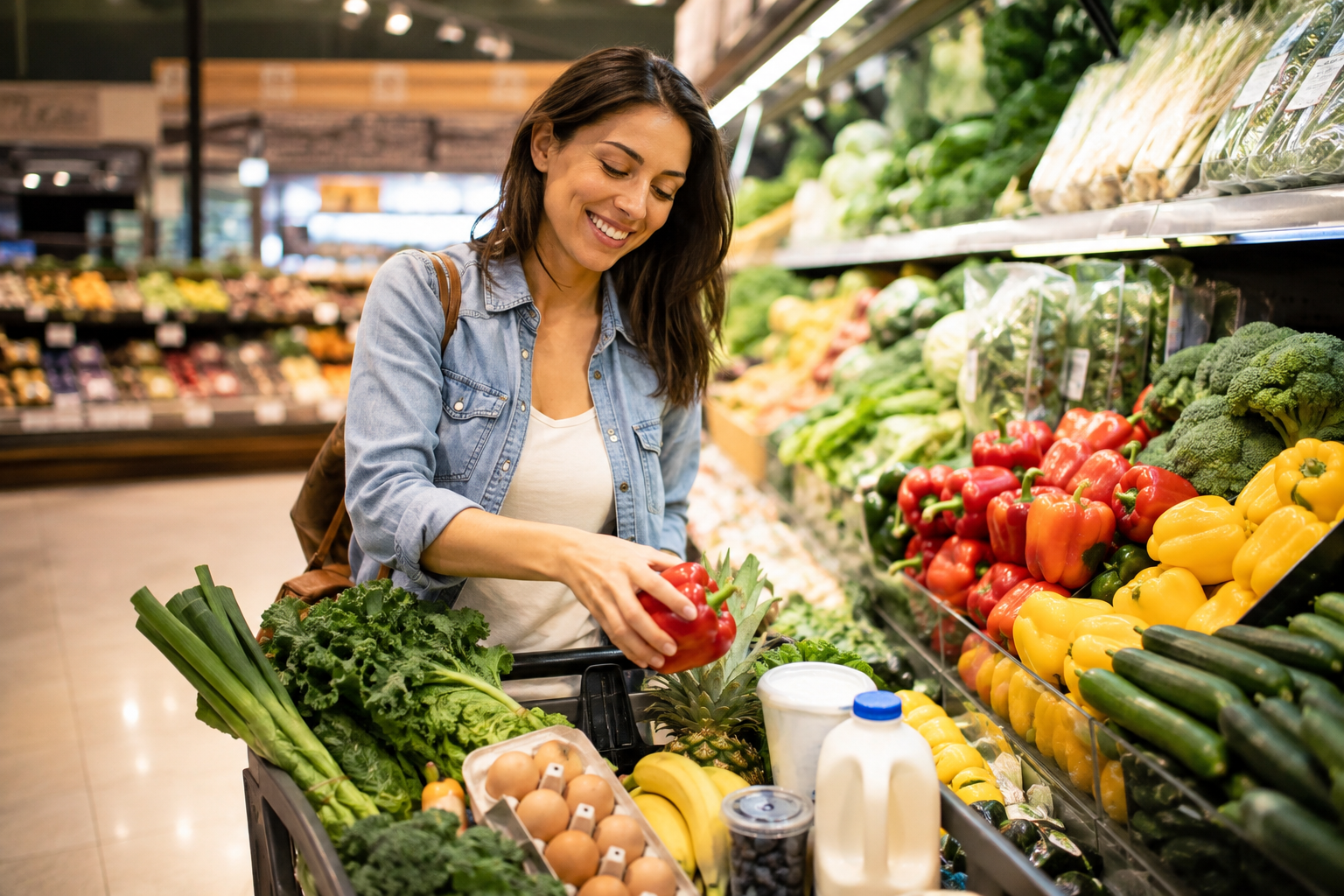
It would be misleading to describe the month as one of scarcity, because the truth is that most of the store remained open to me, and this is an important corrective to the idea that American food is uniformly unacceptable by European standards. The overwhelming majority of my cart was completely fine under European rules.
The whole perimeter of the store was essentially unrestricted. Fresh produce, meat, fish, eggs, dairy, grains, legumes and nuts passed without any trouble at all, because raw and minimally processed foods look much the same under either regulatory system and are governed by broadly similar safety standards. Nothing about shopping for real, basic ingredients changed at all, which is worth emphasizing against the alarmist narrative.
Plenty of packaged food passed too. Many processed products, from pasta to canned tomatoes to countless everyday staples, contained nothing that ran afoul of my European rulebook, since a great deal of ordinary packaged food is made much the same way on both continents, and many American brands already avoid the additives in question. The restricted zone, it turned out, was narrower and more specific than I had imagined, concentrated in particular categories rather than spread across the whole store. This mattered to me because the popular version of the European food story implies that an American shopper is wading through a sea of banned substances, and that is simply not what the aisles showed. The difference is real but bounded, living in identifiable pockets of the store rather than contaminating everything in it. A person eating mostly whole foods and ordinary staples would barely brush against the restricted zone at all, which is a reassuring and underreported fact.
Where the Real Differences Live
Once I had shopped for a while, a clear map emerged of where American and European rules truly part ways, and it was more precise and more interesting than a blanket judgment of one system over the other. The differences clustered in specific places rather than everywhere, and knowing where they live is more useful than any sweeping claim.
The friction points were fairly consistent. Beyond the artificial dyes, my European rulebook flagged certain additives and preservatives used in some American processed foods that Europe restricts, some of the additives used to treat flours and baked goods, and a category of vague labeling, the American allowance of broad terms that disclose less than European rules require about what exactly is in a product. These were the recurring reasons something failed my test.
That last point, labeling transparency, was quietly the most significant. More than any single banned substance, the biggest structural difference was in how much the label is required to tell you, with European rules generally demanding clearer and more specific disclosure of ingredients and additives than American rules do, so that even when the same substance is permitted on both sides, Europe more often makes you tell the shopper it is there. The European difference is as much about what must be disclosed as about what is banned.
The Philosophy Underneath
By the end of the month, I understood that the scattered differences I kept bumping into were surface expressions of a deeper divergence in philosophy, a fundamentally different way of thinking about the burden of proof in food safety. This underlying difference explains the specific rules better than any list of banned ingredients could.
The contrast is often described in terms of precaution. European food regulation leans more heavily on the precautionary principle, a tendency to restrict or require disclosure for an ingredient when there is reasonable doubt about it, placing more of the burden on demonstrating safety, whereas the American system more often permits an ingredient until there is clearer evidence of harm. Neither philosophy is obviously and completely right, and each has real costs and benefits, but they lead to visibly different supermarkets.
This is the invisible architecture behind the shelves. The reason my European rulebook flagged the things it did was not a series of unrelated quirks but the downstream result of this one philosophical difference about how much certainty a society demands before allowing something into the food supply, and once I saw that, the whole pattern of what I could and could not buy made sense. The supermarket, read this way, is a physical expression of a regulatory worldview. And like any worldview, it is invisible precisely because it is everywhere, the way you never notice the water you swim in. An American shopper does not notice the American rulebook any more than a European notices theirs, until the two are set side by side.
What the Experiment Taught Me
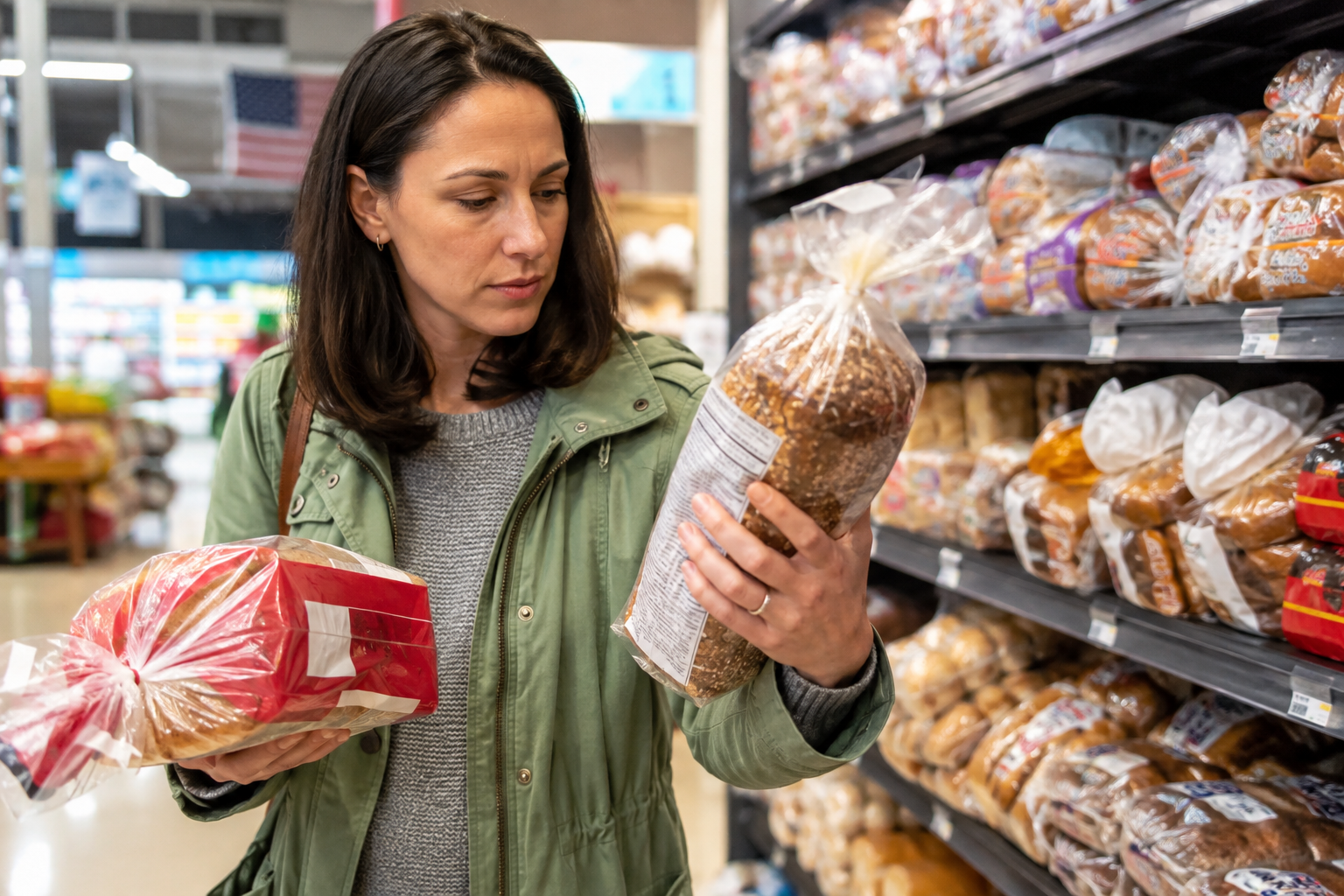
Coming out of the thirty days, my conclusions were more measured and more interesting than the simple story I had half expected to tell, and I want to report them plainly rather than force them into a tidy verdict. The experiment did not prove that American food is poison, nor that European food is flawless, but it did reveal real and meaningful differences worth understanding.
The measured takeaways were these. Most of an American supermarket is perfectly acceptable by European standards, the real differences are concentrated in specific categories like artificial dyes, certain additives, and labeling disclosure rather than spread everywhere, and the single biggest gap is not about danger but about transparency, about how much the label is required to tell you. That is a more nuanced picture than either camp in the usual food-fight tends to paint, and a more accurate one.
What I valued most was simply seeing the architecture. Shopping by another system’s rules made visible the choices baked into my own food environment that I had never noticed, the colors I had accepted as normal, the disclosures I had never been given, the philosophy I had never questioned, and that awareness is worth more than any single rule. Even now, back to shopping normally, I read labels differently, having seen how much a label can be asked to reveal, and how much it can be allowed to withhold. That single shift in attention may be the most durable result of the whole month. I no longer take the front of a package at face value, and I no longer assume that a short, clean-looking label and a fully disclosed one are the same thing, because I have seen how much room the rules leave for what goes unsaid. It is a small habit of skepticism, but it travels with me down every aisle now.
Reading the Aisles Differently

The lasting lesson of my month shopping an American store by European rules is that a supermarket is not a neutral collection of food but the product of countless regulatory decisions, and that those decisions differ enough between societies to change what fills your cart. What I could not buy was a small, specific slice of the store, concentrated in a few categories, and understanding why turned out to be far more illuminating than the ban itself.
What makes the exercise worth doing, even in imagination, is how it restores sight to something we look at without seeing. We walk grocery aisles on autopilot, accepting the colors, the claims, and the silences of the labels as simply how food is, when in fact every one of those things reflects a choice that could have been made differently, and was, a few thousand miles away. Seeing your own food system through another’s rules is a fast way to notice what you had stopped noticing.
So while I am not here to tell you that one system is simply better, I would recommend the mental version of this experiment to anyone. Next time you shop, imagine the European rulebook in your hand, ask what would need a warning, what would need clearer disclosure, what a more cautious system would question, and watch how differently the familiar aisles read. You may still buy most of what you always did, but you will see it, perhaps for the first time, as the product of choices rather than the natural order of things. That change in vision, more than anything I left in the store, is what I carried home from the experiment.

About the Author: Ruben, co-founder of Gamintraveler.com since 2014, is a seasoned traveler from Spain who has explored over 100 countries since 2009. Known for his extensive travel adventures across South America, Europe, the US, Australia, New Zealand, Asia, and Africa, Ruben combines his passion for adventurous yet sustainable living with his love for cycling, highlighted by his remarkable 5-month bicycle journey from Spain to Norway. He currently resides in Spain, where he continues sharing his travel experiences with his partner, Rachel, and their son, Han.