
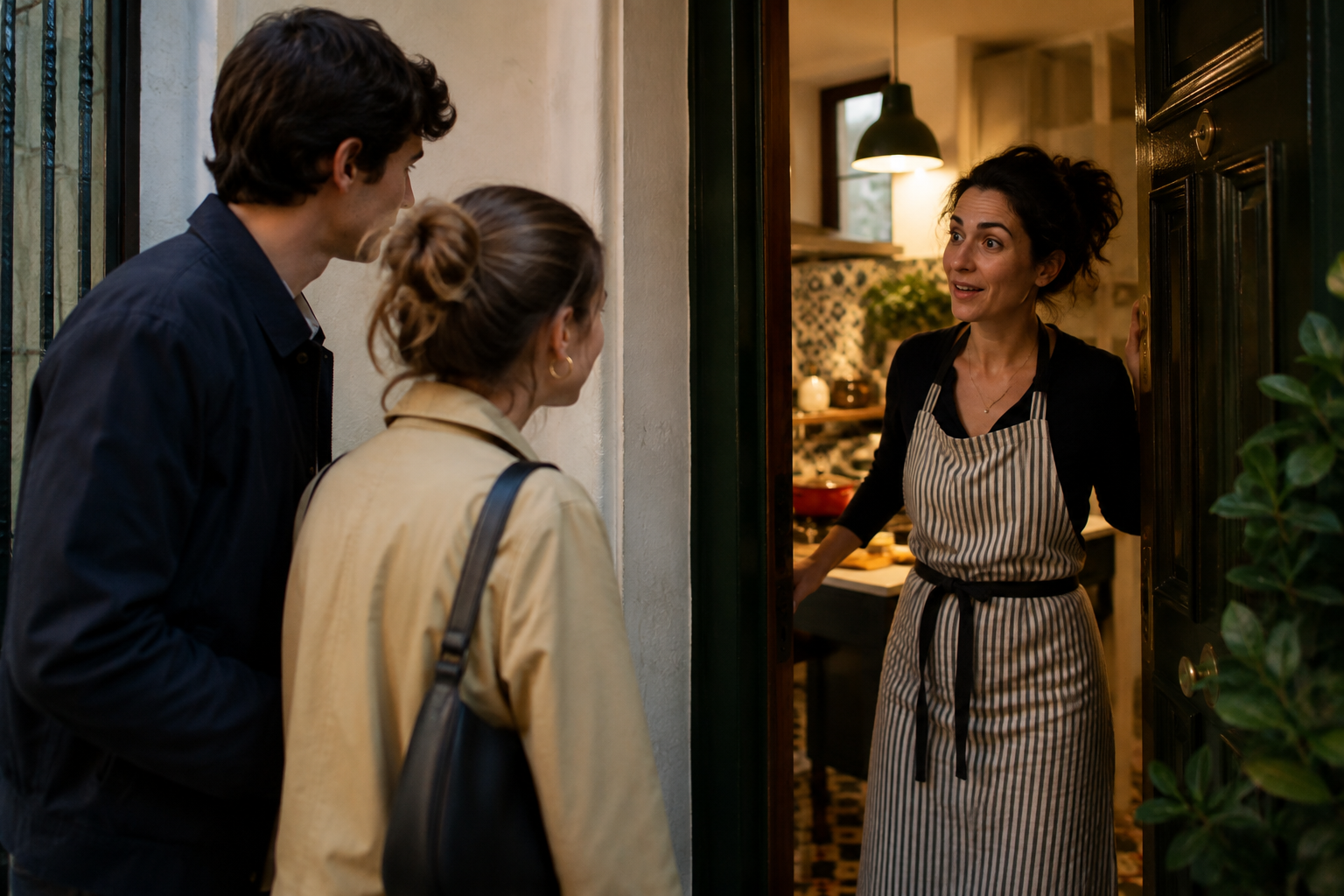
An American invited to dinner at a Spanish home does the natural thing. The invitation says nine o’clock, so they arrive at nine o’clock, perhaps even a few minutes early to be safe, ring the bell, and are met by a slightly flustered host still in an apron, the table not yet set, the evening visibly not ready for them. The guest has done nothing wrong by their own culture’s rules, and yet they have stumbled, because in Spain arriving exactly on time to a dinner party is a small social mistake. There is an unstated rule, understood by everyone and written down nowhere, that you arrive a little later than the time you were given, and knowing that rule, along with exactly how much later for each kind of occasion, is one of the quiet keys to fitting in.
The famous Spanish flexibility with time is real, but it is not the shapeless free-for-all outsiders sometimes imagine. There is a genuine structure to it, a set of unspoken expectations about how late is right for a dinner party, how late for a casual lunch, how late for drinks at a friend’s, and, crucially, when you must instead be exactly on time. The trouble for the newcomer is that none of it is ever stated, so they must either learn it by trial and embarrassment or have it explained. This piece explains it.
Here is the unwritten Spanish rule about arriving late to social occasions, how much lateness is right for each different kind of gathering, why the custom exists, and the important exceptions where being late is truly rude. This is a look at social custom rather than rigid law, and norms vary by region, generation and circle, but understanding the underlying rhythm turns a baffling source of social missteps into something you can navigate with confidence and even come to enjoy.
The Rule Nobody Says Out Loud
The core of it is simple, that for a Spanish social gathering you are expected to arrive somewhat later than the stated time, and doing so is not rudeness but good manners. This is the concept sometimes called la hora española, the Spanish hour, the tacit understanding that social events begin a comfortable margin after the clock time named in the invitation, and that everyone knows it without anyone ever having to say so.
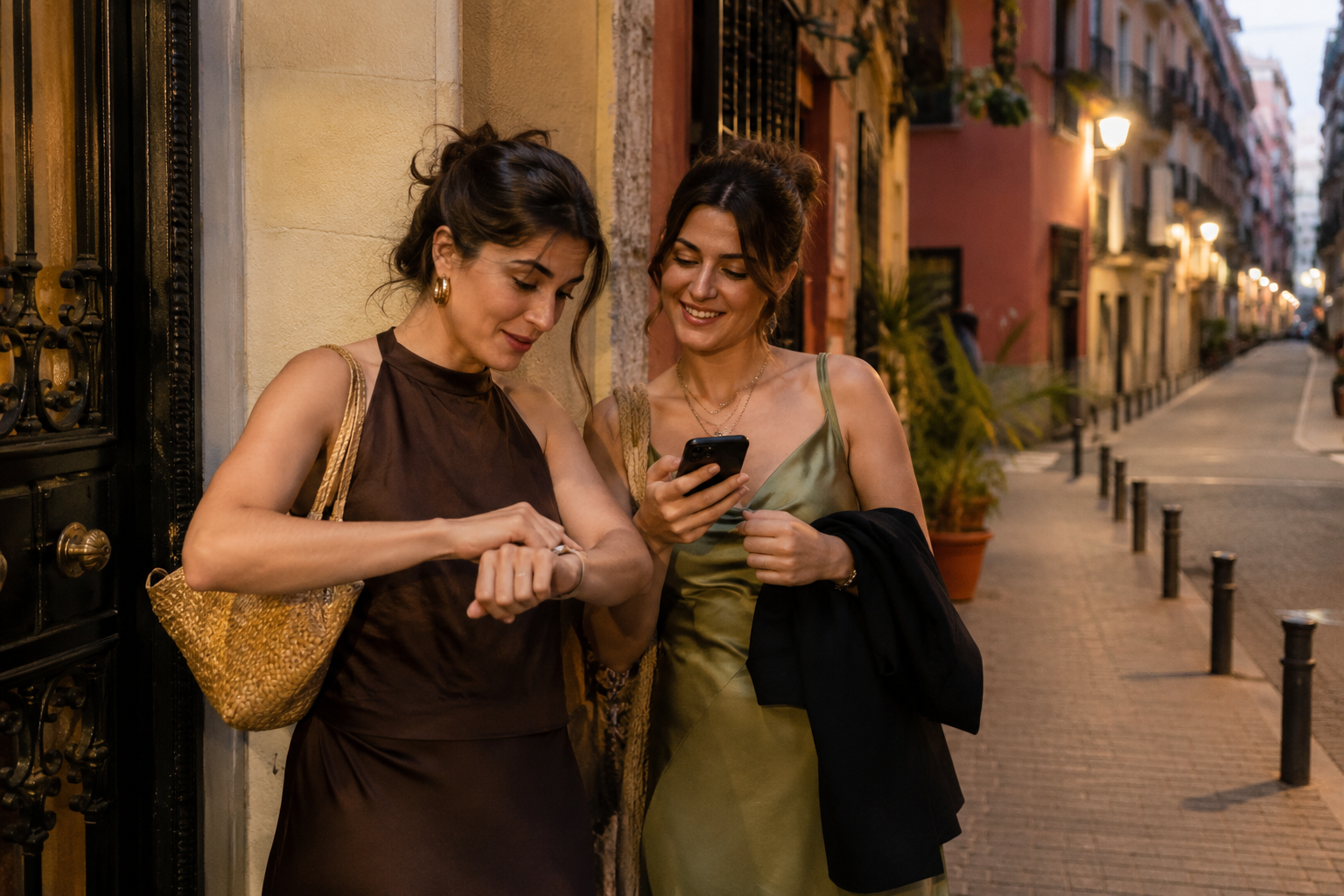
The margin is real and roughly known. For most social gatherings, arriving fifteen to thirty minutes after the stated time is normal, accepted and often expected, so a nine o’clock invitation really means somewhere around nine fifteen to nine thirty in practice, and both host and guest understand this. Turning up at nine sharp is not early by the invitation, but it is early by the real, unspoken schedule that everyone quietly keeps.
This is why arriving precisely on time can misfire. When you appear at the exact clock time, you arrive before the host and the evening are truly ready, catching them in the final frantic stretch of preparation and forcing them to receive you when they wanted those last minutes to finish, so your punctuality, meant as courtesy, lands as a small imposition. The rule that nobody states is that the stated time is an opening bracket, not an appointment, and the gracious guest arrives inside the bracket rather than at its very start. What makes this so hard for newcomers is precisely that it is never spoken. A Spaniard absorbs the rule in childhood and applies it without thought, so it never occurs to them to explain it, and the invitation itself gives no hint, naming a clean clock time that means something entirely different in practice. The outsider is left to decode a convention that everyone around them treats as too obvious to mention, which is exactly why it catches so many by surprise.
Why On Time Is the Wrong Time
To an American raised to believe that punctuality is respect and lateness is rudeness, this can feel backward, so it helps to understand why arriving exactly on time works against you at a Spanish dinner. The reason is practical and kind, rooted in what those final minutes before a party mean to the person hosting it.
Consider the host’s position in those last minutes. The stretch just before the stated time is when a host does the final, chaotic, essential work of getting ready, the last touches to the food, the setting of the table, the quick change of clothes, the tidying of the room, all the small things that turn a home from preparation into party, and it is precisely the time they are least ready to greet a guest. Arriving dead on time drops you into the middle of that scramble.
The customary cushion exists to protect exactly that stretch. By arriving fifteen or twenty minutes after the stated time, you give the host those crucial final minutes to finish and compose themselves, so that when you do arrive they are ready, relaxed and able to welcome you properly, which is a far more pleasant beginning for everyone than a harried greeting at the door. The late arrival is not laziness but a courtesy, a gift of breathing room, which is exactly why the culture treats it as the polite thing to do. Seen this way, the custom is not the absence of consideration but a different form of it. Where the American shows respect by honoring the clock to the minute, the Spaniard shows it by honoring the host’s need for those last unhurried moments, and both are trying to be kind, only by different means. Once you grasp that the lateness is itself the courtesy, the whole thing stops feeling like carelessness and starts feeling like the thoughtful gesture it truly is.
How Late for Which Occasion

The single greatest confusion for newcomers is that the right amount of lateness is not fixed but varies by the kind of event, so the real skill is knowing how late is right for each occasion. Getting this calibration right, rather than applying one blanket rule, is what separates the guest who reads the room from the one who is always slightly off.
A stated dinner at someone’s home sits in the middle of the range. For a dinner party at a fixed time, the classic cushion applies, arriving roughly ten to twenty minutes after the stated hour, so a nine o’clock dinner means arriving around nine fifteen, late enough to respect the rule but not so late as to hold up the meal, which is the sweet spot for the most common kind of invitation. This is the default the newcomer should internalize first. It is the safest bet when you are unsure, striking the balance between respecting the cushion and not holding up a meal that a host has timed. Arriving at this point, you will almost never be the first through the door, which is the position to avoid, nor so late that the food suffers, which is the other extreme, so when in doubt about a home dinner, the modest cushion of a quarter hour or so is the reliable choice.
The other occasions shift the dial in predictable ways. A Sunday family lunch, an earlier and more anchored affair often built around children and grandparents, wants only a small margin, perhaps ten to twenty minutes after the stated time, since the meal is more scheduled. A casual weeknight gathering for drinks or informal tapas at a friend’s home is the loosest of all, where arriving twenty to forty minutes late is perfectly normal, and turning up promptly would be almost eccentric. The looser and more casual the event, the wider the acceptable window, and the more fixed and formal, the tighter it grows.
When You Must Be On Time

Just as important as knowing when to be late is knowing the situations where the whole rule reverses and punctuality is not just acceptable but required, because getting this wrong is a far more serious mistake than arriving on time to a dinner. The relaxed social clock does not apply everywhere, and assuming it does can do real damage.
The great dividing line is between the social and the professional. While Spanish social life runs on the flexible clock, the professional and formal world runs on a strict one, so business meetings, job interviews, medical and official appointments, and anything with a fixed institutional schedule, all demand genuine punctuality, exactly as they would anywhere. Applying Spanish social lateness to a business meeting is a classic and damaging foreign error, reading not as cultural fluency but as unreliability.
There are social exceptions too worth noting. Anything with a hard start time that cannot flex, a restaurant reservation, a show, a concert, a train requires you to be on time regardless of the social custom, since the schedule is fixed by something outside the gathering itself. And occasionally a host will signal that they want promptness, sometimes because of an early start the next day, in which case the considerate guest honors that request. The rule of thumb is that flexibility applies to open-ended social gatherings, while anything on a fixed external clock demands punctuality.
Reading the Signals

Beyond the broad categories, a skilled guest learns to read the specific signals that tell them how to time a given arrival, because the invitation and the context often contain clues. Paying attention to these lets you calibrate precisely rather than guessing, and getting it right marks you as someone who understands the culture from the inside.
The wording of the invitation carries information. A precise, formal time suggests a tighter schedule and less lateness, while a vague or casual invitation, the kind that says come around nine or drop by in the evening, signals a loose and forgiving window where more lateness is fine. When a host adds a note about timing, an explicit request to come early or a warning about an early morning after, that overrides the default and should be followed to the letter.
The nature of the group and the event fills in the rest. A gathering with children, older relatives, or a cooked sit-down meal tends to run more punctually, since food and family impose their own schedule, while a young, informal crowd meeting for drinks runs looser. Over time you learn to read these cues automatically, sensing from the invitation and the company roughly where in the range a given event falls, which is the fluency that turns the whole system from a source of anxiety into second nature. This reading of signals is ultimately what separates the seasoned resident from the newcomer, and it comes only with time and attention. At first every invitation is a small puzzle, but after enough evenings you stop calculating consciously and simply feel the right moment to leave the house, arriving as if by instinct at the hour the occasion wanted. That instinct is the real goal, the point at which the unstated rule has become your own unspoken habit.
When You Are Running Genuinely Late
The flip side of the flexible clock is knowing what to do when you cross from acceptably late into properly late, because even a forgiving culture has a point past which a heads-up becomes polite. Understanding where that line falls, and how to handle crossing it, completes the picture.
There is a threshold beyond the normal cushion. The customary fifteen-to-thirty-minute window is expected and needs no apology or explanation, but once you are running substantially later than that, well past the point the occasion would normally absorb, a quick message to the host becomes the courteous move, letting them know you are delayed and roughly when you will arrive. This is simple consideration, the same anywhere, layered on top of the local tolerance.
The manner of the message matters in Spain. A warm, brief communication works best, a quick voice note or call rather than a terse text, with a light apology and an estimated time, and it is a thoughtful touch to offer to bring something useful, ice or bread or wine, which turns an apology into a small contribution. Handled this way, even real lateness stays gracious, and the evening absorbs it without friction. The culture is forgiving, but the forgiveness is repaid with a little warmth and communication when you push past the ordinary margin.
Learning the Rhythm

The deeper truth behind the fifteen-minute rule is that Spanish social timing is not chaos but a different order, a rhythm that prioritizes the ease and warmth of the gathering over the precision of the clock. Once you stop trying to impose punctual habits on it and start feeling the underlying beat, the whole system reveals itself as sensible and even gracious, designed to make hosting less stressful and gatherings more relaxed.
What makes learning it so worthwhile is how much smoother social life becomes once you do. Instead of arriving to flustered hosts and half-set tables, instead of misjudging every invitation, you begin to arrive at the right moment for each occasion, welcomed by a host who is ready and glad to see you, which transforms your experience of Spanish social life from a series of small missteps into an easy belonging. The rule that once tripped you up becomes a rhythm you move to naturally.
So the next time a Spanish invitation names a time, resist the deep-seated urge to arrive exactly on it. Read the occasion, judge whether it is a fixed dinner, a casual gathering of drinks, or an anchored family lunch, add the appropriate cushion, and arrive a gracious few minutes into the unspoken window rather than at its very start, while remembering to switch instantly to strict punctuality the moment the setting turns professional or the clock turns fixed. Master that single calibration, the one rule nobody states, and you will move through Spanish social life not as a baffled outsider forever arriving at the wrong moment, but as a guest who has learned the rhythm and arrives, every time, exactly when they should.

About the Author: Ruben, co-founder of Gamintraveler.com since 2014, is a seasoned traveler from Spain who has explored over 100 countries since 2009. Known for his extensive travel adventures across South America, Europe, the US, Australia, New Zealand, Asia, and Africa, Ruben combines his passion for adventurous yet sustainable living with his love for cycling, highlighted by his remarkable 5-month bicycle journey from Spain to Norway. He currently resides in Spain, where he continues sharing his travel experiences with his partner, Rachel, and their son, Han.