
A while ago I wrote about the two-meal rhythm I noticed living in Spain, the way so much of Mediterranean life organizes itself around one substantial midday meal and something much lighter in the evening, and it struck a nerve. People wrote to me about it, tried it, told me it changed how their days felt. But in all the attention the rhythm got, something important got lost, which is that the two-meal pattern was never really the thing doing the work. It was the visible tip of a much larger way of living, and the parts nobody talks about are the parts that truly matter.
So let me correct the record on my own popular idea, because I think the emphasis went wrong. The two-meal rhythm is real and it is lovely, but on its own, lifted out of the life it belongs to and treated as a rule to be imposed by willpower, it is close to meaningless. What makes it work in the Mediterranean is not the counting of meals but three quiet habits that surround it, habits that nobody turned into a headline because they are too ordinary to sound like a secret. Those three habits are the real story.
Here is what really sits behind the two-meal rhythm, the three everyday habits that make it more than a rule, and why the pattern falls apart without them. This is general lifestyle observation rather than medical or nutritional advice, meal rhythms that suit one person may not suit another, and this is emphatically not about skipping meals or eating less through sheer discipline, nor a plan for anyone with a fraught history around food, who should treat the whole subject with care and a doctor’s input. It is about the life that makes a gentle rhythm feel natural, which is a very different thing.
Why the Rule Alone Does Nothing

Start with the correction, because it matters most. When people took the two-meal idea and ran with it as a standalone rule, many found it either hard or pointless, and the reason is simple. A meal pattern is just a container, and an empty container changes nothing. Forcing yourself to eat two meals a day through willpower, while everything else about your life stays the same, is a recipe for a hungry, irritable, unsustainable few weeks and little else.
This is the trap of every rhythm lifted out of its context. The Mediterranean two-meal pattern was never a diet rule that people follow through discipline, but the natural byproduct of a whole way of living in which that rhythm simply makes sense, and stripping it of that context leaves you with the hard shell and none of the substance. The rule is the shadow of the habits, not the cause of anything.
That is why I want to redirect the attention entirely. The interesting question was never how many meals to eat but what kind of life makes a gentle, unforced eating rhythm feel easy and good, and the answer lies in three habits that have nothing to do with meal timing at all. Get those right and the rhythm takes care of itself. Chase the rhythm without them and you are just another person white-knuckling a rule, which is precisely the joyless, unsustainable trap the Mediterranean approach was supposed to rescue us from in the first place.
Habit One, the Meals Are Real and Satisfying

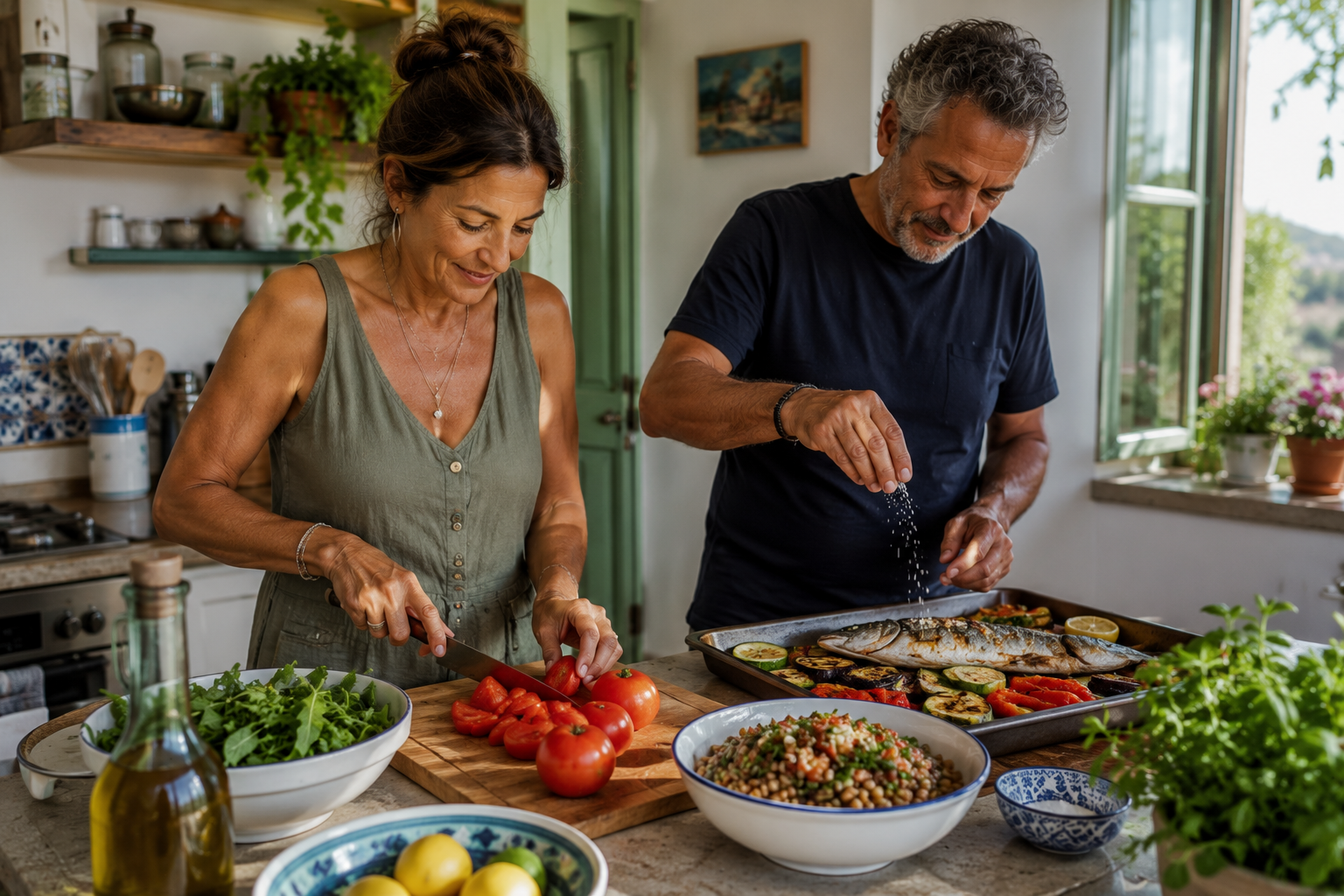
The first habit behind the rhythm is that the meals themselves are substantial, whole and deeply satisfying, and this is what makes a lighter evening feel natural rather than punishing. The Mediterranean midday meal is not a sad diet plate but a real, generous, nourishing spread of whole foods, vegetables and beans and good oil and bread and often a proper main, the kind of meal that leaves you well content for hours.
This satisfaction is the whole mechanism, and it is the opposite of restriction. Because the main meal is rich in fiber, flavor and substance, it satisfies in a lasting way, so that a lighter evening arrives not as a deprivation to be endured but as a natural consequence of already being well fed. You are not resisting dinner through willpower. You simply are not very hungry, because you ate real food earlier and your body is content.
Take this habit away and the rhythm collapses instantly. Eat a small or unsatisfying midday meal and by evening you will be ravenous, and no rule about two meals will survive that hunger, and nor should it, because the hunger is real and the rule was never the point. The lighter evening only works when the day’s eating has truly satisfied you, which means the habit behind the rhythm is not eating less but eating well enough that less feels like plenty.
Habit Two, the Body Is Moving All Day
The second habit is movement, the constant, gentle, unremarkable activity that fills a Mediterranean day, and it changes the whole relationship between a person and their food. This is not exercise in the modern sense but the ordinary motion of a life lived partly on foot, the walking to the shops and the strolling after meals and the general refusal to sit still all day, and it hums along in the background of everything, unnoticed and unlogged. A Mediterranean day simply contains more motion than a modern sedentary one, not through effort but through the ordinary shape of a life that still walks to things.
Movement shapes appetite and wellbeing in ways that make a gentle eating rhythm feel right. A body that moves through its day tends to have a steadier, more honest appetite, hungry when it needs fuel and settled when it does not, in contrast to the restless, bored, disconnected hunger that a sedentary day so often produces. The walking Mediterranean body asks for food differently than the sitting one, and it is easier to feed well.
The evening walk deserves special mention, because it is the quiet companion of the lighter dinner. The tradition of a gentle stroll after the day’s meals aids digestion and eases the body into evening, and it fills the after-dinner hours with something pleasant and active rather than the restless grazing that so often happens in front of a screen. Remove the daily movement and the whole rhythm grows harder, because a still body sends confused signals about hunger that no meal rule can quiet.
Habit Three, the Meals Are Slow and Shared

The third habit is the social, unhurried nature of the meals, and it may be the most powerful of the three precisely because it looks like it has nothing to do with weight or wellbeing at all. Mediterranean meals, above all the main midday one, are long, leisurely and shared, eaten at a table with other people over conversation, stretched out and enjoyed rather than gulped in solitude. The meal is an occasion.
This slowness quietly regulates everything. Eating slowly, in company, gives the body the time it needs to feel its own fullness, which arrives naturally when a meal is savored over an hour of talk rather than inhaled in ten minutes, so a person eating this way tends to feel satisfied and to stop without any conscious rationing. The pace does gently and pleasantly what dieting tries and fails to do through force.
The shared quality matters just as deeply. A meal that is also a gathering satisfies needs beyond hunger, for connection and pleasure and belonging, so that the person leaving a long Mediterranean lunch is full in more than one sense and does not go looking for that fullness again in the evening through food. The lonely, rushed, distracted meal leaves a hollowness that grazing tries to fill, while the slow, shared meal fills it directly, which is why the habit of eating together underpins the whole gentle rhythm. This is the habit modern life has stripped away most completely, and it may be why so many people feel unsatisfied no matter what or how much they eat. When meals are solitary and hurried, a real human need goes unmet at the very moment food is consumed, and the body keeps asking for more because the thing it truly wanted was never food at all. Restoring the shared, unhurried meal restores something the plate alone could never provide.
How the Three Habits Make the Rhythm
Put the three habits together and the two-meal rhythm stops being a rule and becomes simply what happens, which is the entire point. A person who eats a real, satisfying midday meal, who moves gently through their day, and who takes that meal slowly and in company arrives at evening already well fed, physically settled and emotionally full, and a lighter dinner is the natural, effortless result rather than an act of discipline.
This is why the rhythm feels so different when it grows from the habits rather than being imposed on top of them. There is no hunger to fight, no willpower to summon, no rule to obey, only a body that has been fed well and moved often and fed in good company, quietly asking for less in the evening because it genuinely needs less. The pattern that looked like a discipline turns out to be a byproduct of contentment.
And this is the deep reason the standalone rule disappointed so many people. They took the outcome and tried to use it as a method, imposing the light evening without building the satisfying meals, the daily movement or the slow shared eating that make it feel natural, which is a little like admiring a tan and trying to get one by staying indoors, and so they got the hunger without the contentment, the restriction without the ease. The rhythm was never the cause of Mediterranean wellbeing. It was one of its gentlest symptoms. This reframing takes all the pressure off, which is exactly as it should be. You do not have to master a difficult rule or resist your evening hunger through gritted teeth, because if you build the pleasant habits underneath, the rhythm either arrives on its own or it does not, and either way you are eating well and living better. The habits are the goal, and the rhythm is just a sign that they have taken hold.
The Danger of Turning It Into a Diet
There is a warning I want to fold in here, because ideas like the two-meal rhythm can be taken in an unhealthy direction, and I would rather say so plainly. The moment a gentle eating pattern becomes a strict rule enforced against hunger, it stops being the relaxed Mediterranean rhythm and starts becoming a restriction, and restriction is exactly what this way of living is not about. If a lighter evening leaves you truly hungry, the answer is to eat, not to tough it out.
The Mediterranean rhythm works because it is permissive, not punishing. Nobody in a Spanish or Italian kitchen is skipping food they want or ignoring real hunger to hit a target, because the whole point is that the satisfying, well-fed days make a lighter evening feel natural rather than forced. The instant you find yourself using the rhythm to eat less than your body is asking for, you have left the tradition entirely and wandered into dieting, which fails for all the usual reasons.
This matters especially for anyone who has ever had a fraught relationship with food. A rhythm that is meant to bring ease around eating can, taken rigidly, do the opposite, turning meals into a test to be passed and hunger into an enemy to be overcome, which is the last thing anyone needs. If that is a risk for you, the kindest thing is to drop the rule entirely and keep only the pleasant parts, the good food, the walking, the shared table.
The honest measure of whether you are doing this well is simple. If the rhythm feels easy, unforced and pleasant, and you are eating freely when hungry, it is working as intended. If it feels like a struggle against your own body, it has become a diet in disguise, and no eating pattern is worth that. The Mediterranean way is meant to feel like relief, not effort, and that feeling is the truest sign you have understood it.
Why This Matters More Than the Rule
Stepping back, the lesson reaches well beyond meal timing, and it is one worth taking to heart about wellbeing in general. We are forever seizing on the visible tips of healthy ways of living, the two-meal rule, the single superfood, the one weird trick, and trying to install them in isolation, and we are forever disappointed when the trick alone does nothing. The visible pattern is almost never the cause. The quiet habits underneath it are.
This is real good news, because it points at something sustainable. The three habits behind the rhythm, satisfying whole-food meals, daily gentle movement and slow shared eating, are pleasant in themselves and worth having for their own sake, entirely apart from any effect on weight, and they are far easier to live with than any rule imposed by force. You do not have to make yourself do them so much as arrange your life to include them.
So if the two-meal idea appealed to you, I would gently steer you away from the rule and toward the habits behind it. Do not count your meals or force a light dinner through discipline. Instead eat real, satisfying food at your main meal, move gently through your days, and slow your meals down and share them when you can, and then simply notice what your appetite does on its own. The rhythm, if it suits you, will arrive by itself, unforced and easy, the way it does for the people who never named it a rule in the first place. And if it does not arrive, no matter, because you will have gained the three habits that were the real prize all along. That is the part nobody ran with, and it is the only part that was ever going to work. The rule made the headline because it was easy to name. The habits made the difference because they were a way of life.

About the Author: Ruben, co-founder of Gamintraveler.com since 2014, is a seasoned traveler from Spain who has explored over 100 countries since 2009. Known for his extensive travel adventures across South America, Europe, the US, Australia, New Zealand, Asia, and Africa, Ruben combines his passion for adventurous yet sustainable living with his love for cycling, highlighted by his remarkable 5-month bicycle journey from Spain to Norway. He currently resides in Spain, where he continues sharing his travel experiences with his partner, Rachel, and their son, Han.