

Months of searching, negotiating, checking and waiting all come down to a single morning in a small office, seated at a table across from a stranger in a formal role, signing a document you may only half understand in a language that may not be your own. This is escritura day, the completion of a Spanish property purchase, and it is the moment when a house stops being something you are buying and becomes something you own. Everything before it is preparation, everything after it is paperwork, and the table is where it truly happens.
For anyone buying a home in Spain, understanding what happens at the notary’s table removes a great deal of the fear from the most important appointment of the whole process. The signing of the escritura, the public deed of sale, follows a clear and well-worn ritual, one that thousands of buyers pass through every week, and knowing the sequence in advance turns a daunting formality into a manageable, even satisfying, final step.
Here is what escritura day really involves, who is in the room, what the notary does and does not do, how the money moves, and what happens after you leave with the keys. This is general information for buyers rather than legal advice, every transaction has its quirks, and you should rely on your own Spanish lawyer throughout, but the shape of the day is remarkably consistent across the country.
The Notary, and What the Role Really Is
The central figure of the day is the notario, the notary, and the first thing to understand is that this person is not your lawyer and not on your side, nor on the seller’s. The Spanish notary is a neutral public official whose duty is to the state and the law, present to ensure that the transaction is legal, properly documented and correctly executed, representing neither buyer nor seller but the integrity of the act itself.
This neutrality is the source of the notary’s authority and the reason the system works. Because the notary answers to the law rather than to either party, their certification of the deed carries real legal weight, confirming to everyone, including the state and any future buyer, that the sale was conducted properly and the parties were who they claimed to be. The notary is a guarantor of legality, not an advocate, and that is precisely what gives the escritura its force. This surprises buyers from countries where a lawyer handles everything and no such neutral official exists. In Spain the roles are split deliberately, your own lawyer advising and protecting your interests in the run-up, and the notary standing apart as the impartial certifier of the final act, so that the deed carries an authority no private agreement could. Understanding that division is the key to understanding the whole Spanish system.
You have more say over the notary than many buyers realize. In Spain the buyer generally has the right to choose the notary, and you are entitled to receive a draft of the deed in advance and to have every essential term written into it, from how the costs are split to the delivery date and the condition of the property. The notary’s office will also have done crucial homework before you ever arrive, checking that the property is registered in the seller’s name and confirming whether any mortgages or charges exist that must be cleared before the sale can complete.
Who Sits at the Table
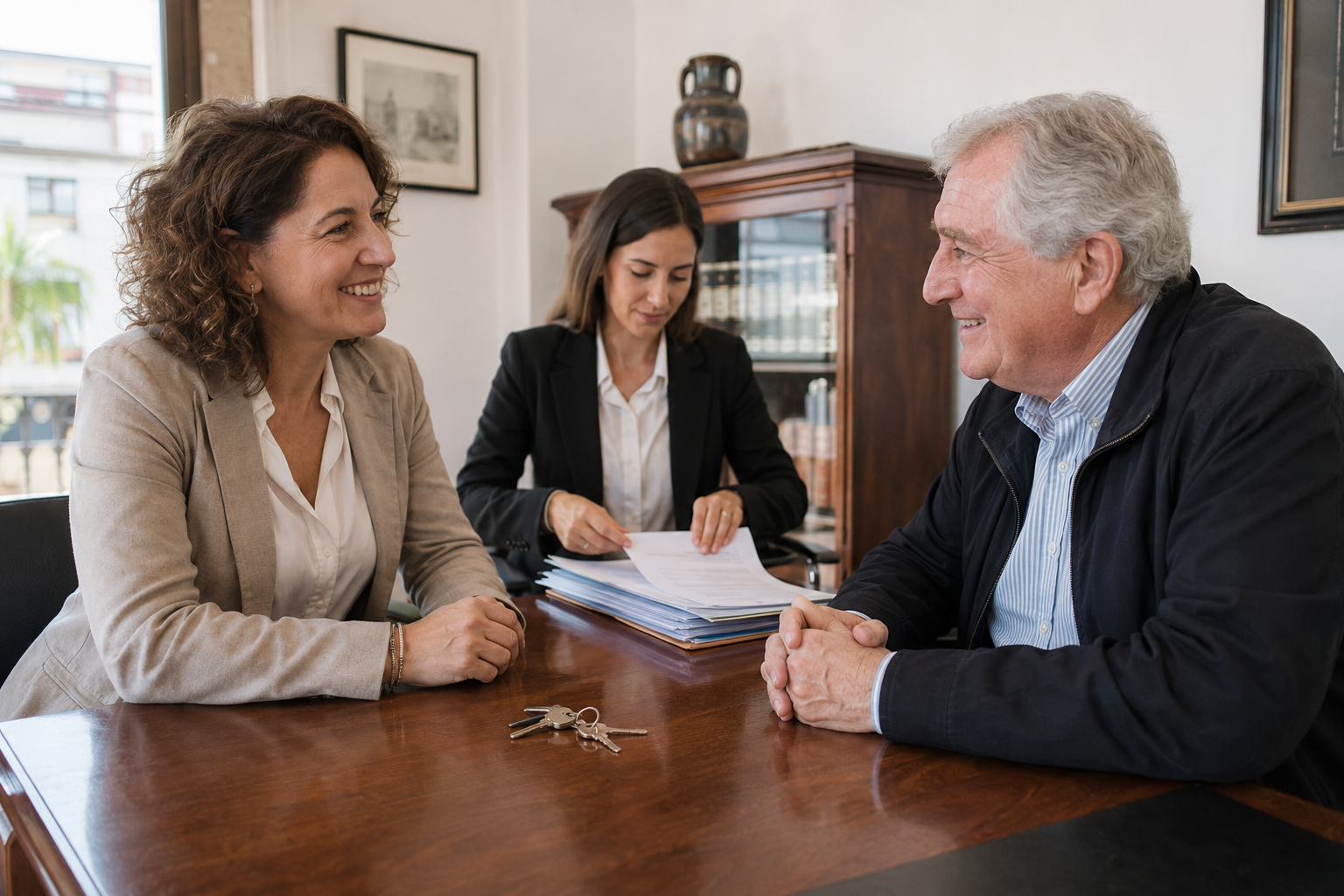
Escritura day gathers a specific cast, and knowing who is in the room helps the whole thing make sense. At the appointed time, the buyers and sellers, or their legal representatives, come together in the notary’s office, usually accompanied by both sides’ lawyers and very often the estate agent who brokered the sale, all assembled around the table for the signing.
Not everyone strictly needs to be there in person, which is one of the most useful things a buyer can know. If you cannot be in Spain on the day, or simply prefer not to be, you can grant your lawyer a poder notarial, a power of attorney, allowing them to attend the notary, sign the escritura and complete the purchase entirely on your behalf. This is how a great many expats and overseas buyers complete, buying a Spanish home without setting foot in the notary’s office at all.
There is one more figure who may be legally required, and it is an important protection. If the buyer does not speak Spanish well enough to understand the deed, the notary will normally insist on an interpreter, so that each clause is truly understood before anyone commits to it. Your lawyer can often play this role, translating the deed as it is read, which ensures that a foreign buyer is never signing something they do not comprehend. Signing in the dark is exactly what the system is designed to prevent. This matters enormously for foreign buyers, who might otherwise feel pressured to sign a lengthy Spanish document they cannot follow. The requirement for genuine comprehension is not a courtesy but a safeguard built into the process, and a buyer should never waive it lightly. If you do not understand a clause as it is read, that is the moment to stop and ask, not after the pen has touched the paper.
The Reading of the Deed

The heart of the ceremony is the reading, a moment that surprises buyers used to silently signing stacks of documents. The notary reads the escritura aloud, working through its main points and confirming the essential facts of the sale, the identities of the buyer and seller, the description of the property, the price, and the confirmation that the funds are available to complete.
This reading is not a formality to be endured but a genuine safeguard. As the notary works through the deed, each party is confirming in real time that the details are correct, that the property described is the one being bought, that the terms match what was agreed, and that nothing has been slipped in or left out. It is the last chance to catch an error before it becomes permanent, and a careful buyer or lawyer listens closely rather than nodding along.
When the reading is done, the notary asks all parties whether they are in agreement, and only then does everyone sign. The signatures make the purchase definite, the act of committing formally and irrevocably to the sale on terms that have just been read out and confirmed aloud. This is the precise moment the deal becomes real, the culmination of all the months of work, executed in a few strokes of a pen at the notary’s table. There is something quietly momentous about it that the plainness of the setting disguises. No fanfare marks the instant, just signatures on a document in a modest office, and yet in that instant a property changes hands and a buyer’s life shifts. The very ordinariness of the ceremony is part of what makes the Spanish system feel so solid, a life-changing act handled with calm, unhurried competence.
How the Money Moves

The payment happens at the table too, and the mechanics of it are more old-fashioned and more secure than many buyers expect. The buyer pays the outstanding balance of the price, along with the taxes and fees, at completion, and the classic instrument for this is a banker’s draft, a certified cheque issued by your bank, handed to the seller in the presence of the notary so that money and deed change hands at the same moment.
The simultaneity is the whole point. Payment and the transfer of ownership occur together, in the same room, witnessed and certified by the notary, so that neither party is exposed to the risk of handing over money or property without receiving the other in return. Where there is a mortgage being paid off, or debts to be cleared, the lawyers prepare the cheques so that those charges are cancelled at the very moment of sale, and every payment made is attached to the deed as proof, a traceability that matters for any future tax audit or resale.
For non-resident buyers there is one particular wrinkle worth knowing in advance. When the seller is a non-resident, the buyer is required to withhold three percent of the price and pay it directly to the tax authorities on the seller’s behalf, an amount later reconciled in the seller’s own tax affairs. Your lawyer handles the mechanics, but it is the kind of detail that can surprise the unprepared, and it is one more reason the money side of escritura day is best left in professional hands. The old-fashioned banker’s draft, rather than a simple transfer, persists precisely because it makes the money certain and immediate at the table. The seller can see and hold guaranteed funds at the moment of signing, with no wait and no risk of a transfer failing, which is why the instrument endures in an age of instant banking. Your lawyer will arrange the drafts in the right amounts, including any needed to clear the seller’s mortgage, so the sums balance perfectly on the day.
The Keys, and the Copia Simple
Then comes the moment everyone has been waiting for, understated as it is. With the deed signed and the payment made, the keys to the property are handed over, and ownership passes to the buyer there and then at the table. There is rarely any ceremony to it, just a set of keys sliding across a desk, but it is the instant a house becomes your home in the eyes of the law.
You do not leave empty-handed on the documentation either. Before you go, you are usually given a copia simple, an unsigned copy of the escritura, which serves as your immediate proof of the purchase and ownership while the formal registered deed is prepared. It is worth keeping this and every receipt from the day carefully, since they are the record of what was paid and agreed, and you will need them for everything from tax to utilities to any future sale.
There is a quiet protection built into this moment that few buyers notice. Immediately after signing, the notary notifies the Land Registry of the sale, a step that blocks the seller from fraudulently selling the same property to someone else in the window before your ownership is formally registered. From the moment you leave the notary’s office, that safeguard is already working on your behalf, closing the door behind you.
After You Leave the Table
Escritura day feels like the end, and in the ways that matter most it is, but a few important steps follow it, handled largely by your lawyer. The most important is registration. Your lawyer takes the signed deed, ensures the purchase taxes are paid within the required window, and submits the escritura to the Registro de la Propiedad, the Land Registry, where your name is formally recorded as the new legal owner.
This registration takes a little time to complete, often a few weeks, after which you receive your fully registered title deed and your ownership is beyond question in the public record. In the meantime your copia simple and the notary’s immediate notification protect your position, so the delay is a procedural formality rather than a period of risk. The wheels turn quietly in the background while you begin moving into your new home.
There is a to-do list of your own that follows as well. The utilities need to be transferred into your name or set up afresh, the community of owners and the property manager informed of the change of ownership, and the various local taxes and bills arranged going forward, from the annual IBI property tax to the rubbish charge and the community fees. None of it is dramatic, but it is the ordinary administrative tail of becoming a homeowner in a new country, and a good lawyer or gestor will guide you through the essential parts so nothing important is missed.
Why the Ritual Is Worth Trusting

Seen as a whole, the Spanish completion process can feel formal and old-fashioned, but that formality is precisely its strength, and it is worth trusting for good reasons. The notary system exists to make property transactions safe, transparent and final, replacing the risk and ambiguity of private deals with a public, certified act that protects everyone involved, above all the buyer who is putting down life-changing sums of money.
The safeguards are woven through every step, if you know to look for them. The neutral notary checking the title, the deed read aloud so nothing is hidden, the interpreter ensuring understanding, the money and keys changing hands simultaneously under certification, the instant notification to the registry blocking fraud, all of it is designed to ensure that when you leave the table, what you have bought is genuinely and safely yours. The occasional real-world complication, a mismatch between the cadastral and registry records, or a community debt discovered late, is exactly what the process and your lawyer are there to catch and resolve before you sign.
For the buyer, the lesson of escritura day is to prepare well and then trust the ritual. Hire a good independent Spanish lawyer, read the draft deed in advance, arrange your funds and your power of attorney if you need one, and then let the well-worn machinery of the notary’s table do its work. The buyers who find the day stressful are almost always the ones who arrived unprepared or unadvised, while those who did the groundwork tend to find it almost anticlimactic, a formality gliding by because everything that could go wrong was caught weeks earlier. The morning that can look so intimidating from a distance turns out, in practice, to be a calm and orderly conclusion, a reading, a signing, a payment, a set of keys. Months of effort resolve into a single quiet act at a small table, and you walk out an owner. That is where buying a home in Spain ends, and where living in it begins. The table does its work, and then the house is yours.

About the Author: Ruben, co-founder of Gamintraveler.com since 2014, is a seasoned traveler from Spain who has explored over 100 countries since 2009. Known for his extensive travel adventures across South America, Europe, the US, Australia, New Zealand, Asia, and Africa, Ruben combines his passion for adventurous yet sustainable living with his love for cycling, highlighted by his remarkable 5-month bicycle journey from Spain to Norway. He currently resides in Spain, where he continues sharing his travel experiences with his partner, Rachel, and their son, Han.