
Picture the scene that plays out every evening in America. It is nine at night, the workday ended hours ago, and an email arrives from a manager marked urgent. The employee, eating dinner or putting a child to bed, feels the familiar pull, the sense that not replying is somehow a failure, and opens the laptop again. The line between work and life, already thin, dissolves a little more. In France, the law has something to say about that email, and what it says would horrify a great many American bosses.
Since 2017, French workers have had what is called the right to disconnect, a legal principle that protects their ability to switch off from work outside working hours without penalty. It is one of those French labor protections that Americans find almost unbelievable, a formal recognition that a worker’s evenings and weekends belong to them and not to their employer. The reality of the law is more nuanced than the headlines suggest, but the principle underneath it is real, and it points to a fundamentally different idea of what an employer may demand.
Here is what the French right to disconnect really is, where it came from, what it does and does not require, and why a law like it would struggle to survive in American workplace culture. This is general information rather than legal advice, and the law’s application varies by company and situation, but its core is a genuine and enforceable idea.
What the Right to Disconnect Is
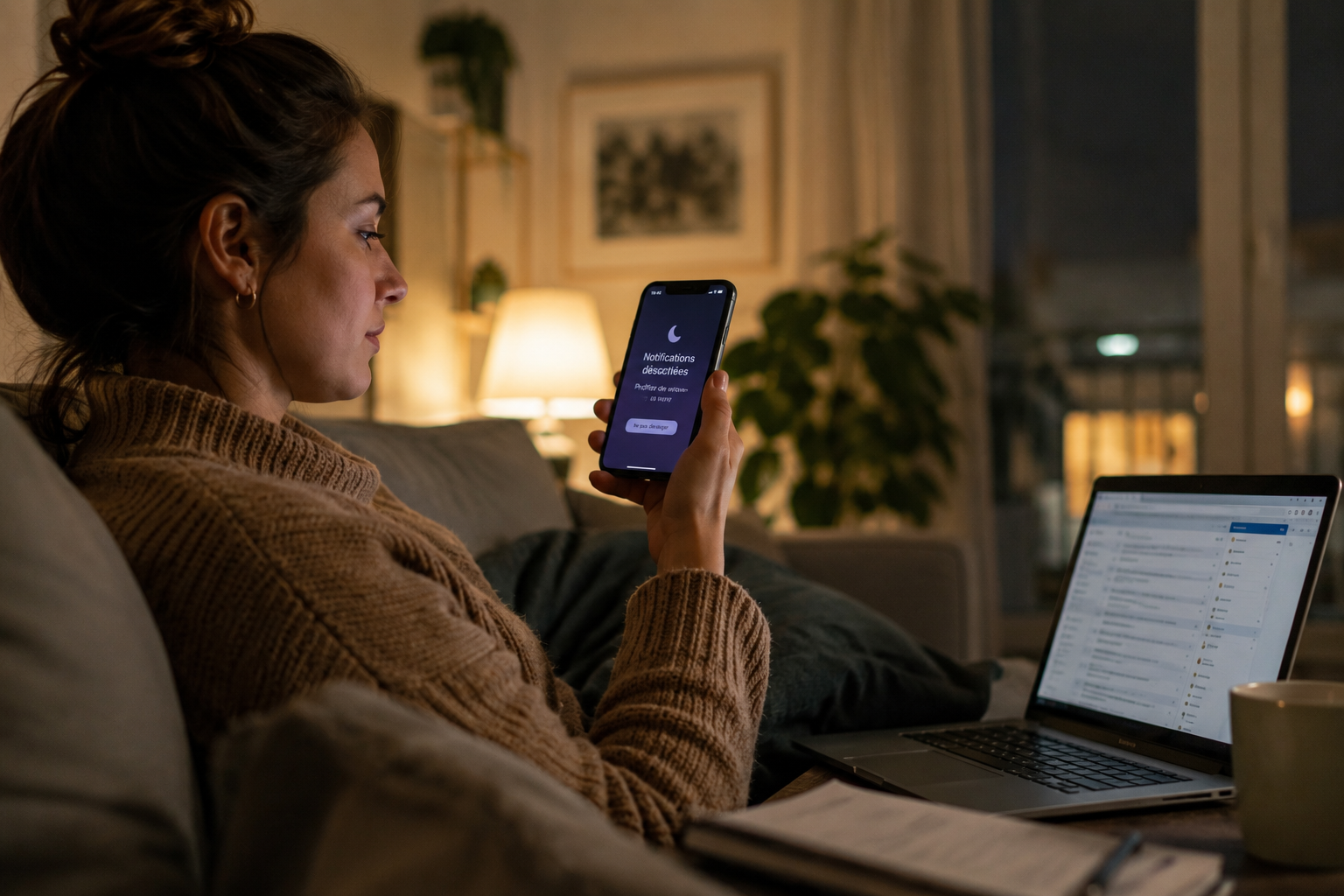
The right to disconnect, the droit à la déconnexion, is the principle that employees are entitled to disengage from work communications outside their working hours, to not answer the emails and calls and messages that arrive in the evening, on weekends and during holidays. It recognizes in law that being perpetually reachable is a harm, and that a worker has a right to genuine time off that is truly free of work.
It entered French law as part of a broader labor reform, the El Khomri law of 2016, and took effect on the first of January 2017. Its stated purpose was to address the way digital technology had erased the boundary between professional and personal life, letting work follow people home through the phones in their pockets and colonize the hours that were supposed to be theirs. A generation earlier, leaving the office had meant leaving work behind, but the smartphone quietly abolished that boundary, and the law was an attempt to restore something the technology had taken. The law was a deliberate attempt to redraw that boundary and defend rest.
The concern behind it was health as much as fairness. The framers were responding to mounting evidence that an always-on work culture drives stress, burnout and the erosion of wellbeing and family life, and they treated constant connectivity as an occupational hazard to be managed rather than an inevitable feature of modern work. The right to disconnect was framed, at its heart, as a protection of employee health against the encroachment of the job. This framing is worth dwelling on because it explains the law’s whole character. By treating constant connectivity as a health and safety matter rather than a mere convenience, French lawmakers placed it in the same broad category as workplace hazards that employers have a duty to manage. Rest, in this view, is not a perk an employer may grant or withhold but a condition of health that the law can require it to protect.
How the Law Works

Here the reality diverges from the myth, and the details matter. The right to disconnect is not a blanket ban on after-hours emails, and it does not make it illegal for a boss to send a message at night or for an employee to read one. What the law does is impose a duty to negotiate, requiring companies of a certain size to sit down with their workers and agree on the rules.
Specifically, the law applies to companies with fifty or more employees, and it obliges them to negotiate a policy on the right to disconnect as part of their regular mandatory workplace negotiations. Employer and staff representatives are meant to hammer out the terms together, defining how and when employees are expected to be reachable and, crucially, when they are not. If the two sides cannot reach an agreement, the employer must publish a charter setting out the rules unilaterally.
This makes it less a single prohibition than a framework that each workplace fills in for itself. One company might establish that no emails are expected after a certain hour, another might shut down its email servers overnight, another might simply affirm that employees face no penalty for not responding until morning. The law sets the obligation to address the issue and to protect the right, while leaving the specific mechanics to be worked out company by company. That flexibility is both a strength and a weakness. It lets the right adapt to the wildly different realities of a hospital, a software firm and a global business spanning time zones, none of which could sensibly live under an identical rule. But it also means the protection is only as strong as the agreement each company reaches, and critics note that a poorly negotiated policy can leave the right more symbolic than real in some workplaces.
The Weight Behind It

If the law imposes no simple criminal penalty for a late-night email, it would be a mistake to conclude it has no teeth, because the weight behind it shows up elsewhere. The right to disconnect plugs into the broader and famously protective structure of French labor law, where employee wellbeing, working time and rest are taken seriously and where employers carry real legal obligations toward their staff.
The consequences tend to arrive through that wider system. An employer who ignores the right to disconnect, who pressures staff to remain constantly available and lets the always-on culture run unchecked, exposes itself to legal risk if that pressure damages an employee’s health or leads to a dispute. French courts have shown they will back workers on questions of working time and availability, and a company that treats the right as meaningless is building a liability rather than avoiding one.
There is also the matter of enforcement through negotiation itself. Because the law compels companies to agree and document their policies with worker representatives, the right becomes embedded in binding workplace agreements that employees can point to and rely on. The protection is real not because a policeman will knock over a single email, but because the whole apparatus of French employment law stands behind the worker’s evenings in a way the American system simply does not. This is the piece Americans most often miss when they scoff that the law has no penalty for a late email. The French system does not work through a single punishment for a single act but through a dense web of obligations, negotiations and court doctrines that together make ignoring a worker’s rest time genuinely risky for an employer. The absence of a simple fine is not the absence of consequences.
The Landmark Case Behind It

The idea that the right to disconnect has no teeth collapses on contact with the case law, and one judgment in particular gave the principle its force. A French court ordered a company to pay a substantial sum to a former employee who had been required to keep his phone on and remain permanently reachable to respond to problems outside his working hours, ruling that this constant on-call availability amounted to working time for which he had not been properly compensated.
The significance of that ruling reaches far beyond the individual involved. It established that permanent availability is not free, that an employer who expects a worker to be reachable at all hours is in effect demanding labor and may have to pay for it, and that the courts will treat the erosion of rest time as a real and compensable harm. Suddenly the always-on expectation carried a price tag.
This is how the right to disconnect bites in practice, not through a fine for a single stray email but through the broader principle that an employee’s time off has legal value which employers cannot simply help themselves to. A company that keeps its staff tethered to their devices after hours is not being efficient in the eyes of French law but is potentially incurring an obligation, one a court may later enforce. The efficiency the always-on culture imagines it is buying may turn out to be borrowed against a bill that comes due.
For an American accustomed to unpaid availability as a basic condition of professional life, the logic is startling. The expectation of being reachable on evenings and weekends, so normalized as to be invisible in much of American work, is treated in France as something an employer must justify and may have to compensate. The phone that never switches off, in other words, is not a neutral fact but a cost, and French law decided the cost should fall on the employer rather than silently on the worker.
Why This Horrifies American Management

To understand why such a law would struggle in the United States, you have to see how alien it is to American workplace assumptions. American professional culture runs, to a significant degree, on exactly the availability the French law restricts, on the expectation that a good employee answers the urgent email at night, jumps on the weekend call and demonstrates commitment through constant responsiveness. Being always reachable is not seen as a burden to be regulated but as a virtue to be rewarded.
In that culture, a legally protected right to ignore the boss after six in the evening reads almost as a provocation. Many American managers would regard it as a direct threat to productivity, competitiveness and the flexibility they prize, an invitation to slack off dressed up as worker protection. The very idea that the law might tell an employer when it may and may not contact its own staff cuts against a deep American belief that this is a private matter between worker and company, not the government’s business. Regulating the timing of an email feels, to that sensibility, like an absurd overreach, a bureaucrat inserting himself into the ordinary give and take of a job.
The structural differences make it harder still. American employment mostly runs on at-will terms with far weaker legal protections for workers, a thinner tradition of collective negotiation, and a cultural lionization of overwork that treats exhaustion as a badge of seriousness. A French-style right to disconnect would collide with all of that at once, which is why, even as the idea attracts admiration and imitation abroad, it remains a hard sell in a country where being unreachable can feel like a career risk rather than a right. The irony is that the same American workers who would find such a law radical are also, by many measures, among the most overworked and burned out in the developed world. The culture that treats constant availability as dedication has produced record levels of exhaustion and a widespread sense that work has swallowed life whole, which is precisely the condition the French law was written to prevent. The resistance and the need point in the same direction.
The Idea Is Spreading Anyway

For all the American resistance, the French model has proved influential, because the problem it addresses is not uniquely French. The tension between digital connectivity and rest is universal in the modern economy, and as more countries confront the costs of an always-on culture, France’s answer has looked increasingly like a template rather than an eccentricity.
Other countries have followed the path. A number of European and other nations have introduced or moved toward their own versions of the right to disconnect, and the concept has spread well beyond where it began, with governments elsewhere weighing similar protections and some enacting them. What was once a distinctly French idea has become part of an international conversation about where the boundaries of work should fall in a connected age.
Even in resistant places, the terms of the debate have shifted. The mere existence of a functioning right to disconnect in France and elsewhere makes it harder to insist that constant availability is simply the natural order of things, since it plainly is not everywhere. The idea gives workers and reformers a concrete alternative to point to, a demonstration that a society can decide its employees are entitled to their own evenings and can write that entitlement into law.
What It Really Represents
Strip away the legal detail and the right to disconnect is about something larger than email, a statement about the proper relationship between a person and their job. It embodies the view that work is a part of life rather than the whole of it, that rest and family and private time have a value the law should protect, and that the burden of an always-on culture should not fall silently on the individual worker to absorb.
That is the deeper reason it resonates and unsettles in equal measure. The law asserts, in effect, that being human comes before being available, that an employer’s claim on a person ends at the edge of the working day, and that the technology which lets work follow us everywhere does not carry with it the right to demand our attention everywhere. It is a modest legal mechanism carrying an immodest idea about human dignity at work.
Whether or not a law like it could ever take root in America, the French right to disconnect performs a useful service simply by existing, because it makes visible a choice that the always-on culture pretends is not a choice at all. The evening email that feels compulsory, the weekend message that cannot wait, the vacation interrupted by work, all of these are presented in much of the world as unavoidable facts of modern employment. France looked at them and decided they were not facts but policies, and that policies can be changed. The email can wait until morning. In France, the law agrees, and says so out loud.

About the Author: Ruben, co-founder of Gamintraveler.com since 2014, is a seasoned traveler from Spain who has explored over 100 countries since 2009. Known for his extensive travel adventures across South America, Europe, the US, Australia, New Zealand, Asia, and Africa, Ruben combines his passion for adventurous yet sustainable living with his love for cycling, highlighted by his remarkable 5-month bicycle journey from Spain to Norway. He currently resides in Spain, where he continues sharing his travel experiences with his partner, Rachel, and their son, Han.