
Every article about Italy’s €1 houses ends at the same place, with the restored kitchen and the terrace and the happy buyer raising a glass. Almost none of them follow the other path, the one where the permits stall, the builder vanishes, the money runs short and the clock keeps running. That path exists, it is written into the contract you sign, and it ends with the town keeping your deposit and, in some places, taking back the house. This is not a reason to avoid the €1 schemes, and it should not be read as one, but a reason to walk into them holding the contract rather than the photograph, because the people who get hurt by these programs are almost never the ones who understood the terms before they signed.
The deposit is the part of the €1 house that nobody puts in a headline. Most schemes require one, typically €2,000 to €5,000, held by the municipality and returned only when your renovation is finished on time. Miss the deadline and it is forfeited. In some towns the consequences go further than the money, and understanding exactly how far is the difference between a project and a trap.
Here is how the deposits work, what happens when a renovation misses its deadline, and how buyers end up in that position in the first place. This is general information rather than legal advice, every municipality writes its own terms and they change with each call, and anyone considering a purchase should read the current notice and take Italian legal advice before signing anything.
The Deposit Is the Whole Contract
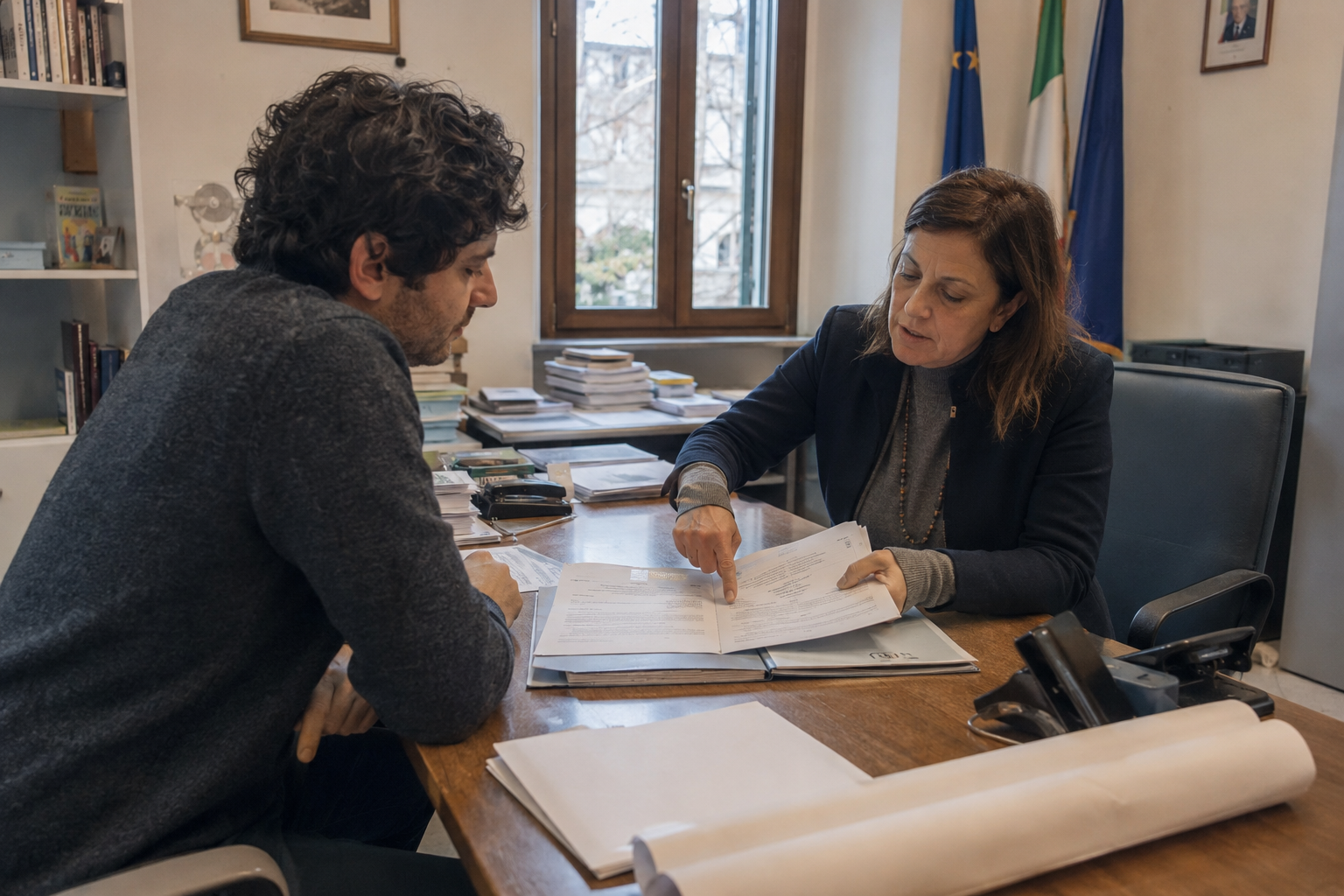
Start with what the deposit really is, because it is widely misunderstood as a fee, and it is nothing of the kind. It is a guarantee, a surety lodged in favor of the municipality to secure a promise, and the promise is that you will restore the building within the time the town has set. Do that, and the money comes back to you in full. It is your own cash held hostage against your own follow-through.
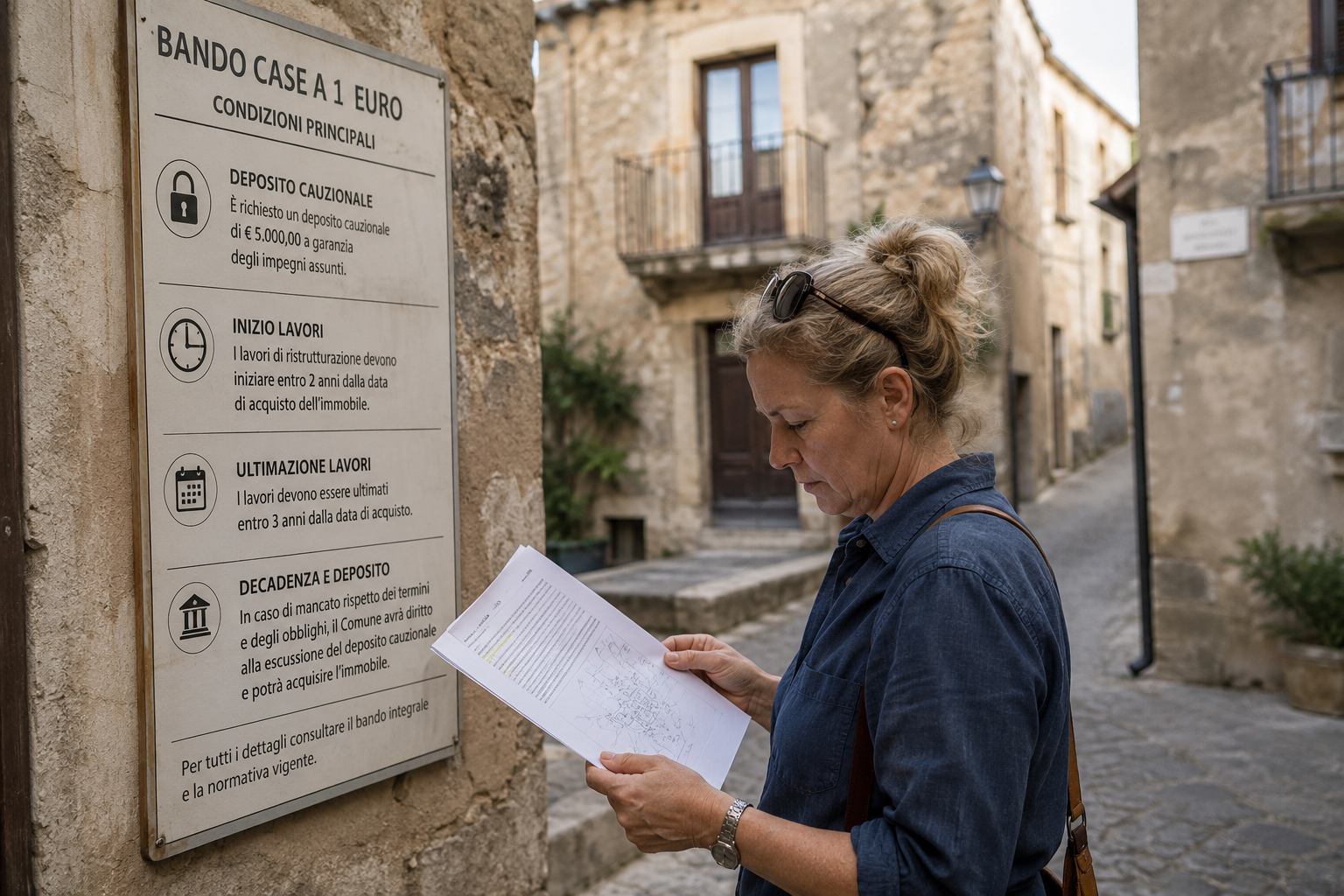
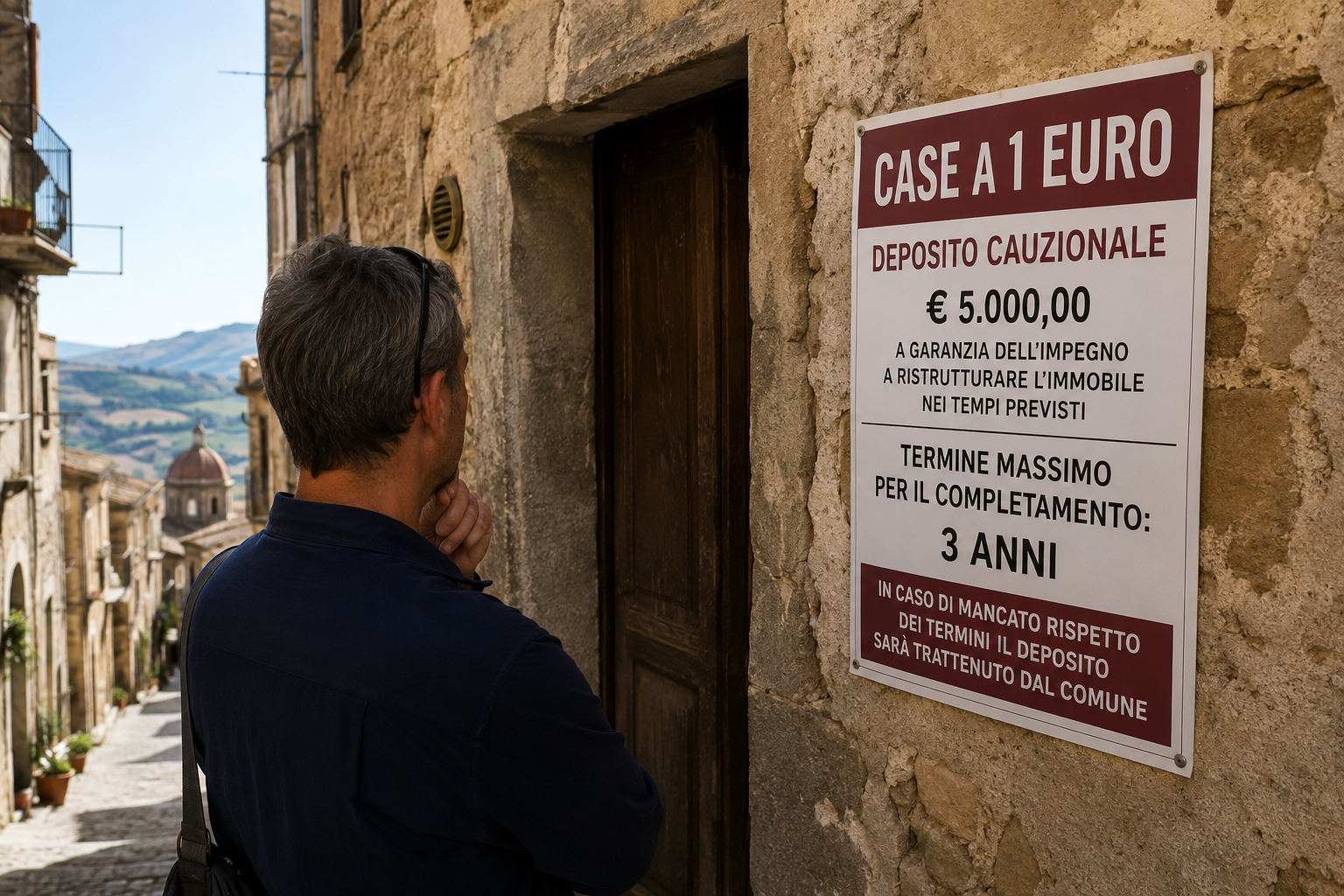
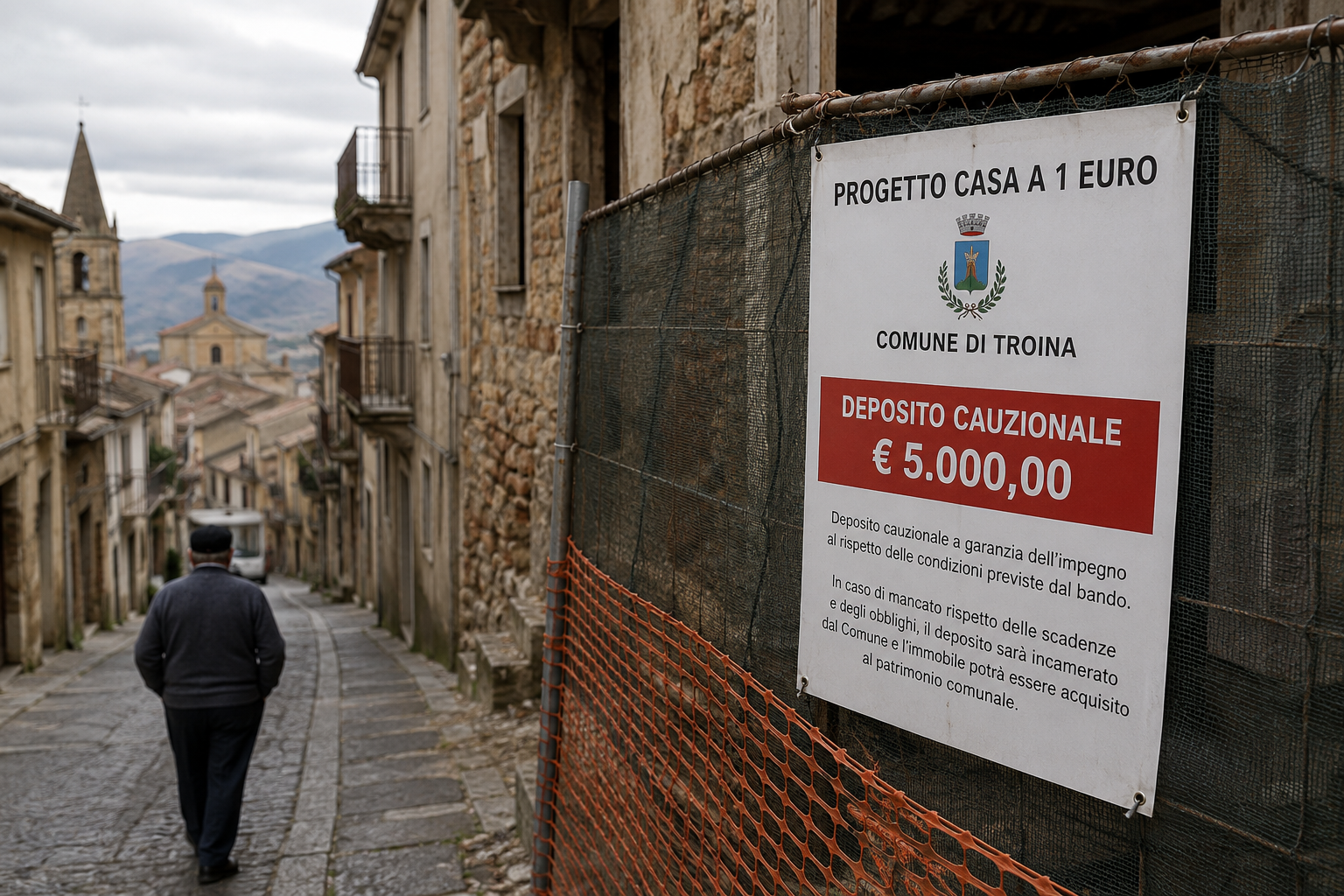
The amounts are consistent across Italy without being identical. Guidance on the schemes puts the typical range at €2,000 to €5,000, with €5,000 the common figure in the best-known Sicilian towns. Troina requires a €5,000 surety in favor of the municipality valid for three years. Mussomeli has run on a €5,000 guarantee policy that the buyer loses if the works do not go ahead within three years.
Not every town uses a deposit at all, which is worth knowing. Pratola Peligna in Abruzzo deliberately chose not to require one, using a penalty instead, with buyers facing a €10,000 fine if they fail to register a detailed plan of works within six months. The mechanism differs but the principle is identical everywhere, which is that the euro buys a legally binding obligation, and the town has secured it. The two models trade off against each other in an interesting way. A deposit ties up your cash from the moment of the deed but caps your downside at the amount lodged, while a fine leaves your money free and exposes you to a larger sum if you fail. Neither is softer than the other. They are simply different ways of pricing the same promise.
The Clock, and How It Runs
The deadlines are where the trouble starts, and they come in layers. Across the schemes, buyers are commonly required to submit a renovation plan within roughly six months to a year of purchase, to begin works within a set window, and to complete the renovation within about two to three years. Troina’s call requires works to begin within two years of purchase against a three-year bond.
The layering matters more than the headline number. In many towns the obligation is not one deadline but a chain of them, a plan by one date, a start by another, a completion by a third, and falling behind on the first can put everything after it out of reach. A buyer thinking they have three comfortable years may in fact have six months to produce approved drawings. This is why reading the actual call matters so much more than reading about it. A summary that says three years to renovate is technically accurate and practically misleading, because the binding constraint for most buyers is the first deadline rather than the last. The plan is the gate, and a buyer who misses it has usually lost the project long before the completion date arrives.
Then there is the detail that catches almost everyone, which is when the clock starts. In the typical structure the completion deadline runs from the date of purchase, not from the date your permits come through, and permits in a small Italian comune can take many months. Buyers have described the resulting squeeze plainly, a requirement to start work shortly after obtaining permits that themselves take half a year or more to obtain, while the three-year clock has been ticking since the deed was signed.
What Forfeiture Means in Practice
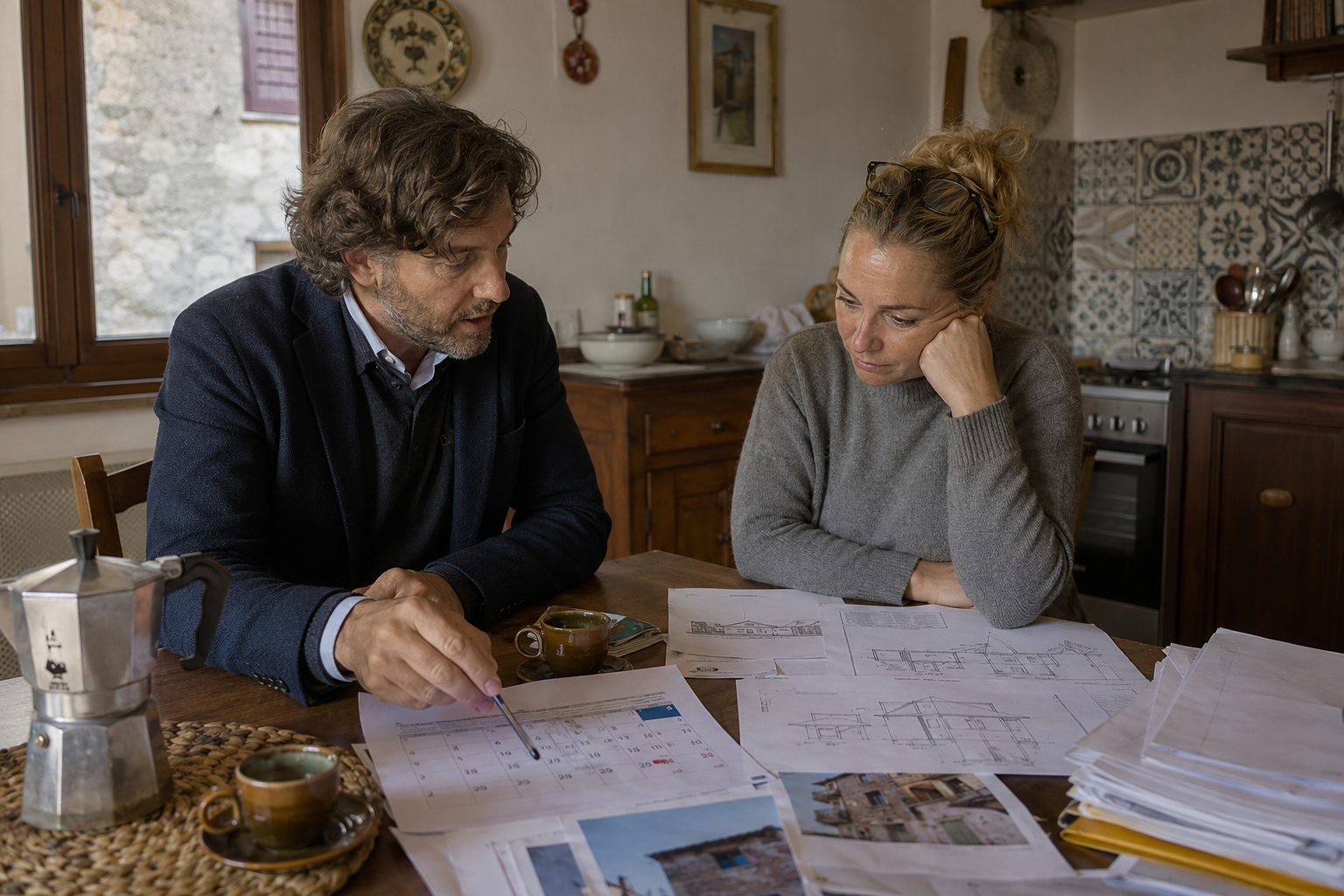
If the deadline passes and the work is not done, the first consequence is the simple one. The municipality keeps the deposit. That is what a surety is for, and the town is entitled to it under terms you agreed to at the deed, so a buyer who walks away from a stalled project can expect to lose their €2,000 to €5,000 without much argument.
In some towns it does not stop at the money, and this is the part that rarely gets reported. Troina’s council has stated that in the event of default, it reserves the right to forfeit the guarantee and acquire ownership of the property. Read that carefully. A buyer who bought a ruin, paid the notary, hired an architect, spent real money on partial works and then ran out of time can lose the deposit and the building both, walking away with nothing but the invoices.
That is the risk the €1 coverage almost never states. Everything you have sunk into the project up to that point, the fees, the professional costs, the materials, the work already done, is not protected by having a receipt. It is protected only by finishing, because the contract you signed exchanges a symbolic price for an obligation, and the security for that obligation is your deposit and, where the town has reserved it, the house itself. It should be said that towns invoking the full reacquisition clause appears to be rare rather than routine, and the schemes are not littered with seized houses. But rare is not never, and the clause is in the call because the town intends to be able to use it. A buyer who assumes it is decorative is making an assumption about a legal document they signed.
Why the Towns Ask for It
It is worth understanding the deposit from the other side of the table, because it did not appear out of municipal spite. When the first schemes launched, the towns discovered the obvious flaw in a symbolic price, which is that a euro attracts people for whom a euro is nothing. A buyer could take the deed, do nothing at all, and simply wait to see whether the neighborhood improved around them.
That outcome is worse for a town than the ruin it started with. The building stays derelict, the street stays dark, the collapse risk remains, and now the property sits with an absentee owner abroad who is far harder to chase than the local family who had it before. A scheme that produced only that would kill itself within a year.
So every mechanism in these calls exists to filter for commitment. The deposit, the plan deadline, the requirement in some towns to show financial capacity, the residency conditions attached to certain incentives and the forfeiture clauses are all aimed at the same person, the buyer who wants the headline rather than the house. The rules are not aimed at the sincere.
Seen that way, the deposit is the sincere buyer’s ally rather than their obstacle. It is what keeps the scheme credible, what stops the historic center filling with speculative absentees, and what persuades a town to hand a building to a stranger from another continent in the first place. Anyone who intends to finish is being asked to prove it with money they will get back, which is a fair request from a town that has been let down before.
How Buyers End Up There
Nobody sets out to forfeit a deposit, so the useful question is how it happens, and the answers are mundane rather than dramatic. The first is the permit squeeze already described, where the paperwork consumes a year of a three-year clock before a stone is moved. Buyers have reported spending €20,000 to €30,000 on permits, deposits and professional services before any renovation work begins at all.
The second is capacity. These towns are small, which is the whole reason the houses are cheap, and a small mountain town has a finite number of builders, architects and surveyors. When a scheme goes viral and dozens of foreign buyers arrive at once, all needing the same handful of professionals, the queue is real. Some schemes also press buyers toward local contractors, which is good for the town and does nothing for your negotiating position. The economics of that queue work against you in the obvious way. A tradesman with more work than he can handle, serving buyers who cannot easily go elsewhere and are working against a deadline, has no reason to hurry or to sharpen his price. That is nobody’s fault and it is entirely predictable, and it belongs in your schedule and your budget from the start.
The third is the building. Historic-center rules generally forbid demolition and require original materials and forms, so a structural surprise cannot be solved by the cheap modern fix. The fourth is simply distance, since managing a build across an ocean, a time zone and a language barrier is slow, and a buyer who cannot visit is a buyer whose project drifts. None of these are exotic risks. They are the ordinary conditions of the deal. What they share is that none of them are visible from the listing photograph. The building looks like the project, when in truth the project is the permits, the queue for a builder, the flights, the translated emails and the two years of slow attrition between the deed and the finished roof. The euro is easy to understand. Everything that decides the outcome is not.
The Flexibility That Does Exist
The picture is not uniformly grim, and it would be unfair to imply that these towns are hunting for defaults. The evidence runs the other way, because a forfeited deposit is a failure for the municipality too, leaving it with a ruin back on the books and a cautionary tale attached to its scheme. Towns want finished houses far more than they want your €5,000.
In practice there is give. Sambuca di Sicilia, whose scheme requires completion within three years or the loss of the deposit, has been reported as flexible with deadlines in the face of the pandemic’s disruption, and guidance on the schemes notes that extensions are sometimes granted where delays are documented and outside the buyer’s control. A town hall watching a genuine, funded, actively progressing renovation run late is generally not looking for a reason to seize it.
The distinction that matters is between the delayed and the departed. A buyer who is present, communicating, spending and visibly working, and who brings the town evidence of a permit backlog or a supply problem, is in a very different position from one who bought for a euro, went quiet and never returned. The deposit exists to catch the second kind, and the reason every scheme has one is that the second kind is exactly what the towns feared from the start.
How to Stay on the Right Side of It
The protections available to a buyer are unglamorous and entirely within reach. Read the current municipal call rather than an article about it, since terms differ by town and change with each notice, and treat any figure you saw in the press as a starting point for questions rather than a fact about your contract. Have an Italian lawyer read what you are signing, and have a surveyor or architect see the building before you bid.
Budget as if the deposit is spent and the schedule will slip. Run the numbers on the renovation with a serious contingency, confirm that you have the capacity to finish rather than merely to start, and understand that some schemes require you to demonstrate that financial capacity anyway. Line up your professionals before the clock starts, since the plan deadline arrives long before you expect it. Ask the comune directly what has happened to buyers who fell behind, because the answer tells you far more about how a scheme is run than any brochure will, and a town hall that answers plainly is a town hall worth dealing with.
Above all, be the buyer the town is not afraid of. Show up, engage the comune early and often, document everything, and keep the project visibly moving, because the difference between a forfeited deposit and a granted extension is very often just whether the town hall believes you are going to finish. The deposit is not a punishment waiting to happen. It is the price of the town’s trust, and it is refundable to everyone who earns it.
The €1 house is a genuine opportunity and a genuinely binding contract, and both halves of that sentence are true at once. The euro buys a ruin and a promise, the deposit secures the promise, and the deadline decides whether you get your money back or the town keeps it. Almost every article stops at the terrace and the glass of wine, which is why so many people arrive at the deed without ever having read the clause that matters most. The buyers who finish are rarely the ones who found the cheapest house. They are the ones who understood, before they signed, exactly what the euro had committed them to, and who treated the deposit not as a hurdle but as the town’s way of asking a perfectly reasonable question.

About the Author: Ruben, co-founder of Gamintraveler.com since 2014, is a seasoned traveler from Spain who has explored over 100 countries since 2009. Known for his extensive travel adventures across South America, Europe, the US, Australia, New Zealand, Asia, and Africa, Ruben combines his passion for adventurous yet sustainable living with his love for cycling, highlighted by his remarkable 5-month bicycle journey from Spain to Norway. He currently resides in Spain, where he continues sharing his travel experiences with his partner, Rachel, and their son, Han.
Kim of Glover Gardens
Saturday 18th of July 2026
What an interesting read! I've been intrigued by these types of deals but had no idea how they worked. Thanks for the clear-eyed analysis.