
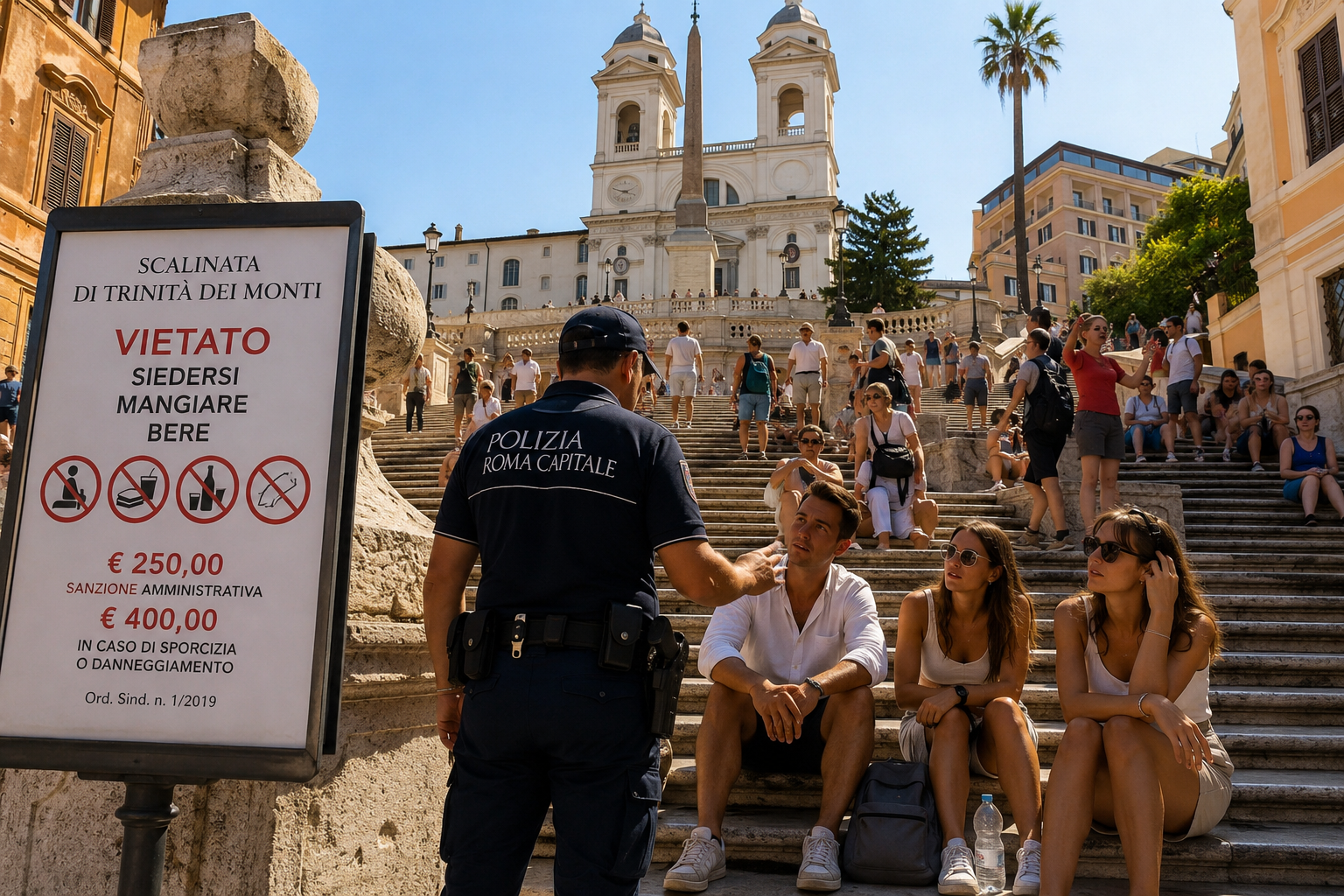
You have walked all morning through the Roman heat, and the Spanish Steps rise in front of you, a hundred and thirty-odd travertine steps sweeping up toward a church, sun-warmed and inviting. So you do the natural thing and sit down to rest. Within moments a police officer with a whistle is heading your way, and if you do not get up, you can be fined €250, roughly $275, for the crime of sitting on a staircase.
It sounds invented, the kind of thing a guidebook exaggerates, but it is entirely real and has been the law in Rome since 2019. And it is only the most famous of a whole set of rules that govern how tourists may behave around Europe’s great monuments, rules that almost nobody reads until a fine is already in their hand. From Rome to Venice to Florence, the fines are large, the enforcement is real, and the behaviors that trigger them are often things visitors do without a second thought.
Here is the truth about the Spanish Steps fine, why Rome imposed it, and the wider web of monument rules that catch unwary tourists all over Italy.
The Spanish Steps Rule
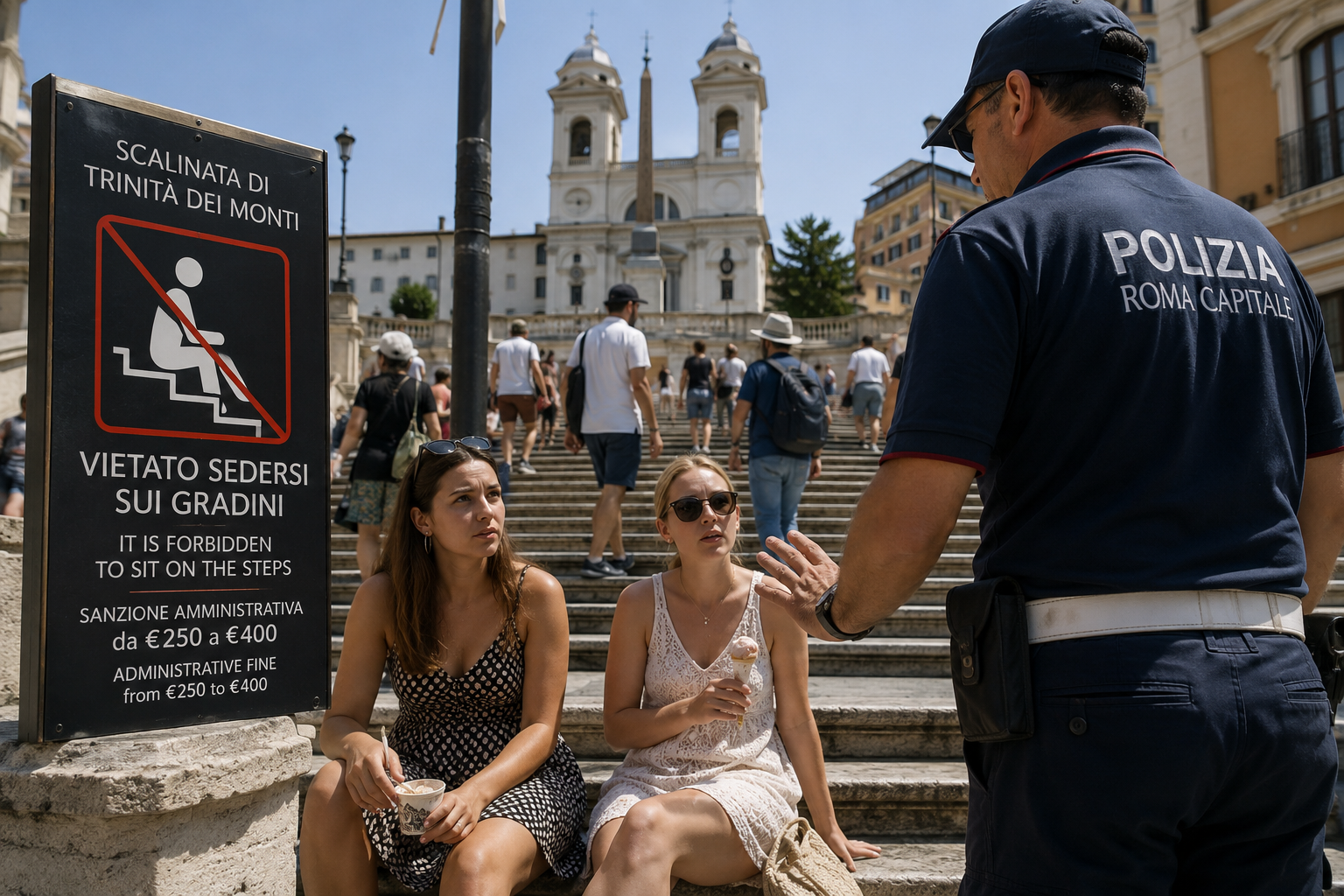
The Spanish Steps, properly the Scalinata di Trinità dei Monti, climb from the Piazza di Spagna to the church at the top, and they are classified under Italian law as a monument. That single fact is the whole basis of the rule, because sitting, lying, or lounging on a monument is prohibited, exactly as it would be on any other protected work of art.
Since 2019, officers of Rome’s municipal police patrol the steps with whistles, moving people along and stopping them from settling in. Ignore the warning and the fine begins at €250, and it climbs to €400, about $440, if you are found to have dirtied or damaged the stone in the process. The ban is not limited to sitting, either. Eating and drinking on the steps are forbidden too, as is leaving any kind of mark on them.
For generations the Spanish Steps were exactly what they look like, a place to sit in the sun, eat an ice cream, and watch the crowds, immortalized that way in films like Roman Holiday. That is precisely the image Rome has decided it can no longer afford, and the whistle-blowing officers are there to enforce the change. What feels to a tired tourist like an absurd overreach is, to the city, simple protection of a fragile piece of its heritage.
The practical upshot is that you may walk up and down the steps freely, pause to take a photograph, and admire them all you like. You simply may not treat them as furniture. Knowing that one distinction in advance saves you both the fine and the embarrassment of being whistled at in front of a piazza full of people.
The steps themselves are worth the respect. Built in the 1720s to link the piazza with the church of Trinità dei Monti above, they are a masterpiece of Baroque design, their gentle curves and terraces still considered one of the most beautiful staircases in the world three centuries later. At the foot of them sits the boat-shaped Barcaccia fountain, and the whole ensemble has drawn artists, poets, and film crews for generations. That fame is exactly the problem, since a landmark this beloved attracts precisely the crowds that wear it down.
Why Rome Banned Sitting
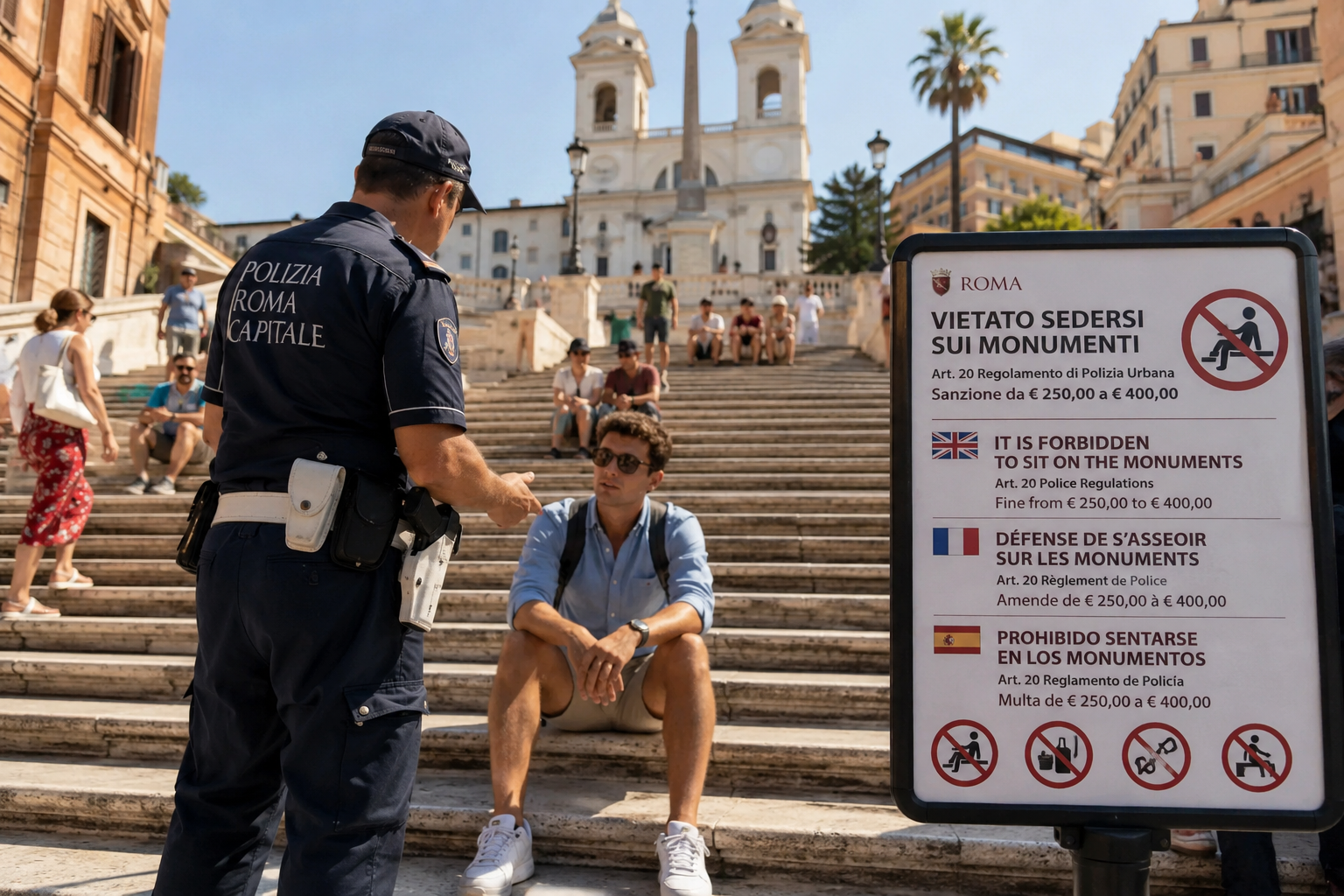
The rule did not appear out of nowhere. It followed a long and expensive restoration of the steps completed in the mid-2010s, funded to the tune of around one and a half million euros by the luxury house Bulgari, which left the travertine clean and bright and newly vulnerable to the daily wear of thousands of seated visitors.
A monument that hosts crowds sitting on it all day takes a specific kind of damage. Food and drink stain the stone, spilled gelato and wine soak in, and the constant friction of bodies and bags grinds at the surface, undoing exactly the work the restoration paid for. Multiply that by the sheer number of people who pass through one of Rome’s most visited sites, and the daily toll on the stone becomes serious rather than sentimental.
The ban also fits into a much larger story, which is Rome’s struggle with the volume of modern tourism. A city receiving millions of visitors a year has to decide how much wear its ancient fabric can absorb, and the answer, increasingly, is less than it once tolerated. Rules like the one on the steps are the visible edge of that reckoning, a city choosing preservation over the postcard image of tourists lounging on its landmarks.
Seen that way, the fine is less a piece of bureaucratic pettiness than a straightforward act of conservation, however jarring it feels in the moment. The steps are nearly three hundred years old, and Rome has decided they should last a great deal longer, even at the cost of somewhere convenient to sit.
The rule also belongs to a wider framework the Italians call decoro urbano, the decorum of the city, a set of local ordinances meant to keep public spaces dignified and undamaged. Under that heading fall many of the behaviors tourists find surprising, from eating on monuments to bathing in fountains, all of them treated not as harmless fun but as small assaults on the shared fabric of a place that belongs to everyone. Once you see the rules as expressions of that idea, they stop looking arbitrary and start looking almost obvious.
The Other Rome Rules
The Spanish Steps are only the headline. Rome has a whole set of rules around its monuments, and the same protective logic runs through all of them. The Trevi Fountain, the other great tourist magnet nearby, comes with its own list. Wading or climbing into the fountain is forbidden and fined, sitting on its edges is discouraged, and eating around it is not allowed, though the tradition of tossing a coin over your shoulder into the water remains perfectly welcome.
Eating and drinking directly at or on monuments across the historic center is broadly restricted, part of a wider effort to stop the city’s landmarks from becoming picnic sites. The rule catches tourists who see a beautiful set of ancient steps or a fountain rim as the obvious place to eat their lunch, which is exactly the behavior the city is trying to end.
Rome also polices a few more colorful offenses. The men who dress as Roman centurions and gladiators to charge tourists for photographs have been cracked down on repeatedly, walking around bare-chested in the streets can draw a fine, and attaching love-locks to bridges is banned after the sheer weight of them began to threaten the structures. None of these is the sort of thing most visitors would guess is illegal, which is exactly why they end up on the wrong side of them.
The list keeps growing. Splashing about or swimming in any of the city’s monumental fountains is banned outright, drinking from glass containers in the street is restricted in parts of the center after dark, and even dunking your feet in a fountain to cool off can bring a warning. Each rule targets a specific way tourists have historically used the monuments as free amenities, a place to wash, to cool down, or to pose, and each one tends to astonish the person it catches.
Venice and Florence Go Further
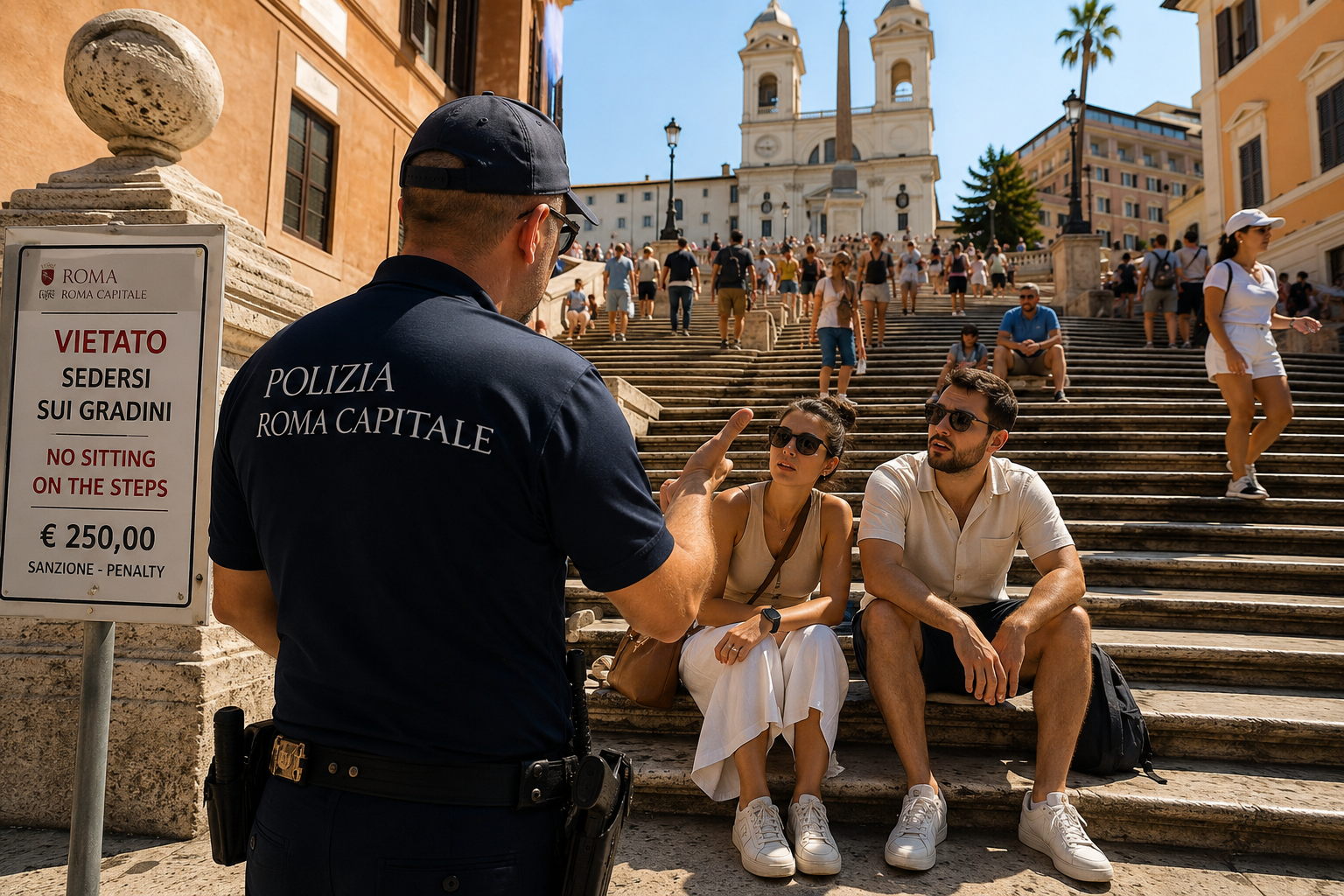
Travel north and the rules multiply. Venice, drowning in visitors and fiercely protective of its fragile center, has some of the strictest of all. Walking around the city in swimwear, or shirtless, can bring a fine reported to run as high as €3,000, and picnicking in public spaces is banned outright to keep the city clean and its monuments unstained.
Venice enforces these seriously. In one widely reported case, a pair of tourists were fined hundreds of euros for making coffee with a camping stove on the historic Rialto Bridge, and feeding the pigeons in St Mark’s Square, once a classic tourist photograph, has long been prohibited. The city has decided that its survival depends on treating itself as a living monument rather than a playground, and it fines accordingly.
Venice has gone further still in recent years, introducing an entry fee for day-trippers on its busiest dates, a small charge simply to walk into the city, in an effort to thin the peak-season crowds that overwhelm its narrow streets. It is the clearest sign yet of a place deciding that unlimited tourism is a threat rather than a blessing, and other historic cities are watching the experiment closely to see whether it works.
Florence has its own signature rule aimed at a specific nuisance. On several streets in its crowded historic core, sitting down to eat is banned during the busy midday and evening hours, with fines that can reach €500, roughly $550, for anyone caught having lunch on a famous doorstep. It is a direct response to streets clogged with people eating takeaway food on monument steps, and like the others, it is a rule almost no visitor knows exists until they break it.
Beyond the Cities
The rules do not stop at the city monuments. Along the Cinque Terre, the string of cliff villages on the Ligurian coast, hiking the famous coastal trails in flip-flops or unsuitable footwear can bring a fine, brought in after too many ill-equipped tourists had to be rescued from the paths in sandals. It is a safety rule dressed as a fashion one, and it catches day-trippers who treat a mountain trail as a seaside promenade.
Further along the coast, the tiny harbor of Portofino created what the local press dubbed no-waiting zones, areas around its most photographed spots where lingering to take selfies is prohibited during busy hours, with fines reported around €275, to stop the picturesque quay from seizing up with camera-wielding crowds. Standing still in the wrong place, in other words, can cost you money in Portofino.
Sardinia guards its beaches with particular fierceness. Taking sand, pebbles or shells from the island’s beaches as a souvenir is banned and can bring a fine running into the thousands of euros, up to around €3,000, because the slow theft of the famous white sand was measurably shrinking the beaches. Airport security has even been known to search departing bags for smuggled sand.
Across the smaller resort towns, from Capri to Positano, a patchwork of local rules governs everything from single-use plastics to noisy footwear on quiet streets. The specifics vary from place to place, but the direction is the same everywhere, a growing insistence that visitors tread more lightly, in every sense, on places that were never built for the numbers now arriving at them.
Why Europe Is Cracking Down
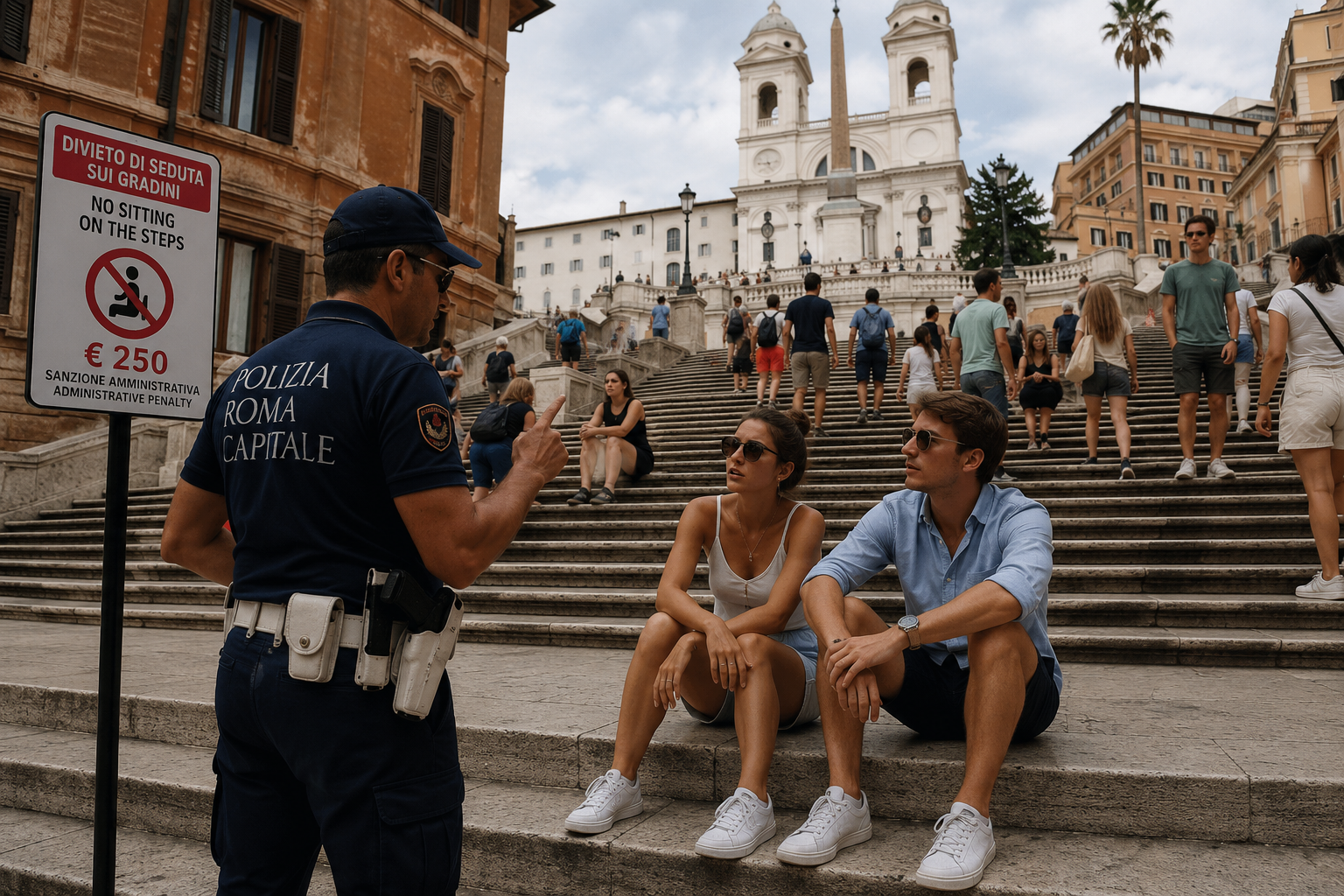
Step back from the individual fines and a clear pattern emerges. Across Italy, and increasingly across the whole of southern Europe, cities that built their economies partly on tourism are now writing rules to protect themselves from its sheer scale. The fines are the mechanism, but the motive is the strain that record visitor numbers place on old and finite places.
Part of it is straightforward conservation, the preservation of stone and structure that cannot be replaced. Part of it is the quality of life of residents, who have grown weary of living in cities treated as open-air attractions, with their doorsteps used as benches and their squares as dining rooms. And part of it is simply managing crowds, imposing a bit of order on places that can feel overwhelmed in high season.
The result is a Europe that is subtly less permissive than it was a generation ago, where the old assumption that a tourist could do more or less as they pleased has given way to a growing list of things they may not. It is not hostility to visitors so much as a shift in the terms of welcome, an insistence that the great monuments be treated as what they are rather than as scenery to be climbed on.
The trend reaches well beyond Italy. Barcelona has moved hard against short-term tourist rentals and cruise-ship crowds. Amsterdam has openly told certain kinds of party tourists to stay away, and Greece has begun capping daily visitor numbers at sites like the Acropolis to protect them. The specifics differ from country to country, but the underlying calculation is the same everywhere, that there is a limit to how many people a fragile old place can absorb before it begins to break.
Understanding that shift is the key to traveling through it gracefully. The cities are not trying to trap tourists, but they are serious about the rules, and the visitor who grasps the underlying principle avoids nearly all the trouble.
How to Stay on the Right Side
The single rule that prevents almost every one of these fines is easy to hold in your head. Treat a historic monument as a protected work of art rather than a convenient piece of furniture, and you will rarely go wrong. Do not sit on it, do not eat on it, do not climb into it or attach things to it, and admire it instead from the space around it.
A few specific habits help. Eat your lunch on a proper bench, in a park, or at a café rather than on monument steps. Keep swimwear for the beach and cover up in city centers, especially in Venice. Photograph the fountains and the staircases rather than wading into them or sprawling across them. And when an official with a whistle gestures at you, assume they are right and move, because they almost always are.
It helps to remember that most of these fines are issued only after a warning has been ignored. The officers patrolling the steps and the squares are generally more interested in prevention than punishment, so a tourist who responds to a whistle or a posted sign by simply getting up and moving on almost never ends up paying anything at all. The rules are strict, but they are not hidden traps, and a moment’s attention to the signs is usually the whole of what it takes to stay clear of them.
None of this makes Italy less wonderful to visit. The Spanish Steps are still breathtaking whether you sit on them or not, the Trevi Fountain still dazzles, and Venice is still Venice. The rules simply ask visitors to enjoy these places with a little more care than the old postcards suggested, and the tourists who read them, or at least grasp their spirit, are the ones who never find a €250 surprise waiting at the bottom of a beautiful set of steps.

About the Author: Ruben, co-founder of Gamintraveler.com since 2014, is a seasoned traveler from Spain who has explored over 100 countries since 2009. Known for his extensive travel adventures across South America, Europe, the US, Australia, New Zealand, Asia, and Africa, Ruben combines his passion for adventurous yet sustainable living with his love for cycling, highlighted by his remarkable 5-month bicycle journey from Spain to Norway. He currently resides in Spain, where he continues sharing his travel experiences with his partner, Rachel, and their son, Han.