
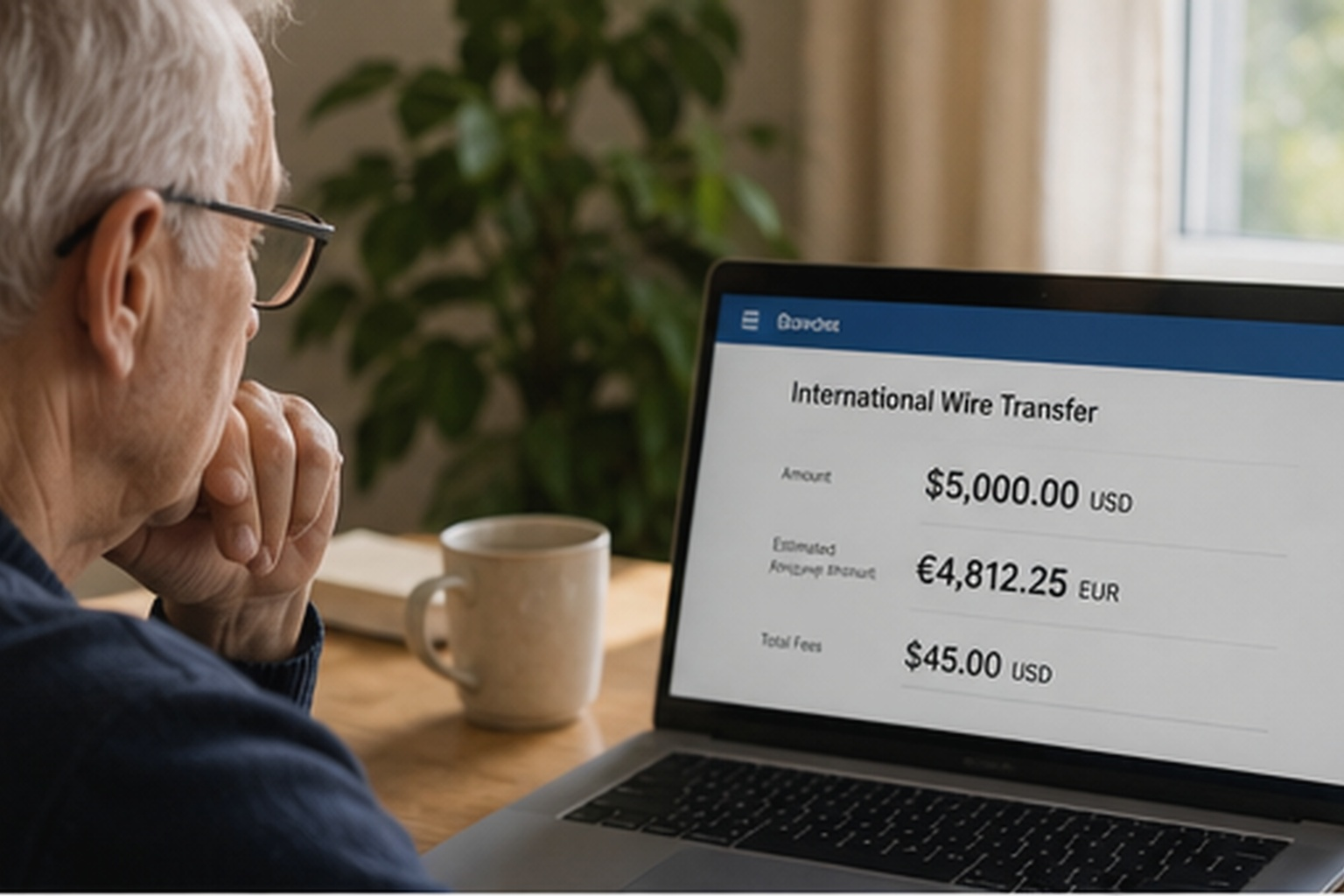
A retiree moves five thousand dollars from an American bank to a Spanish account to cover the first months of a new life abroad. The wire goes through, and a few days later the money lands, except it is not five thousand dollars’ worth of euros. It is closer to forty-eight hundred. Somewhere between the two banks, roughly two hundred dollars quietly evaporated, and nothing on the receipt explains where it went.
That vanished money is the hidden cost of moving money internationally through a traditional bank, and it is far larger than most people realize. The flat fee the bank charges, the thirty or forty dollars you can see, is the small part. The large part is buried in the exchange rate, invisible unless you go looking for it, and on a retirement’s worth of regular transfers it adds up to a serious sum left on the table.
Here is how the cost works, why it can reach four percent of what you send, and what people who move money across the Atlantic regularly use instead. None of this is financial advice, but understanding what you are truly paying is the first step to paying less of it.
The Two Costs, One You See and One You Don’t

Every international bank transfer carries two separate charges, and the banks are far more upfront about the smaller one. The first is the flat wire fee, a fixed charge for sending the money at all. At the major US banks this runs from about $30 to $50 for an outgoing international wire, and it appears clearly on your statement, which is why it is the number most people think of as the cost.
The second charge is the one that does the damage, and it never appears as a line item anywhere. It is the exchange rate markup, the margin the bank adds when it converts your dollars into euros. Rather than converting at the real rate, the bank gives you a slightly worse rate and keeps the difference as profit. Because it is baked into the rate itself rather than charged separately, most people never notice it.
On the major US banks that markup typically runs from 2 to 4 percent above the true rate, and on some banks and some currency pairs it climbs higher. Four percent does not sound like much until you attach it to a real number. On a five-thousand-dollar transfer, a three percent markup alone is a hundred and fifty dollars, and stacked on top of the visible wire fee, the true cost of that single transfer reaches somewhere around a hundred and eighty to two hundred dollars.
There is often a third cost lurking as well, when a wire passes through intermediary banks on the SWIFT network before reaching its destination. Each of those correspondent banks can take a slice, anywhere from ten to a hundred dollars, and you frequently cannot predict how many will be involved or how much they will deduct until the money arrives lighter than you sent it.
How the Markup Hides
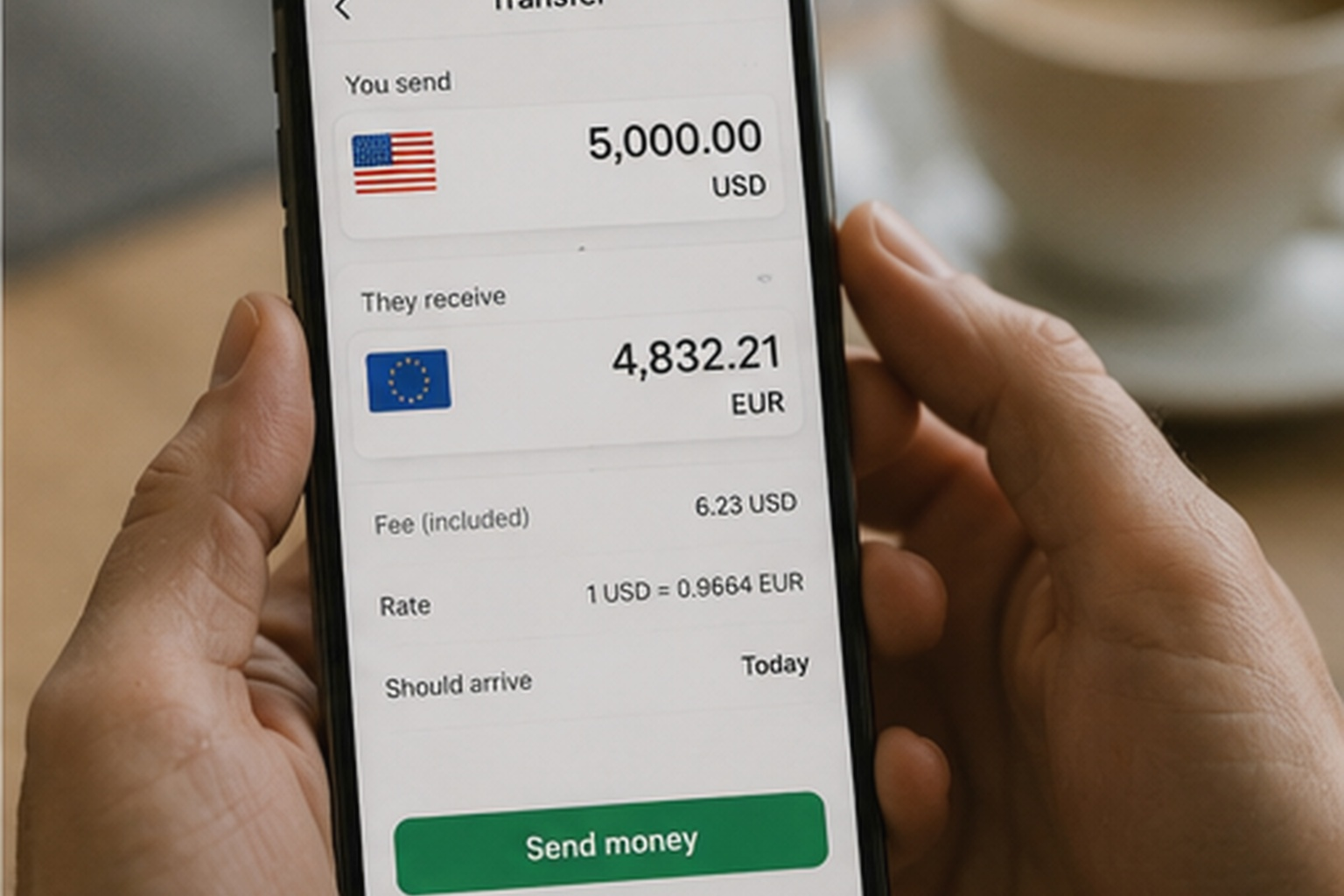
To see the markup you have to know what the real exchange rate is, and most people never look. The genuine rate, the one banks use among themselves, is called the mid-market rate, the midpoint between the buying and selling prices of a currency at any given moment. It is the rate you see if you type a currency conversion into a search engine or check a live rates site.
Banks do not give retail customers that rate. They quote you a rate that is a couple of percent worse and pocket the gap. If the mid-market rate is one dollar to ninety euro cents, a bank might hand you eighty-seven, and the three cents on every dollar are theirs. Nothing on your receipt breaks this out. You simply receive fewer euros than the real rate would have given you, and unless you compared the two numbers yourself, you would never know the difference existed.
This is what makes the markup so effective as a charge. A visible fee invites comparison, so customers shop around and banks compete to keep it low. A hidden markup invites nothing, because the customer cannot see it, and so it can be far larger than any flat fee without ever drawing a complaint. The banks have simply moved most of the cost to the one place people do not look.
The way to catch it is to do the arithmetic once. Note the mid-market rate at the moment you transfer, note the rate your bank gave you, and the percentage gap between them is the markup you paid. Multiply it by the amount you sent and you have the hidden cost in dollars, usually a number several times larger than the flat fee you were focused on.
What It Adds Up To Over a Retirement
For a one-off transfer the loss stings but survives. For a retiree moving money on a schedule, it compounds into something serious. Many people living abroad transfer a set amount every month, a pension payment or a Social Security check converted to euros to cover the rent and the groceries, and every one of those transfers pays the same hidden toll.
Run the numbers over a year. A retiree moving the equivalent of two or three thousand dollars a month through a traditional bank, losing three to four percent each time to the markup plus the flat fee, can hand over well north of a thousand dollars in a single year to the mere machinery of converting their own money. Over a decade of retirement, that is a small fortune, spent on nothing but the act of moving funds from one account to another.
The frustrating part is that the retiree usually has no idea it is happening. The transfers go through, the money arrives, life proceeds, and the steady leak stays invisible precisely because it is spread thin across many small conversions rather than concentrated in one obvious bill. It is death by a thousand exchange-rate cuts, and it is one of the most common and least noticed expenses of retiring abroad.
This is why the people who move money internationally as a way of life, expats, remote workers, anyone with income in one currency and a life in another, tend to abandon the traditional bank wire early. They have run the numbers, felt the leak, and gone looking for something better, which by now is easy to find.
What Expats Use Instead

The alternative that reshaped this whole market is the specialist money-transfer service, and the best known is Wise, though it is far from the only one. What these services share is a simple promise the banks will not make. They convert your money at the actual mid-market rate, with no markup buried in the exchange, and charge a small, transparent fee instead.
The pricing difference is stark. Where a bank takes two to four percent in the rate, a service like Wise typically charges a fee of around 0.4 to 1.5 percent of the transfer, shown to you upfront before you send, and gives you the real rate on top. On a thousand-dollar transfer to Europe, that can mean a total cost of well under fifteen dollars, against the sixty-five to a hundred a bank might take on the same transfer. On larger amounts the gap only widens.
Put the two side by side on a five-thousand-dollar transfer and the difference is impossible to miss. A traditional bank might deliver around forty-eight hundred dollars’ worth of euros once its fee and its markup are taken out. A specialist service, charging a small transparent fee on the real rate, delivers close to the full five thousand. That is a gap of roughly a hundred and fifty to two hundred dollars on a single ordinary transfer, and the same gap opens up again on every transfer after it.
They tend to be faster as well. Traditional wires crawl through the SWIFT network and its chain of correspondent banks over one to five business days. Many specialist services move money over local payment rails instead, paying out from a local account in the destination country, so transfers often complete in hours rather than days. The money is easier to track too, since you can see the fee, the rate, and the arrival amount before you commit a cent.
Several such services compete now, Revolut, OFX, Xe, and others alongside Wise, and many offer a multi-currency account that lets you hold both dollars and euros, receive money with local account details in each country, and convert between them when the rate suits you rather than when a transfer forces your hand. For a retiree splitting life across two currencies, that flexibility is often as valuable as the lower cost itself.
The Big-Transfer Exception
Monthly income is one thing, but a house is another, and the calculus changes when the number gets large. Buying a home in Spain, or moving a lifetime of savings across in one go, means converting a very big sum at a single moment, and at that scale the exchange rate stops being a nuisance and becomes the main event. On a three-hundred-thousand-euro purchase, a one percent difference in the rate is three thousand euros, more than most people spend on the entire rest of the move.
For transfers of that size, many expats step up from the consumer apps to a dedicated currency broker, a firm like OFX or one of its competitors that assigns a human dealer to large moves. These brokers still beat the banks comfortably on rate, but their real value is the tools they offer for managing timing. The most useful is the forward contract, which lets you lock in today’s exchange rate for a transfer you will make weeks or months from now, so that a swing in the currency between signing for a house and paying for it cannot blow up your budget.
A related tool is the limit order, an instruction to convert automatically if and when the rate reaches a level you set, which lets you wait for a better moment without watching the market all day. For the ordinary monthly transfer none of this is worth the trouble, and a simple app is the right tool. For a property purchase, where a bad day on the currency market can cost more than the lawyer, the broker and the forward contract earn their keep.
Timing is the whole game at that size. The currency market can drift a percent or two in a week for no reason a normal person could predict, so on a large sum the question of when you convert can matter as much as the question of who you convert with. The forward contract exists precisely to take that gamble off the table, trading the small chance of a lucky swing for the certainty of a rate you have already agreed.
Whatever route a large transfer takes, expect to document where the money came from. Any transfer of ten thousand dollars or more is reported to the US authorities as a matter of routine, and a Spanish bank receiving a house-sized sum will want to see the paper trail behind it, so keeping records of the source of funds is part of the job rather than an optional extra.
The Fine Print Worth Knowing

A few honest qualifications keep this from being a blanket rule. Not every bank transfer is a rip-off, and there are ways to soften the bank’s cost if you must use one. Some banks waive the flat fee when you send in the destination currency online, and some higher-tier accounts drop the wire fee entirely, though the exchange-rate markup usually survives even when the visible fee is gone. If you already bank somewhere with those terms, the gap narrows, even if it rarely closes completely.
There are limits on the specialist side too. Transfer services apply their own caps and verification steps, and a new account sending a large sum for the first time may face a hold while the service checks it, which is worth planning around rather than discovering on the day a payment is due. The apps are built for speed and low cost, not for hand-holding through a complex or enormous transfer.
Two smaller points round it out. Once your money is inside the euro zone, moving it between European accounts is cheap and often instant through the local SEPA system, so the expensive step is only the crossing of the currency border, not every transfer thereafter. And the mid-market rate itself moves constantly, so the exact cost of any transfer depends a little on timing, which is one more reason the multi-currency accounts, letting you convert when you choose, appeal to people managing money across two currencies.
None of these caveats changes the headline. For the ordinary business of moving retirement income from the United States to Europe, the specialist services are dramatically cheaper than a bank wire, and the difference is money that stays in the retiree’s pocket rather than the bank’s.
How to Stop Overpaying
The practical fix takes one afternoon. Before your next transfer, look up the real mid-market rate, then get a quote from your bank and a quote from a service like Wise for the same amount, and compare not the fees they advertise but the number of euros that would land in the Spanish account. That final figure, the money that arrives, is the only true measure of cost, and it usually settles the question on the spot.
For most people the answer is to keep the US bank for domestic life and route the international transfers through a specialist service, opening the account once and using it for every crossing thereafter. It takes ten minutes to set up and saves money on the very first transfer, which is about as clear as a financial decision gets.
Spain and the rest of Europe are no more expensive to fund from abroad than anywhere else, once you stop paying the invisible tax on moving your own money. The retirees who thrive on a fixed income are often simply the ones who noticed the leak early, plugged it, and kept the four percent that everyone else quietly hands over. As always with money, the sensible move is to compare the real numbers yourself, or ask an adviser to, before you send.

About the Author: Ruben, co-founder of Gamintraveler.com since 2014, is a seasoned traveler from Spain who has explored over 100 countries since 2009. Known for his extensive travel adventures across South America, Europe, the US, Australia, New Zealand, Asia, and Africa, Ruben combines his passion for adventurous yet sustainable living with his love for cycling, highlighted by his remarkable 5-month bicycle journey from Spain to Norway. He currently resides in Spain, where he continues sharing his travel experiences with his partner, Rachel, and their son, Han.