
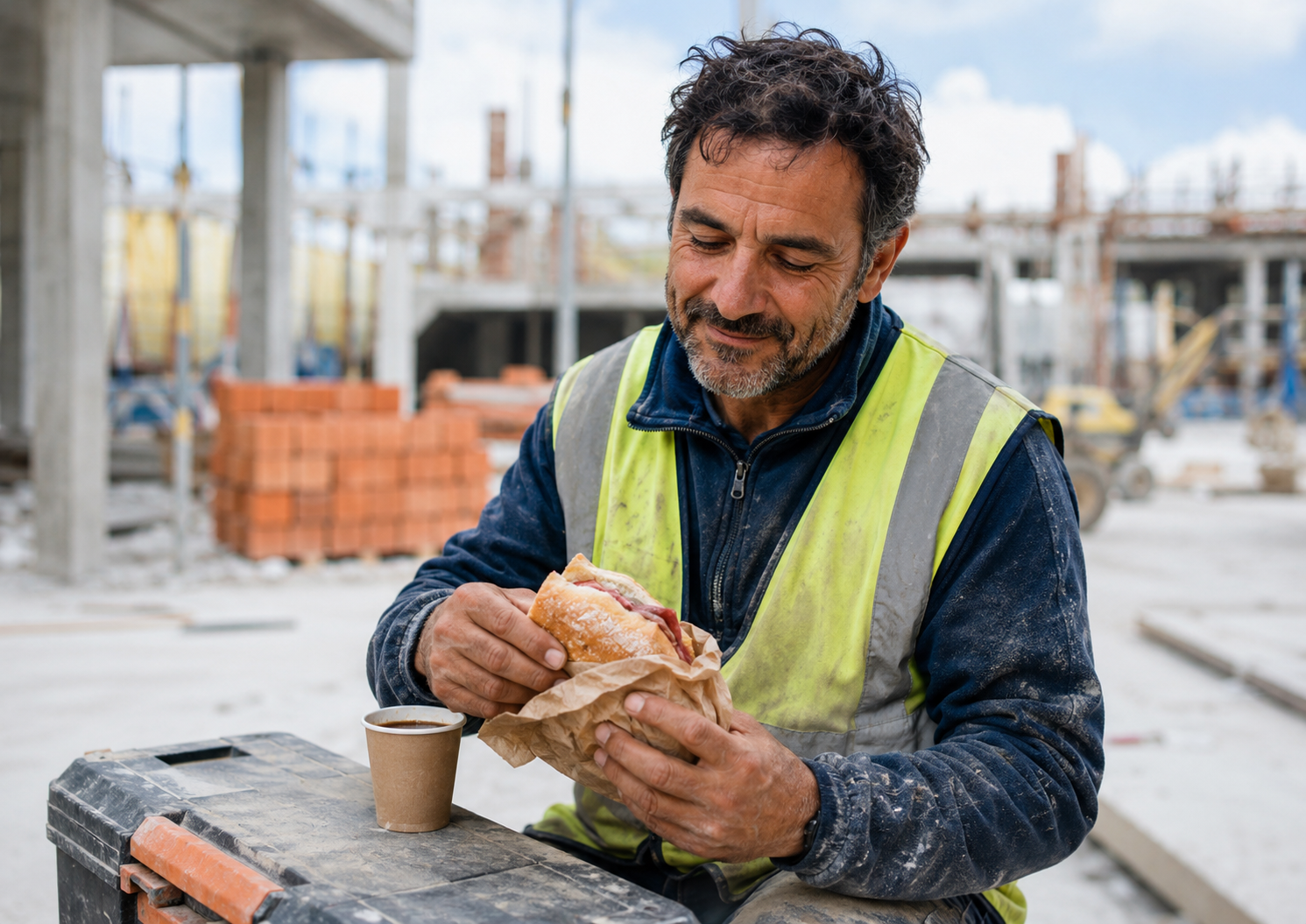
At around ten in the morning on a building site in Spain, something happens that would puzzle most Americans. The drills go quiet, the workers down tools, and everyone heads to the nearest bar. Not for a coffee to gulp on the way back, but to sit down to a proper meal: a fat sandwich, a small drink, and twenty unhurried minutes of talk.
This is the almuerzo, the Spanish mid-morning meal, and for the manual workers who built the tradition it is close to sacred. It is the reason a construction crew will pause an entire morning’s momentum at ten o’clock, and it has survived, unchanged in spirit, in an age when the rest of the world reaches for a protein bar eaten one-handed at a desk. The almuerzo is worth understanding, because it is a small daily rebellion against the idea that fuelling the body should be fast, solitary, and joyless.
The Meal Between Meals
To understand the almuerzo, you have to understand the shape of the Spanish day, which spreads its eating out very differently from the American one. Breakfast, desayuno, is typically light and early, often just a coffee and a piece of toast. Lunch, la comida, is the big meal of the day, but it does not arrive until around two, three, or even four in the afternoon.
That leaves an enormous gap in the middle of the morning, and the almuerzo fills it. Eaten roughly between ten and half past eleven, it is a substantial second breakfast, a mid-morning meal that bridges the light early start and the very late lunch. For someone who began work at seven, a piece of toast at dawn is a distant memory by ten, and a solid almuerzo is what carries them through to a lunch that is still hours away.
For many Spaniards, especially those doing physical work, the almuerzo is not a snack but a genuine meal, sometimes the first real one of the day. It is built to sustain hard labour across a long morning, which is exactly why it is so much more than a nibble. Where an American might bridge that same gap with a granola bar, the Spanish worker sits down to bread, protein, and company, and the difference in both substance and spirit is enormous.
Born in the Fields
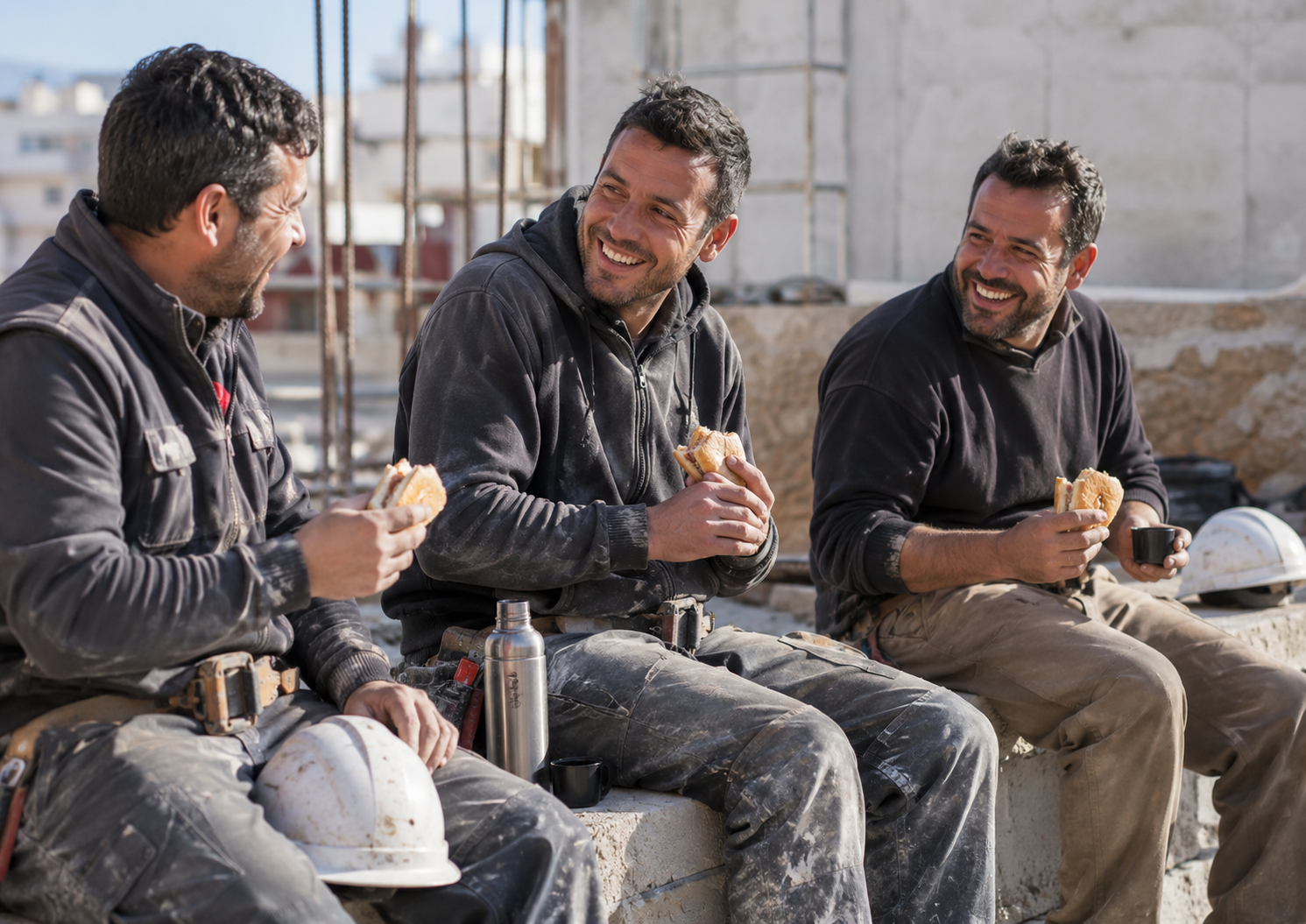
Like many of the best food traditions, the almuerzo comes from working people, and specifically from the land. Its heartland is the region of Valencia, and its deepest roots are in l’Horta, the fertile agricultural belt around the city, where in Valencian the meal is affectionately called the esmorzaret.
The logic was simple and practical. Farmworkers rose before dawn to work the fields in the cool early hours, and by mid-morning, after hours of hard labour on a light stomach, they needed a real, restoring meal. So they built a short, robust ritual around simple, filling, affordable ingredients: bread, cured meats, eggs, whatever the season and the pocket allowed. It was fuel for the body, taken as a proper pause rather than snatched on the move.
Over time, the almuerzo migrated with the workers themselves. It moved from the fields into the factories as Spain industrialised, and then into the bars where it lives today, gradually acquiring a social polish along the way. What began as pure sustenance for labourers became an institution, but it never lost its origins. To this day the surest sign of a good, authentic almuerzo bar is that it is full of workers on their first break of the day, and the tradition remains proudest and strongest exactly where it started, among the people who work with their hands.
There is something fitting in that. A meal invented to power hard physical labour has kept its integrity precisely because the people who need it most never let it become fussy or fashionable. Gourmet versions exist now, with chefs turning out elevated bocadillos, but the soul of the almuerzo remains in the plain workers’ bar, unchanged and unbothered by any of it.
The Anatomy of an Almuerzo
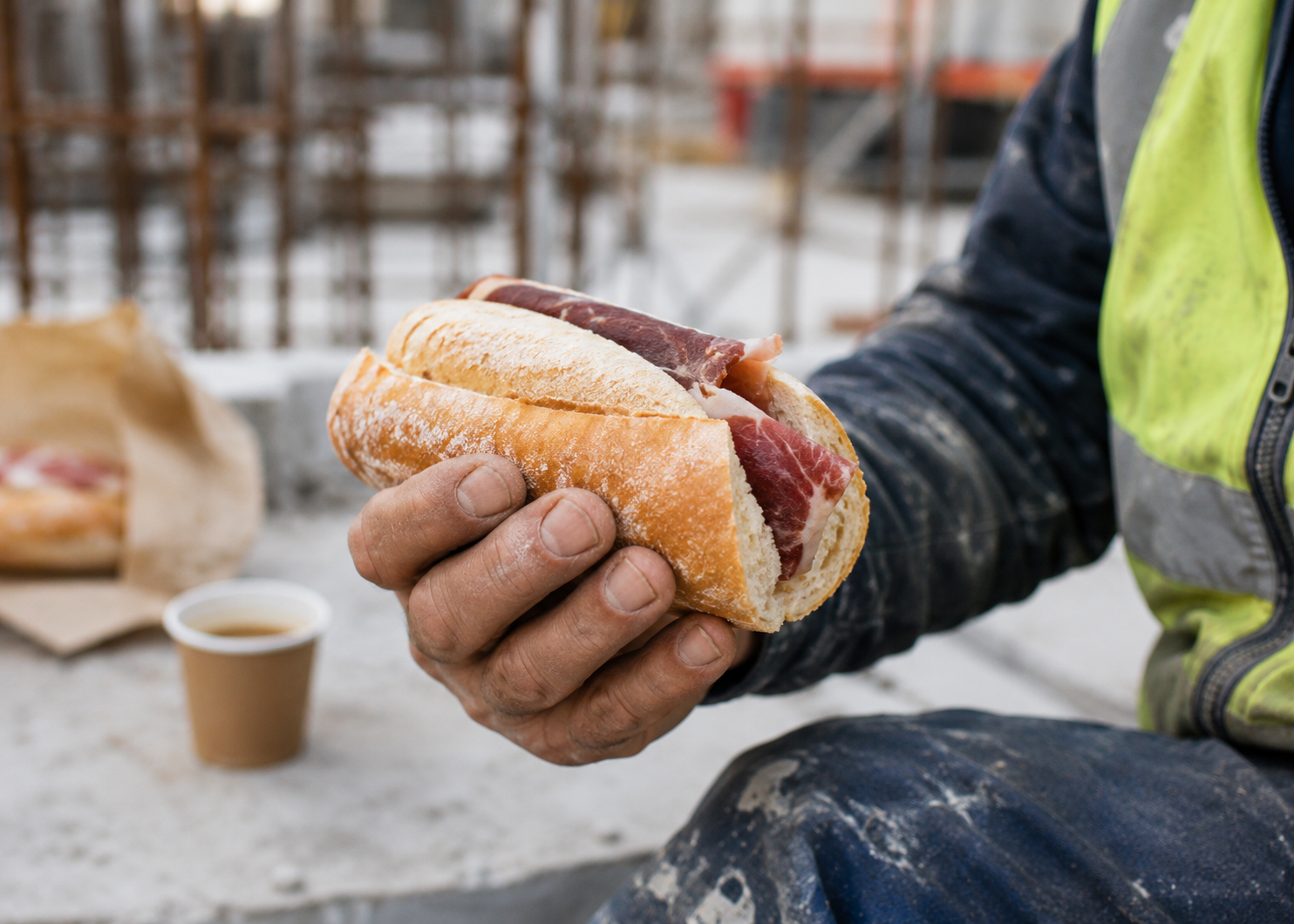
A full almuerzo is not just a sandwich; it is a small, structured feast with its own rhythm, and knowing the sequence is part of belonging to it. It typically begins with the gastos, sometimes called the picaeta: shared bowls of olives, salted peanuts, and pickles set on the table to open the proceedings.
Then comes the star, the bocadillo, the sandwich around which the whole ritual revolves. This is no dainty affair. It is a substantial length of good bread packed with a serious filling, and the classic choices are gloriously hearty. There is the blanco y negro, a pairing of white longaniza sausage and black morcilla blood sausage; the chivito, a towering stack of pork loin, bacon, cheese, and a fried egg; and plenty made with sepia, calamari, tortilla, or slow-roasted pork. To finish, there is coffee, often the local cremaet, a small, potent flambéed coffee laced with rum or brandy, cinnamon, and citrus peel.
Alongside all of this sits a drink, and here is where visitors often raise an eyebrow, because at ten thirty in the morning that drink is frequently a small beer or a glass of wine. The whole thing usually costs somewhere around five to seven euros, roughly six to eight dollars, for the sandwich, the nibbles, the drink, and the coffee together. For that modest sum you get not just food but a complete, unhurried ceremony, which is a large part of the point.
The Sandwich Itself
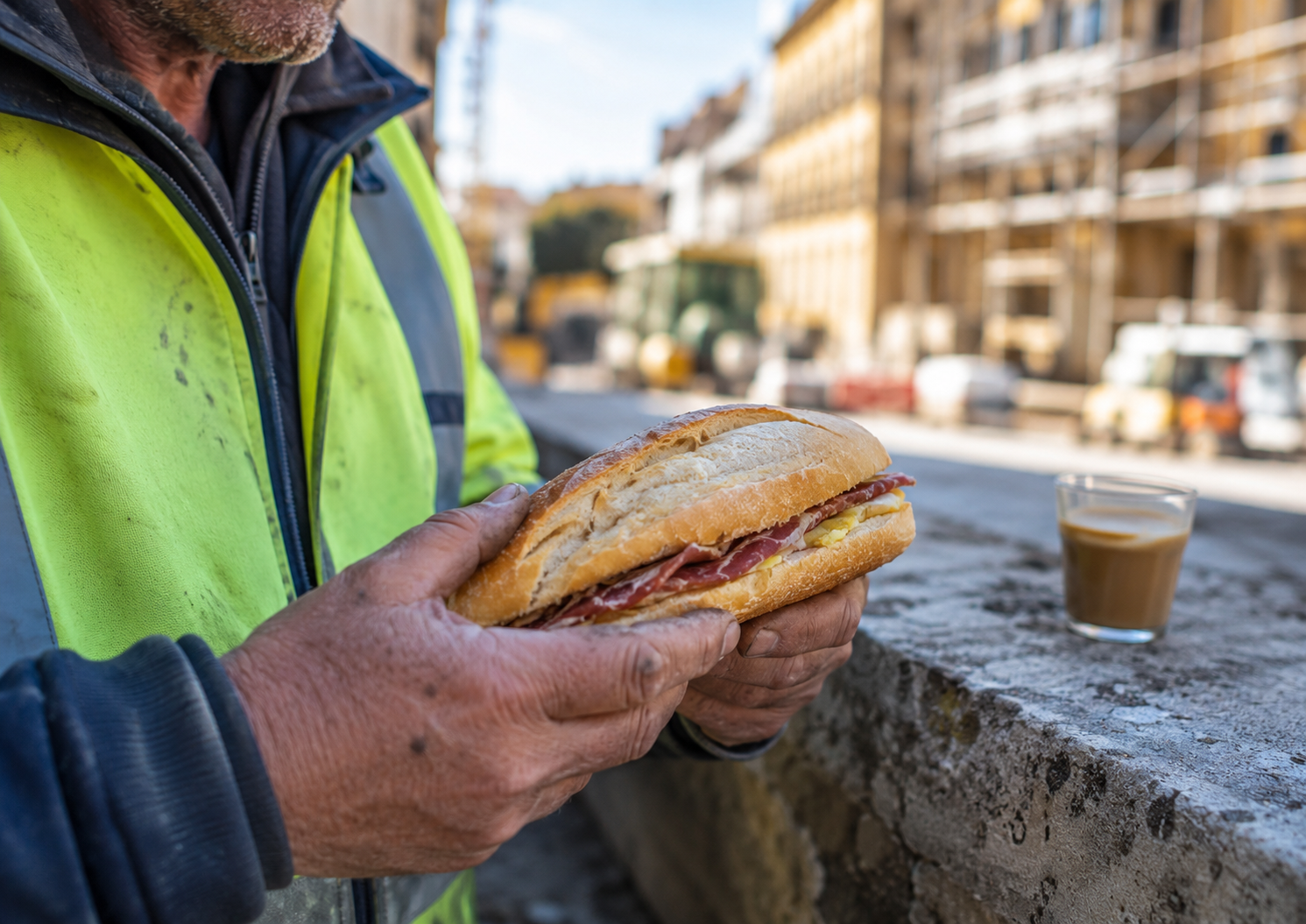
At the centre of everything is the bocadillo, and it deserves its own attention, because it is the antithesis of the small, engineered snack. A proper almuerzo sandwich is generous to the point of being a challenge, often so full that eating it neatly is impossible, and that abundance is entirely deliberate.
It is built on real bread, usually a length of crusty baguette or a rustic roll, filled with genuine, recognisable food: cured sausages, grilled cuttlefish, a thick wedge of potato omelette, roasted meat, tuna and olives. Nothing about it is processed into a bar or reduced to a formula; it is simply good ingredients between good bread, made fresh at the bar that morning. The sandwiches are often so large that bars offer them by the fraction, a medio for half or a mini for a quarter, for those who cannot face the full monster.
That size and substance are the whole idea. This is food designed to sustain someone doing physically demanding work for several more hours, so it is dense, satisfying, and real. It sits in the stomach in a way that keeps hunger at bay until a late lunch, without any of the engineered ingredients of a snack designed to be shelf-stable for a year. The almuerzo bocadillo is proof that the best mid-morning fuel might just be an honest sandwich, made properly and eaten with attention.
The Rules of the Ritual
Like any real institution, the almuerzo comes with unwritten rules, and locals observe them without ever needing to state them. The first and firmest is the timing. A true almuerzo happens roughly between nine and noon; the purists start at nine, the stragglers push toward twelve, but eat that same sandwich at three in the afternoon and you are not having an almuerzo, you are just having a sandwich.
The others are matters of respect. You do not rush someone savouring their bocadillo, because the pause is the point and hurrying it defeats the purpose. You do not sneer at another person’s filling, since tastes are personal and fiercely defended, and a person’s loyalty to their particular sandwich is not to be mocked. And you order with a little boldness, though there is no shame in asking for a medio or a mini if the full sandwich would defeat you, despite the good-natured smiles that request sometimes earns.
None of these rules is written anywhere, and none is enforced by anything but custom, yet they hold. They are the etiquette of a shared ritual, the small courtesies that turn a group of people eating sandwiches into a tradition. To follow them, even as a visitor, is to be briefly let into something, and the quickest way to be welcomed at an almuerzo is simply to slow down, order something hearty, and take your time the way everyone around you is doing.
Why It Outlasts the Protein Bar
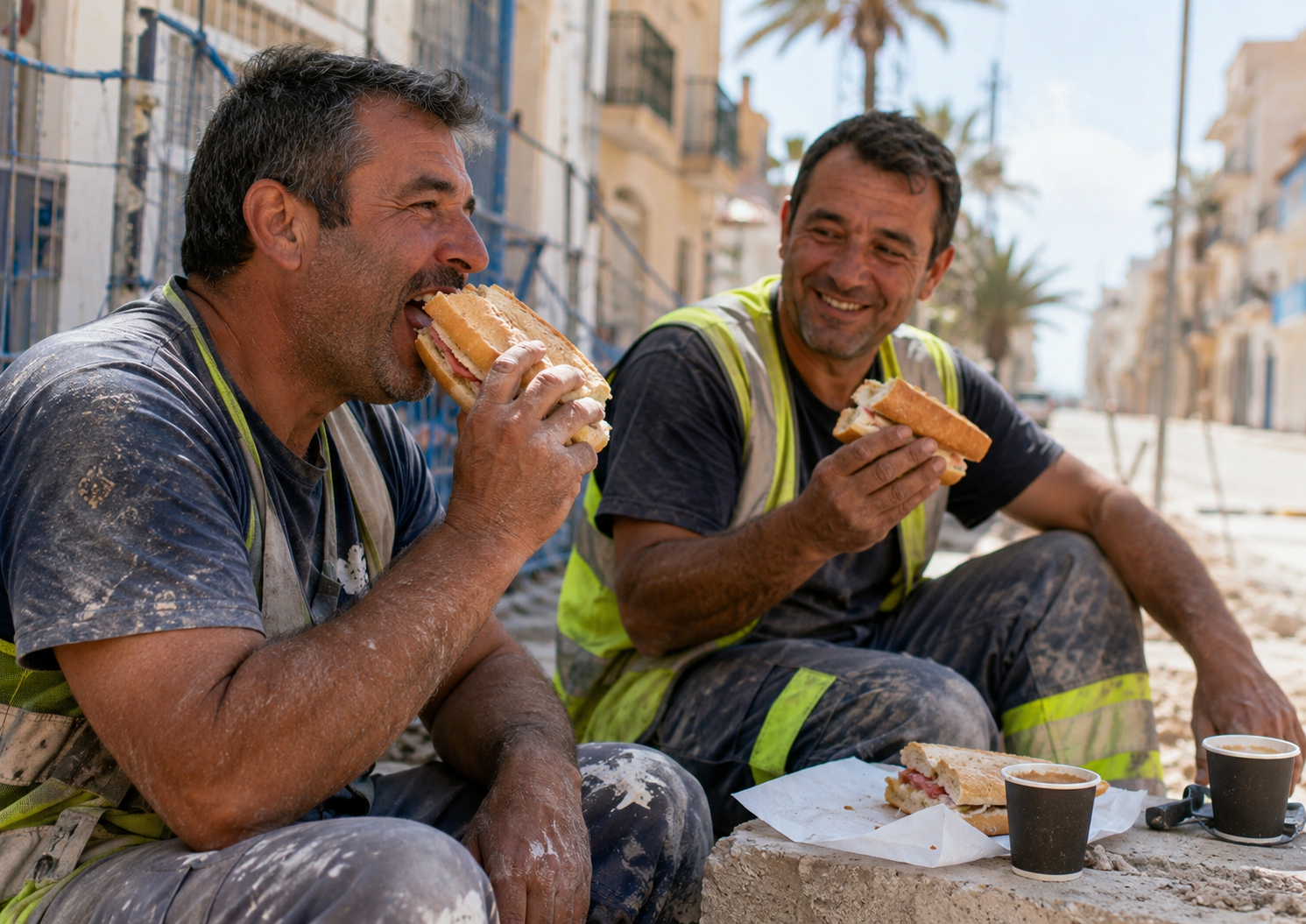
Here is the heart of the matter. The American approach to the mid-morning energy gap is usually the protein bar or the meal-replacement shake: something compact, portable, engineered for convenience, and consumed alone in a few distracted bites while doing something else. The almuerzo is the exact opposite on every axis, and that is precisely why it endures.
Where the protein bar is processed, the almuerzo is made from whole, recognisable food. Where the bar is eaten on the move, the almuerzo is eaten sitting down. Where the bar is solitary, the almuerzo is social, shared with workmates or neighbours. And where the bar treats eating as a task to be optimised and minimised, the almuerzo treats it as a pause worth protecting. The protein bar solves the narrow problem of calories in the least possible time; the almuerzo solves the wider problem of how a person actually wants to eat and rest in the middle of a working morning.
This is not a claim that a bocadillo is nutritionally superior to a bar, a question that depends on the details and is not really the point. The point is that the almuerzo endures because it satisfies things a wrapped bar never can: the need for real food, for a genuine break, for a few minutes of human company in a long day of work. A protein bar is a solution to a problem the almuerzo does not even have, because the almuerzo was never trying to be efficient. It was trying to be good, and things that are genuinely good tend to outlast things that are merely convenient.
The Break Is the Point
It would be easy to focus only on the food and miss the deeper reason the almuerzo has survived, which is that it is as much about the pause as the sandwich. The twenty or thirty minutes of sitting, talking, and switching off are not incidental to the meal; they are half of what it is for.
The small beer or glass of wine, so startling to a visitor at that hour, makes more sense in this light. It is not about drinking; it is a signal that this is a genuine break, a moment of ease and sociability rather than a hurried refuelling stop. The talk turns to football, family, the neighbourhood, last night’s news. For a while, the work is set aside entirely, and the group is simply a group of people enjoying a meal together, which is its own kind of restoration.
This is the part the modern productivity culture struggles most to accept, the idea that stopping properly, in the middle of the morning, for longer than it takes to eat, is not a waste but a benefit. The almuerzo insists that the break has value in itself, that a worker returns to the site sharper and steadier for having truly rested, and that the human company is as nourishing as the bread. A protein bar keeps you working; the almuerzo makes you stop, and the stopping is the point.
A Workers’ Institution Everyone Adopted
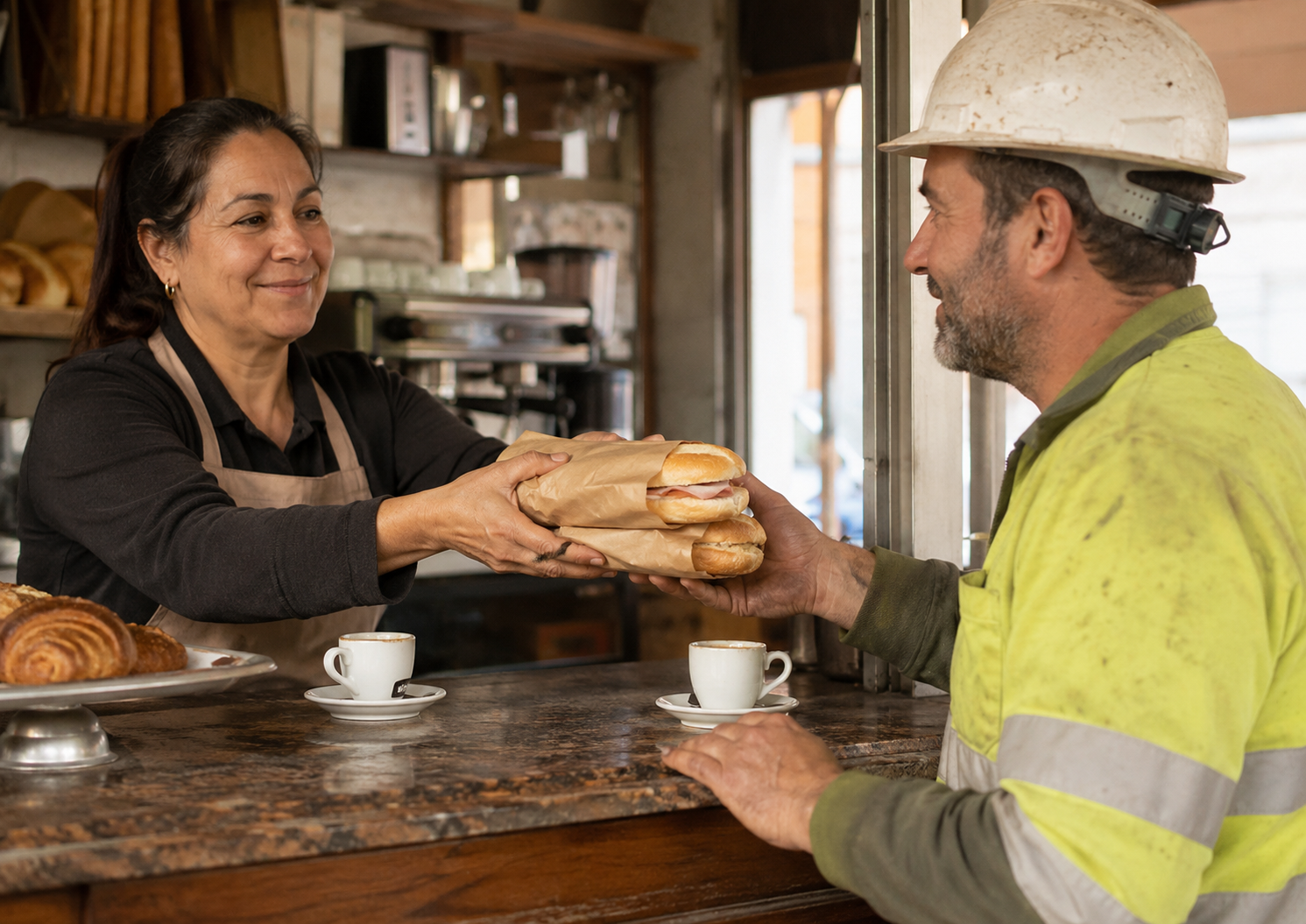
Though it was born among labourers, the almuerzo did not stay confined to them, and its spread through Spanish society is a sign of just how good an idea it is. Today you will find office teams, shopkeepers, retirees, and students all claiming their own version of the ritual, gathering in bars at mid-morning for their bocadillo and their break.
What is striking is that it broadened without losing its character. The office worker’s almuerzo looks much like the bricklayer’s: the same bar, the same big sandwich, the same coffee, the same unhurried pause. It remains a democratic, unpretentious institution, cheap enough for anyone and rooted in the same simple pleasures regardless of who is taking part. Entire workplaces still empty out at the appointed hour, and in its Valencian heartland the tradition is passed down, quite literally, from parents to children, and defended with real pride.
That durability is the ultimate answer to the protein bar. Trends in convenient nutrition come and go, each promising to solve mid-morning hunger more efficiently than the last. The almuerzo, meanwhile, simply continues, unbothered and beloved, because it was never solving for efficiency in the first place. A construction crew downing tools at ten for a sandwich and a chat is doing something humans have always done and always will: stopping to eat properly, together, in the middle of the work.
What the Almuerzo Knows
The almuerzo, in the end, is a small piece of accumulated wisdom about how to get through a working day, and its lesson reaches far beyond Spain. It says that the middle of the morning deserves a real meal, not a wrapped substitute; that eating is better done sitting than moving; and that a proper break, with real food and real company, is worth the time it takes.
For all the ingenuity of modern convenience foods, none of them has made the almuerzo obsolete, and that failure is instructive. The bocadillo at ten in the morning persists not because it is optimised but because it is humane, meeting needs that no bar, shake, or desk snack has ever managed to touch. It fuels the body, yes, but it also feeds the parts of a person that a calorie count cannot measure.
So the next time the mid-morning slump hits, the almuerzo offers a quietly radical suggestion: stop, sit down, and eat something real, ideally with someone else. The Spanish construction worker, pausing at ten for a sandwich the size of a forearm, has understood something the protein-bar industry never will. Fuel is easy. A good meal, properly taken, is something else entirely, and it is worth stopping the drills for.

About the Author: Ruben, co-founder of Gamintraveler.com since 2014, is a seasoned traveler from Spain who has explored over 100 countries since 2009. Known for his extensive travel adventures across South America, Europe, the US, Australia, New Zealand, Asia, and Africa, Ruben combines his passion for adventurous yet sustainable living with his love for cycling, highlighted by his remarkable 5-month bicycle journey from Spain to Norway. He currently resides in Spain, where he continues sharing his travel experiences with his partner, Rachel, and their son, Han.