
At six in the morning, before the coffee machines are even warm, a particular kind of guest is already moving. They pad down to the shuttered pool in flip-flops, towels under one arm, and wait. When the gate opens they move fast, draping a towel over the best lounger, then a second, then a third for the family still asleep upstairs. By seven, half the poolside is claimed and empty, and by nine, the guests who slept in are wandering the deck looking for a seat that does not exist.
This is the sunbed war, and across Mallorca a growing number of hotels have decided to fight back. Staff now walk the pool decks, and towels left on empty loungers for too long are lifted, folded, and set aside, the reservation quietly undone. It is a small revolution in resort etiquette, and it is changing how the summer holiday actually works.
Why the Towel Dash Exists

The root of it is simple arithmetic. A large hotel might have a few hundred loungers and well over a thousand guests, and on a hot day in July everybody wants the same thing at the same time: a bed by the water, in the sun, near the bar, not too far from the shade for later.
All-inclusive resorts sharpen the pressure. When food, drink, and entertainment are all on site, guests spend the whole day at the pool rather than heading out, so demand for a lounger runs from breakfast to dusk. The prime spots, front row, poolside, near the swim-up bar, are genuinely scarce, and scarcity breeds the scramble.
The reserving itself is the problem. A family of four will often claim six or seven loungers so nobody has to sit apart, then vanish to breakfast, the beach, or an excursion, leaving towels to hold ground for hours. The beds sit empty and unusable while other guests go without. Multiply that across a full resort and a large share of the poolside can be locked up by people who are nowhere near it, which is exactly the frustration the crackdown is meant to answer.
There is a psychology to it, too. Once a handful of guests start reserving at dawn, everyone else feels pushed to join in or lose out, and a habit that suits nobody becomes self-sustaining. The busiest days, changeover days and the peak weeks of August, are the worst of all. The same guests who race for a sunny bed at seven often want to migrate to the shade by midday, claiming a second set of loungers and doubling the squeeze on everyone behind them.
What the Hotels Are Doing About It

Faced with daily complaints, hotels across the Mediterranean have started introducing controls, and Mallorca is squarely in the mix. The methods vary from resort to resort.
Some now assign each guest a specific lounger for the length of their stay at check-in, removing the race entirely, though at the cost of choice. Others take the more active route, with staff clearing towels and belongings from loungers left unused for a set period, commonly somewhere between 30 to 60 minutes, on the reasoning that a genuinely occupied bed does not sit empty that long. A few simply keep the pool area closed until a certain hour to stop the dawn rush.
That last tactic has a way of backfiring. At one hotel in Camp de Mar, staff kept the doors to the pool shut until 10am to prevent early reserving. Guests worked it out quickly and began lining their towels up along the corridor leading to the exit, so that the moment the doors opened there was an even more frantic stampede for the loungers outside. The lesson resorts keep relearning is that determined holidaymakers will out-strategise almost any half-measure, and only active enforcement, staff actually removing towels, seems to move the needle.
What the Staff Actually Do With Your Towel
The mechanics of enforcement are less dramatic than the phrase towel-stripping suggests, and worth understanding before anyone pictures the worst. Removal is not confiscation, and it is rarely done on a whim.
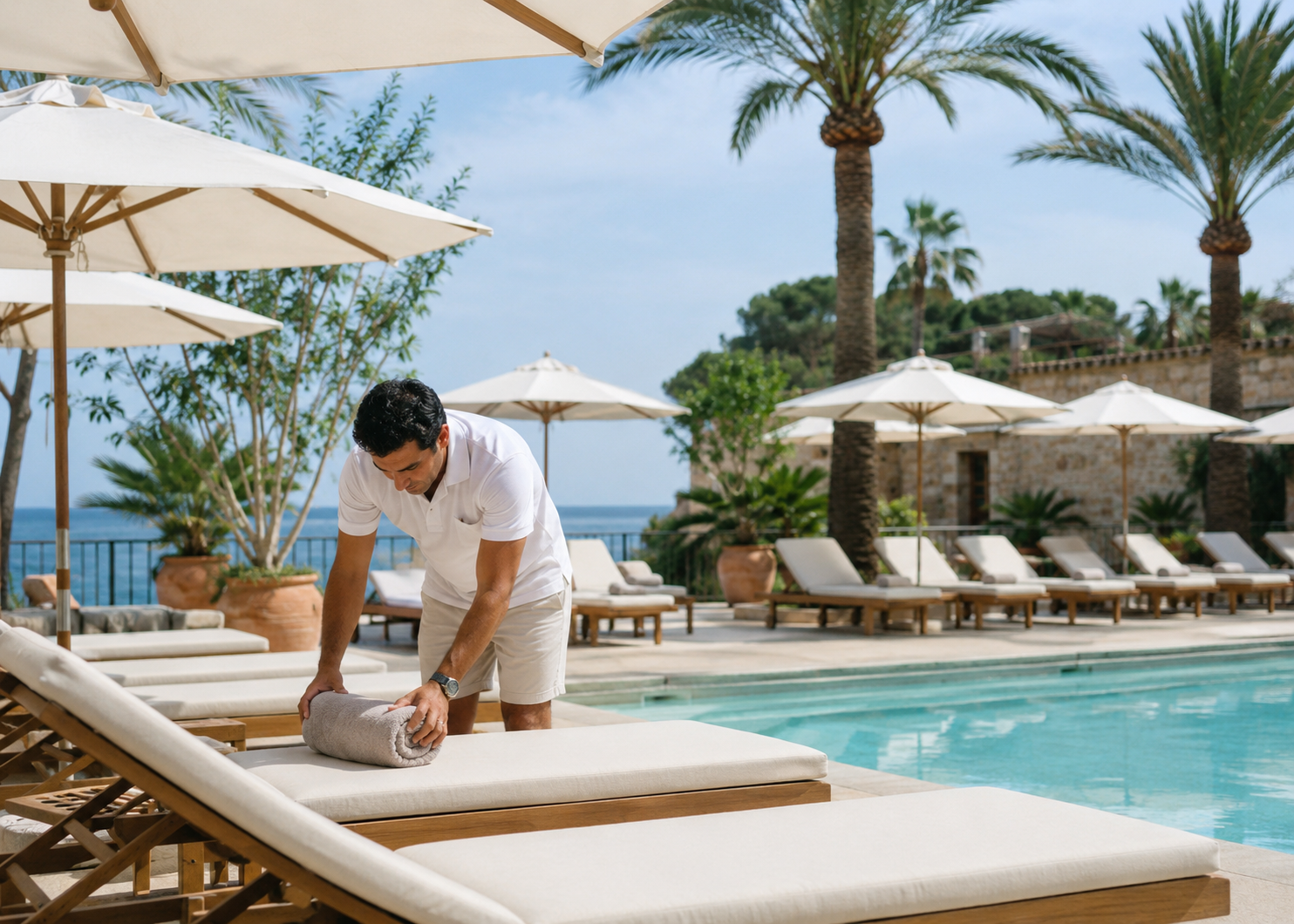
Where hotels clear unused loungers, staff typically watch for beds draped since early morning with no sign of anyone using them. After the grace period passes, usually somewhere in that 30 to 60 minute window, they gather the towels and belongings and, in most cases, store them safely at reception or a nearby desk rather than dumping them on the ground. The lounger is then freed for the next guest. Some resorts go a step further and clip a small time card to a newly reserved bed, so both staff and guests can see exactly when the clock started ticking.
None of this is foolproof, and it does produce the occasional tense exchange when a guest back from a long breakfast finds the spot reassigned and the towel behind the desk. The systems that work best are the transparent ones: a clearly posted policy, a stated grace period, and belongings kept safe rather than discarded. Guests who actually read the pool rules on arrival almost never fall foul of them. It is the ones who assume a dawn towel buys the entire day who get the surprise.
The Rules Have Teeth Now
It is not only hotels acting on their own. In parts of Spain, and the Balearic Islands in particular, public authorities have given themselves real power over the problem, especially on public beaches rather than private pools.
Local rules in several Balearic and coastal areas now allow authorities to remove unattended loungers, towels, and umbrellas that have been left to reserve a spot for long stretches. Some coastal towns have gone further, introducing fines of up to €250, roughly $270, for leaving belongings unattended on the sand. In certain places, anything left alone for more than three hours can simply be confiscated by beach staff.
The message from the authorities matches the one from the hotels. A towel is not a property deed, and leaving one on a bed at dawn does not entitle you to that bed all day while you are elsewhere. Enforcement is patchy and varies by municipality, so the fines are more a statement of intent than a nightly reality, but the direction of travel is unmistakable. The days when a towel could silently hold a prime spot from breakfast until sunset are ending. Travelers should still check the specific municipality’s rules before assuming, since a fine enforced strictly on one beach may be quietly ignored in the next bay along the coast.
The Bigger Fight Over Who the Beaches Belong To
The towel war does not happen in a vacuum. It sits inside a much larger and tenser argument playing out across Mallorca and the Balearics about tourism itself.
Recent summers have brought real friction between residents and visitors on the islands, with protests over crowding, water use, and housing costs that locals tie to mass tourism and holiday rentals. In that climate, the sight of a resort’s loungers monopolised by a handful of guests while everyone else stands around reads as one more small symbol of a system straining at the seams. Managing the poolside better is partly about guest satisfaction and partly about a resort being seen to run a fair, orderly operation at a moment when tourism is under a microscope.
The Balearic government also charges a sustainable tourism tax on overnight stays, and the islands increasingly sell themselves on quality rather than sheer volume. A smoother, less combative pool deck fits that story. It is hard to market a premium, well-managed destination when the defining image of a guest’s morning is a scrum for plastic furniture at dawn. The crackdown on towels, in other words, is a tiny front in a far broader campaign about what kind of tourism the islands actually want.
When the Sunbed War Reaches a Courtroom

The stakes are higher than wounded holiday pride, as one recent case made clear. A German tourist took his tour operator to court after a family trip on the Greek island of Kos, arguing that he had effectively paid for a holiday he could not use.
According to the ruling, the family had paid more than €7,000, about $7,560, for the package. Despite the father waking at 6am each morning to try for loungers, other guests had already reserved them, and his children were at times left sitting on the ground because no beds were free. He complained to the operator and the hotel without success. The court in Hanover sided with him, deeming the holiday defective because his family’s needs went repeatedly unmet, and awarded him more than €900, roughly $970, well above the partial refund the operator had first offered.
The case matters beyond Greece. It puts tour operators and hotels on notice that failing to manage the lounger free-for-all can carry a real legal cost, not just a bad review. That is a large part of why resorts across Mallorca and the wider Mediterranean are tightening their rules this summer rather than shrugging the problem off as they long did.
The ruling also exposed an old buck-passing habit. When the German guest first complained, the operator told him the loungers were the hotel’s responsibility, while the hotel itself proved hard to pin down at all. The court’s answer was that the company which sold the package could not simply wash its hands of what happened at the pool, which is precisely the accountability the industry had dodged for years.
The Vigilante Tourists
Where official enforcement is thin, some guests have appointed themselves. The results tend to go viral, which is half the point.
One British tourist became briefly famous online after filming himself removing towels from eight unattended loungers at a hotel in Tenerife, clearing the deck for guests who were actually present. In Mallorca, another visitor made headlines by sprinkling itching powder over the belongings left on empty beds, a pettier and less advisable form of protest. Footage of the daily scramble at Spanish resorts, most recently along the Andalucían coast, circulates every summer and reliably reignites the same argument in the comments.
The online debate is remarkably heated for a dispute about deck furniture. Some cheer the towel-removers as folk heroes enforcing a fairness the hotels will not. Others point out that self-appointed justice at the poolside is a fast route to a screaming row on holiday, or worse. What the viral clips really capture is a genuine shift in mood: guests are less willing than they used to be to accept the towel land-grab as simply how things are, and that impatience is pushing hotels to act. The staff, for their part, mostly wish both the reservers and the self-appointed enforcers would stop, since they are the ones left refereeing strangers’ quarrels over plastic furniture at eight in the morning.
The Tech Fix Nobody Expected

The newest answer to the towel war is not a rule at all. It is an app. Some parts of Mallorca are trying to move the whole contest onto a phone screen, where a queue can be managed by software rather than adrenaline.
In Calvià, the town hall has rolled out a mobile booking system for some of its beaches, letting visitors reserve a sunbed and parasol before they even arrive. Instead of wandering the shoreline hunting for a free bed, a beachgoer checks availability and books a spot in advance, the same way one might reserve a restaurant table. Officials frame it as part of a broader push toward smart tourism and easier beach services, and it does neatly sidestep the dawn dash.
Whether holidaymakers embrace it is another matter. Some love the certainty of a guaranteed bed booked from the sofa the night before. Others prefer the old spontaneity of turning up and finding a patch of sand, and grumble that booking a beach chair by phone drains the last bit of romance out of a day by the sea. The technology solves the fairness problem cleanly, but it asks people to plan a beach day like a theatre trip, and not everyone wants their holiday that organised.
The model is spreading regardless. As more Balearic municipalities digitise their beach services, booking a lounger by phone may become as routine as booking airport parking, at least on the busiest public stretches. Private hotels are watching the experiment too, and some may fold pool-bed reservations into their own guest apps, turning the dawn dash into a quiet notification the night before.
How to Get a Lounger Without Joining the War

For anyone heading to Mallorca this summer, there is a calmer path through all this than setting a 6am alarm. It starts with a single question at check-in.
Ask the hotel directly how its pool works. If loungers are assigned for the whole stay, the war is already over and you simply take your allocated bed. If the hotel actively clears towels after a set time, there is little point in early reserving anyway, so you can arrive at a civilised hour and pick up a bed the dash-crowd abandoned when they went to breakfast. Knowing the policy is most of the battle.
It also helps to notice which guests you are up against. Adults-only and higher-end hotels tend to run far calmer pool decks than the big family all-inclusives, where the towel race is fiercest, so the choice of resort quietly shapes the whole experience before you even arrive.
Beyond that, a few habits help. Where a beach booking app exists, as in Calvià, use it and skip the uncertainty entirely. Consider the beach over the hotel pool on the busiest days, since public beaches are larger and less prone to the total lock-up of a small pool deck. And accept the honest trade-off of a mid-morning arrival: you lose the absolute front-row spot, but you gain an extra two hours of sleep and skip the least dignified ritual in modern tourism. The towel wars are real, but they are mostly a fight over the first hour of the day, and it is a fight you can simply decline to enter.

About the Author: Ruben, co-founder of Gamintraveler.com since 2014, is a seasoned traveler from Spain who has explored over 100 countries since 2009. Known for his extensive travel adventures across South America, Europe, the US, Australia, New Zealand, Asia, and Africa, Ruben combines his passion for adventurous yet sustainable living with his love for cycling, highlighted by his remarkable 5-month bicycle journey from Spain to Norway. He currently resides in Spain, where he continues sharing his travel experiences with his partner, Rachel, and their son, Han.