
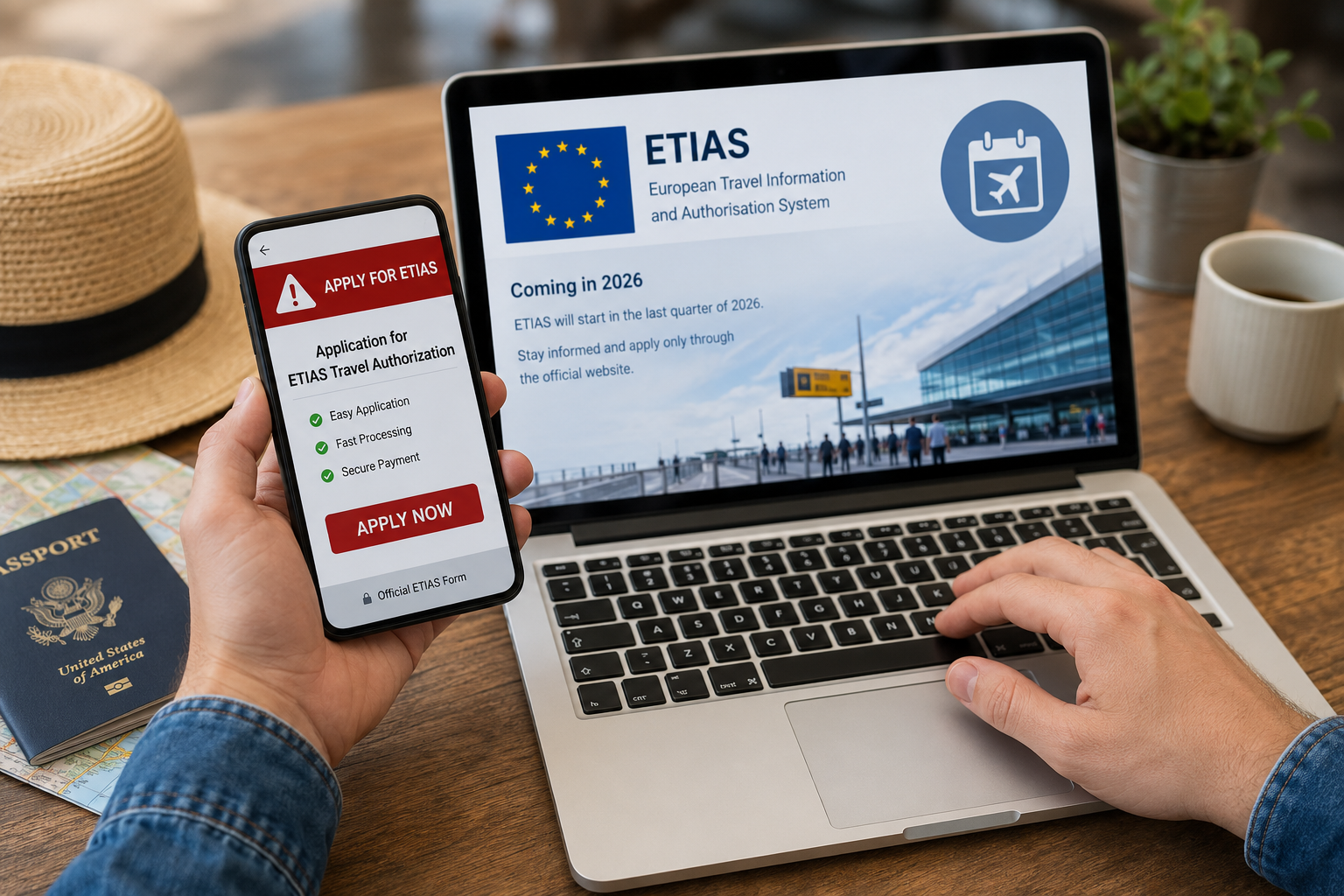
Type “ETIAS application” into a search engine today and you will find slick websites, official-looking logos, and a form ready to take your passport number and your card details. Almost every one of them is a trap. As of the middle of 2026, ETIAS does not exist yet. There is no portal, no application, and no way to pay the real fee, because the real system has not launched.
That gap, between what travelers assume is already required and what is actually running, is exactly what the scammers are feeding on. The genuine article is coming, it will cost €20, roughly $22, and it starts at the end of 2026. Anything charging for it right now is either an outright fraud or a middleman inflating a fee you cannot even pay yet. This is a case where knowing a few plain facts saves both money and a stolen identity.
What ETIAS Actually Is
ETIAS stands for the European Travel Information and Authorisation System. It is not a visa, and the distinction matters. It is a pre-travel screening, much closer to the American ESTA that the United States has required of foreign visitors since 2009.
Once it is live, travelers from visa-exempt countries will need an approved ETIAS before entering a group of 30 European countries for short stays. The application is an online form that asks for personal details, passport information, the first country you intend to enter, and a set of background questions covering criminal history and past immigration problems.
Approval is expected to take minutes for the large majority of applicants, though a minority of cases can stretch to a few days if the system wants a closer look. One authorisation covers all 30 countries at once, so there is no need to apply separately for each. It stays valid for three years, or until the passport it is linked to expires, whichever comes first, and it permits tourism, business meetings, and transit. It does not permit paid work or long-term study, both of which still require a proper national visa arranged with the country in question.
Who Needs One, and Who Does Not
The reach of ETIAS is wide, which is part of why the confusion has spread so far. Roughly 60 visa-exempt nationalities fall under it, including citizens of the United States, the United Kingdom, Canada, Australia, New Zealand, Japan, and dozens of others who currently stroll into Europe on a passport alone.
Anyone holding the passport of an EU or Schengen country does not need ETIAS, since it applies only to non-EU visitors. Dual nationals can sidestep it entirely by entering Europe on an EU passport if they hold one. Everyone else in the affected group will need their own authorisation, including children, though as noted the youngest and oldest travelers are spared the fee.
For an American who splits the year between the States and a place in Spain or Portugal, this is worth reading closely. ETIAS is tied to short-stay, visa-free travel. It does not apply to anyone already holding a residence permit or long-stay visa for a European country, because those people are residents rather than short-stay visitors. A retiree with a Spanish residence card does not file an ETIAS to fly home to Madrid. A relative visiting them for three summer weeks does.
The confusion often runs the other way, too. Some long-term residents, hearing the steady ETIAS drumbeat in the news, start to worry that they now need to apply and pay for something that does not touch them at all. If you hold a valid residence card for a European country, ETIAS is simply not your document, and no honest website would try to sell you one.
Why It Still Is Not Live
ETIAS was first meant to launch in 2021. It has slipped every year since, and the reason is technical rather than political will.
The system cannot run on its own. It leans on a second, larger project, the Entry/Exit System, or EES, the biometric border programme that records fingerprints and facial scans at Schengen crossings. EES had to be working first, and it only became fully operational on the tenth of April 2026, after its own long run of delays while 29 countries upgraded their border infrastructure more or less simultaneously.
With that dependency finally cleared, the European Union has placed ETIAS in the last quarter of 2026, meaning sometime between October and December. Even then it arrives gently rather than all at once. A transition period of several months follows the launch, during which travelers are encouraged to apply but will not be turned away at the border simply for lacking one. Only after that grace period, around April 2027, does an ETIAS become strictly mandatory for boarding a flight or a ship bound for Europe. The staggering is deliberate, meant to spread the load and absorb the inevitable early glitches.
The €20 Fee, and Where the €7 Went
For years the number attached to ETIAS was €7. That figure is now dead, and any site still quoting it is working from old notes. On the seventeenth of July 2025, the European Commission confirmed the fee would be €20, roughly $22, nearly triple the original.
The rise reflects a system that grew more expensive to build than anyone first budgeted, with heavier cybersecurity demands and a broader scope than the 2018 plan imagined. Whatever the reasoning, €20 is the real, official price now, charged once and covering the full three-year validity no matter how many trips you take.
Not everyone pays it. Applicants under 18 and those over 70 are exempt from the fee, although they still have to apply and carry a valid authorisation like everyone else. The payment is non-refundable even when an application is denied, so it pays to check every detail, especially the passport number, before submitting. There is no loyalty discount at renewal either, because a renewal is simply a fresh €20 application once the old one lapses.
Set against its peers, the fee is still fairly gentle. The American ESTA now runs close to $40 for two years and a single country, and the United Kingdom’s own ETA rose to £20 in April 2026, again covering just one country. At €20 for three years across 30 nations, ETIAS is arguably the best value of the three, whatever the sticker shock on first reading.
One practical detail catches families out. The fee is charged per person, with no household bundle and no group rate. Two adults pay €40, about $44, and a family of four travelling with two teenagers over 18 pays the full €80, roughly $88, because only the under-18s among them escape the charge. It is small money, but worth building into a trip budget rather than meeting as a surprise.
The Scam Sites Are Already Here
Here is the part that is costing real people real money today. Because ETIAS has been discussed for years, and because it looks confusingly close to the EES that only just went live, fraudsters have built an entire cottage industry around the muddle.
Frontex, the European border agency, has flagged well over a hundred unofficial websites already claiming to accept ETIAS applications, with some counts running past a hundred and fifty. The travel association ABTA has been warning its members and the public directly for months. These sites lift official EU logos, buy search-engine advertising to appear above the real portal, and charge anywhere from €50 to €150, about $54 to $162, for a €20 authorisation that does not yet exist.
The harm runs deeper than an inflated price. Many of these operations exist mainly to harvest data, collecting passport numbers, dates of birth, home addresses, and card details from travelers who believed they were filling in a government form. Some take the payment and submit nothing whatsoever, because at this stage there is nowhere legitimate to submit it to.
The warning signs stay consistent. Any urgency message insisting that spaces are limited or that you must apply this instant is a tell, since ETIAS has no capacity cap and, right now, no live application at all. The blunt rule is that any website accepting ETIAS applications in 2026 is fraudulent by definition, no matter how convincing the design.
What makes these sites dangerous rather than merely annoying is how professional they look. Many register domains that read almost right, copy the EU’s colour scheme and typefaces, and even publish accurate-sounding guides to build trust before the payment screen. A traveler who has read three correct paragraphs tends to trust the fourth, which is where the passport number and the card go in. The safest posture is to assume that no site outside europa.eu has any business taking your money or your data for this, however polished it appears.
How to Tell the Real Portal From the Fakes
The single most useful thing a traveler can memorise is the address of the genuine article. The only official ETIAS portal will operate on the European Union’s own domain, at travel-europe.europa.eu. Anything else is unofficial, without exception.
A handful of plain habits keep people safe. Never pay more than €20, because no legitimate charge can exceed it. Always confirm that the web address ends in europa.eu rather than a convincing lookalike such as etias-application.com or official-etias.org. Treat every sponsored search result for ETIAS with suspicion, because the scam operators pay to sit at the very top of the page, above the real thing.
The official EU line could not be plainer. For now, no action is required from travelers, and the Union has promised to announce the exact start date several months ahead of launch. Until that announcement lands and that portal opens, there is simply nothing legitimate to apply for, and every form claiming otherwise is a fake.
How EES and the 90-Day Rule Fit In
It helps to separate the two systems, because the live one is the source of most of the confusion. EES, the Entry/Exit System, has been running since April 2026, and travelers are already meeting it in the arrivals hall.
EES replaces the old ink passport stamp with a digital record. Non-EU visitors have their fingerprints and photograph taken at the border, and every entry and exit is logged automatically, which flags overstays and identity mismatches far more reliably than a stamp ever could. It is free, it happens at the border itself, and there is nothing to arrange beforehand. Anyone charging a fee for EES is running the same con in a different costume, because that system carries no traveler fee at all.
Together, EES and ETIAS put real teeth into the 90 days in any 180-day period that visa-free visitors are allowed. Until now, that limit was policed by a border guard flipping through stamps. Soon it will be counted automatically, to the day, across all 30 countries. For occasional tourists this changes little. For the snowbird who has quietly stretched a few extra weeks each winter, an automated tally is a very different world, and the safe habit is to count days carefully rather than trust the old blur.
The line between visiting and residing gets sharper under this regime, which is where many Americans with one foot in Europe get tripped up. Ninety days is a ceiling for tourists, not a way to live in Europe by other means, and treating repeated three-month stays as a quiet residence plan has always been a grey area that the new systems paint firmly black. Anyone wanting more than short visits needs a proper long-stay visa or residence permit, and the automated clock is a strong nudge to stop improvising and sort the paperwork out properly.
What Happens If You Arrive Without One
Once the grace period ends and ETIAS becomes mandatory, the enforcement point is not really the border. It is the departure gate, and often the check-in desk before it.
Airlines carrying passengers to Europe will be required to confirm a valid ETIAS before letting them board, in the same way carriers already check an American ESTA or a UK ETA today. No authorisation means no boarding pass scan and no flight. Because the airline faces its own penalties for carrying an improperly documented passenger, there is little room for a sympathetic exception at the desk.
That is why leaving it to the airport is the one truly avoidable disaster. An approval usually lands within minutes, but a minority of applications are held for further checks that can run to several days, and a delayed or denied ETIAS discovered an hour before a flight becomes a ruined trip with no refund attached. The sensible rhythm, once the system is live, is to apply as soon as the flights are booked rather than the night before departure. Since airlines will fold the ETIAS check into their own systems, a missing authorisation tends to surface at online check-in, days ahead, for anyone who checks in early.
What Travelers Should Do Right Now
For a trip to Europe across the rest of 2026, the honest answer is reassuring. Nothing about ETIAS needs doing yet. Americans, Britons, Canadians, and the rest travel exactly as they did last year, on a valid passport, with no form and no fee to worry about.
The one genuinely useful task is checking passport validity. Once ETIAS is live, it will require a passport valid for at least three months beyond the planned departure, and passport renewals in several countries are running weeks or months behind. Anyone whose document expires in 2026 or early 2027 is far better off renewing now than scrambling against a deadline later.
Beyond that, the smart move is to bookmark the real portal and wait for the official date. When the system does open, likely late in 2026, the process should take about ten minutes, cost €20, and return an approval within minutes for most people. The only real mistake on offer today is paying a stranger for a document that Europe has not started issuing. For the organised, there is one further step worth taking: mark the official launch window on a calendar for the autumn, so that when the genuine portal opens you can apply early and calmly, well before any booked trip forces the question.

About the Author: Ruben, co-founder of Gamintraveler.com since 2014, is a seasoned traveler from Spain who has explored over 100 countries since 2009. Known for his extensive travel adventures across South America, Europe, the US, Australia, New Zealand, Asia, and Africa, Ruben combines his passion for adventurous yet sustainable living with his love for cycling, highlighted by his remarkable 5-month bicycle journey from Spain to Norway. He currently resides in Spain, where he continues sharing his travel experiences with his partner, Rachel, and their son, Han.