
On the Malvarrosa in Valencia, on a Tuesday in August, a woman somewhere past seventy walks out of the sea, wrings the water from her grey hair, and lies back down on her towel without adjusting a single thing. She is wearing the bottom half of a bikini and nothing else. Nobody looks. The teenagers near her are on their phones, the family beside her is arguing about lunch, and the lifeguard strolls past without a flicker. She is the least remarkable person on the beach.
This is the thing an American woman at the water’s edge cannot quite process. Not the toplessness on its own, though that is the headline. The deeper shock is the absence of self-consciousness, spread evenly across every age and size on the sand, as though nobody had ever told these women their bodies were a problem to be managed in public. That single impression sits on a whole stack of habits, some of them centuries old, that add up to a woman at the water who is simply not thinking about herself.
The Part Everyone Means Is The Toplessness

The image is real, and it has a shorter history than people assume. Far from ancient custom, European topless bathing was a 1960s invention, worked out on the sand at Saint-Tropez and turned into an actual garment when the designer Rudi Gernreich unveiled the monokini, a bikini with the top removed, in 1964. What started as provocation settled, over a couple of decades, into an unremarkable default along much of the Mediterranean coast.
It is strongest in Spain. When Ifop, the French polling institute, asked women across five countries whether they had ever sunbathed topless, Spanish women led at 48 percent, ahead of Germany at 34 percent and well ahead of Italy at 15 percent. On a Spanish beach in August the monokini is not a statement. It is just what a lot of women wore before they had children and a fair number still wear after.
You see it up and down the Spanish coast, from La Barceloneta in Barcelona to the town beaches of the Costa Blanca, less Saint-Tropez glamour than a practical local habit. Tan lines get avoided, tops come off for the same reason a sleeve gets rolled up. For a whole generation of Spanish women it was never daring, just cooler.
It Is Also Quietly Disappearing
Here is the part the postcards leave out. Topless sunbathing is fading, and quickly. The same Ifop tracking found that among French women under fifty, the share who regularly go topless had fallen to 19 percent, down from 28 percent in 2009 and 43 percent back in 1984, a forty-year low. The researcher who ran it, François Kraus, described the collapse as one of the clearest shifts in French beach behavior on record.
The reasons have little to do with modesty. Women named skin cancer first, after decades of blunt public-health messaging about the sun. Younger women named something bleaker: fear of harassment, and fear of being photographed without consent and turning up online. Camille Froidevaux-Metterie, a philosopher at the University of Reims who writes about women’s bodies, argues the retreat is driven less by shame than by marketing and phone cameras, a beach that now arrives with an audience it never used to have.
There is a colder irony under the health reason. The same sun that makes the whole relaxed beach culture possible also gives southern Europe real rates of skin cancer, and the women who tanned topless through the 1980s are now the ones sitting in dermatologists’ waiting rooms. Their daughters covering up is not only about cameras. They are the first cohort to take the sun itself seriously.
The Germans Take It All The Way Off

Topless is the mild version. To see how far the European ease with the body can run, you go north, to Germany, where the tradition is not a bare chest but a bare everything. Freikörperkultur, “free body culture,” usually shortened to FKK, has been a recognizable German institution since the first association was founded in 1898, an offshoot of a back-to-nature health movement that treated sun and air on bare skin as medicine rather than scandal.
It went deepest in the East. Under the GDR, communal nudity on the Baltic beaches became close to a national pastime, and by the 1980s something like a third of East Germans took part. The state disapproved at first. When authorities tried to ban nude bathing on the Baltic in the mid-1950s, citizens buried them in letters and petitions until the government quietly gave up. In a country that controlled nearly everything, taking your clothes off at the beach was one of the few freedoms nobody could confiscate. Even Erich Honecker, the man who ran the place, spent his summers on a nude beach.
The Germans were deliberate about draining the body of its charge. The whole practice rests on the idea that a naked body at a lake carries no sexual meaning, that it is simply a body among bodies, and the etiquette enforces it: bring a towel, join the volleyball, and above all do not stare or photograph. It is nudity with the leer engineered out.
The same reflex carries indoors. In a German spa or sauna the swimsuit is close to forbidden rather than optional, and the newcomer who keeps one on is told, kindly, that the suit is the thing making it strange. Staying covered is what draws the stares. A German child grows up seeing grandparents, parents, and strangers in the water without a stitch, and it registers as unremarkable years before it could register as anything else.
Like the monokini, FKK is fading. Since reunification in 1990, participation in the eastern states has dropped by a third or more, and younger Germans, raised on phones and gyms, are more private than their parents were. The bare Baltic beach is slowly turning into a photograph of the country that used to be there.
What Does Not Disappear Is The Ease
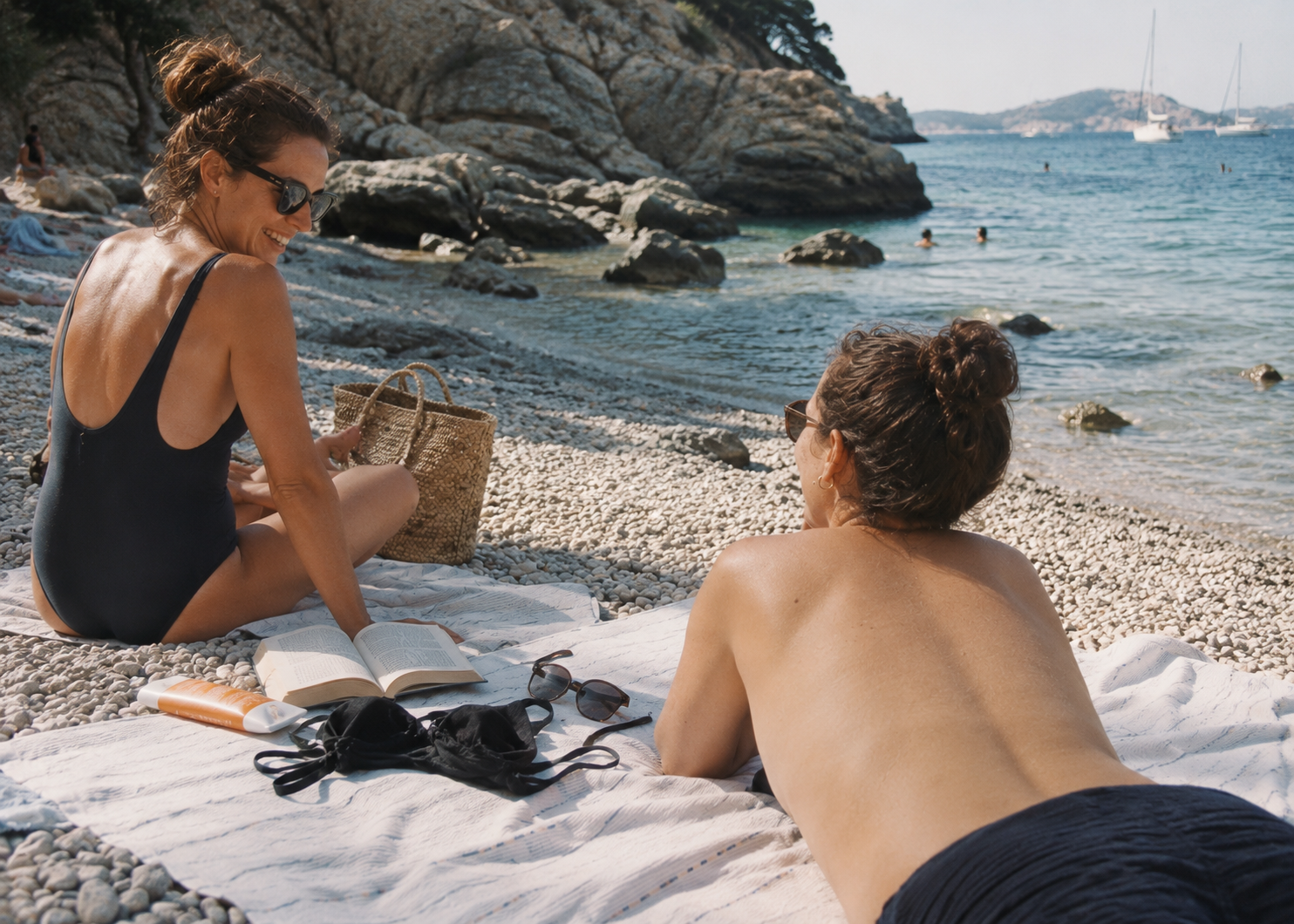
Strip the toplessness away and the thing underneath is still there, and it is the thing that actually stops American visitors. The women on a Spanish beach are every age and every shape, and they are all simply present. The eighty-year-old in a floral two-piece is in the water to her waist, talking. The pregnant woman is not hiding the bump under a sarong. The teenager with a soft stomach is not clutching a towel to her front on the walk down from the car.
Nobody is performing readiness. There is no visible class of woman who has earned the beach and another who is quietly apologizing for being on it. Bodies with scars, stretch marks, cellulite, mastectomy lines, and sun-worn skin are all just out in the light, doing beach things. A woman raised on a different set of rules watches this and feels something loosen that she did not know had been clenched.
None of it is confined to the women. The men are just as unbothered, in swim briefs that would earn a double take in Miami, bellies out, nobody holding anything in. And everyone shares the same casual competence with the logistics of a body in public: the towel wrapped, the wet swimsuit swapped for dry underneath it in ten practiced seconds, done since childhood, no drama and no scramble to a changing room. The body is treated as ordinary equipment you manage in the open, not a secret you smuggle to and from the water.
The Shame Sailed On The Mayflower
To understand the American side you have to go back much further than any swimsuit. The people who set the tone for the country arrived in 1620 on the Mayflower, and the Puritans brought a specific conviction with them, that the body was an occasion for sin and its display a danger to be governed. That instinct never fully left. It runs through American law all the way down to the Comstock Act of 1873, which made it a federal crime to send anything deemed obscene through the mail, and it still shapes what an American beach feels like two centuries on.
Spain inherited the opposite settlement. It is a Catholic and Mediterranean country, where the body was something to be confessed rather than hidden, and where centuries of sun and sea built a matter-of-fact relationship with skin that no reformer ever shamed away. The Puritan covered the body because the body was a temptation. The Catholic covered the cathedral in gold and left the beach alone.
This is why the same swimsuit means two different things on two coasts. On a Spanish beach it is just what you wear in the water. On an American one it carries four hundred years of inherited suspicion about what a body in public is for. The advertisers who came later simply found that unease already present, deep in the culture, and built an industry on top of it.
America Built A Body You Have To Earn
That industry has a surprisingly precise origin. The phrase bikini body was not folk wisdom that bubbled up from the culture. It was an advertising slogan, coined around 1961 by a weight-loss-salon chain called Slenderella to sell the notion that a woman had to be reshaped before she was allowed to wear one. A few years later the Sports Illustrated Swimsuit Issue, first published in 1964, welded the beach to a single narrow professional body type and broadcast it every February for the next sixty years.
This is the part that matters, and it is not a story about vanity. American women are no more shallow than Spanish women. The difference is the machine they were raised inside, which turned the beach into an exam and then sold them the products to pass it.
The Numbers Are Not Subtle
Ask Americans directly and the picture is stark. In a Planet Fitness poll, a third of Americans said they were so uncomfortable being seen in a swimsuit that they would rather go to the dentist. The same poll found nearly half with no confidence in a bathing suit at all, while more than three-quarters admitted they judged their own beach appearance far more harshly than they judged anyone else’s. A separate Refinery29 survey found 42 percent of women felt worse about themselves after looking at other people’s beach photos, and most of those who refused to be photographed at the beach said it was because they felt exposed.
The cost is not only a bad afternoon. Large body-image studies find that American women avoid wearing a swimsuit in public at roughly twice the rate of men, and that the anticipation alone, the mere thought of the changing room, is enough to sour a woman’s mood and pull her attention onto her own perceived flaws before she has left the house.
There is even a name for the annual dread of it, “swimsuit season,” a phrase built on the idea that summer arrives as a deadline the body has to meet. Spanish has no equivalent term, and no equivalent deadline.
Even buying the thing is an ordeal with its own folklore in America: the fluorescent dressing room, the unforgiving mirror, the quiet arithmetic about what can be hidden. In a much-cited 1998 experiment, women asked to try on a swimsuit rather than a sweater reported more body shame and afterward performed worse on a math test. The garment arrives loaded before it ever reaches the sand. A Spanish woman buys a bikini the way she buys a T-shirt, because that is all it is to her.
The Beach Here Is Not A Stage

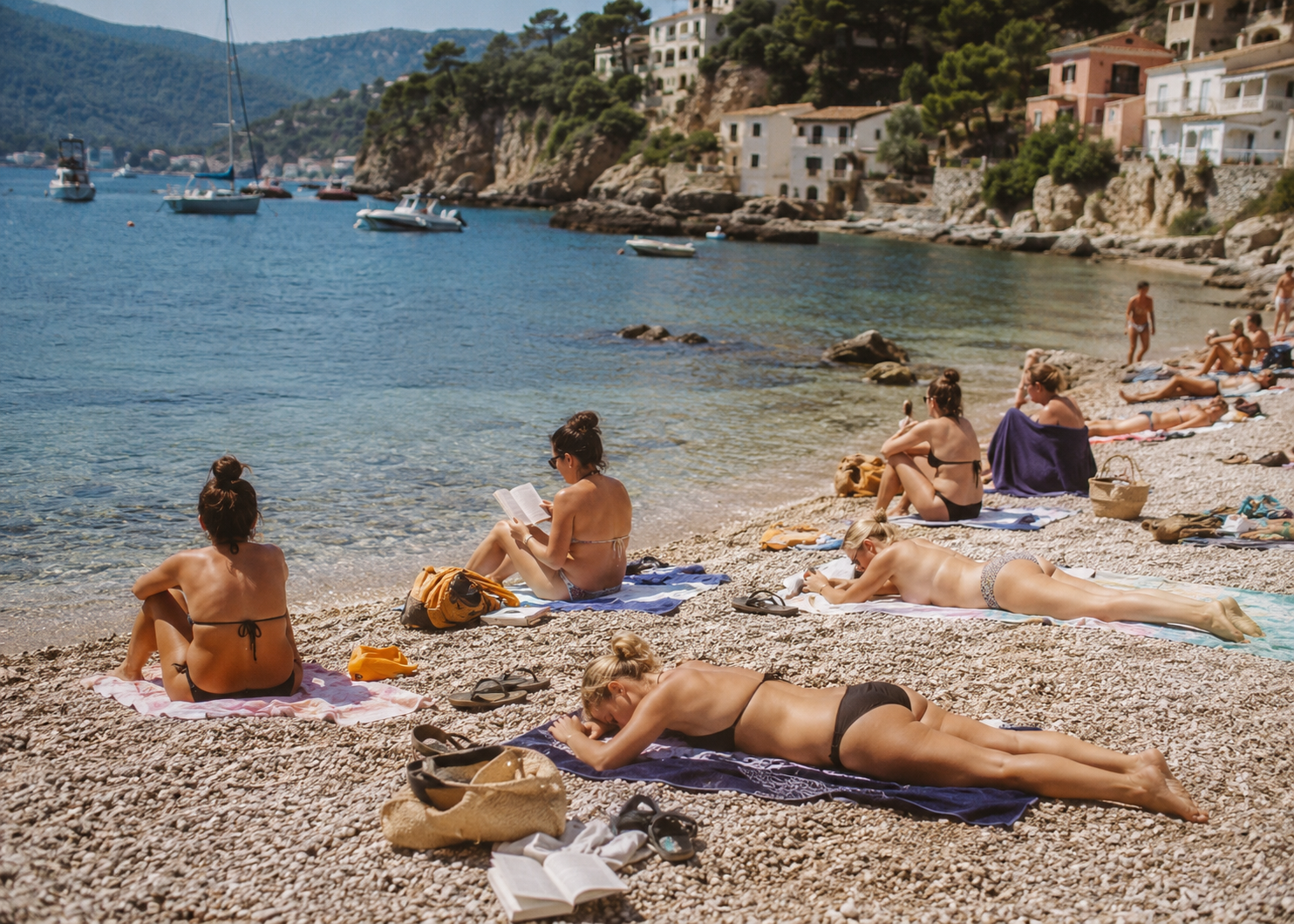
So why does the ease hold in Spain even as the toplessness fades? The setting does most of the work. A Spanish beach is less an event you prepare for than an extension of the neighborhood, a place you go after work with a thermos, where three generations of one family camp under a single umbrella from noon until the light goes. The eighty-year-old is there because she is always there, alongside the toddler and the eye-rolling teenager. Nobody is auditioning, because everybody already belongs. The rhythm is domestic. People come down in the late afternoon once the worst heat has broken, with a cool bag and a paddle bat and somebody’s grandmother, stay through the long golden evening, and wander home for a late dinner. It is the last room of the house at the end of a hot day, and used about as casually as one.
That daily, ordinary, multigenerational quality is the whole secret. When the beach is a normal Tuesday and not a photo opportunity, the pressure to resemble the swimsuit issue never manages to assemble itself. The bodies on a Spanish beach look like the bodies in a Spanish town because they are the same bodies, and nobody has been told to leave the ordinary ones at home.
American women who move here feel it shift in themselves, usually within a summer or two. The first year they still reach for the more covering swimsuit and still measure the walk to the water. By the second or third, something has worn off. They did not decide to feel confident, which never works anyway. They were simply dropped into a place that stopped sending the signal, and the old vigilance, with nothing left to feed on, quietly starved. Confidence turned out to be less a personal achievement than a question of which beach you were standing on.
You Put Your Body In It
The only beach anxiety that really survives on this coast is the tan line, and even that gets treated as comedy rather than defect, compared between friends at the end of August like a souvenir. Everything the American beach runs on, the readiness, the earning, the covering up on the walk from the car, has no equivalent here. A body goes to the beach because a beach is where the warm water is, and it goes in the same shape it was an hour earlier in the town. The woman past seventy on the Malvarrosa understood that long before she could read. She walked out of the sea, lay back down, adjusted nothing, and was, by a comfortable margin, the most relaxed person on the sand.

About the Author: Ruben, co-founder of Gamintraveler.com since 2014, is a seasoned traveler from Spain who has explored over 100 countries since 2009. Known for his extensive travel adventures across South America, Europe, the US, Australia, New Zealand, Asia, and Africa, Ruben combines his passion for adventurous yet sustainable living with his love for cycling, highlighted by his remarkable 5-month bicycle journey from Spain to Norway. He currently resides in Spain, where he continues sharing his travel experiences with his partner, Rachel, and their son, Han.