
In early July, Sevilla and Córdoba close their shutters against afternoons of 42 degrees Celsius (108°F), and the Mediterranean beaches pack towel to towel under the same heat. Eight hundred kilometers north, the people of Gijón are deciding whether the evening calls for a light jacket.
This is the coast the title means: the green north, the strip Spaniards call España Verde, running from Galicia’s northern shore through Asturias and into Cantabria. In August it rarely gets hot, in the way the rest of Spain understands hot, and along most of it a good apartment still rents for less than €800 a month ($860), often far less.
Spaniards have known about it forever. Madrid has summered in the north for a century. What is new is that the rest of the world is starting to look at the map the same way, for reasons the thermometer explains better than any brochure.
Where This Coast Actually Is
Draw a line along the top of Spain, facing the Atlantic and the Bay of Biscay. It starts around Ferrol in Galicia, runs east through the seafood towns of the A Mariña coast, crosses into Asturias past fishing villages like Luarca and Cudillero, hits the two working cities of Avilés and Gijón, and finishes toward Llanes and the Cantabrian border, with the limestone wall of the Picos de Europa rising a half hour inland.
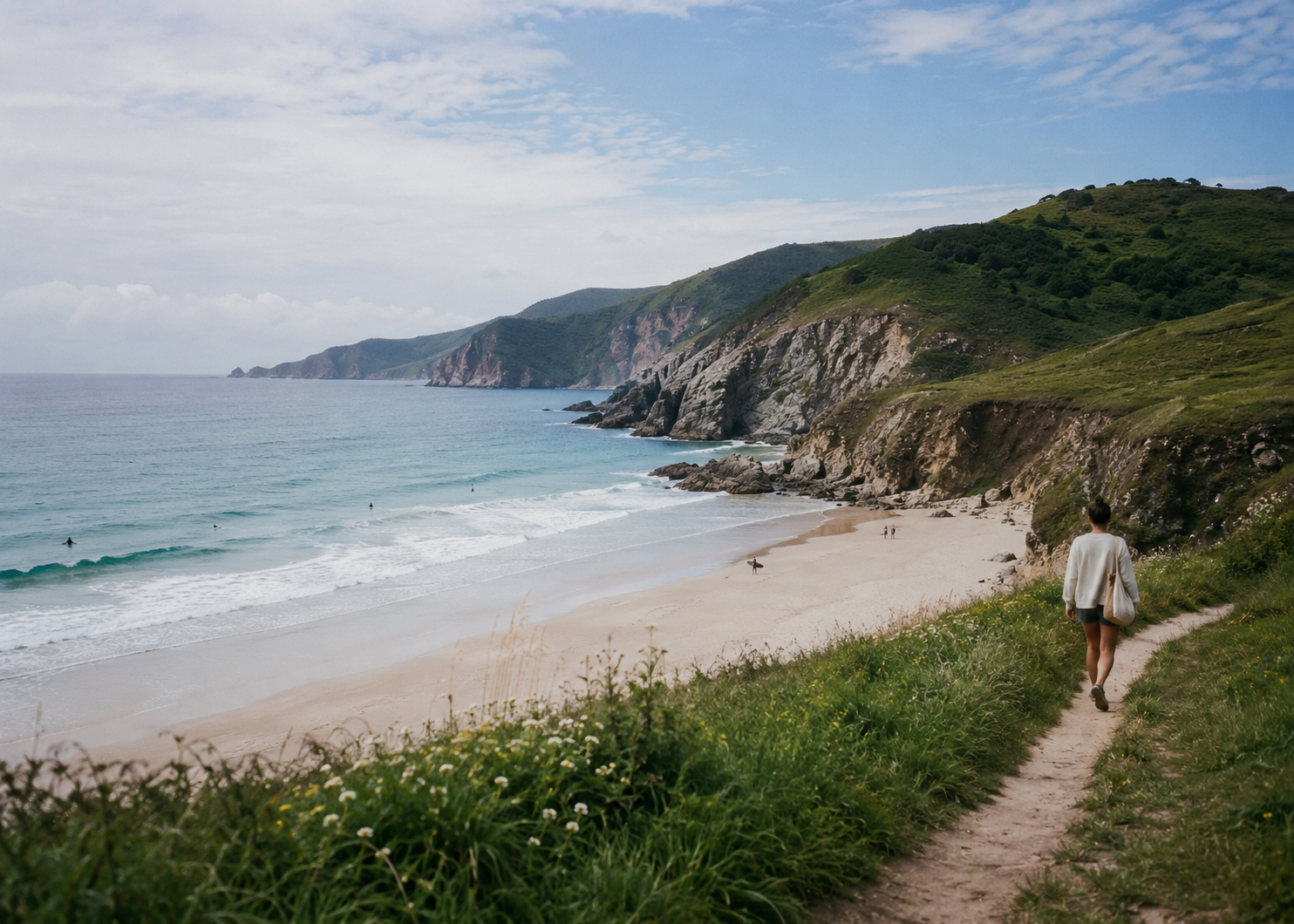
That is roughly 400 kilometers of coastline, and almost none of it looks like the Spain of the postcards. It is green the way Ireland is green, cliff-edged, backed by pasture and eucalyptus, dotted with towns built on fishing and shipyards rather than tourism.
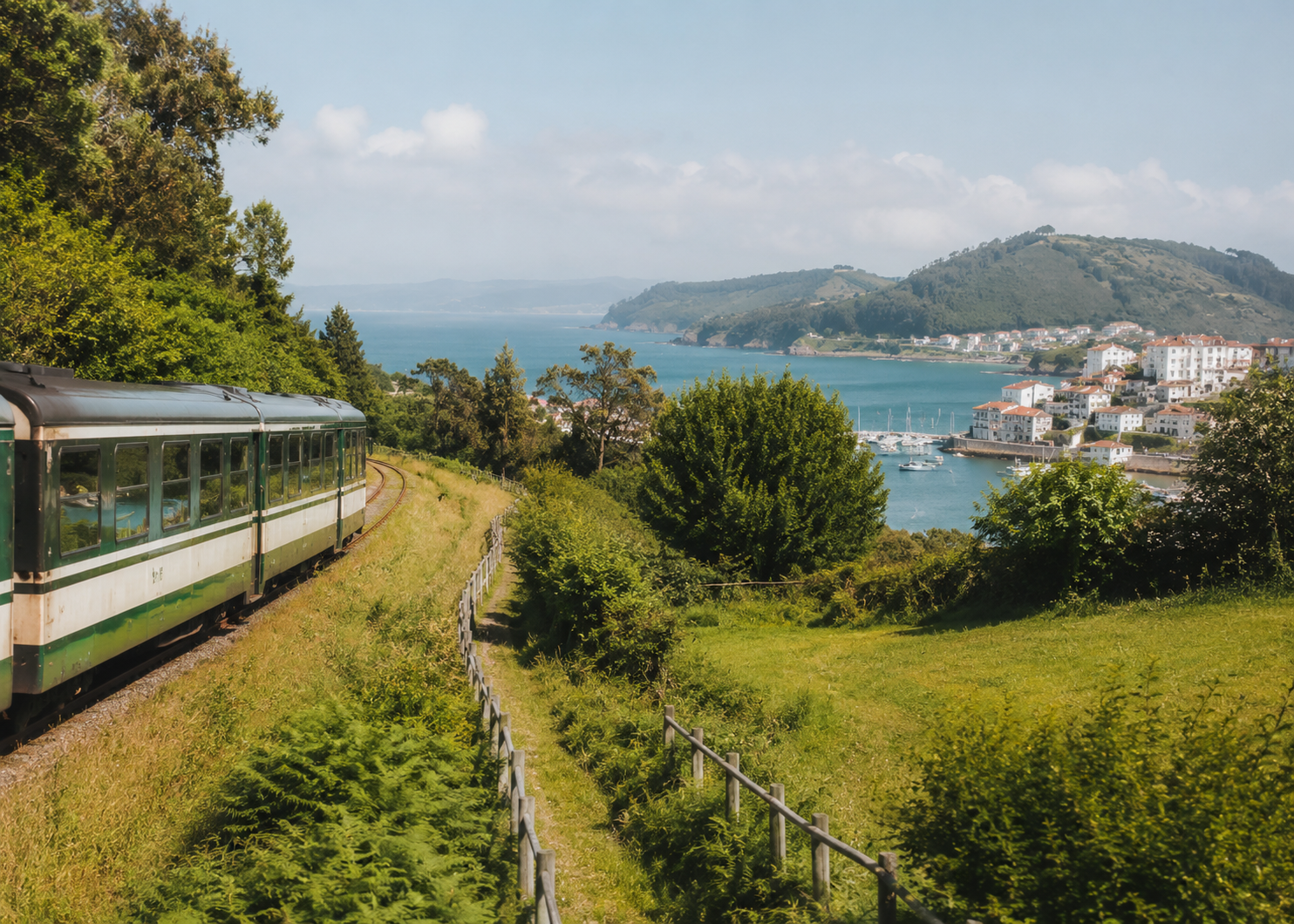
A narrow-gauge railway, the old FEVE line, ambles along the whole coast, one of Europe’s great slow train rides and still a working commuter service. Faster Alvia trains connect Gijón and Oviedo to Madrid in around four and a half hours, and the strip has three airports, Asturias, A Coruña, and Santander, with cheap connections through Madrid and a handful of direct European routes.
The Summer That Stays In The Twenties
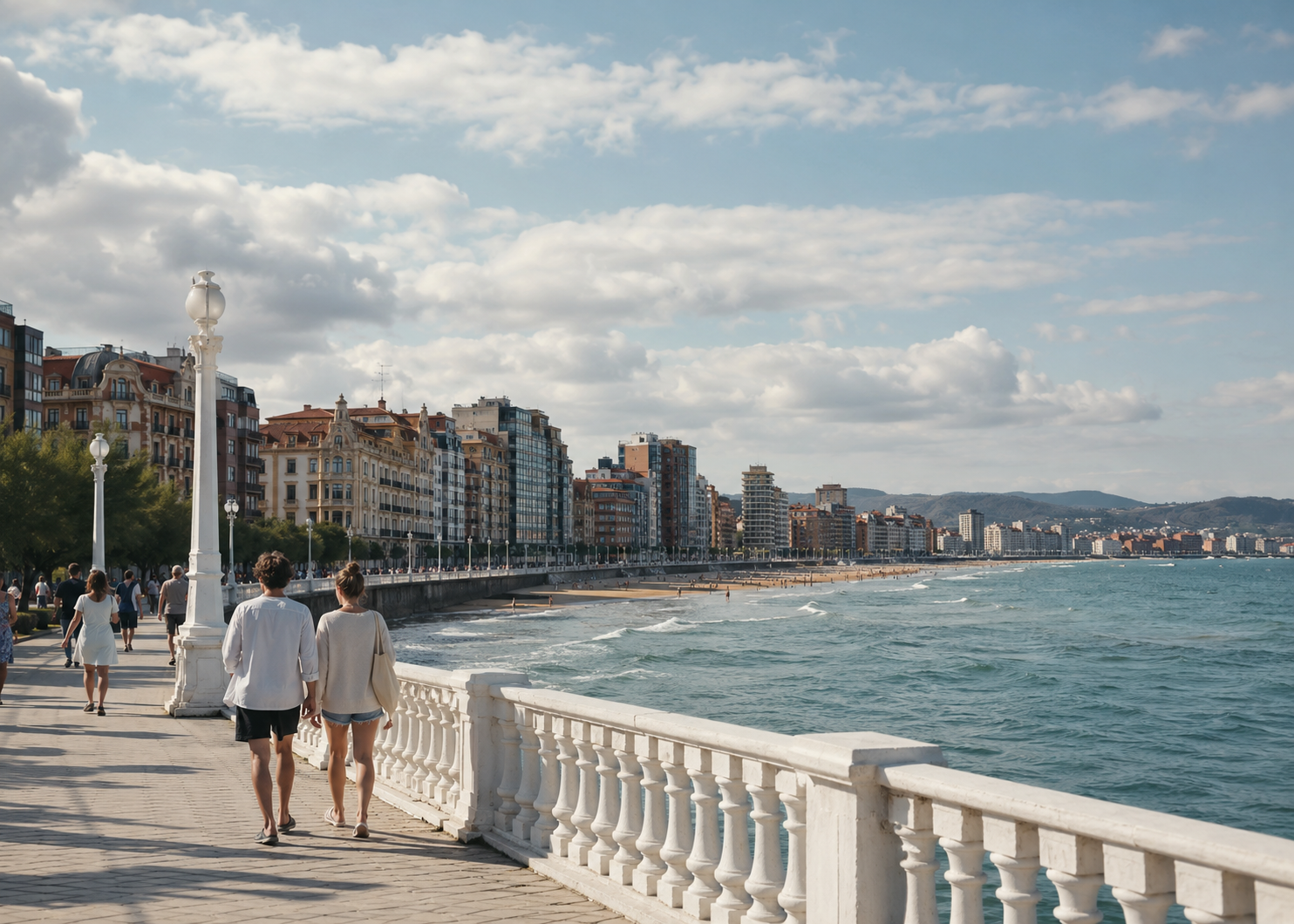
The numbers are the story. August afternoons in Gijón average around 23 degrees (73°F). Nights drop to 16 or 17, which means sleeping under a blanket in the hottest month of the year. The Atlantic keeps the water around 19 to 20 degrees, cold enough to wake you and warm enough to swim, and genuinely hot days, past 30, arrive a handful of times a season and leave within seventy-two hours.
Air conditioning barely exists here because it has barely been needed, and that fact alone separates the north from everywhere else in the country. While the south now strings together heatwaves that push past 40 degrees for weeks, the north coast runs on open windows.
The nights are the half of it people underestimate. The Mediterranean coast now logs weeks of what Spanish forecasters call tropical nights, when the temperature never drops below 25 degrees and sleep becomes a negotiation with the air conditioner. The north coast has essentially none. Whatever the afternoon did, the evening resets it, and that difference, more than any afternoon high, is what decides whether a summer feels livable after 50.
Spain has noticed. Every summer more of the country migrates north instead of south, a movement the Spanish press now covers as its own phenomenon, and August bookings along the green coast climb year after year as families from Madrid and Sevilla decide that a beach holiday should not require surviving the beach. The climate that made this coast a minority taste for a century is quickly becoming its main argument.
What Under €800 Actually Rents
Now the other half of the title, with real numbers from the current market rather than folklore.
Avilés, the mid-sized Asturian city between Gijón and the western villages, averaged €9.4 per square meter in May 2026, which puts a typical 65 to 70 square meter two-bedroom apartment at roughly €600 to €660 a month. That is a walkable historic center, a food market, and the coast within fifteen minutes.
Gijón, the biggest city on the strip and the one with the urban beach, is the expensive end, and even there long-term listings currently start around €530, with one-bedroom flats near the center at €625. The pressure is real, and central Gijón in high season is the one place on this coast where €800 stops feeling roomy, but it still undercuts Madrid and Barcelona, where the same flat runs €1,300 and up, by nearly half.
Ferrol and its surrounding area sit at the other extreme, with listings starting around €370 a month, numbers that regularly rank it among the cheapest cities in the country. And in the villages and small towns between the cities, Luarca, Ribadeo, Navia, the €450 to €600 range still buys a proper apartment, sometimes with a sea view the Costa del Sol would price like a yacht.
And €800 at the top of the range is not a ceiling to squeeze under but a budget with room in it. On the current listings it buys a 90 square meter three-bedroom with the glassed-in gallery windows the north builds against its weather in Avilés, or a two-bedroom with a harbor view in Luarca, the kind of specification that would read as a misprint on the Costa del Sol.
For an American point of reference: €800 is about $860, less than the median rent on a one-bedroom in most mid-sized US metros, and here it sits near the top of the market rather than the bottom.
The Galician End: Ferrol To Ribadeo
Ferrol is the honest start of the tour, a naval city that built Spain’s warships for three centuries and looks like it, handsome in its 18th-century grid and rough at the edges where the shipyard work thinned out. It is not pretty in the postcard sense. It is cheap, real, and twenty minutes from the medieval streets of Pontedeume, surrounded by some of the emptiest white-sand beaches in Spain, including the surf strands of Doniños and Pantín, where a world-tour surf contest sets up every autumn in front of a crowd that would not fill a village bar.
East along the A Mariña coast, the towns get smaller and the scenery gets louder. Ribadeo anchors the far end, a lively little port town near Praia das Catedrais, the cathedral beach whose rock arches draw the region’s one genuine tourist crowd at low tide. Between the two lie estuary towns like Viveiro and Foz, where the Thursday market still matters more than any restaurant guide, and where the rental listings read like typographical errors to anyone arriving from a capital city.
The catch on this stretch is scale. These are towns of five to fifteen thousand people, magnificent for a certain temperament and quiet in a way that deserves a honest November test before any commitment.
The Asturian Middle: Luarca, Cudillero, Avilés, Gijón
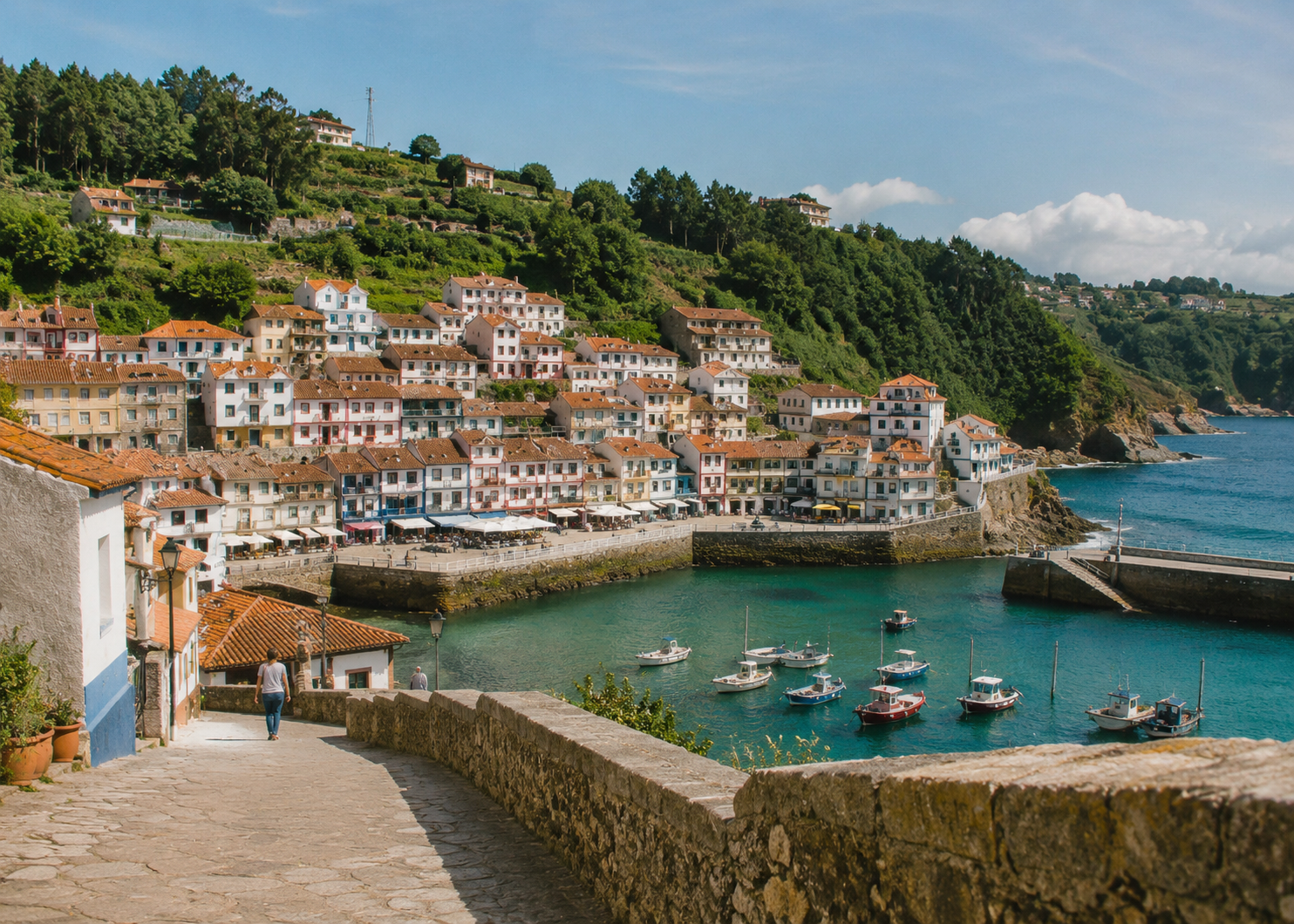
Asturias supplies the coast’s postcard villages and both of its real cities, which makes it the natural landing zone for a first stay.
Cudillero stacks its painted houses down a cliff funnel to a tiny port, and Luarca wraps a white town around a working harbor where the fishing fleet still comes in. Both are lovely, both have modest year-round rental markets in the €450 to €600 range, and both empty pleasantly once the Spanish holiday month ends.
Avilés is the sleeper. Written off for decades as a steel town, it hides one of the best-preserved old quarters in the north, arcaded streets, sidrerías, a daily market, plus the surreal white curves of the Niemeyer Center across the estuary, the last major work Oscar Niemeyer designed. It is the best price-to-life ratio on the entire coast.
Gijón is the full-service option: a city of 270,000 wrapped around the urban crescent of San Lorenzo beach, with a real food scene, a university, hospitals, and the coast’s most connected station. It costs the most and gives the most, and its seafront paseo on an August evening, full at 23 degrees while Andalusia hides indoors, is the whole thesis of this article walking past you in both directions.
The eastern end deserves its own mention. Llanes is the prettiest town on the Asturian coast and knows it, a walled old quarter, thirty beaches within a short drive, and the Picos de Europa filling the rearview mirror, which is why it is also the priciest small town on the strip and the one place where summer rentals evaporate. Just over the Cantabrian border, San Vicente de la Barquera repeats the trick with a tidal estuary. Both are better visits than value plays, and both are an easy day from the cheaper towns doing the actual renting.
What Daily Life Runs On
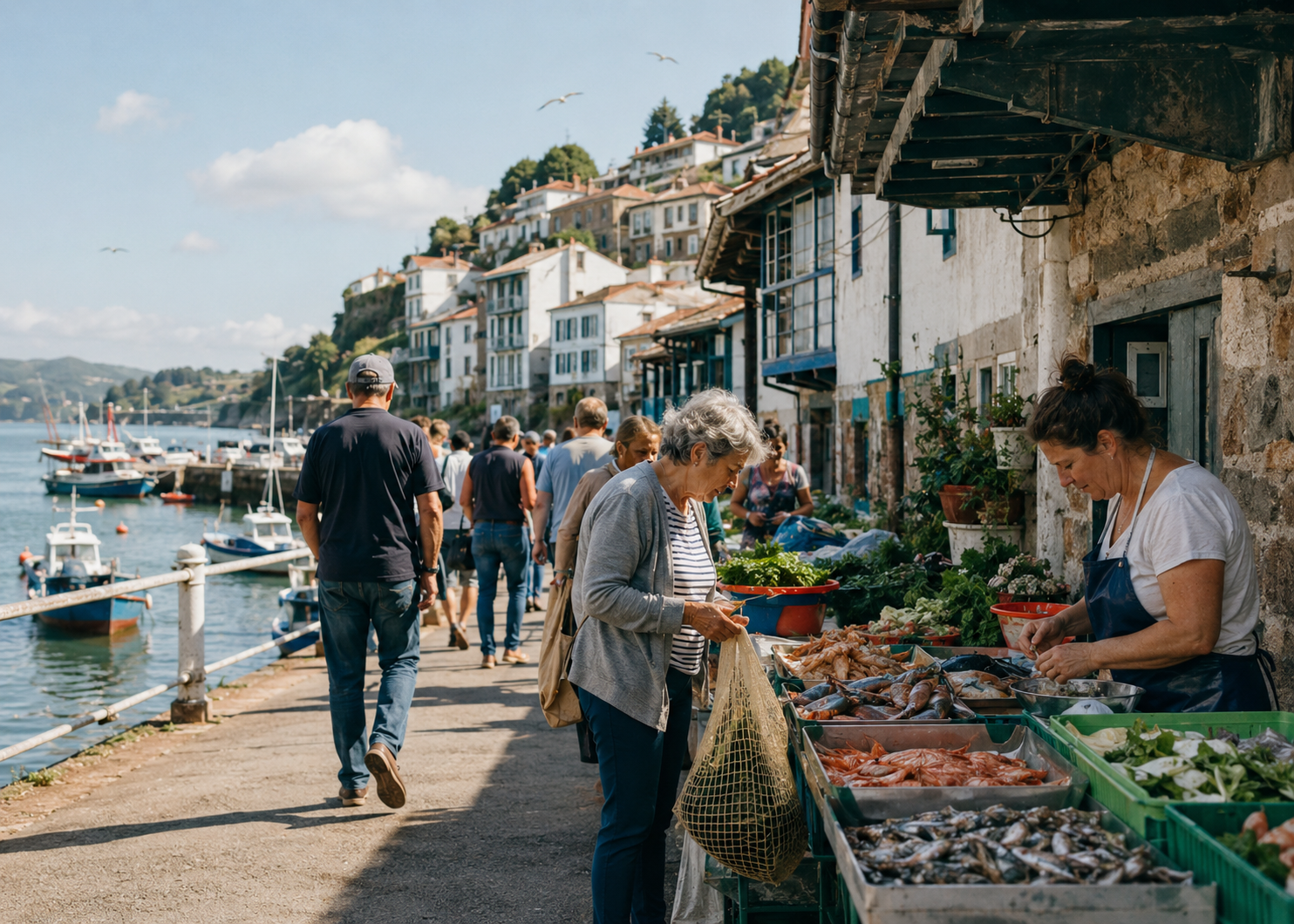
The north is Spain’s larder, and eating here is the daily luxury that costs least. The markets sell the country’s best seafood and its best beef, the menú del día in a working restaurant still lands around €12 to €14 for three courses, and fabada, the Asturian bean stew, exists specifically for the climate this article is selling.
The social institution is the sidrería, where Asturian cider is poured from arm’s length overhead in a splash of theater called the escanciado, and where a newcomer’s first clumsy attempt at it is worth a month of introductions.
The practical layer holds up. Asturias runs one of Spain’s better-regarded public health systems, and the private policies that visa applicants need price the same here as anywhere in the country, around €60 to €120 a month per person depending on age. Towns are compact and walkable, the FEVE and bus network stitches the coast together, and a car, useful in the villages, is optional in Gijón or Avilés.
The connectivity surprises people. Spain runs one of the best fiber networks in Europe and it reaches deep into the north, so symmetric fiber at €30 to €35 a month is normal even in towns of a few thousand, which is what makes the remote-work version of this coast realistic rather than romantic. Put the whole monthly picture together, rent, utilities, fiber, groceries from the market, the occasional menú del día, and a couple on this coast lives comfortably on €1,700 to €2,000 a month, rent included, without practicing austerity.
English is thinner on the ground than on the Mediterranean expat coasts, which cuts both ways. Daily life runs in Spanish, integration comes faster because it has to, and the foreigner who arrives with even survival-level Spanish is received with genuine warmth and some curiosity, because the north still finds it slightly funny that anyone from abroad chose the rainy coast on purpose.
For Americans, the two usual doors are the non-lucrative visa for retirees and the digital nomad visa for remote workers, and this coast flatters both. The non-lucrative route currently asks for passive income around €2,400 a month for a single applicant, with an additional margin per dependent, and the nomad visa sits in a similar band tied to the minimum wage. Figures adjust yearly, so check the current numbers when you apply.
The relevant point is the ratio. On the Mediterranean, rent eats half of that income floor. Here it takes a third or less, which converts the same pension or salary from a tight budget into a comfortable one, and immigration offices in Asturias and Galicia process a fraction of the volume that Málaga’s do, a small administrative mercy people only appreciate after they have queued elsewhere.
The Rain Is The Price, And Also The Reason
Everything above has one bill attached, and it falls from the sky. This coast is green because it rains, roughly 130 to 150 days a year, including the orbayu, the fine Galician-Asturian drizzle that can hang in the air for a week. Winters are not cold by American standards, daytime highs run 12 to 14 degrees, but they are gray, short-dayed, and Atlantic, and the same towns that glow in July can feel shuttered in January. Jobs are scarce, since the region’s industry left before the tourists arrived, so this is a coast for retirees, remote workers, and the self-employed rather than job seekers. And the secret is leaking: every heatwave sends another wave of Spanish buyers and August renters north, and the rental numbers in this piece are drifting upward, slowly for now, in a market that spent decades flat.
Anyone considering it should hear all of that plainly and then weigh it against a 23-degree August. Plenty of people run the math and choose the rain.
The affordability is not a mystery once you see the history. This was mining, steel, and shipbuilding country, and when those industries contracted through the 1980s and 1990s the young left for Madrid and beyond, leaving cities full of solid apartments and short of bidders. Mass tourism never replaced the industry because tour operators cannot guarantee sunshine here, and the charter-flight economy that inflated the Mediterranean coasts simply never landed.
So the north kept its housing stock, its fishing fleets, and its prices, protected by the same clouds that kept the crowds away. The rain, it turns out, has been the best rent control in Spain.
How To Test It Before You Commit
Do it backwards from the obvious way. Anyone can love this coast in August; the question is February. Book a month in November, when the winter rental market is wide open and landlords in Luarca or Avilés will happily do short contracts, and live the gray version: the market shopping, the drizzle, the 6pm dark, the sidrería with the locals in it.
Winter is also when the listed prices soften further, since a landlord facing an empty flat until June negotiates, and it is when the second market opens, the one that never reaches a website. In towns this size, telling the woman at the market stall or the owner of your morning café that you are looking for a flat still produces phone numbers, and half the best rentals on this coast change hands exactly that way.
Search on Idealista and Fotocasa with the map open rather than by town name, since the best prices hide in places you have not heard of yet, and filter for long-term only. If the November version of this coast still charms you, the July version will feel like a reward for the rest of your life here. And if it does not, you will have spent one mild, cheap, seafood-heavy month finding out, which beats discovering it after the moving truck.

About the Author: Ruben, co-founder of Gamintraveler.com since 2014, is a seasoned traveler from Spain who has explored over 100 countries since 2009. Known for his extensive travel adventures across South America, Europe, the US, Australia, New Zealand, Asia, and Africa, Ruben combines his passion for adventurous yet sustainable living with his love for cycling, highlighted by his remarkable 5-month bicycle journey from Spain to Norway. He currently resides in Spain, where he continues sharing his travel experiences with his partner, Rachel, and their son, Han.