
By the middle of July our kitchen here becomes a room you pass through, not one you linger in. The afternoon sun hits the west wall around four and the place holds the heat like a clay oven long after the light has gone. Lighting a burner in there feels like a small act of self-harm. So we stopped lighting them.
We learned this the way we learn most of the good things about eating in the heat, by watching people who have been at it for centuries. The Italians built an entire summer cuisine on the refusal to cook. Walk into a kitchen in Liguria or Sicily in August and you will not find a grandmother bent over a steaming pot. You will find her assembling. A few tomatoes, yesterday’s bread, a good bottle of oil, some slices of something cured, and dinner is on the table without a single flame.
That is the whole secret, and it is less a set of recipes than a change of attitude. Stop thinking of dinner as something you produce with heat. Start thinking of it as something you compose from things that are already perfect. In a Mediterranean summer, the ingredients have done the hard work for you. Your job is mostly to not get in their way.
The Tomato Is Already Cooked
The thing that makes this work, the load-bearing ingredient under almost everything that follows, is the summer tomato. Not the pale, chilled, woolly thing that gets shipped in winter. A real one, grown in heat, picked ripe, sitting on the counter at room temperature with the smell of the vine still on it.
A tomato like that does not need cooking because the sun already cooked it. The sugars are up, the acid is bright, the flesh is heavy with juice. Put it next to good mozzarella and you have caprese, which on paper is three ingredients and in practice is one of the best things you can eat in August.
The real version is humbler and better than the restaurant one. Thick slices of tomato, torn or sliced mozzarella di bufala if you can get it, basil leaves left whole, a hard pour of olive oil, flaky salt. That is it. No balsamic glaze, which is an American addition that drowns the tomato in sweetness it does not need. No pepper grinder theatre. The oil and the salt are the seasoning, and the tomato is the point.
Eat it with bread to catch the juice and pink oil at the bottom of the plate, and you understand why nobody in a hot country is reaching for the stove.
Panzanella Was Invented To Save Bread
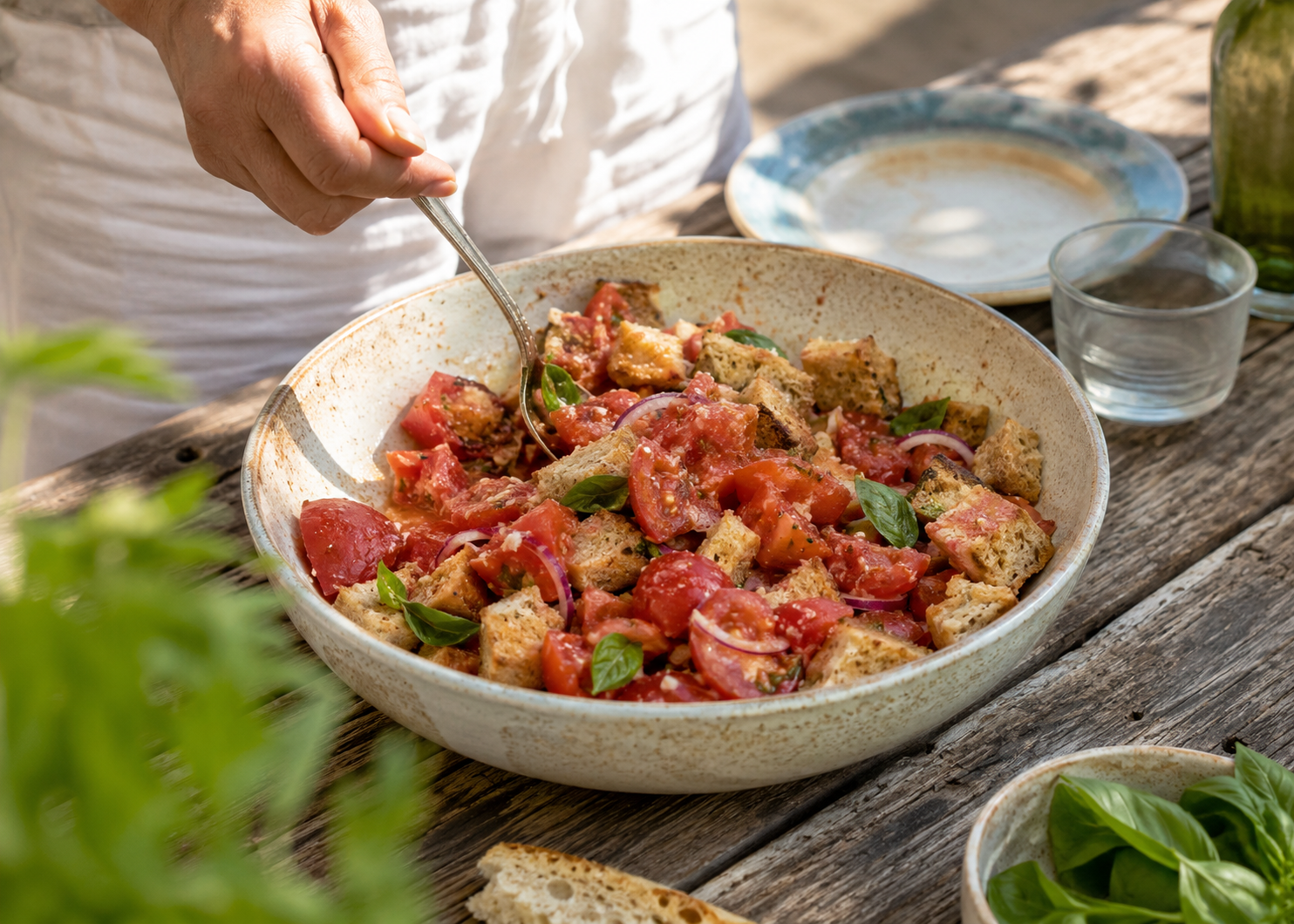
Tuscans hate waste the way some people hate noise, and panzanella is the proof. It started as a way to use up bread that had gone hard, which in a place that bakes saltless loaves happens fast. Stale bread is not a flaw in this dish. It is the entire foundation.
You tear the dry bread into chunks and let it soak, not in water exactly, but in the juice that ripe tomatoes give up when you salt them and leave them to sit. The bread drinks the tomato. It goes from inedible to the best part of the bowl, soft where it met the juice, still with a little chew at the centre.
Around that you build the rest. Tomatoes cut into rough pieces, thin red onion, cucumber if you like, a lot of basil, oil, a splash of red wine vinegar. Some people add the onion raw, some soak it briefly to take the edge off. There is no version a Tuscan grandmother has not argued about with her sister.
What there is not, in a real panzanella, is lettuce, or croutons, or anything toasted. The bread is meant to be soft and tomato-soaked, not crisp. Get that one thing right and the dish makes sense. Get it wrong and you have made a salad with bread in it, which is a different and lesser thing.
Two Ingredients Can Be Dinner
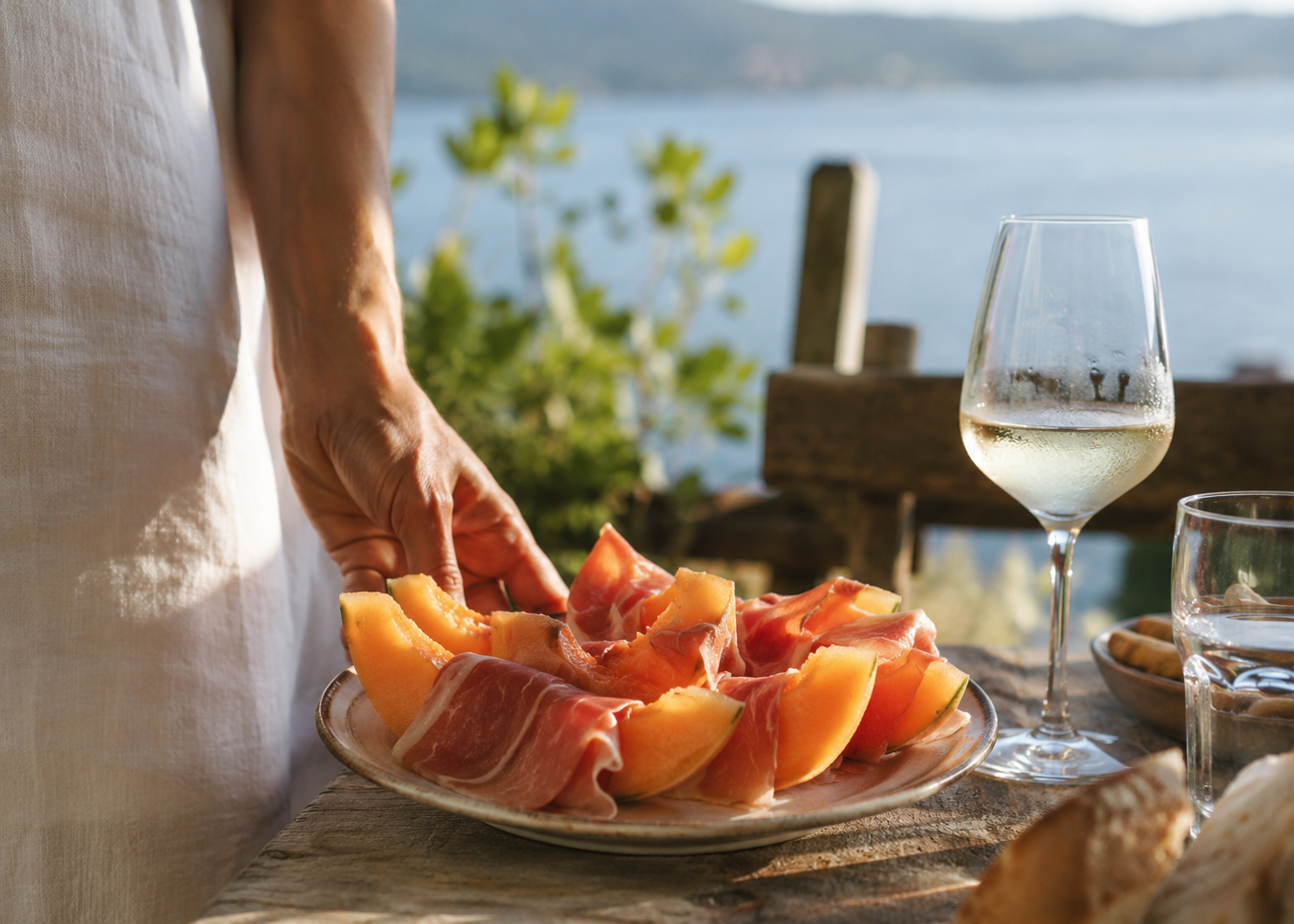
There is a dish eaten all over Italy in summer that has exactly two components and requires you to do almost nothing, and it is still better than most things people labour over. Prosciutto and melon. Sweet orange melon, ripe to the point of perfume, wrapped in paper-thin salty cured ham.
The whole thing lives on a single contrast, the cool sweetness of the fruit against the salt and fat of the pork. That is a complete idea. You do not improve it by adding to it. The only real skill is in the shopping, a melon at its peak and ham sliced thin enough to be almost translucent, draped rather than laid.
We eat it as a starter when we have people over and as an actual dinner when it is just us and the thermometer says something unreasonable. A plate of it, some bread, a glass of cold wine, and you have eaten well without once raising the temperature of the room.
This is the part Americans tend to resist, the idea that two good things on a plate are allowed to be the meal. In a heat wave, that resistance is the only thing standing between you and a perfectly good dinner.
The Pantry Holds A Dinner Too
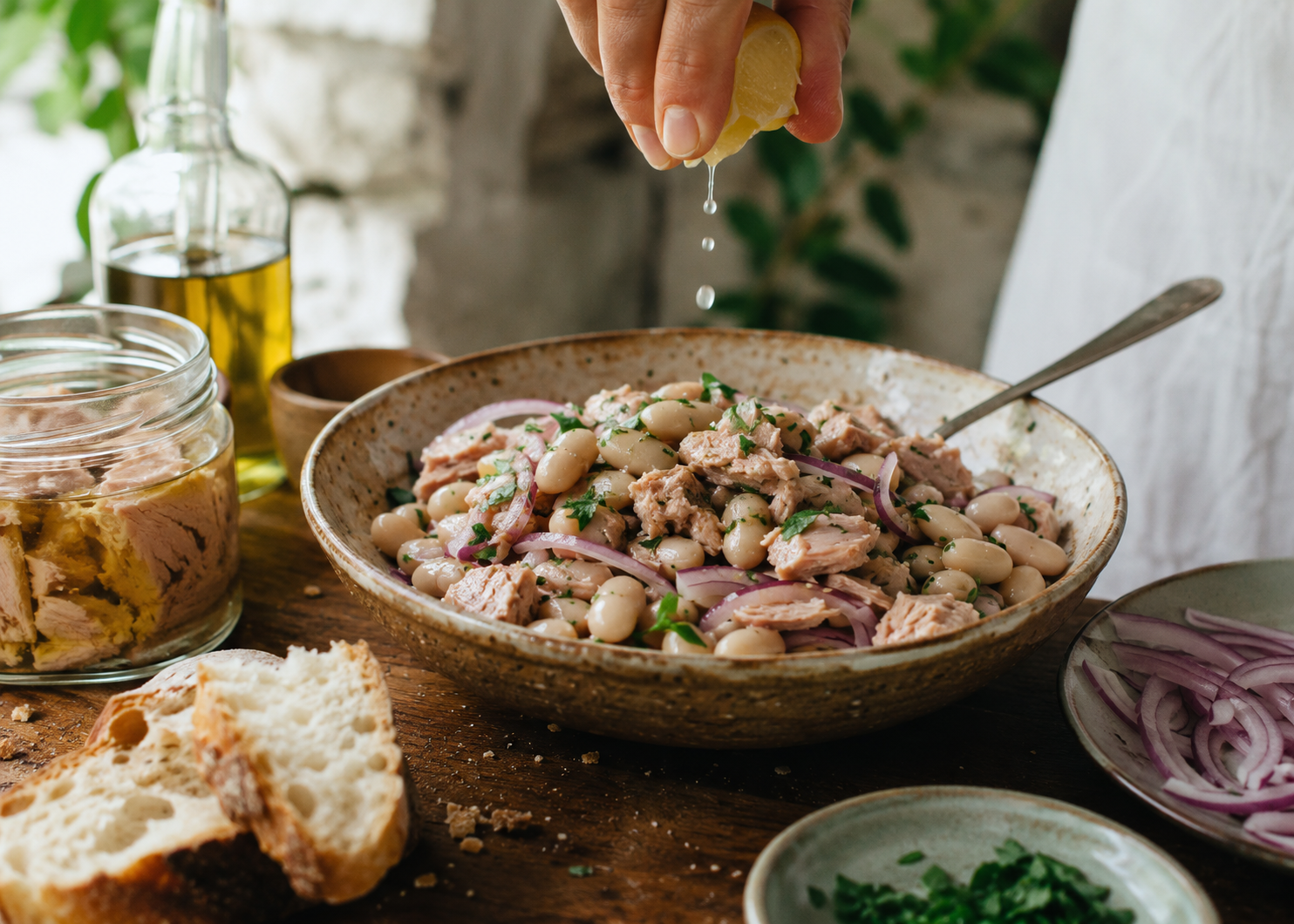
Some of the best no-cook Italian meals never touch the fridge at all. They come out of the cupboard. Tonno e fagioli is the one we fall back on most, tuna and white beans, and it is assembled almost entirely from things in jars and tins.
Good tuna packed in olive oil, the kind that comes in a glass jar and costs more than you think it should, is worth it here because it is the whole dish. Drain it, but not too hard. Tip it over cannellini beans, the soft white ones, also from a jar. Add thin slices of red onion, a hard pour of oil, lemon or a little vinegar, salt, pepper, parsley if you have it.
That is dinner, and it took the length of time it takes to open two lids. It is the meal we make on the days when even assembling feels like too much, when the heat has flattened any ambition beyond eating something that tastes good and asks nothing of us.
The lesson tucked inside it is worth keeping. A well-stocked Italian pantry is a no-cook dinner waiting to happen. Good tinned fish, good beans, good oil, and you are never more than five minutes from a real meal, even on the day the stove stays cold and the windows stay shuttered against the afternoon.
Air-Dried Beef, Lemon, And Almost Nothing
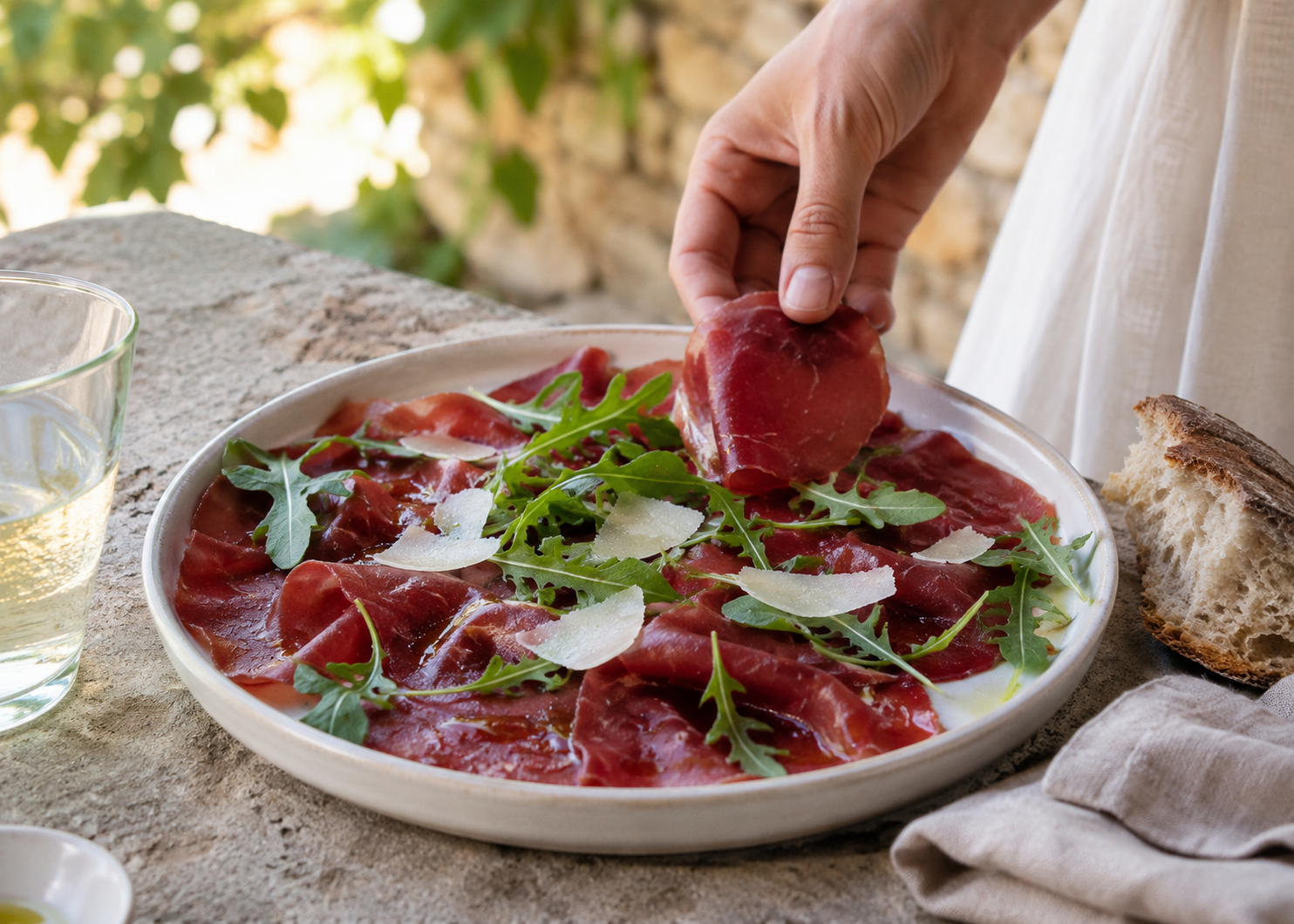
There is a dish from the Italian north that feels too elegant to be this little work. Bresaola, lean beef cured and air-dried until it turns deep red and tender, sliced as thin as the prosciutto and laid flat across a plate.
You dress it where it lies. A hard squeeze of lemon, a pour of good oil, a scatter of rocket, shavings of parmesan pulled off the block with a peeler. The lemon wakes the meat up, the rocket brings a peppery bite, the parmesan brings salt and richness, and none of it ever sees a flame.
It eats lighter than the other cured meats, which is the point on the nights when the air itself feels heavy and even a slice of salami seems like too much. We found it in our second Spanish summer and it became the thing we reach for when dinner has to be cool and clean and almost weightless.
The Lombardians serve it as a starter, but there is no law that a plate of bresaola, some bread, and a glass of something cold cannot be the whole meal. On a night in the high thirties, it usually is.
The Board Is A Real Meal, Not A Trend
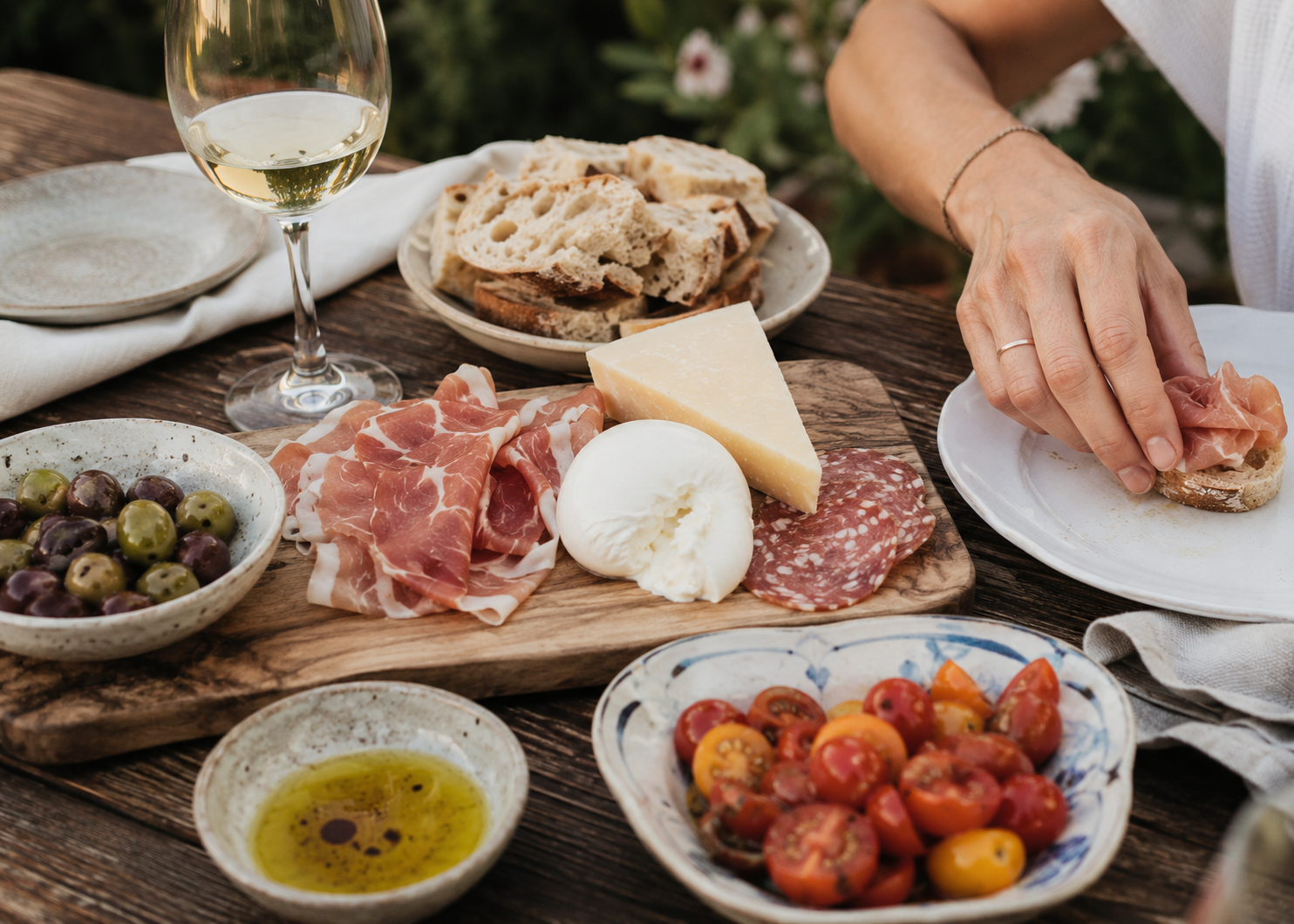
Long before anyone photographed a grazing board for the internet, Italian families were putting out affettati e formaggi, cured meats and cheese, and calling it supper. In summer it becomes the easiest dinner in the house.
The difference between this and the Instagram version is restraint and quality. You do not need fourteen things. You need a few good ones. A couple of cured meats, a hard cheese and a soft one, bread, olives, maybe some of those tomatoes again. Prosciutto, some salami, a wedge of pecorino, a ball of mozzarella, and you have covered every craving without warming anything.
What makes it Italian rather than just a cheese plate is the bread doing real work and the oil always within reach. This is food you tear and fold and build little bites from, slowly, over a long evening, which is exactly the pace a hot night wants. Nobody is in a hurry. The meal stretches because the company does.
We learned to lean on this hard in our first Spanish summers, when the heat made cooking unthinkable and a board of good things, set out and grazed for two hours, turned out to be not a compromise but one of the best ways to eat all year.
Bread, Rubbed With Tomato
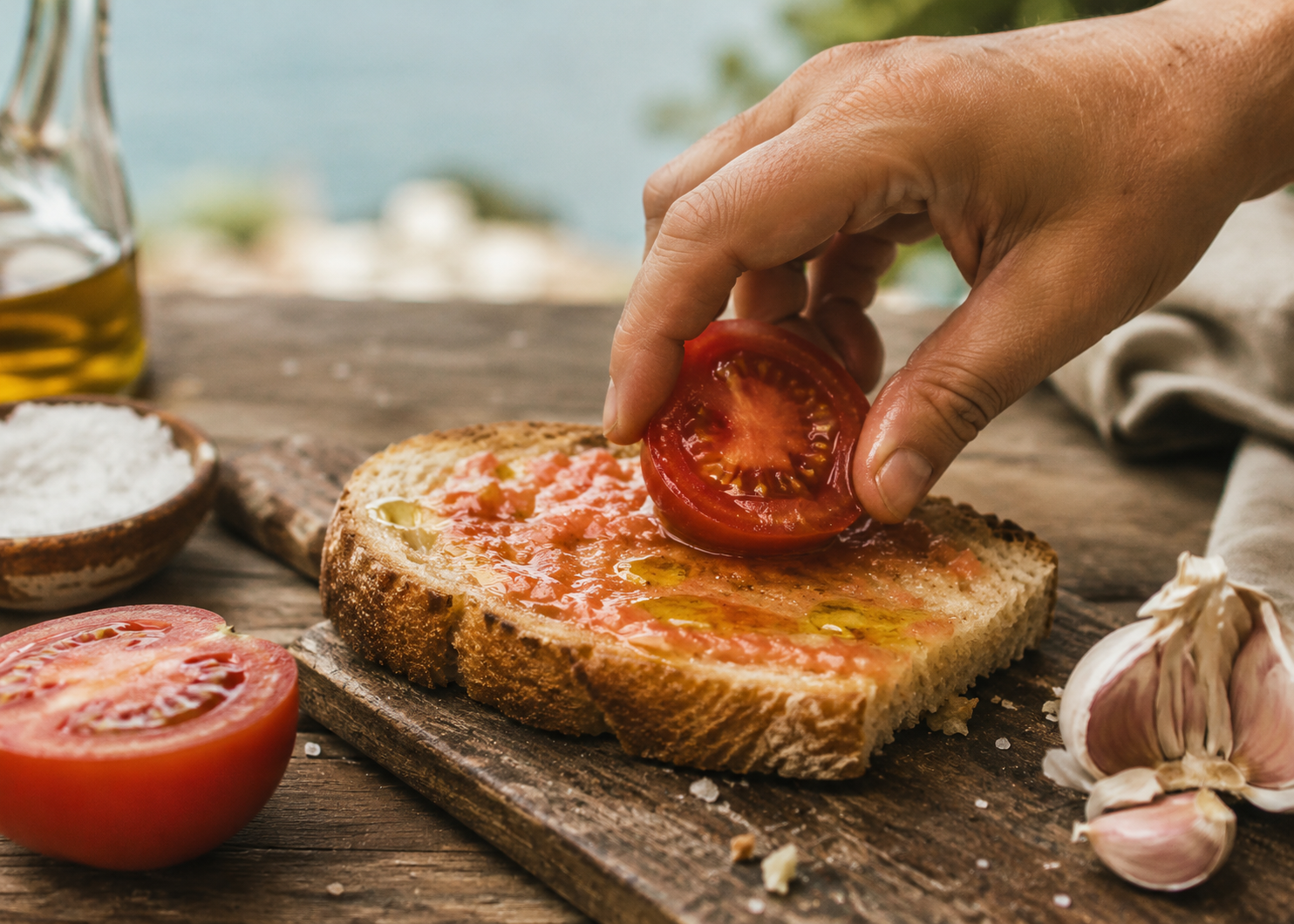
The simplest dinner in this whole tradition is also, on the right night, the most satisfying. Bread rubbed with a cut tomato, doused in oil, hit with salt. That is the entire recipe. The Spanish do their own version and so do the Italians, and in both it is peasant food that happens to be perfect.
You take good bread, ideally a bit firm. You cut a ripe tomato in half and drag the cut face across the bread until the surface is stained red and wet with pulp. Then oil, a real amount of it, and salt. If you want, a clove of garlic rubbed on first.
It should not work as well as it does. It is bread and a tomato. But the bread gives structure, the tomato gives sweetness and acid, the oil gives richness, the salt ties it together, and you end up with something you keep going back to until the loaf is gone.
This is the dish I would point to if someone wanted the whole philosophy in one bite. No heat, almost no effort, nothing but good ingredients treated simply. On a night too hot to think, it is enough, and most nights it is more than enough.
Putting Them On The Table
None of this needs a recipe so much as a shopping list and a little nerve to keep things plain. But here are the assemblies, stripped down, so you can build any of them without thinking too hard on a hot evening.
Caprese: Sliced ripe tomatoes, torn mozzarella di bufala, whole basil leaves, olive oil, flaky salt. Layer, pour, salt, eat with bread. No balsamic.
Panzanella: Tear stale bread into chunks. Salt rough-cut tomatoes and let them sit to release juice. Combine bread, tomatoes and their juice, thin red onion, basil, oil, a splash of red wine vinegar. Let it sit 20 minutes so the bread softens.
Prosciutto e melone: Ripe melon in wedges, draped with thin slices of prosciutto. Nothing else.
Tonno e fagioli: Drain good jarred tuna and a jar of cannellini beans. Combine with thin red onion, olive oil, lemon or vinegar, salt, pepper, parsley.
Bresaola: Thin-sliced bresaola laid flat on a plate. Dress with lemon, olive oil, a scatter of rocket, and shaved parmesan.
Affettati e formaggi: A couple of cured meats, two cheeses, bread, olives, oil. Arrange on a board. Graze slowly.
Pane e pomodoro: Drag a halved ripe tomato across firm bread until red and wet. Oil generously, salt. Optional garlic rubbed on first.
What The Heat Taught Us
The first summer we lived through a real Mediterranean July, we treated the heat as a problem to be solved, something to push through so we could keep eating the way we always had. That was the mistake. The heat is not asking you to suffer through your normal cooking. It is offering you a different and arguably better way to eat.
These dinners are not consolation prizes for when it is too hot to do the real thing. In August, they are the real thing. The tomato is never better, the appetite never wants anything heavy, and the long slow grazing meal eaten late on a cooler patio is one of the genuine pleasures of summer in this part of the world.
So when the kitchen turns into a clay oven and the thought of a hot pan makes you wilt, do what the nonnas do. Shut the stove. Open the fridge and the cupboard. Put good things on a board and good bread alongside them, pour the oil with a heavy hand, and let the ingredients, which have spent all summer getting this good, finally do their job.

About the Author: Ruben, co-founder of Gamintraveler.com since 2014, is a seasoned traveler from Spain who has explored over 100 countries since 2009. Known for his extensive travel adventures across South America, Europe, the US, Australia, New Zealand, Asia, and Africa, Ruben combines his passion for adventurous yet sustainable living with his love for cycling, highlighted by his remarkable 5-month bicycle journey from Spain to Norway. He currently resides in Spain, where he continues sharing his travel experiences with his partner, Rachel, and their son, Han.