
The hotel is a quieter stage than the cafe or the restaurant, but it has its own set of American tells, the habits and expectations that mark the American traveler as surely in the lobby and the room as at the table. Americans arrive at European hotels with a set of assumptions formed by American hotels, about size and amenities and service and how things work, and European hotels are different in ways that catch the American out and reveal them, the gap between American expectations and European hotel reality being a quiet but constant giveaway. None of it is anyone’s fault, but the habits and the surprises mark the tourist.
Understanding these differences is not about embarrassment but about traveling more smoothly and happily, since knowing what European hotels are actually like, and adjusting your expectations and habits accordingly, saves you frustration and surprise and lets you enjoy the stay for what it is rather than measuring it against an American standard it was never going to meet. European hotels have their own logic, charming in some ways and frustrating in others, and knowing it helps. Here are six hotel habits that give American travelers away in Europe, and how to adjust.
Expecting American-Sized Rooms

The first and most universal tell is the reaction to room size, since European hotel rooms are much smaller than Americans expect.
The most universal American tell in European hotels is the surprise and dismay at the size of the rooms, since European hotel rooms, especially in older buildings and historic city centers, are typically much smaller than American hotel rooms, the space tighter, the room more compact, which catches Americans off guard and marks them by their reaction. Americans accustomed to large spacious hotel rooms are often startled by the European room, the compactness reflecting the older buildings, the denser cities, the different norms, so the surprise and disappointment at the small room is a near-universal American tell, the size expectation giving them away. Expecting American-sized rooms marks the American.
The thing to do instead is to adjust your expectations in advance, understanding that European hotel rooms are generally smaller, especially in historic centers, and accepting this as part of the European experience rather than a failing, so that you are not surprised or dismayed. The smaller room is part of staying in the atmospheric old buildings and central locations that make European travel special, a fair trade for the charm and the location, so embracing it rather than measuring against the American standard lets you enjoy the stay. Adjusting your expectations to the smaller European room rather than expecting American size is the way to avoid both the surprise and the disappointment.
Being Surprised By The Lack Of Air Conditioning

The second tell is the surprise at the absence or weakness of air conditioning, which is far less universal in Europe.
Americans, used to powerful universal air conditioning, are often surprised and uncomfortable to find that many European hotels, especially older and smaller ones, have weak air conditioning or none at all, the European norm being far less reliant on it than the American, so the surprise and discomfort at the lack of cooling marks the American. Air conditioning is simply less universal and less powerful in Europe, particularly in older buildings, where it may be absent or modest, so the American expectation of strong cooling everywhere is often disappointed, and the reaction to its absence is a clear tell, the air conditioning expectation giving them away. Being surprised by the lack of air conditioning marks the American.
The thing to do instead is to check and plan ahead, confirming whether a hotel has air conditioning if it matters to you, and otherwise adjusting your expectations to the European norm, using the passive cooling methods, the shutters and windows and the cooler hours, that Europeans rely on. If air conditioning is essential to you, it is worth verifying before booking, but otherwise accepting the European approach and using the local cooling methods lets you stay comfortable without the American assumption, so planning ahead and adjusting is the way to handle it. Checking for air conditioning if it matters and otherwise adjusting to the European norm is the way to avoid the surprise.
Misunderstanding The Electricity And Key Card System
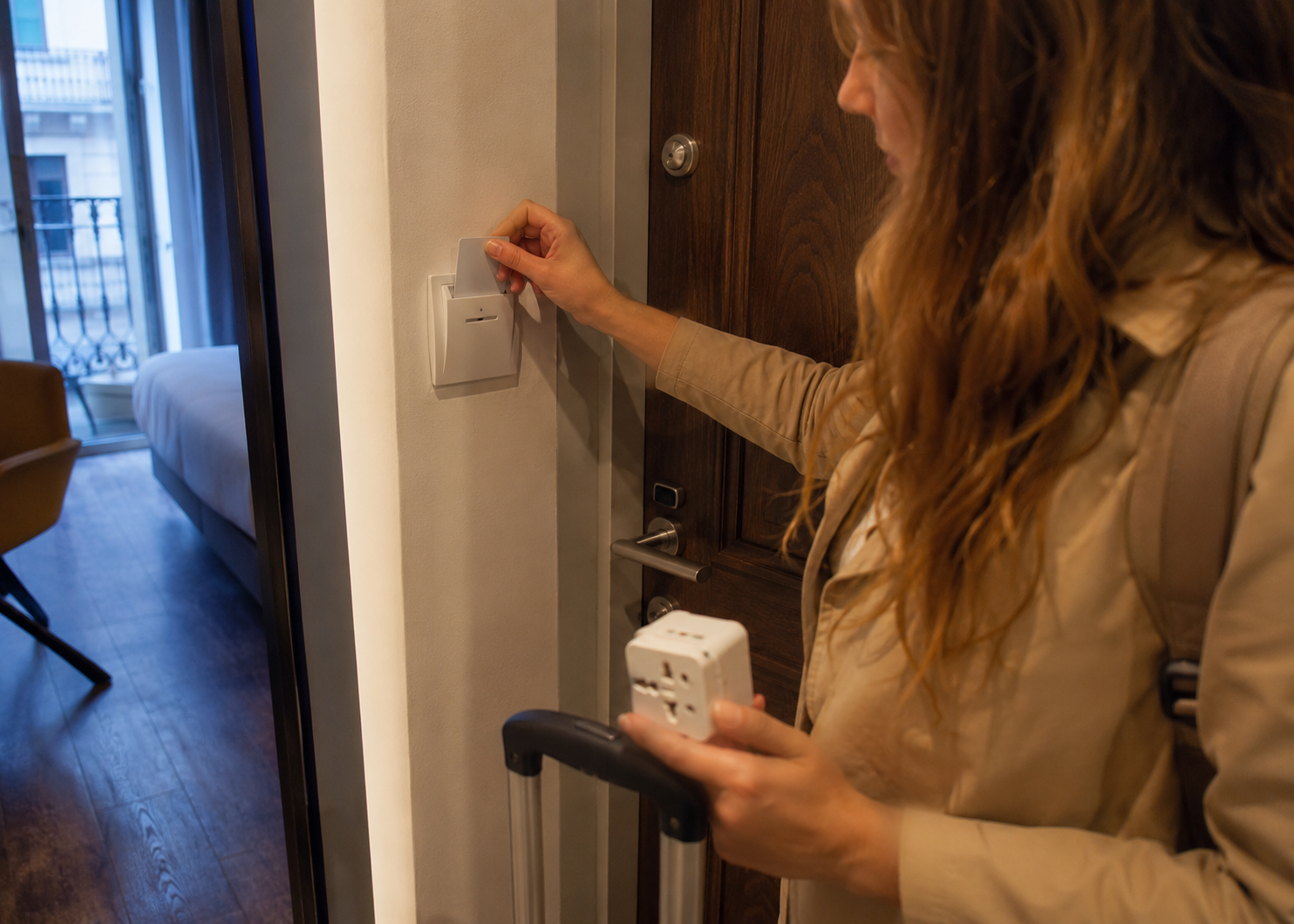
The third tell is confusion at the small systems, the electricity that needs the key card and the different outlets.
A small but classic American tell is confusion at the European hotel systems that differ from the American, above all the common European setup where the room electricity only works when the key card is placed in a slot by the door, which catches out Americans who leave and find the power off or who cannot work out why nothing turns on, and the different electrical outlets and voltage that require adapters. These small system differences, the key card power slot, the outlets, the light switches, catch the American unfamiliar with them, the confusion at the European hotel systems being a quiet tell, the unfamiliarity giving them away. Misunderstanding the hotel systems marks the American.
The thing to do instead is to learn these common European systems in advance, knowing about the key card power slot so you place the card to turn on the electricity, bringing the right plug adapters for the European outlets, and being ready for the small differences rather than confused by them. These are easy things to know once you are aware of them, so a little preparation, understanding the key card system and bringing adapters, removes the confusion and the tell, letting you navigate the European hotel room smoothly. Learning the European hotel systems in advance rather than being caught out by them is the way to handle the room like a seasoned traveler.
Over-Expecting Amenities And Service

The fourth tell is expecting the level of amenities and service of American hotels, which differs in Europe.
Americans often expect the amenities and service levels of American hotels, the ice machines, the large bathrooms, the abundant toiletries, the particular service touches, and are marked when European hotels, especially smaller and older ones, do not provide them in the same way, the European norms being different, so the expectation of American amenities and service reveals the American. European hotels, particularly the smaller independent and historic ones, often have different and sometimes fewer amenities than the American standard, no ice machines, smaller bathrooms, different service, so the American expecting the full American amenity set marks the foreigner, the amenity expectation being a tell. Over-expecting amenities marks the American.
The thing to do instead is to adjust your expectations to the European norm, understanding that hotels, especially the charming smaller and historic ones, may offer different and sometimes fewer amenities than American hotels, and accepting this as part of the character rather than a failing. The smaller European hotel trades some amenities for charm, character, and location, a fair trade for many, so embracing the different amenity level rather than expecting the American one lets you enjoy the European hotel for what it is. Adjusting your amenity expectations to the European norm rather than expecting the American standard is the way to enjoy the stay.
Misreading Breakfast Customs

The fifth tell is misreading the hotel breakfast, which differs from the large American hotel breakfast.
Americans often expect the large American hotel breakfast, the big buffet, the eggs and bacon and the abundance, and are marked when the European hotel breakfast is different, often a lighter continental affair of bread, pastry, cheese, and coffee, or sometimes not included at all, the European breakfast norms differing from the American, so the expectation of the big American breakfast reveals the foreigner. The European hotel breakfast is frequently the lighter continental style rather than the large American spread, and is sometimes a paid extra rather than included, so the American expecting the big free breakfast is often surprised, the breakfast expectation being a tell. Misreading the breakfast customs marks the American.
The thing to do instead is to understand the European hotel breakfast, expecting the lighter continental style of bread and pastry and cheese and coffee rather than the large American spread, and checking whether breakfast is included or a paid extra. Embracing the lighter European breakfast as part of the experience, and knowing whether it is included, removes the surprise and lets you enjoy it for what it is, so understanding the breakfast customs in advance is the way to handle the morning. Understanding and embracing the lighter European hotel breakfast rather than expecting the American one is the way to start the day without surprise.
Tipping Confusion

The sixth tell is tipping confusion, since hotel tipping customs differ between America and Europe.
Americans, with their strong habitual tipping culture, are often unsure how to tip in European hotels and either over-tip in the American way or are confused about the different customs, which marks them, since European hotel tipping is generally more modest and less expected than the American, the customs differing, so the American tipping confusion or over-tipping reveals the foreigner. The European norms for tipping hotel staff, the porters, the housekeeping, are generally lighter than the American, so the American who tips heavily or frets about it marks themselves, the tipping habit being a tell here as elsewhere. Tipping confusion marks the American.
The thing to do instead is to learn the modest European hotel tipping norms, which are generally lighter than the American, tipping a small amount for genuine service like a porter but not applying the heavy habitual American tipping, and not fretting about it. The European approach is more modest and relaxed about tipping than the American, so adjusting to the lighter local norm, a small tip for real service but not the heavy American habit, is the way to handle it smoothly. Learning the modest European hotel tipping norms rather than applying or fretting over the American ones is the way to handle tipping like a seasoned traveler.
The Spirit Behind Adjusting
These habits are finally about traveling more happily, and that is the spirit in which to take them.
The point of knowing these hotel tells is not embarrassment but smoother, happier travel, since adjusting your expectations and habits to the European hotel reality, the smaller rooms, the different cooling, the systems, the amenities, the breakfast, the tipping, saves you the frustration and surprise of measuring the European hotel against an American standard it was never meant to match. Much of the disappointment Americans feel in European hotels comes from mismatched expectations rather than from the hotels themselves, so adjusting the expectations removes the disappointment and lets you enjoy the European hotel for its real virtues, the charm and character and location, the adjustment being the key to a happier stay. The spirit is smoother travel, not embarrassment.
So take these six tells as a friendly guide to European hotels rather than a list of shortcomings, and use them to adjust your expectations and habits, the smaller room, the different cooling, the key card and adapters, the different amenities, the lighter breakfast, the modest tipping, so that you travel more smoothly and enjoy the European hotel for what it genuinely is. Approach the European hotel not with American expectations destined for disappointment but with adjusted ones ready for its real character, and you will find the stay far more pleasant, the European hotel having its own charm once you stop expecting it to be American. That is the real spirit behind adjusting, a happier stay and a deeper appreciation of the European way, opened by a little understanding.
The Charm Hidden Behind The Differences
It is worth dwelling for a moment on the fact that the very differences that catch Americans out are often bound up with what makes European hotels special, since this reframes the whole matter.
The differences that mark the American, the small rooms, the older systems, the lighter breakfast, the modest service, are very often the flip side of exactly what makes European hotels charming and distinctive, since the small room is in the atmospheric centuries-old building, the quirky systems come with the historic character, the independent hotel that lacks the American amenities offers instead a personality and a location that no American chain could match. The European hotel, especially the small independent and historic one, trades the standardized American amenity set for character, history, location, and charm, so the very things that disappoint the American expecting the American standard are inseparable from the things that make the European hotel special, the trade being a genuine one. The differences are not just deficiencies but the other face of the charm.
Seeing this transforms the experience, since once you understand that the compact room in the old building, the hotel without the big breakfast or the ice machine, is offering you character and history and a central location in exchange, you can appreciate the trade rather than lamenting the missing amenities, embracing the European hotel for its real and considerable virtues. The American who reframes the differences this way, as the price and the companion of the charm rather than as mere shortcomings, enjoys the European hotel far more, appreciating the atmospheric old building and the perfect location rather than missing the American spaciousness and amenities. Seeing the charm hidden behind the differences is the deepest adjustment, turning the European hotel from a disappointment measured against America into a delight appreciated on its own terms, which is the real reward of understanding.

About the Author: Ruben, co-founder of Gamintraveler.com since 2014, is a seasoned traveler from Spain who has explored over 100 countries since 2009. Known for his extensive travel adventures across South America, Europe, the US, Australia, New Zealand, Asia, and Africa, Ruben combines his passion for adventurous yet sustainable living with his love for cycling, highlighted by his remarkable 5-month bicycle journey from Spain to Norway. He currently resides in Spain, where he continues sharing his travel experiences with his partner, Rachel, and their son, Han.