
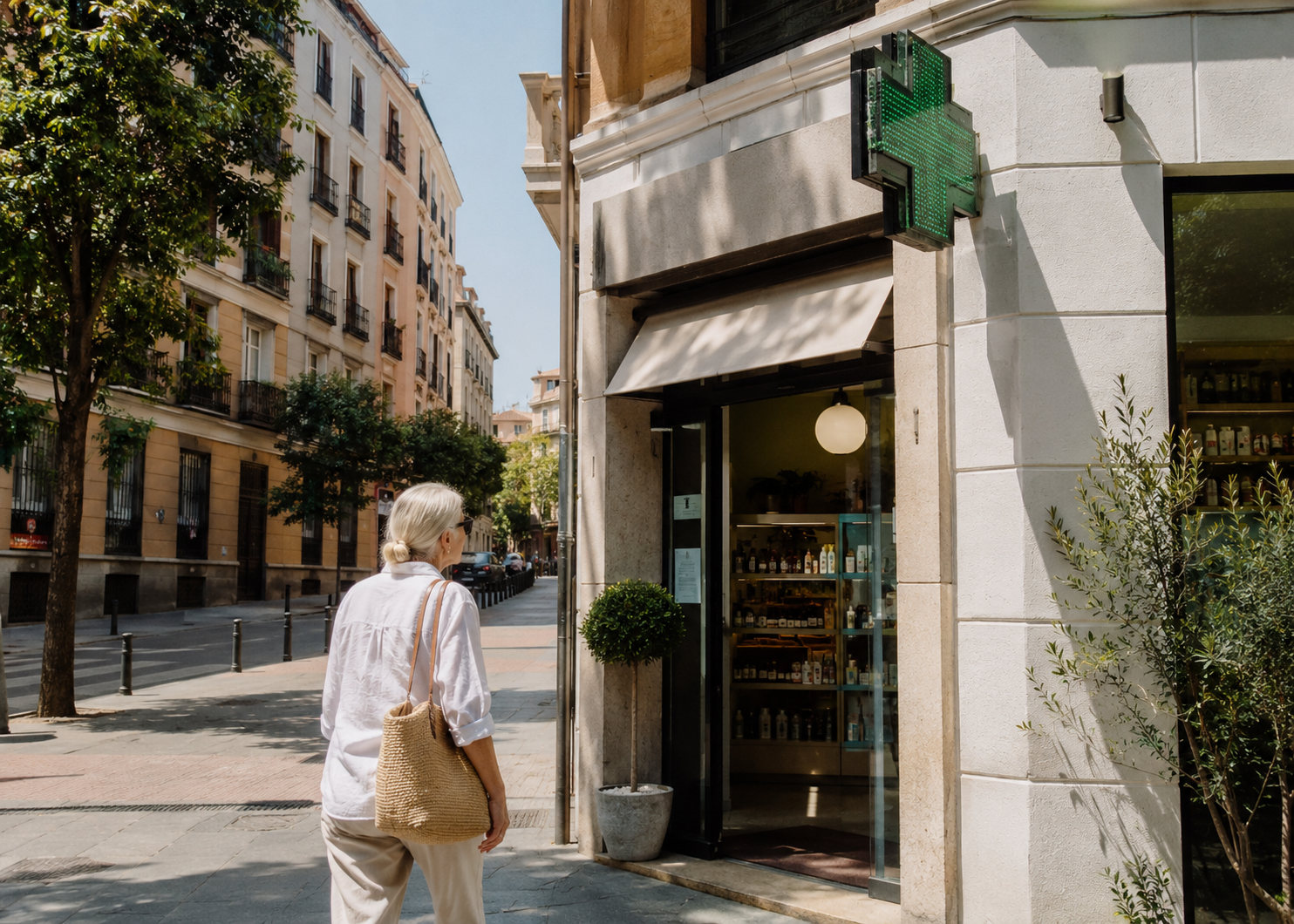
There is a particular conversation that happens at the counter of my neighborhood farmacia in Madrid most summer days, and it always goes roughly the same way. An American, sunburned or sniffling or rubbing a sore shoulder, asks for something by its American brand name, the pharmacist gives a gentle blank look, and then, once the active ingredient gets sorted out, the American discovers they can simply buy, over the counter, after a thirty-second chat, something that back home meant a doctor, an appointment, and a co-pay. The look on their face is always the same. Relief, then a kind of mild outrage at the years of hassle they did not need to have.
The Spanish pharmacy is one of the quiet wonders of living here, and Americans consistently underestimate it. The farmacia is not a shop with a pharmacy counter at the back, it is a healthcare institution staffed by a highly trained pharmacist who can assess, advise, and dispense a wide range of things directly, no prescription required, for the everyday complaints that in America are funneled expensively through a doctor. Here is what Americans keep asking for, what the system actually allows, and how to use it well, with one important caution running underneath.
The Pharmacist Is The Point
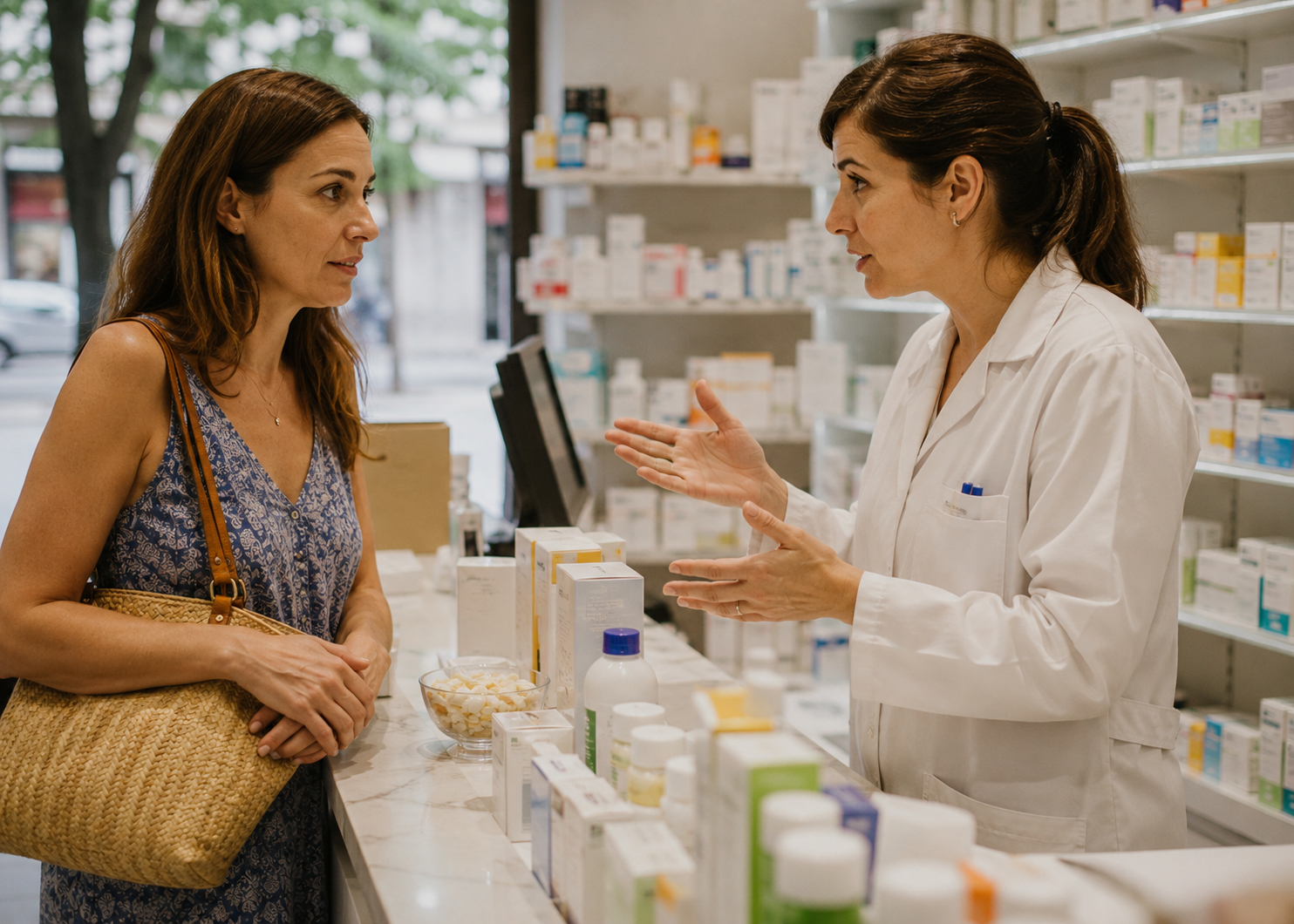
Before any specific medication, understand the institution, because the Spanish farmacia works on a logic Americans have never been offered.
The farmacéutico, the pharmacist, in Spain holds a demanding university degree and functions as a frontline healthcare professional, the first stop for minor ailments, not merely a dispenser of what a doctor ordered. You describe your problem, the cough, the rash, the heartburn, the sore muscle, and the pharmacist assesses it, asks a few questions, and either recommends and dispenses an appropriate treatment on the spot or, when it is beyond their scope, tells you to see a doctor. This is the green cross system working as designed, triaging the minor stuff directly and keeping the doctors for the things that need them, and it means a vast range of everyday complaints get resolved in a five-minute pharmacy conversation that in America would consume a half-day and a bill.
The cultural shift for an American is to stop thinking of the pharmacist as a clerk and start treating them as the knowledgeable professional they are, the person to consult first for anything minor. The advice is free, expert, and immediate, and the Spanish use their pharmacist constantly, popping in for guidance on everything small. An American who learns to do the same unlocks the real value of the system, which is not just easier access to medication but free expert triage for all of life’s small medical questions, available on every other corner, with no appointment and no charge. The medication is half the point. The pharmacist is the other half.
Stronger Pain Relief, Within Limits
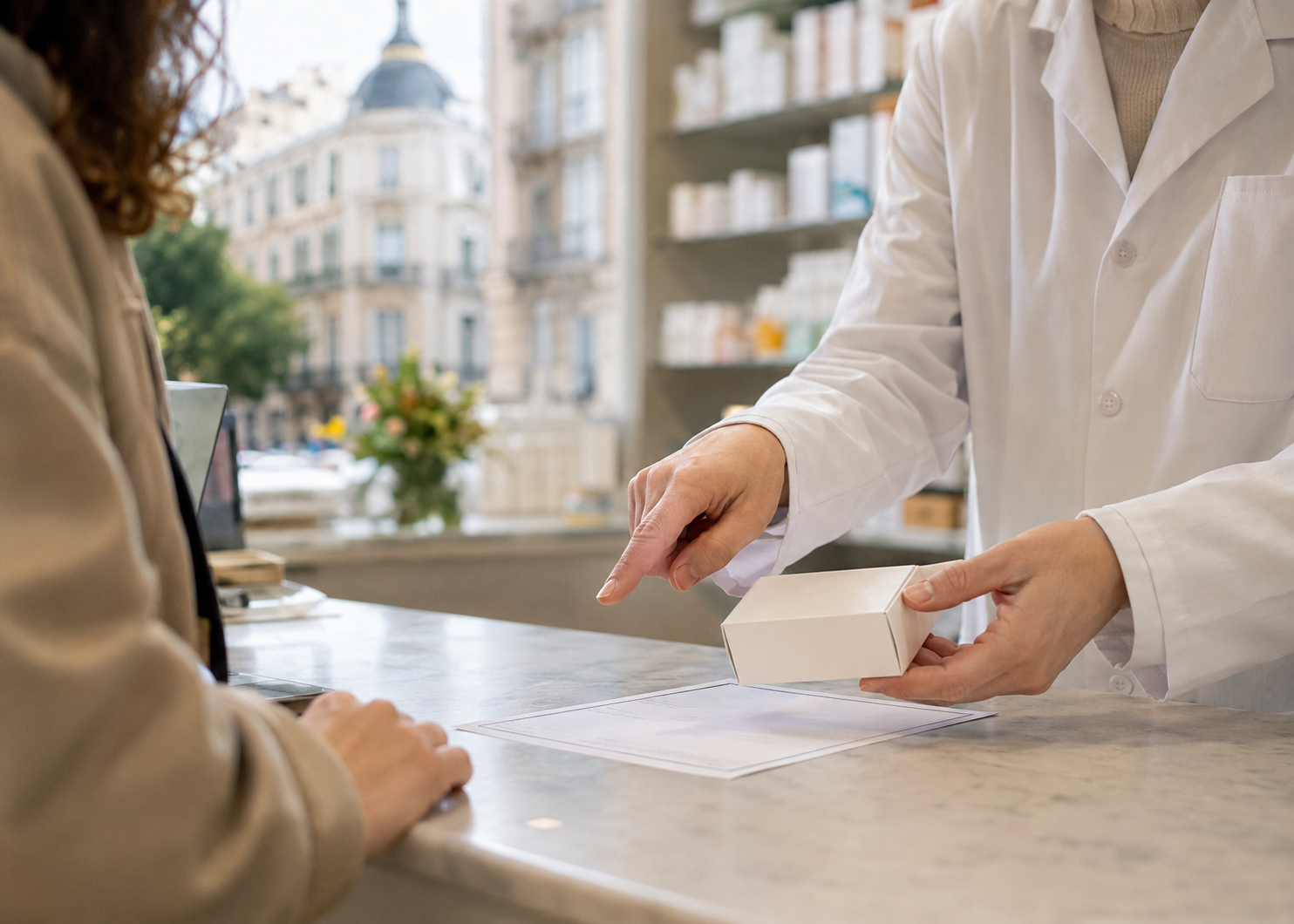
The most common American request is for proper pain relief, and Spain occupies a sensible middle ground that surprises people.
Americans are often startled by what is available over the counter for pain and inflammation, with anti-inflammatories that are prescription-strength or prescription-only in the US sometimes more readily obtained here after a pharmacist consultation, and the everyday painkillers sold in formats and combinations the American market does not offer. The sunburned tourist wanting something for the pain, the traveler with a wrenched back, the person whose knee is acting up, often find the Spanish pharmacy can help directly and effectively where the American system would have required a prescription. The pharmacist assesses and advises, recommending an appropriate option and the correct dose, which is the system working well, expert guidance attached to easier access.
But this is exactly where the important caution enters, and it matters. Easier access is not no limits, the genuinely strong and controlled medications, the opioids and the serious prescription drugs, absolutely still require a prescription in Spain and are properly controlled, so the picture is not that anything goes. It is that the sensible middle tier, the stronger anti-inflammatories and effective everyday treatments, is more accessible through pharmacist consultation than in America, while the truly serious drugs remain controlled as they should be. And the caution underneath all of it is that easier access raises the responsibility to use these things correctly, since stronger pain relief carries real risks, for the stomach, the kidneys, the heart, and interactions with other conditions and medications, which is precisely why the pharmacist’s advice matters and should be sought and followed rather than bypassed.
Antibiotics, And An Important Correction
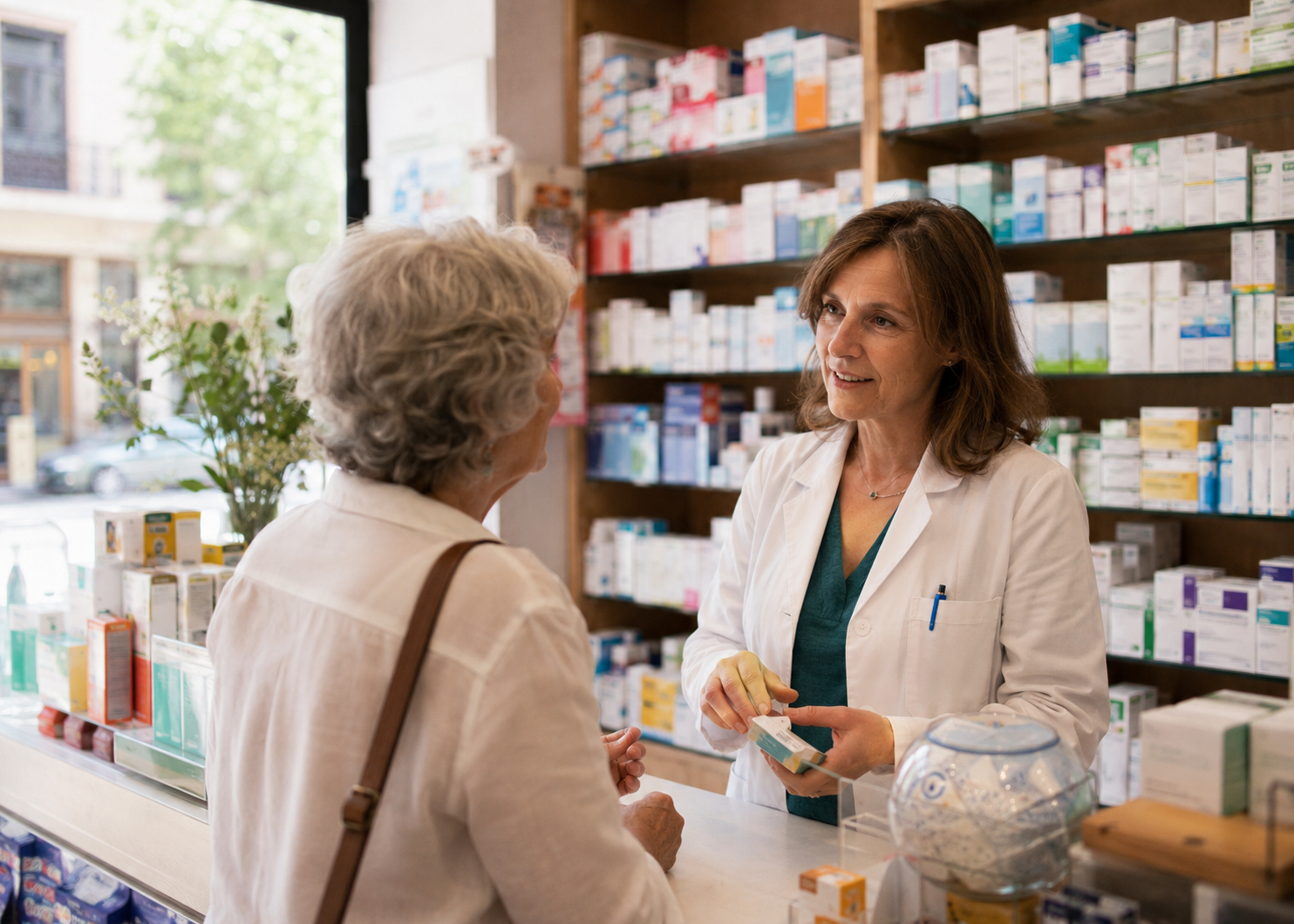
This is the one Americans ask for most expecting a yes, and it is the one where the answer has rightly become no.
There is an old reputation, and many a traveler’s anecdote, about buying antibiotics over the counter in Spain without a prescription, and Americans frequently arrive expecting to do exactly that, to skip the doctor and buy the antibiotic directly. The honest and important correction is that this is no longer how it works, since Spain, like the rest of the European Union, has cracked down significantly on over-the-counter antibiotic sales as part of the serious global effort against antibiotic resistance, and a legitimate pharmacy will now require a prescription for antibiotics. The reputation is out of date, and acting on it is both likely to fail and, more importantly, exactly the wrong instinct.
This correction is genuinely important rather than a mere technicality, because antibiotic misuse, taking them unnecessarily, incompletely, or for the wrong thing, drives the resistance that is one of the gravest threats in medicine, and the casual over-the-counter antibiotic culture that once existed was a real part of the problem. So the American hoping to self-prescribe an antibiotic in a Spanish pharmacy should not, both because the legitimate pharmacies will properly decline and because self-prescribing antibiotics is a bad idea that the medical world is right to be stamping out. If you genuinely need an antibiotic, you need a doctor to determine that, which in Spain is easily and affordably done, and the pharmacy will then dispense it. This is one case where the harder access is the system working correctly, not a hassle to route around.
The Things That Genuinely Are Easier
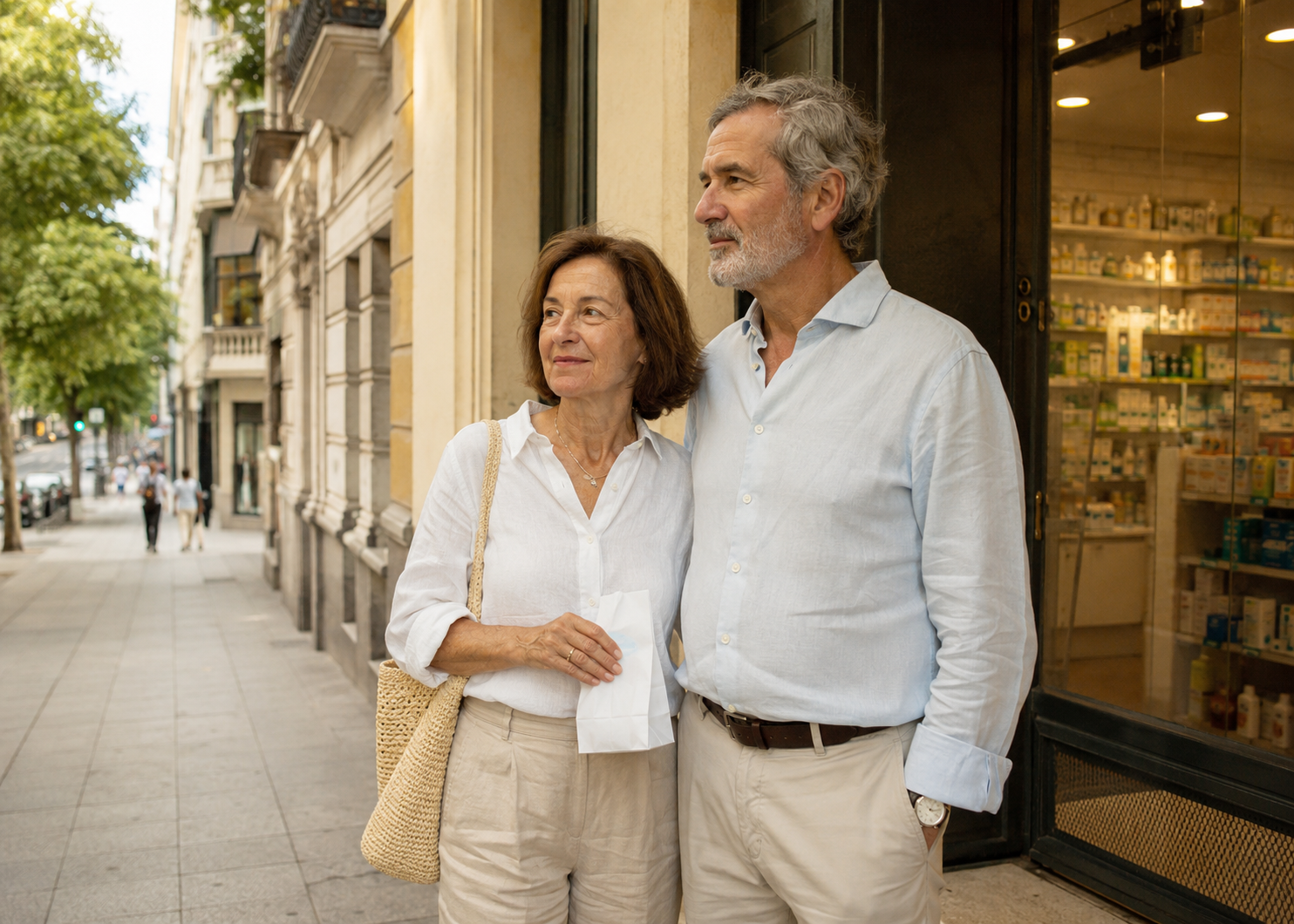
Beyond pain relief, a whole range of everyday treatments genuinely is more accessible, and these are the real everyday wins.
For the ordinary complaints of travel and life, the Spanish pharmacy can directly help with a great deal, the strong antihistamines for allergies, the effective treatments for stomach upset and reflux, the good remedies for coughs and colds, the muscle rubs and anti-inflammatory gels, the eye drops, the treatments for minor infections of the skin, much of it available on pharmacist recommendation without the doctor visit an American expects. The traveler hit with an allergy, a stomach bug, a cold, a minor skin irritation, can walk into a farmacia, describe it, and walk out with something genuinely effective, advised by a professional, in minutes and for a modest price. This is the everyday magic of the system, the small stuff handled directly and expertly.
The prices add to the pleasant surprise, since medications in Spain are dramatically cheaper than in the United States, both because of how the system is structured and because the American pharmaceutical market is uniquely expensive, so the American often finds the thing not only easier to obtain but a fraction of the price they would pay at home. The combination, expert advice, no appointment, direct access for minor things, and low prices, is why Americans living here come to regard the farmacia with something close to devotion, and why the visiting American at my neighborhood counter so often leaves with that expression of relief. For the everyday medical small change of life, the Spanish pharmacy is simply a better system, and learning to use it is one of the real pleasures of being here.
How To Actually Use A Spanish Pharmacy
Some practical guidance makes the system work even better, since a few things about using it are not obvious to an American.
Bring the active ingredient, not the brand name, since your American brand names mean nothing here and the pharmacist needs to know what the drug actually is, so look up the generic active ingredient of anything you rely on before you come, or bring the box. Describe your problem plainly and trust the pharmacist’s assessment, treating it as the expert medical consultation it is, and follow their advice on what to take and how. Know that pharmacies rotate an out-of-hours duty, the farmacia de guardia, so there is always one open somewhere for nights and holidays, posted on every pharmacy door and findable online, which means you are never truly without access. And carry your own prescriptions and a list of your regular medications with active ingredients, so the pharmacist can advise safely around what you already take.
The deeper practical wisdom is to fold the pharmacy into your life here the way Spaniards do, as the first port of call for anything minor, the free expert you consult before considering a doctor, the place that handles the small stuff so the medical system can keep the doctors for the real things. An American who learns this stops defaulting to the American instinct of doctor-for-everything and starts using the pharmacist as the frontline resource they are, which is faster, cheaper, and genuinely good care for the minor complaints that make up most of life’s medical needs. The farmacia rewards the person who uses it as designed, and using it well is one of the small competences that turns a foreigner into a resident.
The Caution That Runs Underneath
One honest thread has to be drawn through all of this, because easier access is a genuine good only when paired with genuine care.
The easier access of the Spanish system is a real benefit, but it raises rather than lowers the responsibility to use medications sensibly, since the doctor that the American system forced you through did, among the hassle, provide a check on what you were taking, and getting things directly from the pharmacy means that check now rests more on you and the pharmacist. This is why the pharmacist’s advice is not a formality to rush past but the safety mechanism of the whole system, the expert assessment that should be sought and genuinely followed, especially regarding doses, interactions with your other medications and conditions, and when something is actually beyond self-treatment and needs a doctor. The freedom to get things easily works well precisely when the user takes the pharmacist’s professional guidance seriously.
And the line where you must see a doctor remains real and should be respected, since the pharmacy is for minor everyday complaints, and anything that is severe, persistent, worsening, or out of the ordinary needs a doctor regardless of what the pharmacy could technically hand you. The Spanish system makes the doctor affordable and accessible too, so there is no reason to push the pharmacy beyond its proper scope to avoid a doctor you actually need. Used within its real limits, with the pharmacist’s advice respected and the doctor consulted when warranted, the Spanish pharmacy is a wonderful resource. Used as a way to self-prescribe around medical advice you actually need, it is a risk. The relief on the American’s face at the counter is well founded, as long as the freedom it represents is matched by the care that freedom requires.
What Americans Get Wrong At The Counter
A few specific misunderstandings play out at the counter again and again, and naming them saves the visitor some friction.
The first is the brand-name problem, the American asking for Tylenol or Advil or a dozen other names that mean nothing in Spain, where the same drugs exist under different names or simply as their generic active ingredient, so the conversation stalls until someone works out what the drug actually is. The second is volume, the American wanting the giant American bottle of two hundred tablets, where Spanish pharmacies sell smaller, sensible packs, because the system does not assume you are stockpiling, and the smaller pack is a feature, fresh medication bought as needed rather than a cabinet full of expiring pills. The third is the assumption of self-service, the American wandering looking for shelves to browse, when most real medication sits behind the counter and comes through the pharmacist, who is meant to be consulted rather than bypassed.
The fourth and most consequential is the expectation of confrontation, the American braced to argue or negotiate for access, who is startled to find the pharmacist helpful, knowledgeable, and willing, because the access was never the fight it is in America, it was always meant to be this collaborative and easy. The adjustment in every case is the same, to drop the American assumptions, the brand names, the bulk, the self-service, the adversarial posture, and to step into the Spanish way, the active ingredient, the sensible pack, the counter consultation, the helpful professional. Do that and the counter conversation becomes one of the most pleasant routine interactions of life here, a small daily proof that some things really are done better elsewhere.
A Word On Bringing Your Own Medications
For Americans moving here rather than visiting, the question of their existing prescriptions deserves its own note, since the transition has a few wrinkles.
An American relocating with regular prescription medications should plan the handover rather than assume it, since their American prescriptions are not valid in Spain and the specific brand or formulation they rely on may differ or carry another name here, so the move involves getting established with a Spanish doctor who can assess and re-prescribe their ongoing medications under the Spanish system. This is generally straightforward and the medications are usually available and far cheaper, but it requires the step of seeing a doctor to transfer the prescriptions rather than expecting to simply continue, and it is worth bringing enough supply to cover the transition plus a full list of everything taken, with active ingredients and doses, to make the handover smooth. The pharmacist can advise during the gap, but the formal re-prescribing needs the doctor.
The reward, once established, is the same low-cost easy-access system applied to ongoing care, with regular medications obtained affordably and the pharmacist available for everything around them, a far cheaper and often simpler experience than the American one it replaces. The newcomer who handles the transition properly, bringing a supply and a list, getting established with a doctor early, and re-prescribing their regulars into the Spanish system, slides into a medication regime that costs a fraction of the American version and runs more smoothly. It is one more piece of the larger truth about healthcare here, that the system is both more humane and more affordable, and that the work for the newcomer is mostly in learning to use it rather than in any real hardship, with the pharmacy, as ever, the friendly frontline of the whole thing.

About the Author: Ruben, co-founder of Gamintraveler.com since 2014, is a seasoned traveler from Spain who has explored over 100 countries since 2009. Known for his extensive travel adventures across South America, Europe, the US, Australia, New Zealand, Asia, and Africa, Ruben combines his passion for adventurous yet sustainable living with his love for cycling, highlighted by his remarkable 5-month bicycle journey from Spain to Norway. He currently resides in Spain, where he continues sharing his travel experiences with his partner, Rachel, and their son, Han.