
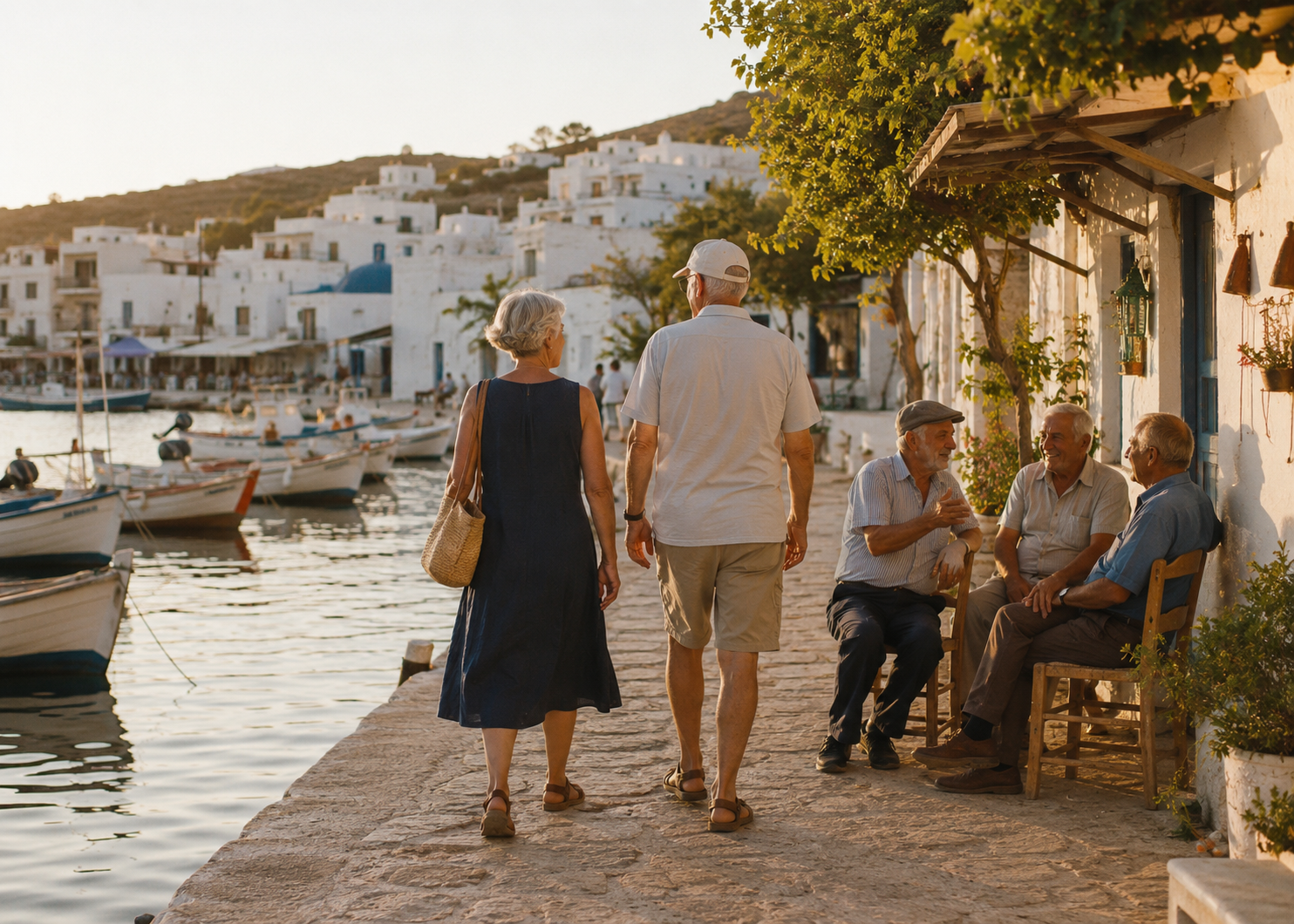
Everyone has seen the two Greek islands. Santorini’s blue domes, Mykonos’s white windmills, the photographs that launched a million cruises. Almost nobody outside Greece can name the islands where Greeks actually live year-round, raise families, grow old, and bury their parents, and those are the ones worth an American’s attention for retirement. They have hospitals instead of just clinics, communities instead of just tourists, and a life that does not pack up and leave in October. For an American over sixty thinking seriously about a Greek island, the famous two are exactly the wrong answer, and a handful of quieter ones are close to ideal.
Greece took the top spot in International Living’s global retirement ranking for 2026, and the island life is a large part of why, the climate, the cost, the pace, the welcome. But island life rewards the careful and punishes the romantic, and the three things that matter most over sixty, healthcare, year-round community, and a climate that suits an aging body, vary enormously from island to island. Here are the islands that get all three right, and the honest truth about what each asks in return.
The Three Things That Actually Matter Over Sixty
Before the islands, the criteria, because choosing a Greek island for retirement is not the same as choosing one for a holiday.
Healthcare comes first, and it is where the famous islands fail and the sensible ones succeed. A retiree needs more than a summer clinic staffed for tourists with sunburn, they need a real medical presence year-round, ideally a hospital on the island and certainly fast reliable access to one, because the medical needs of sixty-five are not the medical needs of twenty-five. Many beautiful Greek islands have only a basic health center with limited staff, fine for a sprained ankle, not for managing a chronic condition or handling an emergency, so the retiree’s island must be chosen substantially on its medical infrastructure, which immediately rules out the smaller and more isolated ones however lovely.
The second is year-round community, because an island that empties in winter is a different and lonelier place than the summer postcard suggests. Many Greek islands are seasonal, alive and crowded from June to September and then shuttered and silent, the restaurants closed, the ferries thinned, the population collapsed to a few hardy locals, and a retiree who bought the summer dream finds the winter reality isolating and grim. The islands that suit retirement are the ones that stay genuinely alive year-round, with a permanent community, open shops and tavernas through the winter, and a social life that does not depend on tourists. The third thing, climate, Greece largely delivers everywhere, the mild Mediterranean winters and warm dry summers that suit an aging body, though the summer heat and the meltemi wind vary and matter. Get healthcare and year-round community right, and the climate mostly takes care of itself.
Syros, The Year-Round Capital
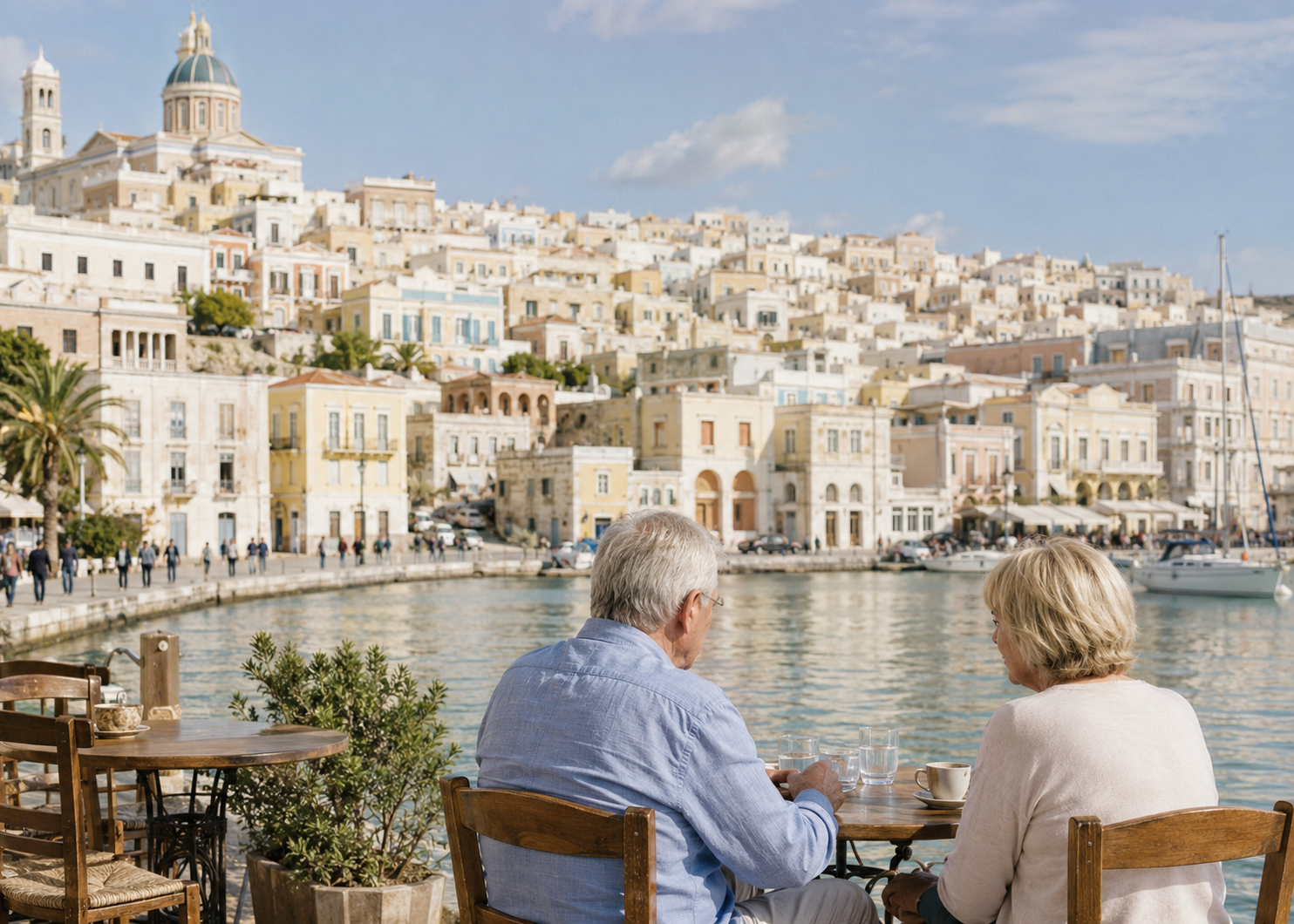
If one island answers all three criteria at once, it is Syros, and it is the one most Americans have never heard of.
Syros is the administrative capital of the Cyclades, which is the key to everything good about it for a retiree, because being the capital means it is a real working town that lives year-round rather than a seasonal resort. Its main town, Ermoupoli, is one of the most distinguished towns in the Aegean, grand neoclassical and Venetian-influenced architecture, a marble-paved main square, a famous old theater, a genuine cultural life of festivals, concerts, and exhibitions that runs through the year, not just the season. Crucially for the over-sixty retiree, Syros has a hospital, real year-round medical infrastructure as the capital of the island group, which puts it in a different and safer category than the islands with only summer clinics.
What makes Syros special is exactly that it is not primarily a tourist island, it is a working Greek town that happens to be beautiful, so it stays vibrant in winter, the cafes and tavernas open, the community present, the cultural life continuing, the streets lived in rather than shuttered. A retiree on Syros joins a real ongoing community rather than camping in a seasonal resort, gets genuine healthcare on the island, and lives in a town of real architectural and cultural distinction, all at Greek-island cost of living. For the American over sixty who wants island life without the isolation and the medical risk, Syros is close to the ideal answer, and its relative obscurity to foreigners is part of the charm, since it was never built for them.
Naxos, The Authentic One
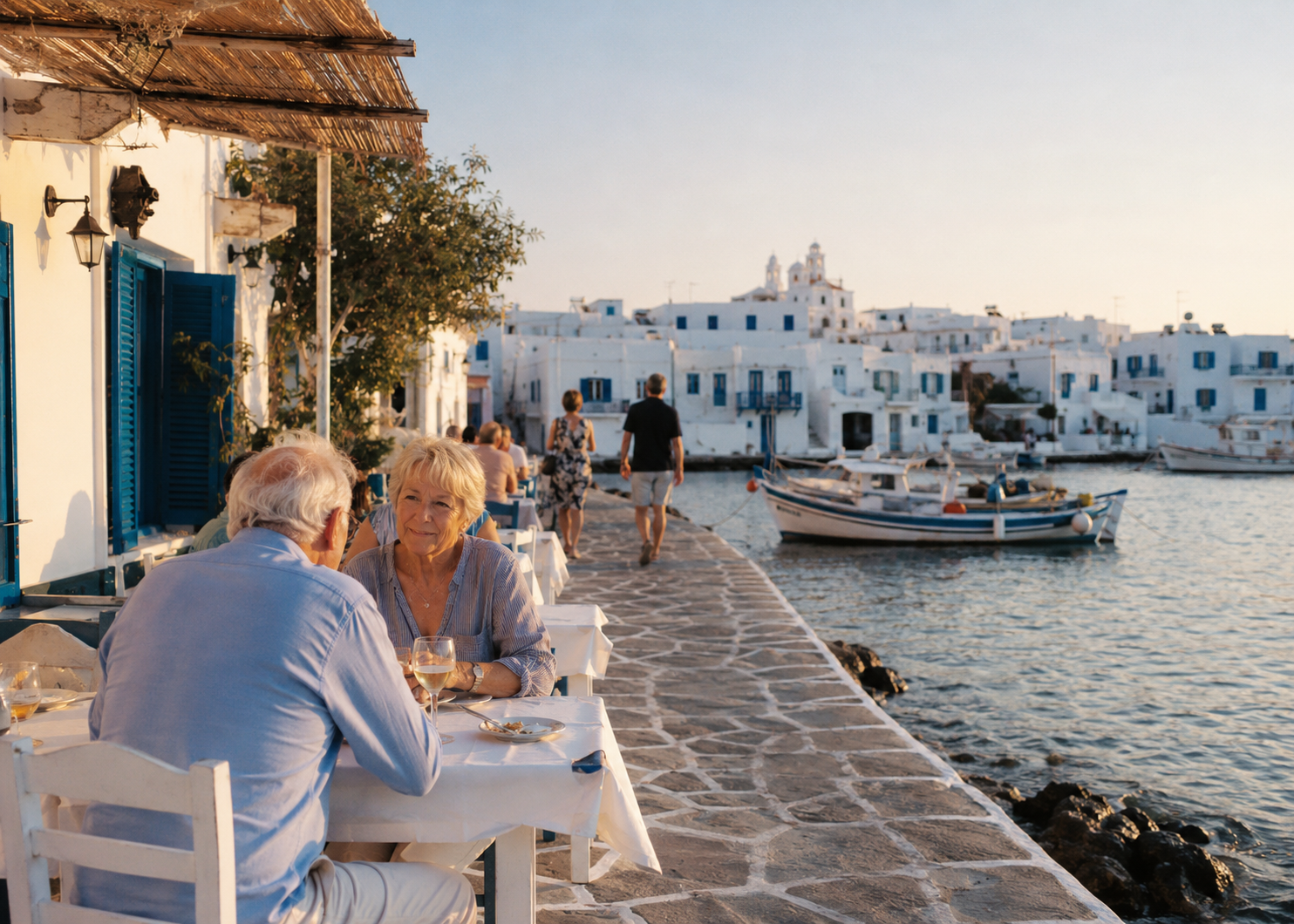
Naxos offers a different balance, more rural and authentic, more space and nature, with a real but smaller community and the honest caveat about healthcare.
Naxos is the largest of the Cyclades, big enough to be genuinely self-sufficient and agricultural rather than purely touristic, known as the cheese capital of Greece, a place of farming, real villages, mountains including the highest peak in the Cyclades, and a deep authenticity that the resort islands lost long ago. It has a growing expat and even digital-nomad community centered on Naxos Town, where about half the island’s twenty thousand people live, so a foreigner finds both an authentic Greek island and a small ready-made community of other newcomers, a useful balance for the years of settling in. The cost of living is among the more affordable, and the island’s size and agriculture mean a real year-round life rather than a seasonal one.
The honest caveat is healthcare, since Naxos has medical facilities for ordinary needs but, like most islands its size, relies on the bigger centers or the mainland for serious care, so a retiree there must factor the reality that a major medical event means a transfer to Athens or a larger island. This does not disqualify Naxos, many retirees happily accept it given good travel insurance and a plan, but it is the real tradeoff against the authenticity and space, and it should be weighed honestly, especially by anyone with existing health concerns. For the active, relatively healthy over-sixty who values authenticity, nature, gastronomy, and a real community over having a hospital on the doorstep, Naxos is wonderful. For someone whose health needs are already significant, Syros or Evia, with their better medical access, may be the wiser choice.
Evia, The One You Can Drive To
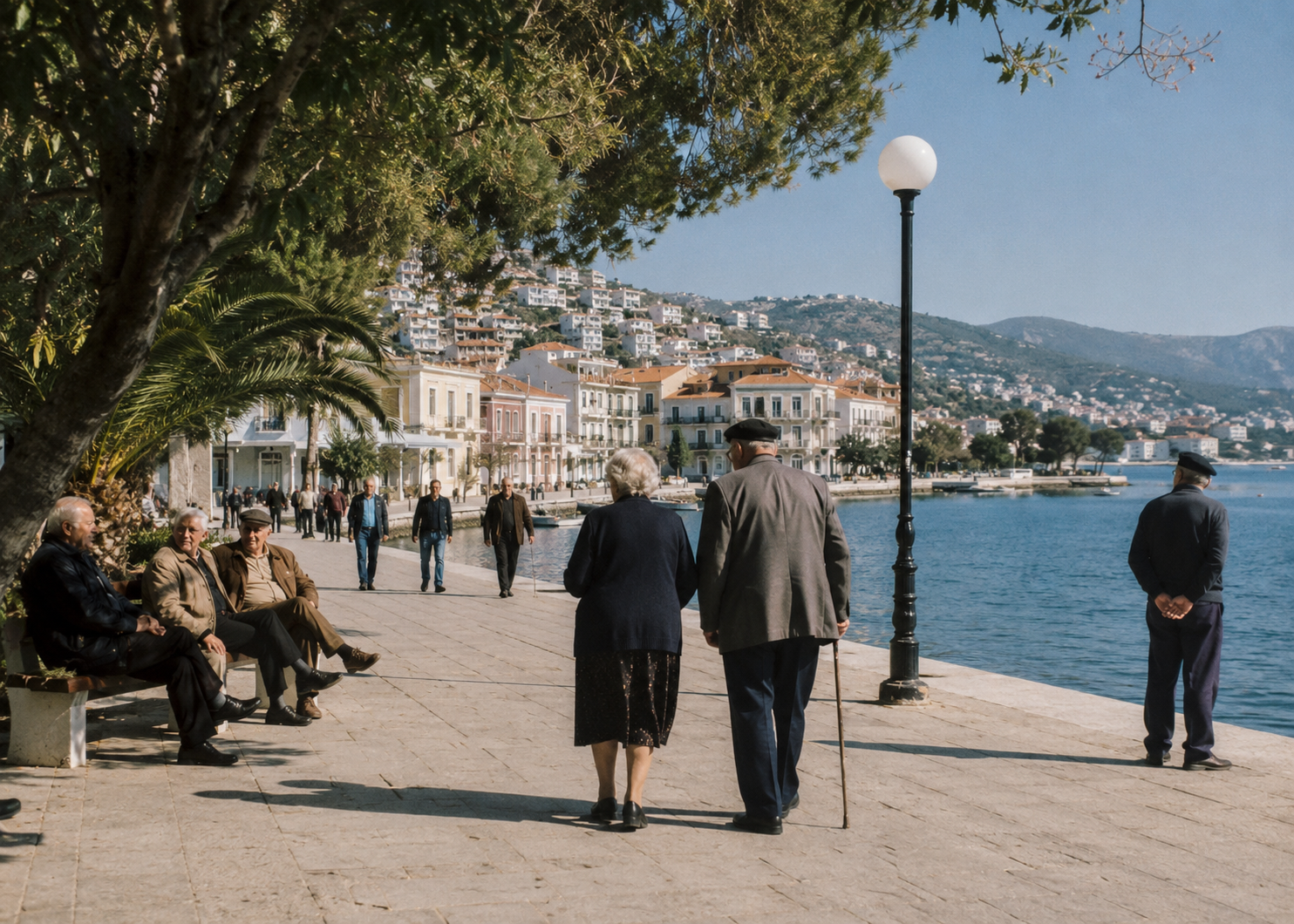
Evia solves the healthcare and access problem more completely than any island on this list, because it is barely an island at all in the ways that cause trouble.
Evia is the second-largest Greek island and is connected to the mainland by bridges, which changes everything for a retiree, because it means island life, the sea, the pace, the beauty, the lower cost, combined with the mainland access that islands usually lack, no dependence on ferries or flights for medical care or travel, just a drive across a bridge. Its capital, Chalkida, is a functional real city with hospitals, restaurants, and shops, so the retiree gets genuine urban amenities and serious healthcare on the island itself, and the proximity to Athens, easily reached by road, means top-tier medical care and an international airport are within practical reach, which is exactly the access that remote islands cannot offer.
This makes Evia perhaps the most practical choice on the list for the older or more health-conscious retiree, the one who wants island life but cannot accept the isolation and medical risk of a remote island. You get the charm and the lower cost of island living with the safety net of mainland access and real healthcare, the best of both worlds for someone whose priorities have shifted with age toward security and access. Evia is less romantic than a remote Cycladic island, less of a postcard, but for the retiree who is honest about needing reliable healthcare and easy travel, that practicality is worth far more than another island’s photogenic isolation, and Evia delivers the island life without the island’s usual costs.
Paros And The Honest Tradeoffs
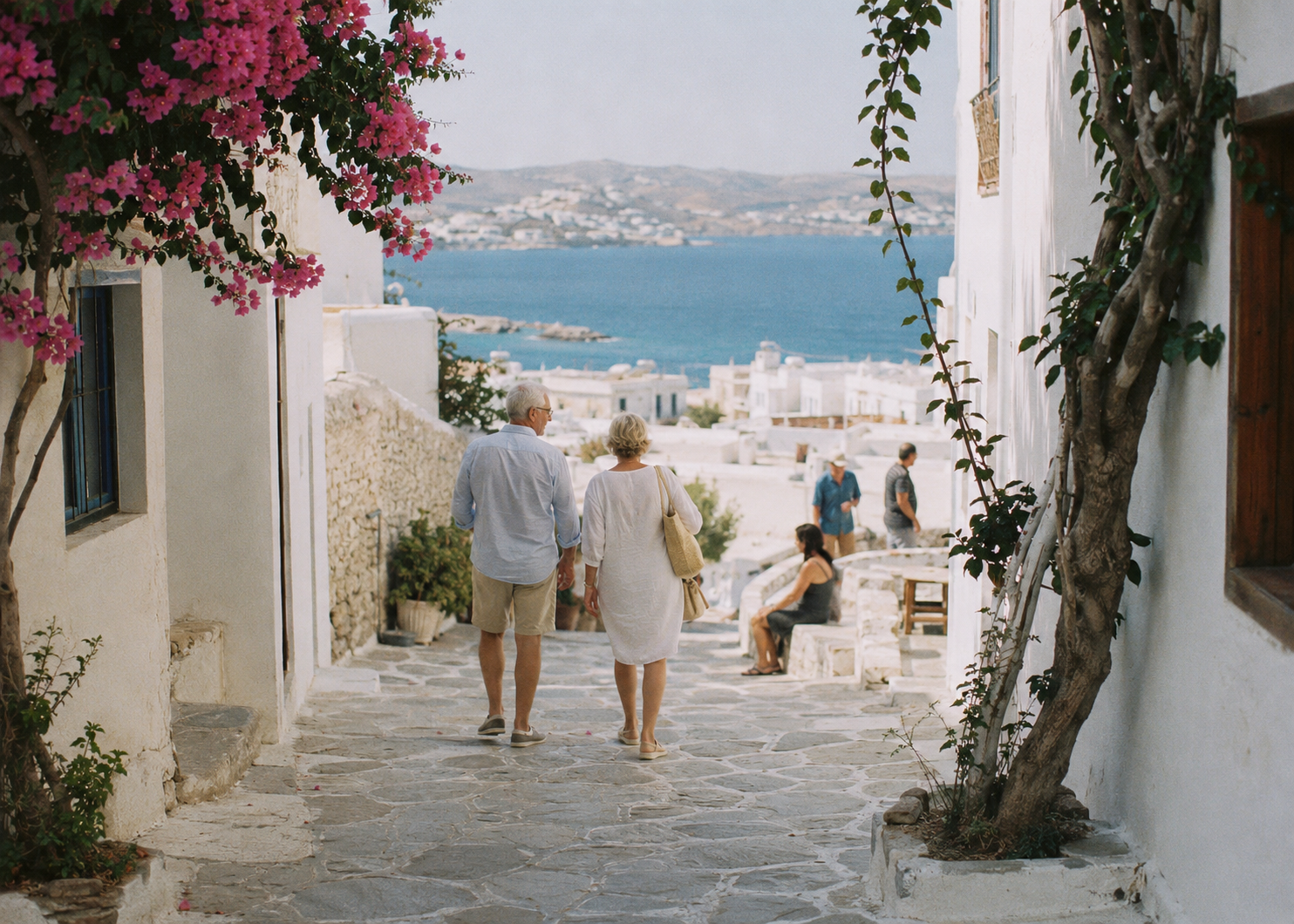
Paros rounds out the picture and illustrates the tradeoffs that every island choice involves, the balance of charm against practicality.
Paros is beautiful, accessible, and well-connected, with its own airport and frequent ferries and a real charm, more lively and connected than many islands its size, which makes it tempting for retirement. But it carries the classic tradeoffs honestly worth naming, it can get genuinely crowded in July and August when the tourists arrive, its healthcare is limited compared to Syros or Evia, and its winters, while not as dead as the smallest islands, are quiet enough to feel isolating to someone used to a busy life. Paros is a real candidate, but it sits closer to the charm end of the spectrum and further from the practical end than Syros or Evia, and the retiree considering it should weigh the summer crowds, the limited healthcare, and the quiet winter against the beauty and accessibility.
The broader point Paros illustrates is that every Greek island is a specific balance of charm against practicality, beauty against healthcare, summer life against winter quiet, and there is no perfect island, only the one whose particular tradeoffs suit a particular retiree. The healthiest, most adventurous, most self-sufficient retiree can choose further toward charm and accept the tradeoffs, Naxos, Paros, even smaller islands. The retiree who needs reliable healthcare and a year-round community should choose toward practicality, Syros or Evia. The skill is not finding the best island but matching the island’s real tradeoffs to your own real needs and honest health situation, which requires knowing both the islands and yourself clearly.
The Test That Settles It
There is one test that cuts through all the comparison, and every honest source on Greek island living repeats it.
Spend a winter there first. The single biggest mistake foreigners make with Greek islands is choosing one on the strength of a summer visit and discovering too late what it becomes in February. The island you fall in love with in July, alive, warm, social, golden, is a different place in January, when the tourists have gone, the ferries run thin, the cold wind comes off the sea, and the population shrinks to its hardy winter core. Some islands stay genuinely alive, Syros, Evia, and you will love them in winter too. Others empty into a silence that the summer visitor never imagined, and the retiree who bought in on the summer alone finds the winter unbearable.
So the rule is absolute, do not commit to any Greek island for retirement on the basis of a summer holiday, spend a real stretch of the off-season living as a resident would, and see what the island actually is when the show is over and only the locals remain. The islands that pass this test, that you love in February as much as July, are the ones to retire to, and the test reliably sorts the year-round-living islands from the seasonal-resort ones better than any list. An American over sixty who applies it, who winters on the island before buying, will choose well, and will avoid the expensive, lonely mistake of retiring to a postcard that turns out to be closed half the year.
What It Actually Costs To Live There
The money is part of why Greece won the 2026 ranking, and island life is more affordable than the postcards suggest, within honest ranges.
A couple can live on a Greek island for roughly 1,500 to 2,500 euros a month depending on the island and the lifestyle, with the more affordable islands and the modest local way of living at the lower end and the more comfortable, more imported lifestyle toward the top. Rent for a decent place runs far below American or Northern European levels, the food is cheap and superb if you eat the local way, the market fish, the island cheese, the vegetables, the wine, and the daily costs of a simple Mediterranean island life are low. Healthcare, once you are in the Greek system as a legal resident, is affordable, and the public system supplemented by reasonable private cover costs a fraction of the American equivalent, though the island reality means budgeting for travel to the mainland for serious care on the less-equipped islands.
The cost varies by island in predictable ways, Evia and the larger working islands tending to be more affordable for everyday life, the more touristic islands pricier in season, and the imported and foreign goods always dear given the shipping. A retiree who lives the local island way, eating and shopping as the Greeks do, spends remarkably little for a life of real quality, while one who tries to import a foreign lifestyle pays for the privilege. The honest figure for a comfortable, locally-integrated couple’s life on a well-chosen island sits comfortably within that 1,500 to 2,500 range, which against American retirement costs is the quiet engine of the whole proposition, a real Mediterranean island life funded by a modest retirement income.
A Word On The Visa And The Paperwork
The dream needs a legal basis, and an American cannot simply move to a Greek island, so the practical route matters.
An American retiring to Greece generally needs a residence visa, most commonly a route for those with sufficient passive income, the kind of financially-independent-person visa that requires demonstrating a stable income and private health insurance, applied for before the move through the proper channels. Greece also runs its investment-residency program, the route this blog has examined elsewhere, but for most retirees the income-based residence visa is the appropriate and far cheaper path, requiring proof of pension or other passive income above a threshold and the usual documentation. The process is bureaucratic in the way all these European routes are, demanding patience and meticulous paperwork, and benefits from professional help.
The deeper practical point is that retiring to a Greek island is a real relocation with all the legal, tax, and healthcare machinery that implies, not a simple matter of buying a house and moving in, and an American should approach it with the same seriousness as any move covered on this blog. The visa, the tax situation including the American worldwide-taxation reality that follows citizens everywhere, the healthcare enrollment, the residency paperwork, all need handling properly and ideally professionally, and the island’s remoteness can add friction to the bureaucracy, another reason the better-connected islands like Evia and Syros ease the path. Get the legal foundation right, and the island dream rests on solid ground. Skip it, and the dream has no legal floor to stand on.

About the Author: Ruben, co-founder of Gamintraveler.com since 2014, is a seasoned traveler from Spain who has explored over 100 countries since 2009. Known for his extensive travel adventures across South America, Europe, the US, Australia, New Zealand, Asia, and Africa, Ruben combines his passion for adventurous yet sustainable living with his love for cycling, highlighted by his remarkable 5-month bicycle journey from Spain to Norway. He currently resides in Spain, where he continues sharing his travel experiences with his partner, Rachel, and their son, Han.