
Most Americans who move abroad for the dream of a richer life arrive and then quietly fail at the one thing that actually matters, which is building a real social life. They get the house, the visa, the view, and then they discover that they are lonely, marooned in a beautiful place among people they do not know, and within a couple of years many of them go home. The Texas couple who moved to Chania, on the Greek island of Crete, did the opposite, and the way they did it is worth studying because it was deliberate rather than lucky.
They are a composite, the kind of couple this blog meets repeatedly among Americans who have settled successfully on Crete, their specifics drawn from the shared shape of many real stories rather than one household. From Spain, where the same loneliness sinks so many expat dreams, what stands out about their version is that they treated the social life as the actual project of the move, not an afterthought, and they cracked it within eighteen months through three simple weekly habits. Those three places they went every week are the whole story.
Why The Social Life Is The Hard Part

Before the three places, it is worth understanding why the thing they got right is the thing most people get wrong, because it reframes the entire challenge of moving abroad.
The logistics of moving abroad, the visa, the housing, the shipping, the bureaucracy, are difficult but finite, problems with definite solutions that you solve once and then they are done. The social life is different. It is not a problem you solve once but a thing you have to build slowly, through repeated presence and accumulated familiarity, and it does not respond to money or planning the way the logistics do. You cannot buy a community or arrange one through a relocation agent. You have to grow it, in person, over time, and that is precisely the part that money and competence cannot shortcut, which is why so many otherwise capable people fail at it.
The failure usually looks the same. A couple arrives, handles all the practical matters efficiently, and then finds that the days are quiet and the social calendar empty, that they know their landlord and the woman at the bakery and almost no one else. They retreat into each other and into screens, maybe into a thin circle of other expats, and the loneliness slowly curdles the dream until they conclude the place was not for them and leave. The Texas couple understood this risk going in, having read enough cautionary tales, and they decided to attack the social life with the same deliberateness most people reserve for the visa paperwork. That decision, more than anything about Chania itself, is why they succeeded.
The First Place, The Kafeneio
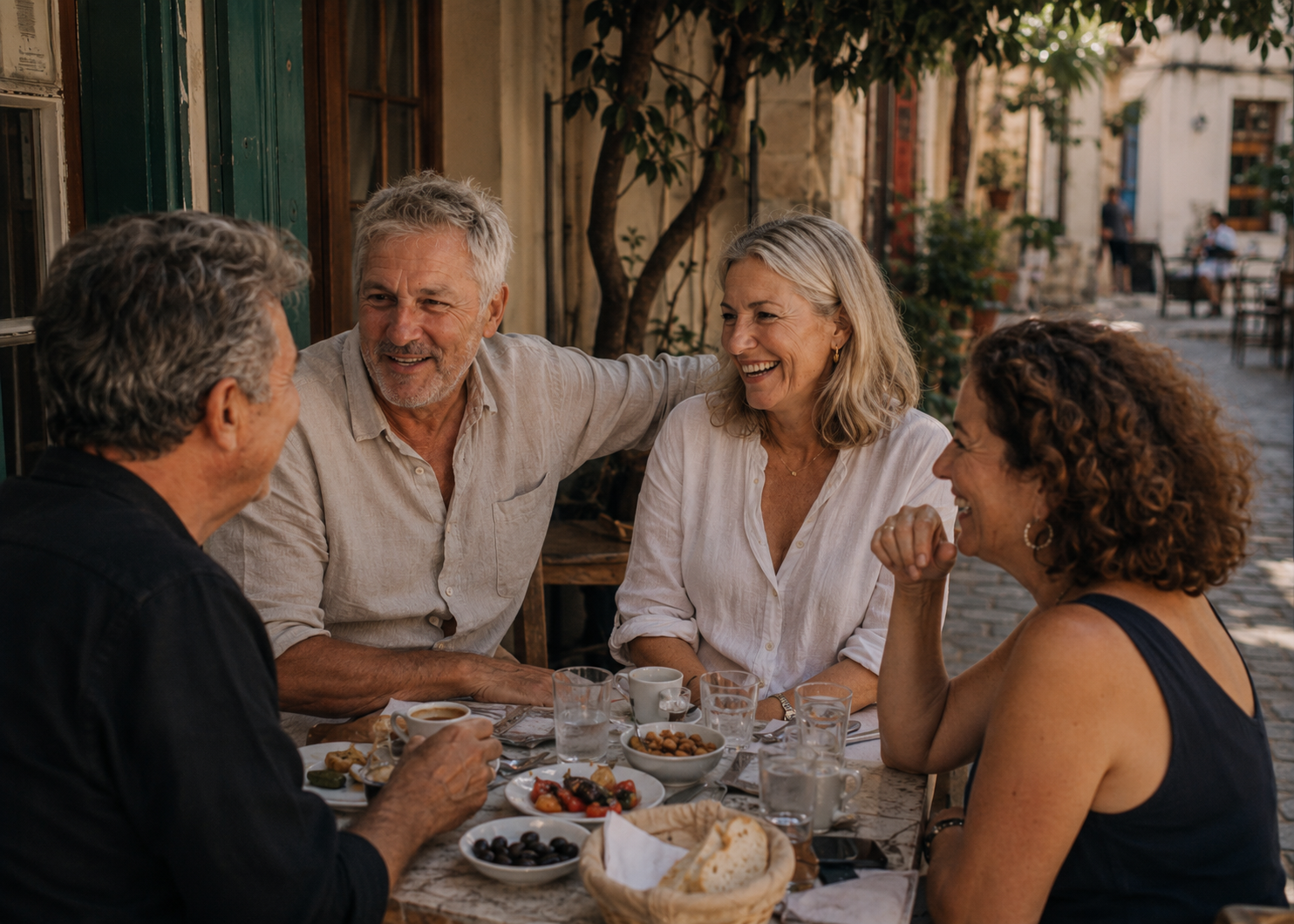
The first of their three weekly places was the traditional Greek coffee house, the kafeneio, and it became the cornerstone of their integration.
The kafeneio is a Greek institution, the traditional coffee house where, especially in a place like Crete, local people, often the men of a neighborhood, gather to drink coffee, talk, play cards or backgammon, and pass the time in a way that has barely changed in generations. It is the social heart of a Greek neighborhood, a place defined by regulars and routine, and the couple made a point of going to the same one every week, at the same time, ordering the same thing, becoming familiar faces. At first they were the curious foreigners in the corner. Over months, through sheer repetition, they became the foreigners who are always there on Tuesday, then simply part of the furniture, then people the regulars nodded to, then people the regulars talked to.
This is the mechanism of integration in miniature, and the kafeneio was perfect for it because its entire culture is built on regulars and repetition. The couple did not try to force friendships or perform their interest in Greek culture. They simply showed up, reliably, in a place where showing up reliably is how belonging is earned, and let the familiarity accumulate at its own pace. The breakthrough, they say, was not a single moment but the slow crossing of a line, the point at which they stopped being visitors to the kafeneio and started being regulars of it, recognized and expected, and from that recognition the first real local connections grew.
The Second Place, The Laiki Market

Their second weekly anchor was the laiki, the open-air farmers market, which served a different social function than the kafeneio.
The laiki is the weekly open-air market found in Greek towns, where farmers and producers bring their fruit, vegetables, oil, cheese, fish, and the rest directly to the streets, and where a large part of the local population does its weekly food shopping. The couple went every week and, crucially, bought from the same vendors each time rather than wandering anonymously, building relationships with the man who sold them oranges and the woman with the best greens and the fisherman at the end of the row. These market relationships, repeated weekly, became a web of small familiar connections, the vendors learning their faces and their preferences, offering them the good tomatoes, teaching them the Greek names of things, gradually treating them as customers who belonged rather than tourists passing through.
What the market gave them that the kafeneio did not was a connection to the practical life of the place and a reason to use and improve their Greek in low-stakes daily exchanges. Buying food from the same people every week is one of the most natural integration tools there is, because it is something you have to do anyway, it recurs reliably, and it puts you in repeated friendly contact with locals around a shared practical purpose. The couple turned a chore into a social practice simply by being loyal to particular vendors, and over the months the market became a place where they were known and greeted, another set of threads in the web they were deliberately weaving.
The Third Place, A Greek Language Class
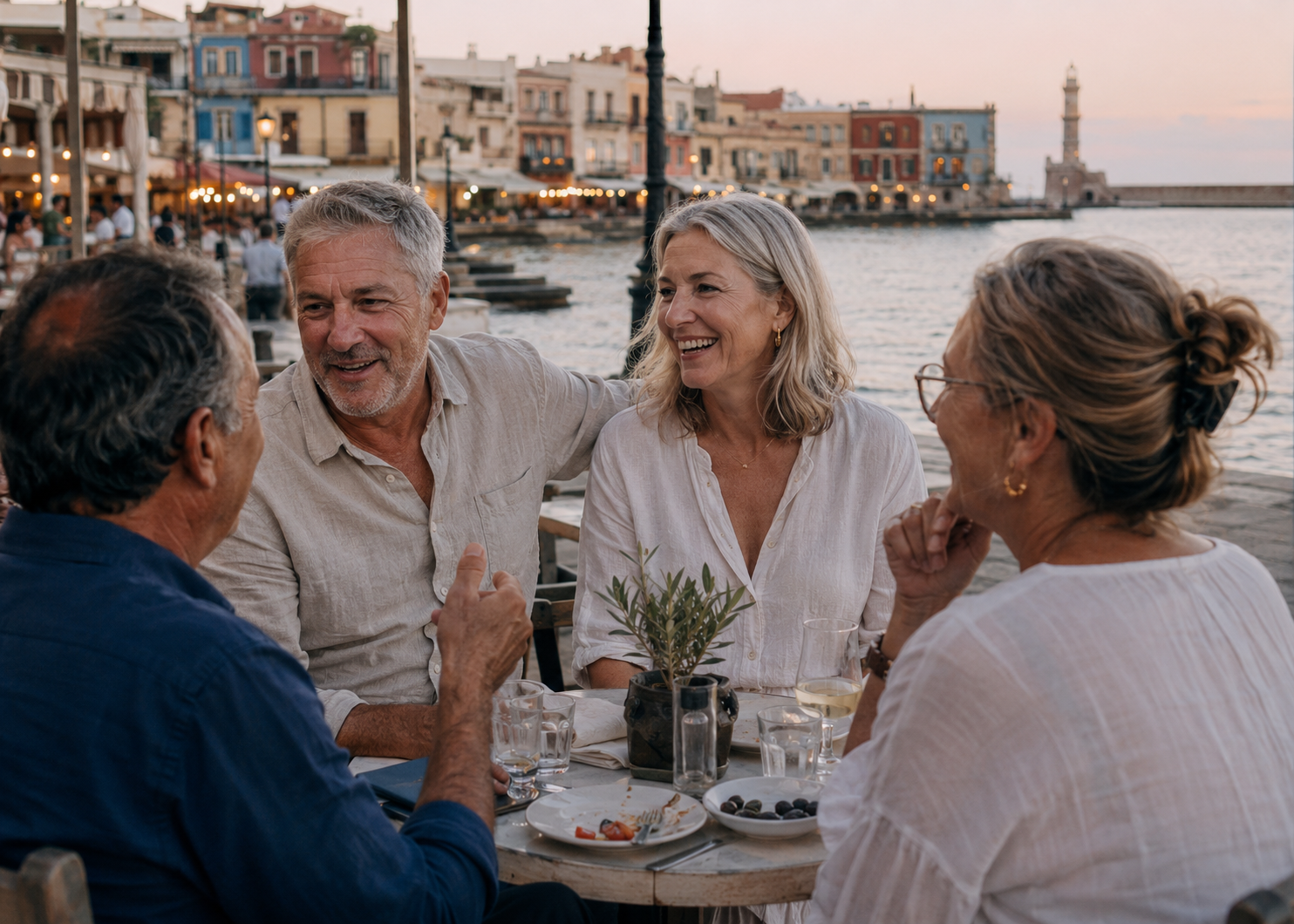
Their third weekly commitment was the one that most directly attacked the central barrier, a regular Greek language class.
They enrolled in a weekly Greek language course and stuck with it, which served two purposes at once. The obvious one was the language itself, the slow acquisition of enough Greek to move through daily life, to manage the kafeneio and the market and the bureaucracy in the local tongue rather than relying on English, which both deepened their integration and signaled to locals that they were serious about belonging rather than just passing through. The Greeks they encountered, they found, responded warmly to even halting attempts at the language, reading the effort as a mark of respect, and every word of Greek they gained opened doors that English kept shut.
The less obvious purpose was that the class was itself a social structure, a weekly gathering of other people, both fellow learners and the teacher, that came with built-in conversation and a shared endeavor. Language classes for foreigners are full of other newcomers facing the same challenges, and the couple made friends there among people in the same situation, which provided a different kind of connection than the local relationships of the kafeneio and market. The class gave them the tool, the language, that made all the other integration possible, and it gave them a ready-made social setting at the same time, a double return on a single weekly commitment.
Why Three Was Enough
The striking thing about their approach is how modest it was, just three regular weekly commitments, and understanding why that was sufficient is the real lesson.
Three reliable weekly anchors were enough because consistency, not intensity, is what builds a social life. The couple did not attend every festival, join a dozen clubs, or throw themselves at the community in a frenzy of effort that would have been impossible to sustain. They picked three places, went to each every week without fail, and let the slow magic of repeated presence do its work over many months. The regularity was the active ingredient, the fact that they were reliably, predictably present in the same places, because that reliability is exactly what turns a stranger into a familiar face and a familiar face, eventually, into a friend. Three sustainable habits beat ten unsustainable ones every time.
This is the insight that the loneliness-prone expat misses. Integration is not achieved through occasional bursts of social effort but through humble, boring consistency, showing up in the same places again and again until you belong to them. The couple treated their three weekly places almost as appointments, non-negotiable commitments in the calendar, and that discipline was what produced the result. Anyone can manage three weekly habits. Almost no one can manage a life of constant social exertion. The couple’s genius was to choose the sustainable path and trust it, and within eighteen months they had what most expats never get, a real local social life.
What Made It Actually Work
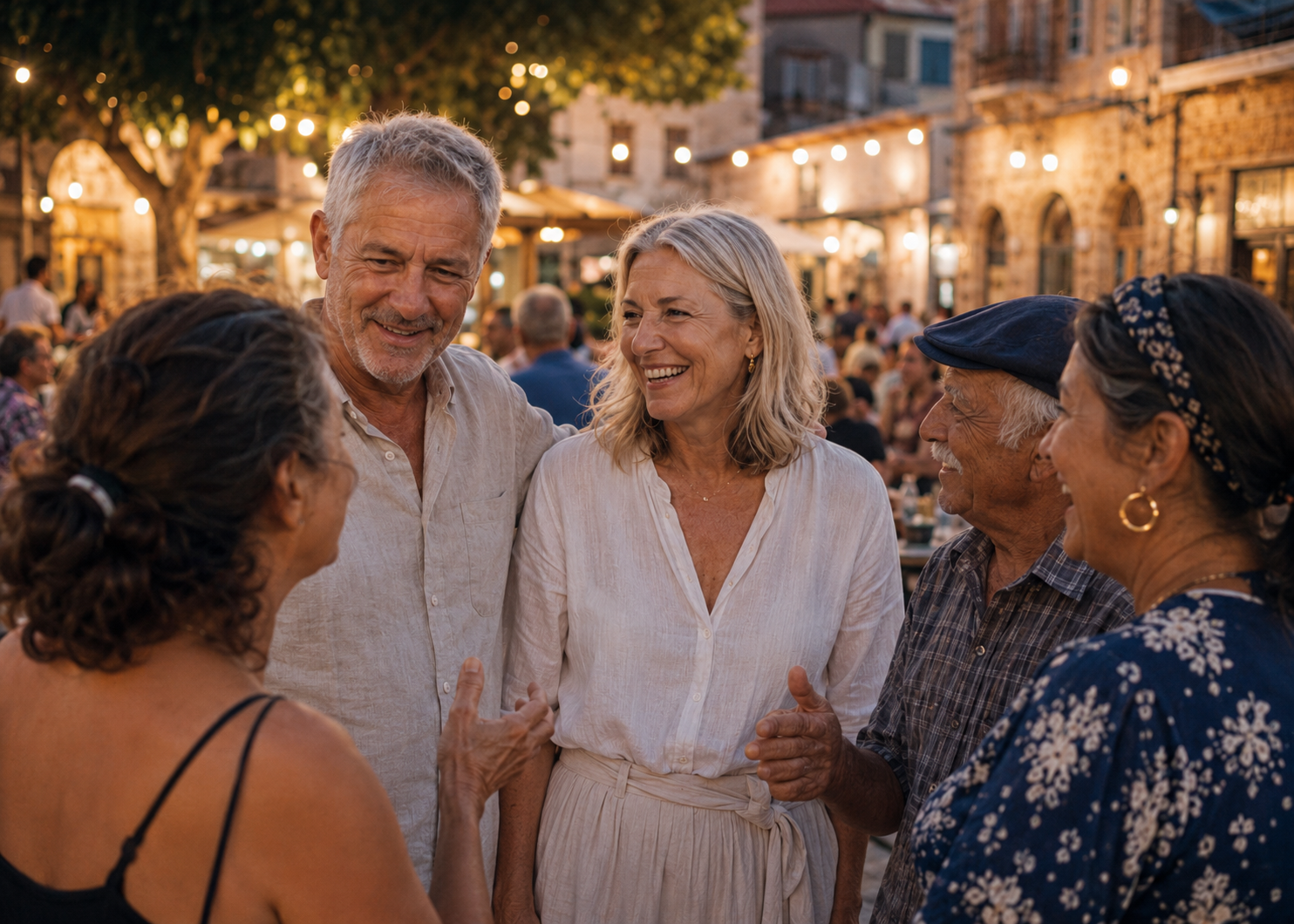
Beneath the three places sat a few attitudes that made the whole approach succeed, and they are as transferable as the habits themselves.
The first was patience. The couple went in expecting integration to take a long time, and so they were not discouraged when the first months produced little, when they were still the strangers in the corner with no local friends. They understood that the familiarity they were building accrued slowly and invisibly for a long time before it suddenly bore fruit, and that the temptation to give up early, to conclude it was not working and retreat, was the very thing that defeated most people. They held the course through the discouraging early period precisely because they expected it to be discouraging, and that expectation was itself a kind of armor.
The second was humility, the willingness to be the beginner, the foreigner who speaks badly and does not know the customs, without letting embarrassment drive them back into the safety of English and the expat bubble. They accepted that integration required being a little uncomfortable, a little foolish, for a while, and they were willing to pay that price. And the third was the decision to prioritize local connection over expat convenience, to spend their limited social energy on the harder, more rewarding work of entering Greek life rather than the easier path of socializing only with other Americans. Those three attitudes, patience, humility, and the choice of the local over the easy, were what made three weekly habits add up to a real life.
How To Steal Their Method

The reason their story is worth telling is that the method is completely transferable, not specific to Chania or to them, and anyone moving abroad can copy it.
The portable formula is simple. Choose three regular weekly anchors in your new place, a social one where locals gather and regulars are made, a practical one tied to daily life like a market where you can build relationships through repeated custom, and a learning one, ideally a language class, that both equips you and provides a ready social setting. Commit to all three every week without fail, treat them as non-negotiable, and hold the course through the long discouraging early period when nothing seems to be happening. Approach it with patience, humility, and a deliberate preference for local connection over the expat bubble. Do that, and the social life that defeats most people will, slowly and then suddenly, take shape.
The specifics will vary by place. In Spain the kafeneio might be a particular neighborhood bar, the laiki a particular market or the daily round of local shops, the language class the same in any country. But the structure holds anywhere, because it is built on the universal mechanics of how humans form bonds, through repeated presence, shared practical life, and the effort to communicate. The Texas couple in Chania did not have a secret unavailable to others. They had a method, applied with discipline, and the method is there for anyone willing to choose three places and show up at them every week until they belong.
The Honest Caveat
As with any single story, theirs is not a guarantee, and honesty requires saying what the method cannot promise.
It worked for them because they were temperamentally suited to it, sociable enough to enjoy the kafeneio, patient enough to endure the slow start, humble enough to be beginners, and committed enough to hold three weekly habits for a year and a half. A more introverted couple, or one less willing to be uncomfortable, or one without the discipline to keep showing up, might have found the same method harder, and integration is genuinely difficult in ways that no formula fully dissolves. Some people, through no fault of their own, struggle to build a social life abroad despite real effort, and it would be dishonest to suggest three weekly outings guarantee a community.
But the method stacks the odds heavily in your favor, which is all any method can do, and it directly attacks the specific failure, passive isolation, that sinks most expat dreams. The couple’s real lesson is not that their exact three places are magic, but that the social life of a move abroad has to be worked at as deliberately as the visa, attacked with a concrete plan rather than left to chance. Most people leave it to chance and lose. The couple who moved to Chania made it the project, and they won the thing that actually determines whether a life abroad succeeds. That is the transferable truth, and it is available to anyone willing to choose their three places and go.
The couple themselves, asked what they would tell someone just arriving, keep returning to the same plain instruction. Pick your three places in the first month, before the loneliness has a chance to set in, and start showing up immediately, because the clock on integration only starts running once you do. The biggest mistake they nearly made, and the one they watched others make fatally, was waiting, settling the house and the paperwork first and postponing the social life until later, only to find that later never came and the isolation had already hardened. Start the three habits the week you arrive, they say, and let the eighteen months begin counting from day one rather than from whenever you finally get around to it.

About the Author: Ruben, co-founder of Gamintraveler.com since 2014, is a seasoned traveler from Spain who has explored over 100 countries since 2009. Known for his extensive travel adventures across South America, Europe, the US, Australia, New Zealand, Asia, and Africa, Ruben combines his passion for adventurous yet sustainable living with his love for cycling, highlighted by his remarkable 5-month bicycle journey from Spain to Norway. He currently resides in Spain, where he continues sharing his travel experiences with his partner, Rachel, and their son, Han.