

Watch a Spanish child eat across a day and one thing stands out to an American parent. There is far less of the constant grazing that fills an American childhood, the endless stream of packaged snacks between meals, the snack cup in the car, the granola bar at every transition. The Spanish child eats at fairly set times, eats real food when they do, and somehow seems perfectly content between meals without a wrapper in hand.
From inside a Spanish household, this is not a strategy or a discipline. It is simply the rhythm of the day, the way eating has always been organized, and no one thinks of it as remarkable. But set against the American pattern of near-continuous snacking, the Spanish approach to feeding children looks like a quietly different philosophy, one worth understanding for any parent puzzled by how Spanish kids eat the way they do. This is not about restriction or weight. It is about a structure of eating that happens to produce children with a healthier relationship to food.
The Day Has A Shape

Start with the structure, because everything else follows from it.
The Spanish eating day has a clear shape, a set of defined eating occasions spaced through the day, rather than the American open-ended grazing where food is available and acceptable at almost any moment. There is breakfast, a mid-morning bite, the large midday meal, an afternoon snack, and a lighter dinner, each at a roughly predictable time. Between these occasions, children are simply not eating, and crucially, not expecting to eat, because the structure has taught them that food comes at mealtimes and the spaces between are for playing, not snacking.
This shape does most of the work that American parents try to achieve through rules and willpower. A child who knows the merienda is coming at five does not need to graze at three, because the body and the expectation are both set to the rhythm of the day. The American child, by contrast, lives in a foodscape with no clear shape, where snacks are available continuously and the line between a meal and a snack has blurred into a constant low-level eating that never quite starts or stops. The Spanish structure is not a restriction laid on top of grazing. It is the absence of grazing in the first place.
The Merienda Is Real Food
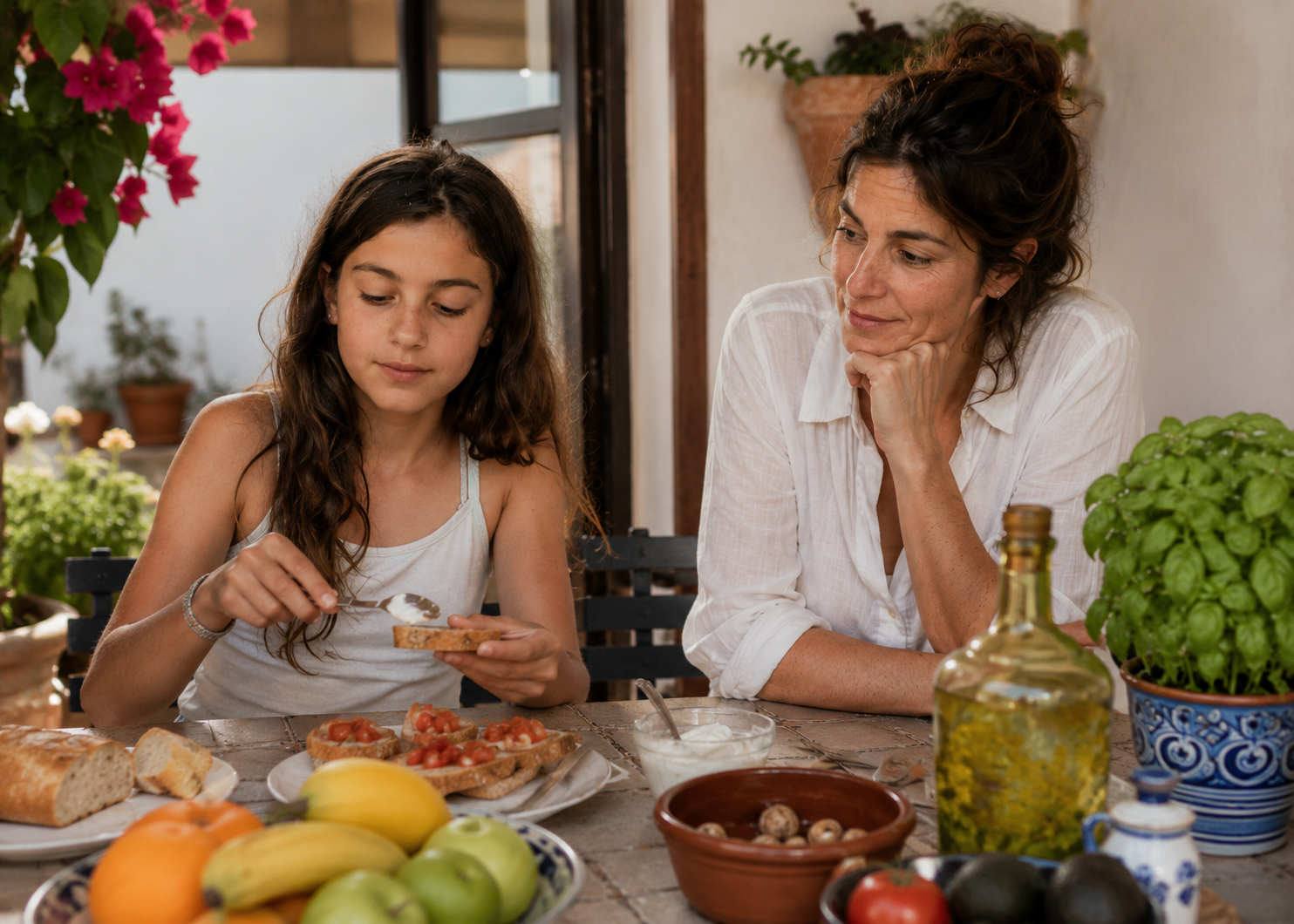
The afternoon snack deserves its own attention, because it is where the difference in what children eat shows most clearly.
The merienda, the Spanish afternoon snack for children, is a defined occasion with real food, not a packaged product. A child comes home from school and has a merienda that might be a piece of bread with chocolate, a piece of fruit, a small bocadillo, a yogurt, a handful of nuts, food that resembles a small meal rather than a snack from a wrapper. It happens at a set time, it is eaten sitting down, and then it is over, a bounded eating occasion rather than an open-ended graze.
The American after-school equivalent tends toward the packaged and the continuous, the box of crackers, the fruit snacks, the chips, eaten standing or in the car or in front of a screen, often flowing into more snacking through the afternoon with no clear end. The contrast is not just the food but the form, the Spanish merienda being a real thing eaten at a real time, the American snacking being a diffuse haze of packaged products with no boundary. A child raised on the merienda learns that the afternoon snack is a small meal of real food at a set time, which is a very different lesson than the one the snack drawer teaches.
Less Ultra-Processed Food In The House
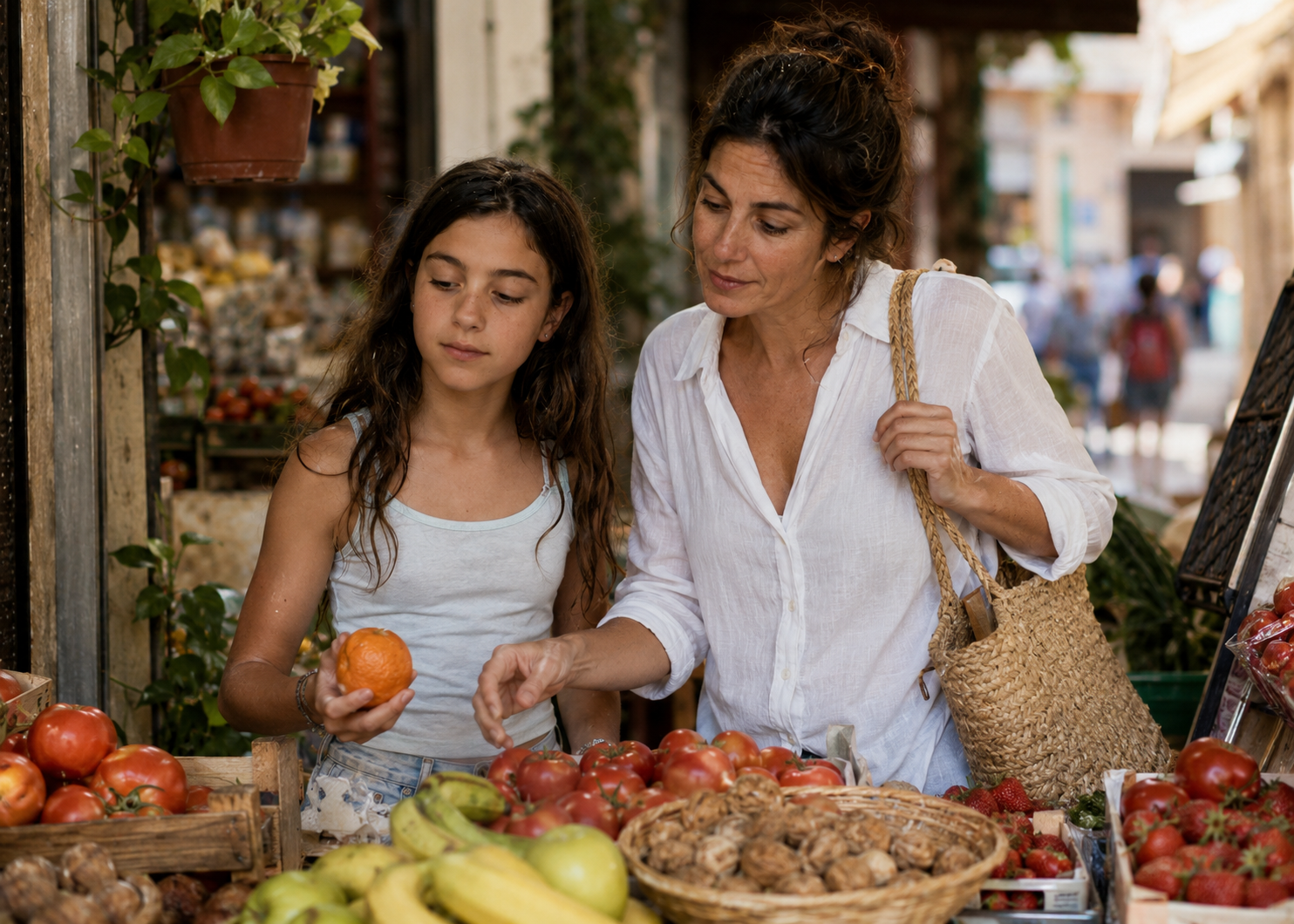
The third difference is about what is available, and availability shapes everything.
Spanish households, on the whole, keep less ultra-processed snack food in the house than American ones, fewer of the brightly packaged crackers, cookies, fruit snacks, and chips engineered to be eaten continuously. The snacks that do exist tend toward whole foods, fruit, nuts, bread, cheese, yogurt, and there is simply less of the hyper-palatable packaged product that an American pantry holds in abundance. A child cannot continuously graze on ultra-processed snacks that are not in the house, and the Spanish kitchen tends not to stock them in the same quantity.
This matters because children, like adults, largely eat what is available and easy, and the American pantry makes continuous snacking on engineered foods both available and easy. The Spanish pantry, holding more real food and fewer engineered snacks, makes grazing harder and real-food eating the default almost by accident. It is not that Spanish parents are constantly saying no to packaged snacks. It is that the packaged snacks are not there in the same way to say no to, and a child reaching for a snack finds fruit and bread rather than a box of something designed to be eaten until it is gone.
Eating Is Social And Seated
The fourth difference concerns the setting, and it shapes how children relate to food.
In Spain, eating tends to happen sitting down, often with others, at the table, as a social occasion rather than a solitary in-between activity done on the move. Even the smaller eating occasions have something of this quality, food as something you sit down for, with people, with attention, rather than something you consume continuously while doing other things. Children absorb this, learning that eating is a bounded social act with a beginning and an end, not a constant background activity.
The American pattern has drifted heavily toward eating on the move and eating alone, snacks consumed in the car, at the desk, in front of the television, while walking, a continuous low-attention grazing detached from any social occasion or any table. The difference trains children very differently. The Spanish child learns to associate eating with sitting, with company, with a defined occasion, while the American child learns that food is a constant companion to every other activity. The seated social meal is not just pleasant. It teaches a child that eating is a thing you do at a time and a place, which is the foundation of not grazing constantly.
Hunger Is Allowed To Exist
The fifth difference is subtle and important, and it runs against a deep American instinct.
In the Spanish rhythm, a mild hunger between eating occasions is treated as normal and fine, the natural signal that the next meal is approaching, rather than a problem to be solved immediately with a snack. A child who says they are a little hungry an hour before the merienda is told the merienda is coming, and that small wait is understood as ordinary rather than as deprivation. Hunger is allowed to exist as a normal part of the rhythm of a day.
The American instinct, by contrast, often treats any expression of hunger as something to be resolved at once, reaching for a snack the moment a child says they are hungry, which trains the child to expect immediate food in response to the slightest hunger signal and erases the normal rise and fall of appetite across a day. The Spanish approach lets appetite build toward the next eating occasion, so that children arrive at meals genuinely hungry and eat well, while the constantly snacked American child often arrives at meals with no appetite, having grazed it away. Allowing a little hunger to exist is not neglect. It is what makes the next meal work.
What This Teaches A Child
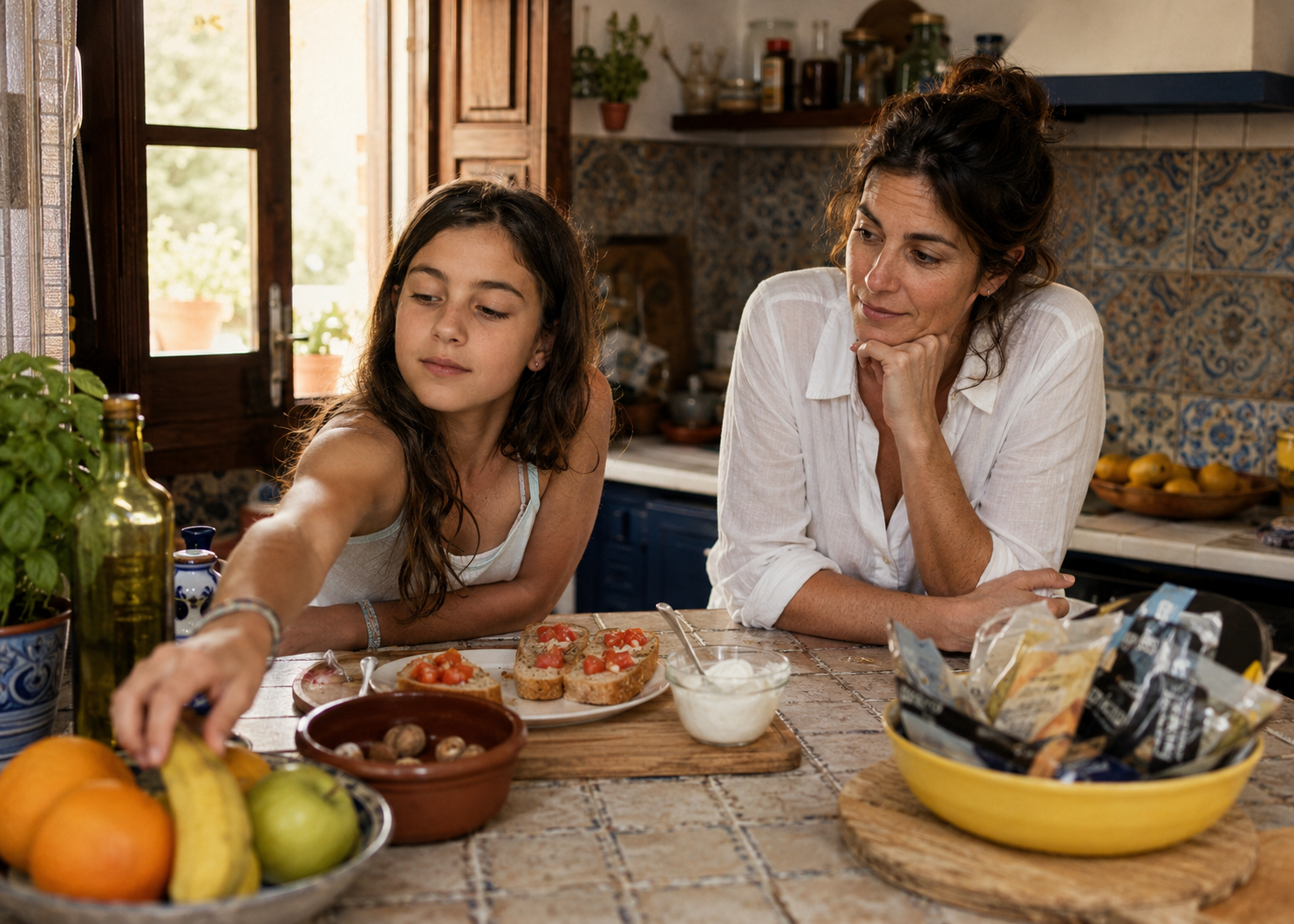
The point of all this, for a parent watching from outside, is not the specific foods but what the whole pattern teaches a child about eating.
A child raised in the Spanish rhythm tends to learn to eat real food at set times, to sit down for meals, to recognize and tolerate normal hunger, and to relate to food as something bounded and social rather than a constant engineered presence. These are, more or less, exactly the habits that nutritionists and family doctors try to instill in families struggling with children’s eating, and the Spanish child often arrives at them simply by growing up inside the ordinary structure of a Spanish day. The structure does the teaching.
The American pattern, with its continuous availability of engineered snacks, its eating on the move, and its instinct to resolve every hunger signal immediately, tends to teach a child a very different set of habits, grazing, eating for reasons other than hunger, associating food with screens and cars and constant availability. None of this comes from American parents caring less. It comes from a food environment built around constant snacking, and from products engineered to be eaten continuously, which together make the grazing pattern the path of least resistance. The Spanish child is not better behaved around food. They are growing up in a different structure, and the structure produces the habits.
Borrowing The Structure Without The Lecture
For an American parent who finds this appealing, the encouraging part is that the Spanish approach is a structure to adopt rather than a set of rules to enforce, and structure is far easier to live with than constant vigilance.
The transferable pieces are straightforward. Give the day a shape, with eating at roughly set times and the spaces between understood as not-eating time. Make the afternoon snack a real thing, a small plate of real food at a set time, eaten sitting down, rather than an open packet. Keep less ultra-processed snack food in the house, so that the easy default for a hungry child is fruit or bread rather than an engineered product. Eat sitting down and together when you can, so that eating becomes a bounded social act. And let a little ordinary hunger exist between meals rather than rushing to resolve it, so that children arrive at meals hungry and appetite keeps its natural rhythm.
None of these requires a confrontation or a diet or a single number, and that is the whole point. This is not about restriction, and it is certainly not about a child’s weight, which is not a thing to make a child conscious of. It is about the shape of the eating day and the contents of the pantry, structural things a parent controls without ever turning food into a battle. The Spanish family did not design this approach to raise healthy eaters. It simply organizes eating the way it always has, and healthy eaters are what the structure tends to produce. An American family can borrow the structure, and the rest tends to follow on its own.
Why The Two Cultures Diverged
It is worth understanding why American and Spanish children came to eat so differently, because the answer is structural rather than a matter of one culture caring more about its children than the other.
The American snacking pattern is in large part a product of the last few decades, built by a food industry that found enormous growth in the snack category and engineered an ever-expanding range of products designed specifically for children and for continuous eating. Snacking became a marketed behavior, promoted as normal, convenient, and even wholesome, and the packaging, the portions, and the products themselves were all built to fit into a life lived on the move. The American day, with its long commutes, its packed schedules, and its car-centered logistics, created both the demand for portable continuous food and the opening for an industry happy to supply it. The grazing child is, in a real sense, a designed outcome.
The Spanish rhythm survived because the surrounding structure of life supported it. The long midday meal, the later schedule, the cultural weight placed on the family table, and a food culture that never fully surrendered to convenience all held the traditional eating shape in place. Spain industrialized its food supply too, and ultra-processed snacks are certainly available and increasingly present, so this is not a story of a culture frozen in time. But the underlying structure of the eating day has proved durable, carried by the rhythms of family and work life that still leave room for it. The two patterns are not really about parenting philosophy. They are about two different shapes of daily life, and the eating followed the life in each case.
The hopeful reading for an American family is that the eating can be changed back toward the Spanish shape even within an American life, because the structure is more portable than the surrounding culture. A family cannot single-handedly change American work schedules or the supermarket, but it can give its own days a shape, stock its own pantry differently, and sit down together when it can. The structure is the lever, and it remains within a single family’s reach even when the wider food environment is not.
A Note On Children And Food
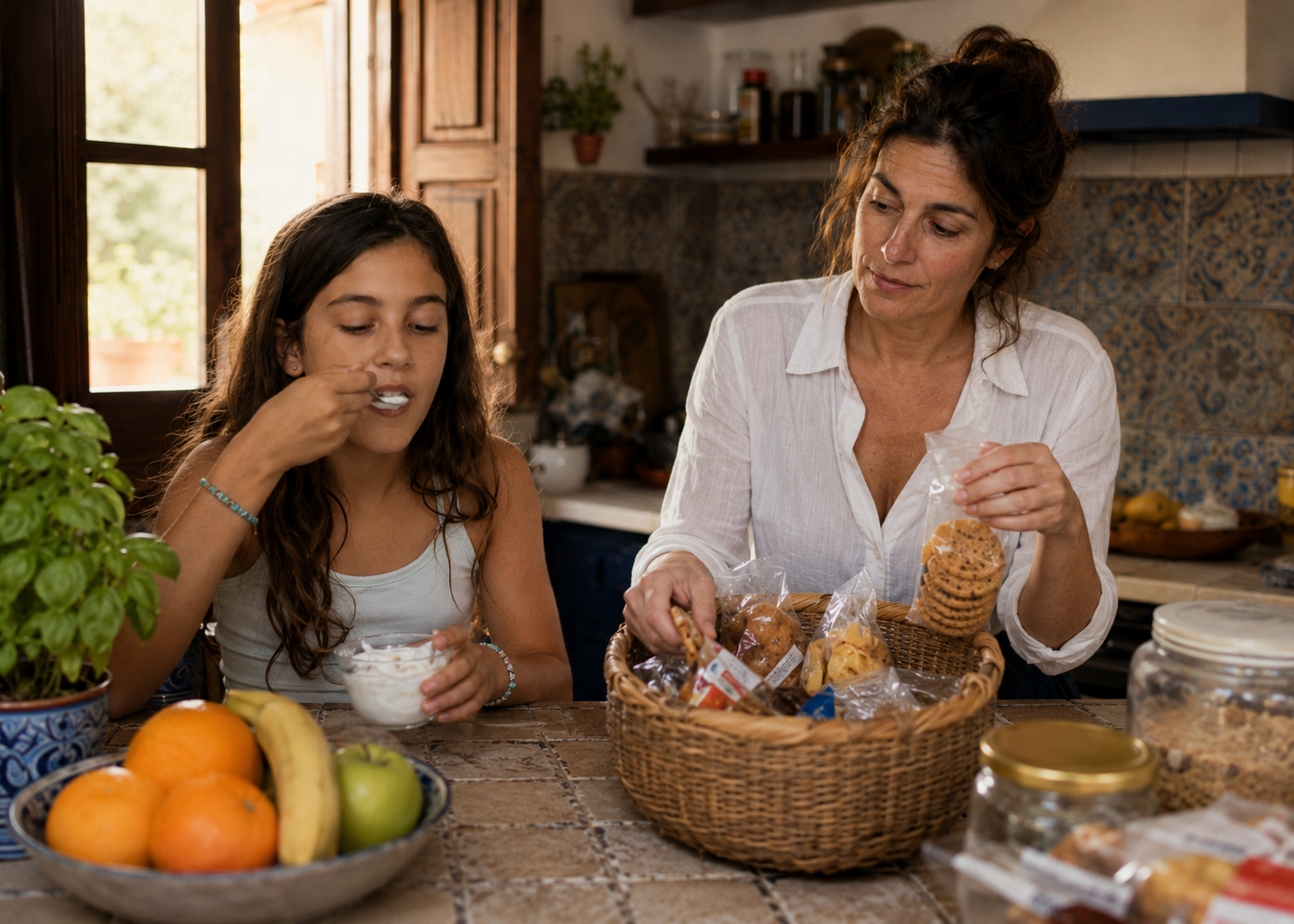
Because feeding children is a sensitive area where well-meant ideas can go wrong, one honest caution belongs at the close.
The Spanish approach described here is about the structure and rhythm of family eating, not about restricting how much a child eats or making a child aware of their weight or their body. Children need adequate food to grow, their appetites vary enormously and normally from day to day, and the goal of any eating structure should be a calm, healthy relationship with food, never restriction for its own sake. If a child seems genuinely hungry, they should be fed, and the structure of set mealtimes works precisely because the meals themselves are real and satisfying, not because food is withheld. Any specific concern about a child’s growth, eating, or weight belongs with a pediatrician who knows the child, not with a general article, and nothing here is a substitute for that guidance. The aim is a good rhythm and good food, which is a gift to give a child, and never a source of anxiety about their body.

About the Author: Ruben, co-founder of Gamintraveler.com since 2014, is a seasoned traveler from Spain who has explored over 100 countries since 2009. Known for his extensive travel adventures across South America, Europe, the US, Australia, New Zealand, Asia, and Africa, Ruben combines his passion for adventurous yet sustainable living with his love for cycling, highlighted by his remarkable 5-month bicycle journey from Spain to Norway. He currently resides in Spain, where he continues sharing his travel experiences with his partner, Rachel, and their son, Han.