
It is one of the great small injustices of European travel, or so it feels in the moment. You bought your train ticket in Italy, you have it in your hand, you paid real money for it, and then the conductor comes down the aisle, looks at it, and fines you around €50 anyway. You protest that you paid, you wave the ticket, and it makes no difference, because in the conductor’s eyes your ticket, though purchased, was never actually valid. You committed the classic tourist error on Italian regional trains: you did not validate it before boarding, and in Italy an unvalidated ticket is treated almost as if you had no ticket at all.
This catches an enormous number of visitors every year, because it runs completely counter to the American assumption that buying the ticket is the whole transaction. In Italy, for a certain kind of ticket, buying it is only half the job, and the other half is a small green machine on the platform that you have probably walked straight past. Here is what validation actually is, why Italy demands it, which tickets need it and which do not, how to do it so you never get fined, and what to do if a conductor catches you out. Rules and fines vary and change, so treat this as general guidance.
The Half of the Transaction Tourists Miss

The key to the whole thing is understanding that a traditional Italian regional train ticket is open, not tied to a specific train or time when you buy it. You buy a ticket from, say, Florence to Pisa, and that ticket is good for that journey on any regional train, within a validity window, but only once you tell the system you are using it now. The buying establishes what journey you are entitled to take; it does not establish when you are taking it, and that second piece is what validation supplies.
Validation is the act of stamping the ticket in a machine at the station before you board, which prints the date and time onto it and starts the clock on its validity. From that stamp, the ticket is good for a set period, enough to complete your journey, and it is now a used, spent, time-stamped document rather than an open entitlement. The machine does in one second what the American system does automatically when you buy a dated ticket for a specific train: it fixes the ticket to a moment in time.
Without that stamp, your purchased ticket is, in the eyes of the railway, an open ticket that has not been activated, which to a conductor looks indistinguishable from a ticket you intend to reuse. That is the heart of the apparent injustice: you did pay, but an unvalidated open ticket is treated as not yet validly in use, and traveling on one is treated as traveling without a proper ticket. The fine is not really for failing to pay, it is for failing to complete the second half of the transaction, the part that turns a purchase into a valid journey. The system assumes you know to validate, and punishes the assumption when you do not.
Why Italy Works This Way
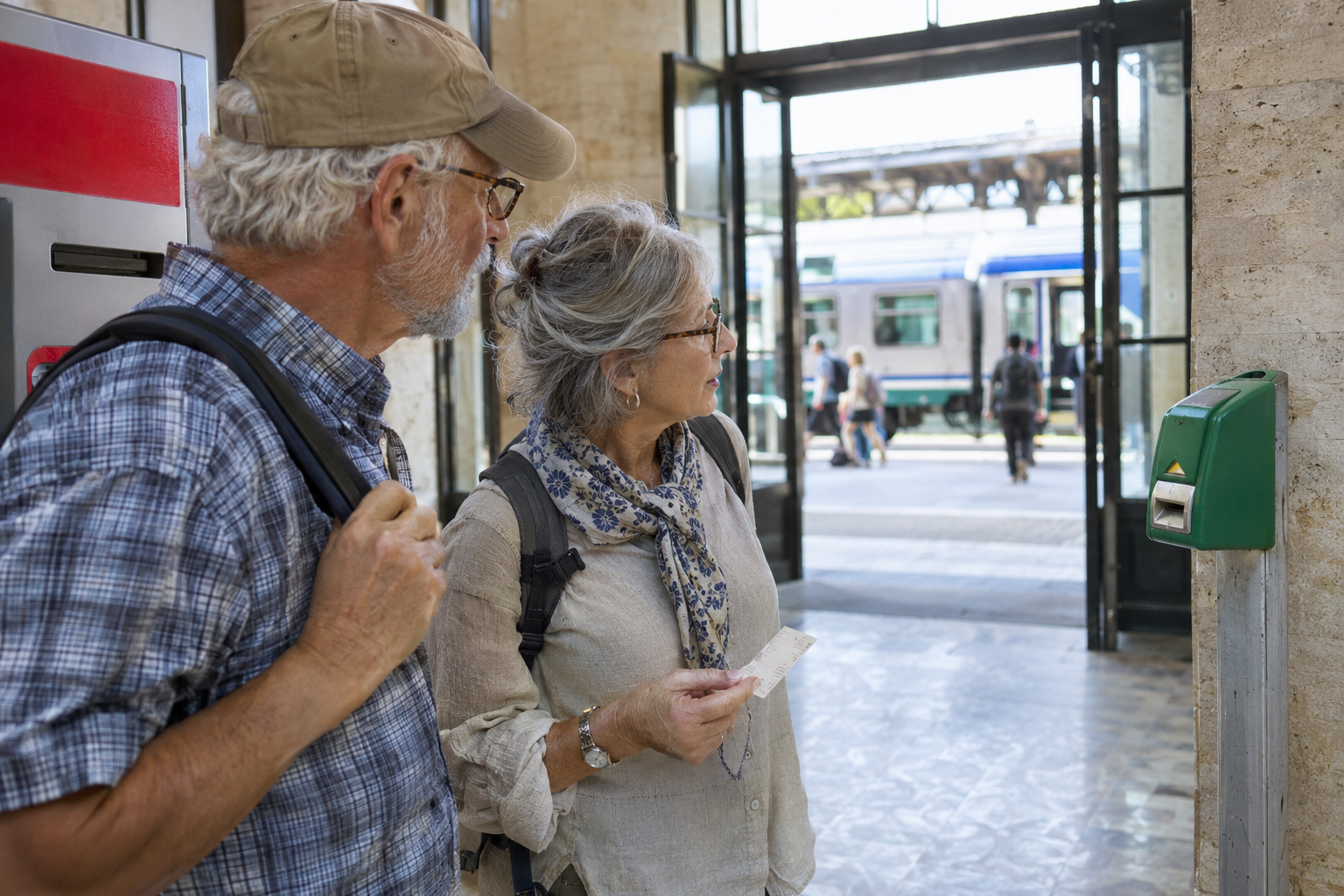
The logic behind validation, once you see it, is about preventing the reuse of open tickets, and it makes sense on its own terms even as it traps the uninitiated. If a regional ticket were valid simply by being purchased, with no time stamp, a traveler could in principle buy one ticket and use it over and over, since nothing on the ticket would show it had already carried someone on a journey. Validation solves this by marking the ticket with the exact moment it entered use, after which its short validity window closes and it cannot be used again.
In other words, the stamp is the system’s way of saying this ticket is being used now, and only now, converting an open, reusable-looking document into a single spent fare. The machine on the platform is the mechanism that burns the ticket, so to speak, so that it cannot be burned twice. Seen this way, validation is not a bureaucratic trap invented to catch tourists but a sensible anti-fraud measure for a system built around flexible, open, undated tickets, which is itself a convenience, letting you buy ahead and travel on any train rather than being locked to one.
The trouble is purely that the system assumes everyone knows the rule, and Italians do, absorbing it from childhood, while visitors from countries where a purchased ticket is simply valid have no reason to expect a second step. The gap is not in the logic but in the cultural knowledge, the unspoken assumption that of course you stamp your ticket, which every Italian carries and almost no first-time visitor does. That gap is exactly where the fine lives, and it is why validation is the single most common way tourists get caught on Italian trains.
Which Tickets Need It, and Which Do Not
This is the part that genuinely confuses people, because not every Italian train ticket needs validating, and knowing the difference is half the battle. The tickets that must be validated are the open regional tickets, the paper tickets for the slower regional trains, the Regionale and Regionale Veloce services, which are sold as open fares good on any train on the route within a window. These are the ones with no assigned seat, no specific train, no date and time printed at purchase, and they are the ones you must stamp before boarding.
The tickets that do not need validation are those already tied to a specific train, date, and time at the moment you buy them, which above all means the high-speed trains, the Frecce and Italo services, where you book a particular departure and often a specific seat. Because such a ticket is already fixed to one train at one time, there is nothing for validation to add, and you simply board with it. Likewise, most digital tickets bought through an app or website, including increasingly for regional journeys, are tied to your identity or a time and do not require the platform machine, which is slowly shrinking the validation trap as paper gives way to phones.
So the rule of thumb is this: if you are holding a paper regional ticket with no specific train or time on it, you must validate it before boarding, and if you have a high-speed ticket for a named train or a digital ticket on your phone, you generally do not. The danger zone is precisely the cheap paper regional ticket, bought at a machine or counter for a short hop, which is exactly the kind of ticket a tourist buys for a day trip, and exactly the kind they forget to stamp. When in doubt, if the ticket does not already say which train and when, assume it needs validating, because validating a ticket that did not strictly need it does no harm, while failing to validate one that did costs you €50.
How to Actually Validate
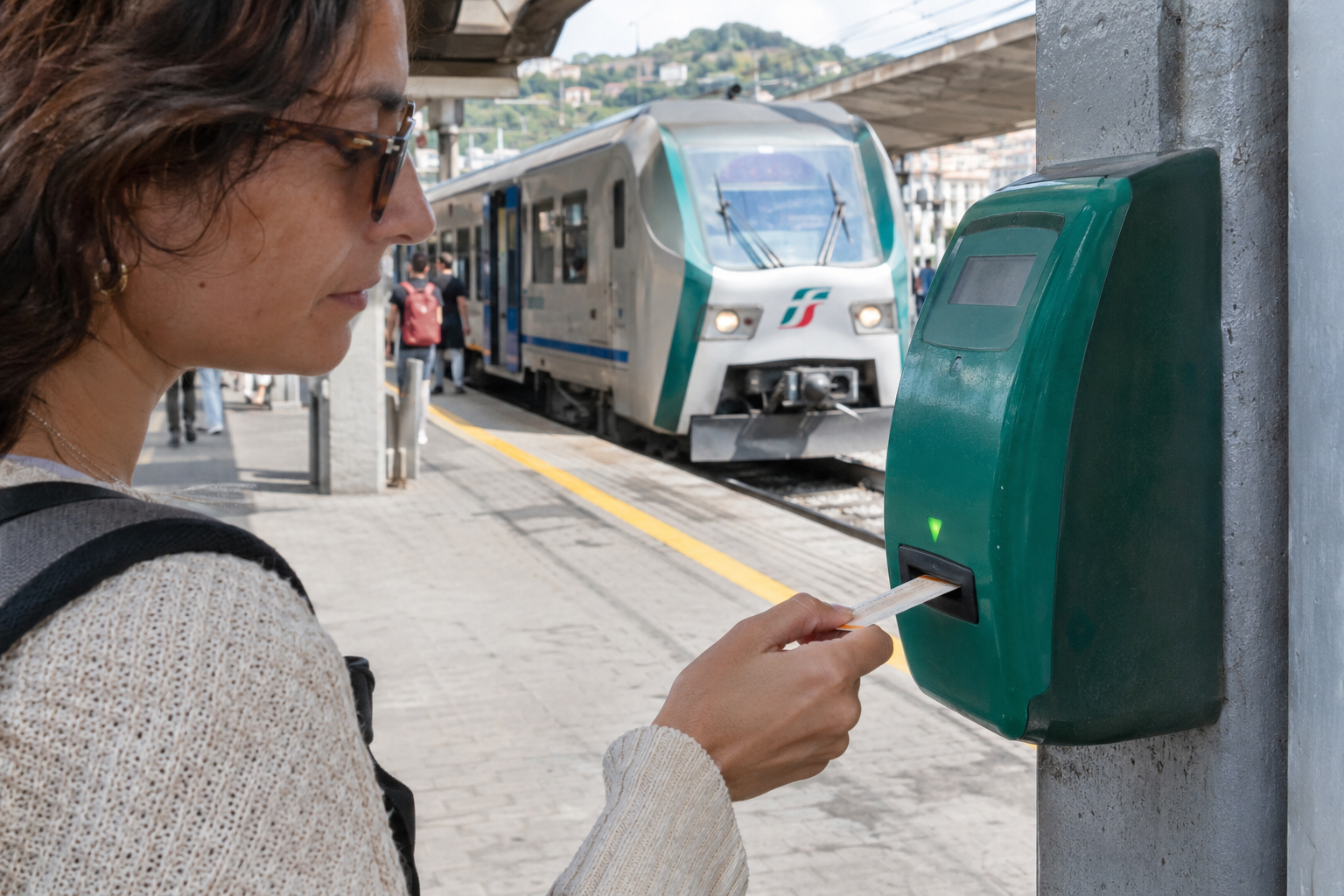
Doing it is simple once you know to look, and the whole thing takes a few seconds. Somewhere in the station, on the platforms and often near the entrances to them, are the validation machines, small boxes mounted at waist height, traditionally green, though some are white, red, or yellow depending on the era and the operator. They are easy to walk past because they are small and unremarkable, which is part of the problem, but once you are looking for them they are everywhere in the station.
To validate, you take your paper ticket and insert the end into the slot on the machine, which grips it for a moment and stamps the date and time onto it, usually with a mechanical clunk, then lets you withdraw it. That is the entire operation, a one-second stamp, and your ticket is now validated and your journey legal. You do this before you board, on your way to the platform or on the platform itself, not on the train, because once you are aboard without a stamp you are already in the wrong and a validation machine is not provided onboard for ordinary regional travel.
The habit to build is to treat validation as an automatic step between buying the ticket and boarding the train, every single time, for every regional paper ticket, so it becomes as reflexive as it is for Italians. Buy the ticket, find the green machine, stamp it, then board, in that order, without exception. If you are changing trains and your journey involves a second separate regional ticket, validate that one too before its leg. Make it a reflex and the fine becomes impossible, because the only way to be fined is to skip the step, and the step takes a second once you know where the machine is.
When the Conductor Catches You
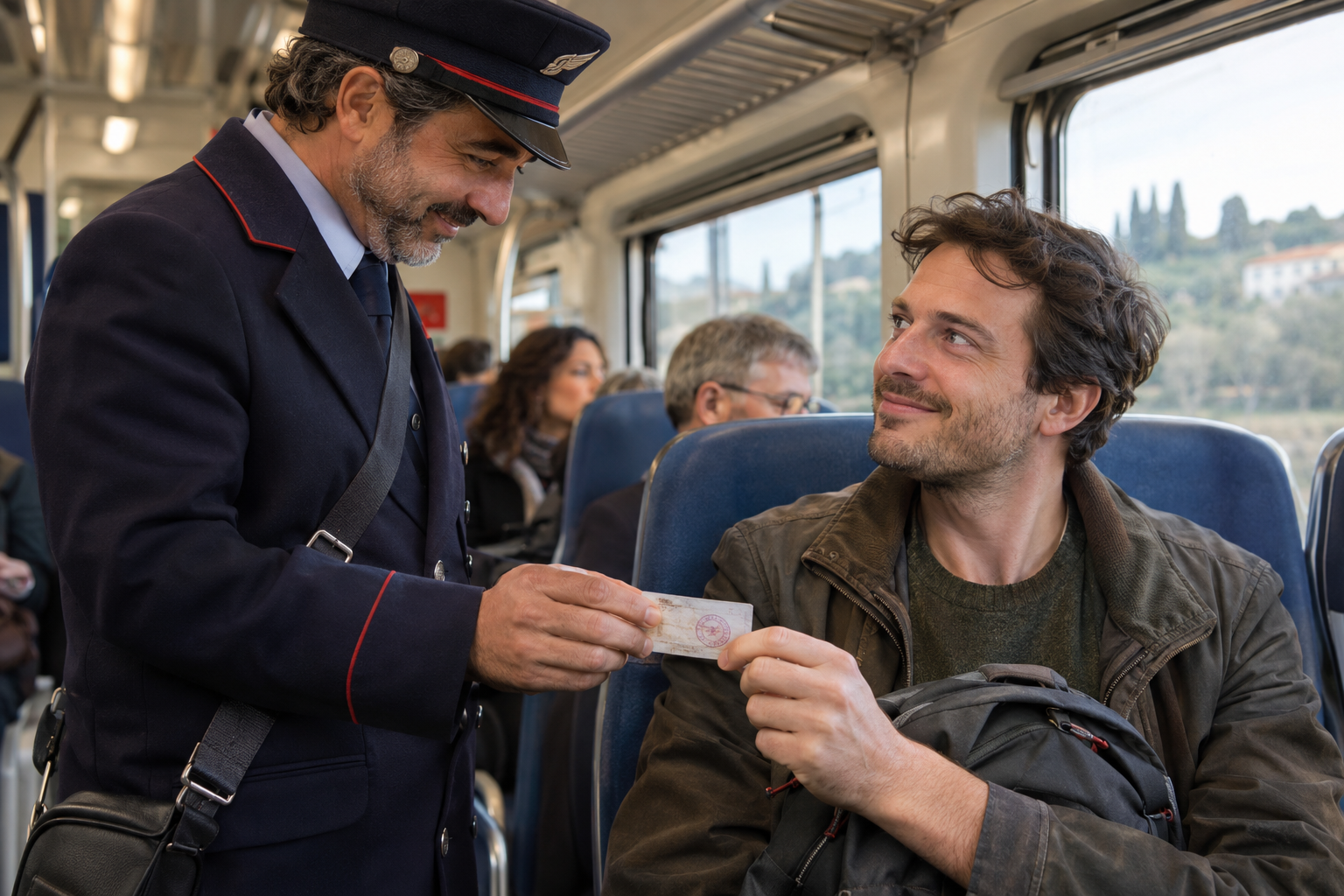
Suppose it happens anyway, as it does to so many, and the conductor finds you with an unvalidated ticket. The first thing to know is that protesting that you paid will not help, because, as we have seen, the fine is not for failing to pay but for failing to validate, and the conductor has heard the wave-the-ticket protest from a thousand tourists before you. The rules are the rules, and the conductor is generally not empowered, or inclined, to waive the fine for a visitor who did not know, however sympathetic your case.
The fine itself is typically around €50 on the spot, sometimes offered at a reduced rate if you pay immediately and rising if you do not, plus in some cases the fare, and conductors do check regularly on regional trains, so the risk is real rather than theoretical. The one situation that sometimes earns leniency is if you proactively find the conductor before they find you, the moment you realize you boarded unvalidated, and explain honestly that you are a tourist who did not know and ask to sort it out, which occasionally results in a warning rather than a fine, though it is entirely at the conductor’s discretion and should not be relied on. Honesty offered first lands better than excuses offered after you are caught.
If you are fined, the practical advice is to pay it rather than argue, because arguing will not work and may only make the encounter worse, and to treat it as the tuition fee for a lesson you will never forget. Almost everyone who gets the validation fine gets it exactly once, because the sting ensures they validate religiously forever after, and in that sense the €50 is an expensive but effective teacher. The better path, of course, is to learn the lesson for free, from a piece like this, and simply stamp the ticket, so that the green machine and not the conductor is the only part of the system you ever meet.
The Same Trap on Buses and Trams

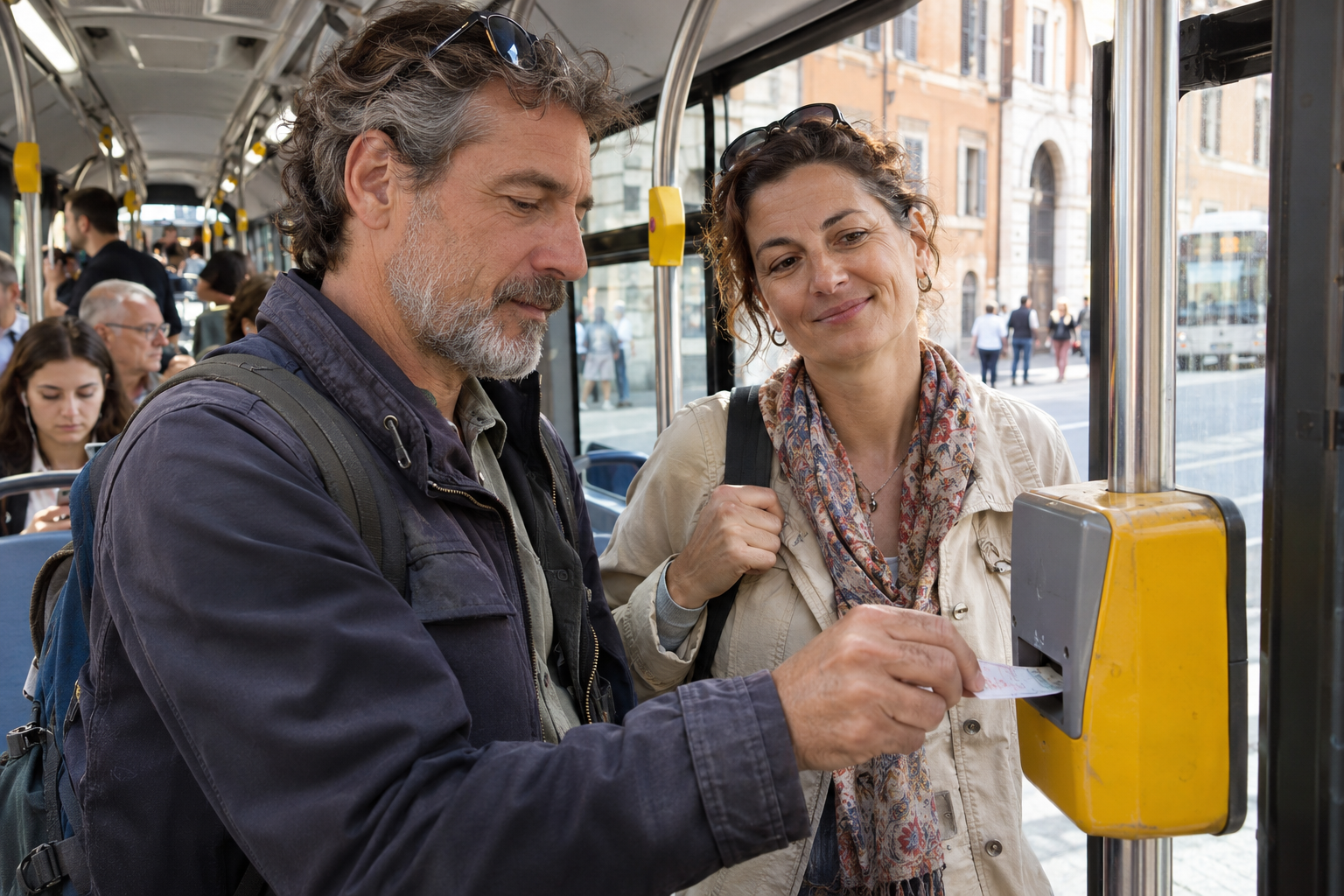
The validation habit does not stop at the train platform, because Italy applies the same logic to its city buses and trams, and tourists who learn the train rule often still get caught on urban transport. A bus or tram ticket bought in advance, from a tobacconist or a machine, is likewise an open ticket that must be stamped in a small machine once you board, usually a little box mounted on a pole inside the vehicle, which prints the time and starts the validity. An unstamped bus ticket is, just like an unstamped train ticket, treated as not valid, and ticket inspectors do board buses and trams to check.
This trips people up in a particular way, because city tickets are often bought in bulk ahead of time, a handful of bus tickets from a kiosk to use across a few days, which makes it even easier to forget that each one must be validated at the moment you actually use it. You board, you have a valid ticket in your pocket, and you simply forget to feed it into the little machine by the door, and that is enough to earn a fine if an inspector appears. The same €50-ish sting applies.
So the rule generalizes into a single Italian travel instinct worth carrying everywhere: whenever you have an open paper ticket, train, bus, or tram, find the machine and stamp it as you begin the journey. Validate the train ticket on the platform, validate the bus ticket as you board, and the whole category of Italian transport fines simply closes to you.
The Rule in One Sentence
Strip it all away and the whole thing reduces to a single habit worth carrying into any Italian trip: if you have a paper regional train ticket, stamp it in the green machine on the platform before you board. That one action, costing a second and nothing more, is the entire difference between a valid journey and a €50 fine, and it is the piece of knowledge that separates the seasoned Italy traveler from the one learning the expensive way. The ticket in your hand is only half of what you need; the stamp is the other half.
It helps to remember why, because the reason makes the rule stick. The open regional ticket is a flexible, convenient thing, good on any train within its window, and validation is simply the price of that flexibility, the stamp that fixes the open ticket to the moment you actually use it and stops it being reused. Italy gives you a ticket you can buy ahead and use on any train, and asks only that you tell the machine when you are using it, which is a fair trade once you understand it rather than a trap sprung on the unwary.
So as the digital ticket slowly makes the paper one rarer and the validation machine less central, the rule still stands wherever paper regional tickets are sold, which is still almost everywhere in Italy. Learn it once, make the stamp a reflex, and you will glide through Italian regional travel while the tourists around you are still learning the expensive way, waving their paid-for tickets at an unmoved conductor and reaching, too late, for €50 they never needed to spend.

About the Author: Ruben, co-founder of Gamintraveler.com since 2014, is a seasoned traveler from Spain who has explored over 100 countries since 2009. Known for his extensive travel adventures across South America, Europe, the US, Australia, New Zealand, Asia, and Africa, Ruben combines his passion for adventurous yet sustainable living with his love for cycling, highlighted by his remarkable 5-month bicycle journey from Spain to Norway. He currently resides in Spain, where he continues sharing his travel experiences with his partner, Rachel, and their son, Han.