
Spend any time in Germany or Austria and you will see them, often retirees, striding along the paths and parks with a pair of poles, planting and pushing in a brisk rhythm that looks half like skiing without the snow. This is Nordic walking, and in the German-speaking countries it is not a fringe activity but a mainstream one, a thing that pensioners and the health-conscious do by the thousands, poles clicking along the trails. To an American eye it can look slightly comical, a person walking with ski poles on dry ground, and I will admit that was my first reaction. But the Germans are rarely silly about fitness, so I got myself a pair of poles and committed to thirty days of walking with them, tracking two things: my knee pain, which has been a low background nuisance for years, and my resting heart rate, which my watch records every night.
What follows is an honest account of a month of pole walking, including the self-consciousness, the surprises, and the two numbers I set out to watch, reported at their real and modest size rather than inflated into a transformation. I came out of it a quiet convert, not because anything was miraculous but because the effects were real, pleasant, and more than I expected from the slightly goofy-looking activity. Here is what Nordic walking actually is, what my knees and heart rate did, what the science supports, and the cautions worth knowing. This is a personal experiment and general information, not medical advice, and persistent knee pain in particular is something to take to a professional.
What Nordic Walking Actually Is
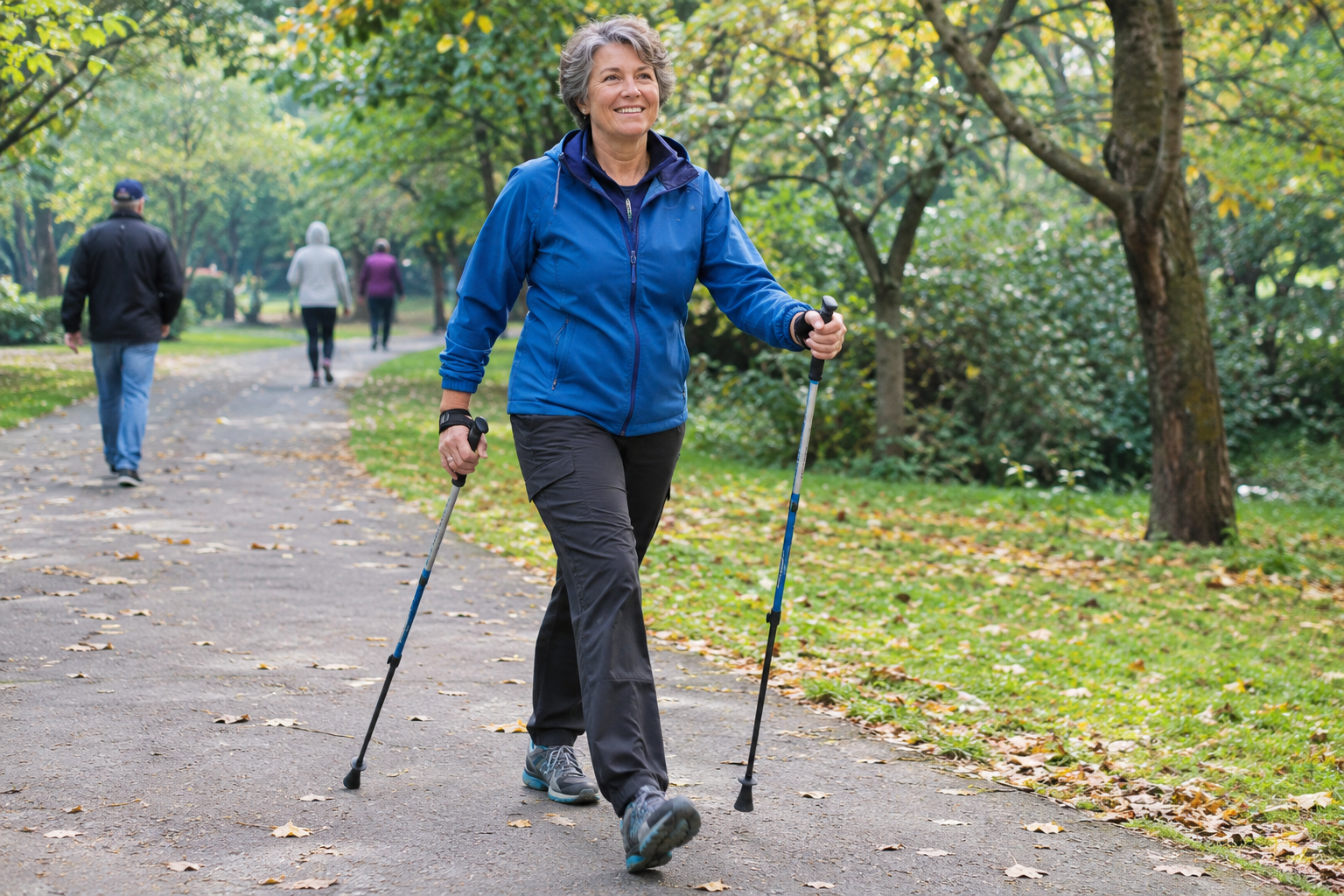
Nordic walking is not just walking while holding poles, which is the misconception that makes it look pointless, but a specific technique that turns an ordinary walk into a whole-body activity. The poles are planted and pushed against the ground behind you with each stride, so that your arms, shoulders, chest, and back are actively working to propel you forward, not just swinging along for the ride. Done properly it engages a large share of the body’s muscles, upper and lower together, transforming the gentle lower-body activity of walking into something much more complete.
The technique originated with off-season training for cross-country skiers, which is why it looks like skiing, and that heritage is the key to understanding it, because the poles are doing propulsive work just as ski poles do, not merely providing balance. There is a real skill to it, getting the rhythm of plant and push in time with your stride, and when it clicks you can feel the upper body genuinely driving you along. This is what separates Nordic walking from simply carrying poles, and it is why the activity is more than it looks.
The two headline effects that follow from this whole-body engagement are what drew my interest. Because more muscles are working, Nordic walking raises the effort and the heart rate compared with ordinary walking at the same pace, giving more of a cardiovascular workout, and because the poles share some of the load and aid stability, it is often gentler on the lower body and joints than you might expect for the extra intensity. More exercise and, potentially, less joint strain, from the same walk, was a combination worth testing on my own heart and knees.
The Rules and the Self-Conscious Start
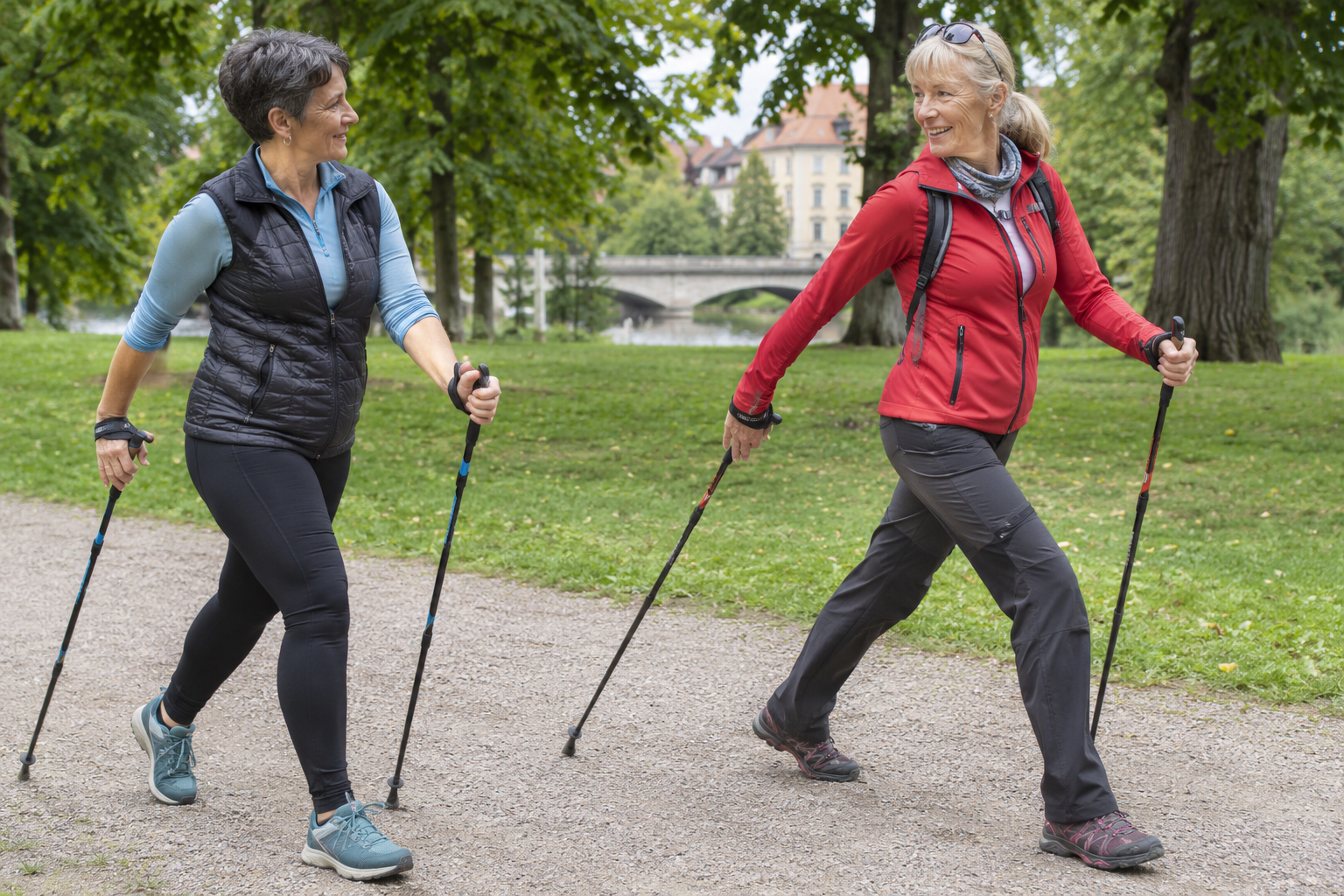
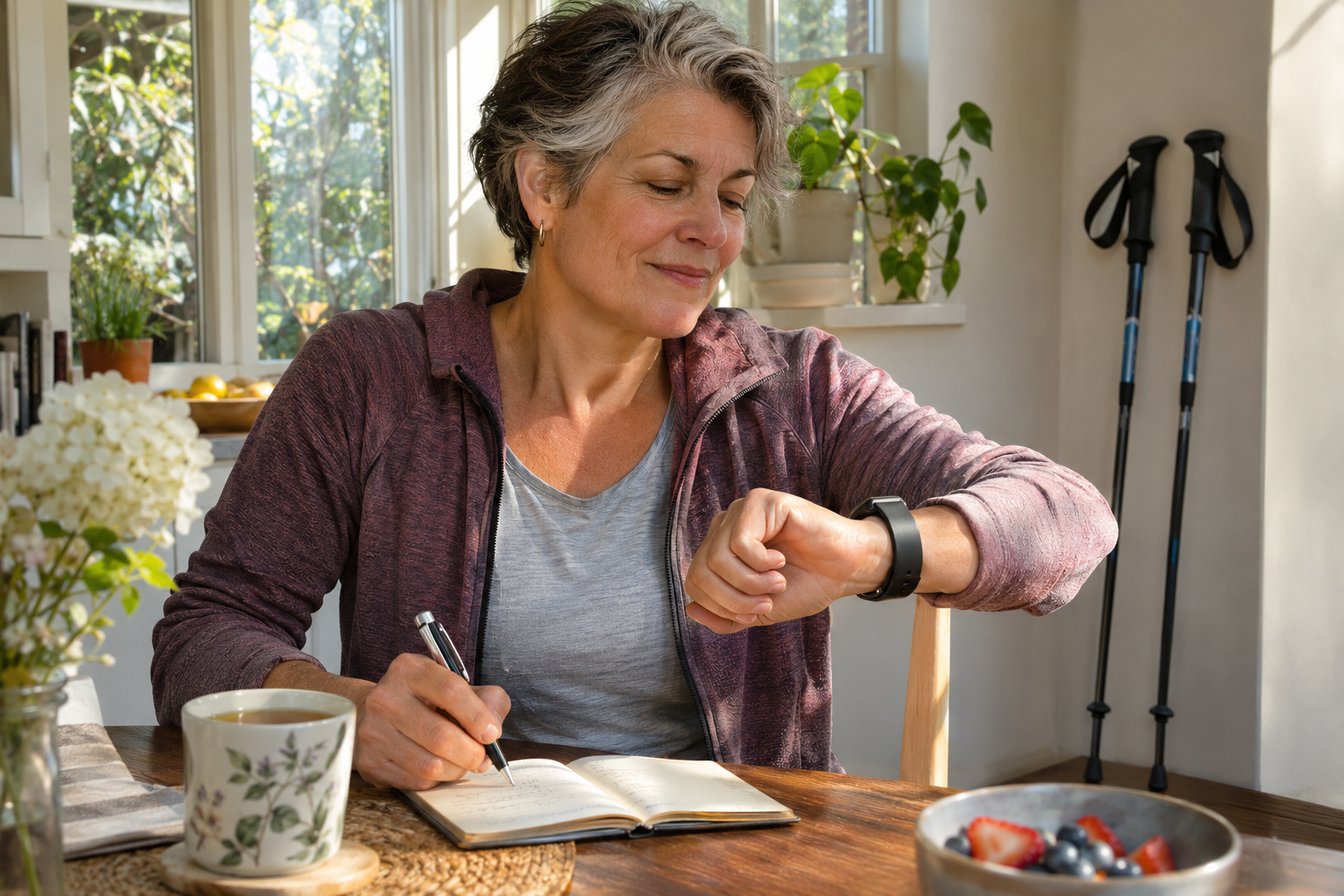
My rules were simple. For thirty days I would do my regular walks, which I do most days anyway, but with the poles and proper technique instead of empty-handed, learning the plant-and-push rhythm from the start rather than just holding the poles limply. I set the poles to the right height, roughly so my elbows were at a comfortable bend when planting, learned the basic form, and committed to using them on every walk for the month. I tracked my knee pain each day as a rough daily sense of how my knees felt, and I let my watch record my resting heart rate nightly to compare the month against my baseline.
The first few walks were, frankly, an exercise in swallowing my self-consciousness, because walking with poles on the flat paths of an ordinary neighborhood draws looks, and I felt faintly ridiculous. In Germany nobody would blink, but I was not in Germany, and the sensation of striding along with poles past people walking normally took some getting used to. For the first week the embarrassment was a bigger obstacle than any physical difficulty, and I had to remind myself that the Germans doing this outnumber the skeptics and tend to be remarkably fit.
By the second week the self-consciousness had faded, partly because I got absorbed in the technique and partly because I started to feel the activity working, which made the looks stop mattering. Getting the rhythm right took a few days of clumsiness before it clicked into something smooth and almost meditative, the plant and push falling into time with my stride, and once it did the poles stopped feeling like props and started feeling like tools. The awkward beginning gave way to something genuinely enjoyable faster than I expected, and the embarrassment, in the end, was the easy part to get over.
What My Knees Did
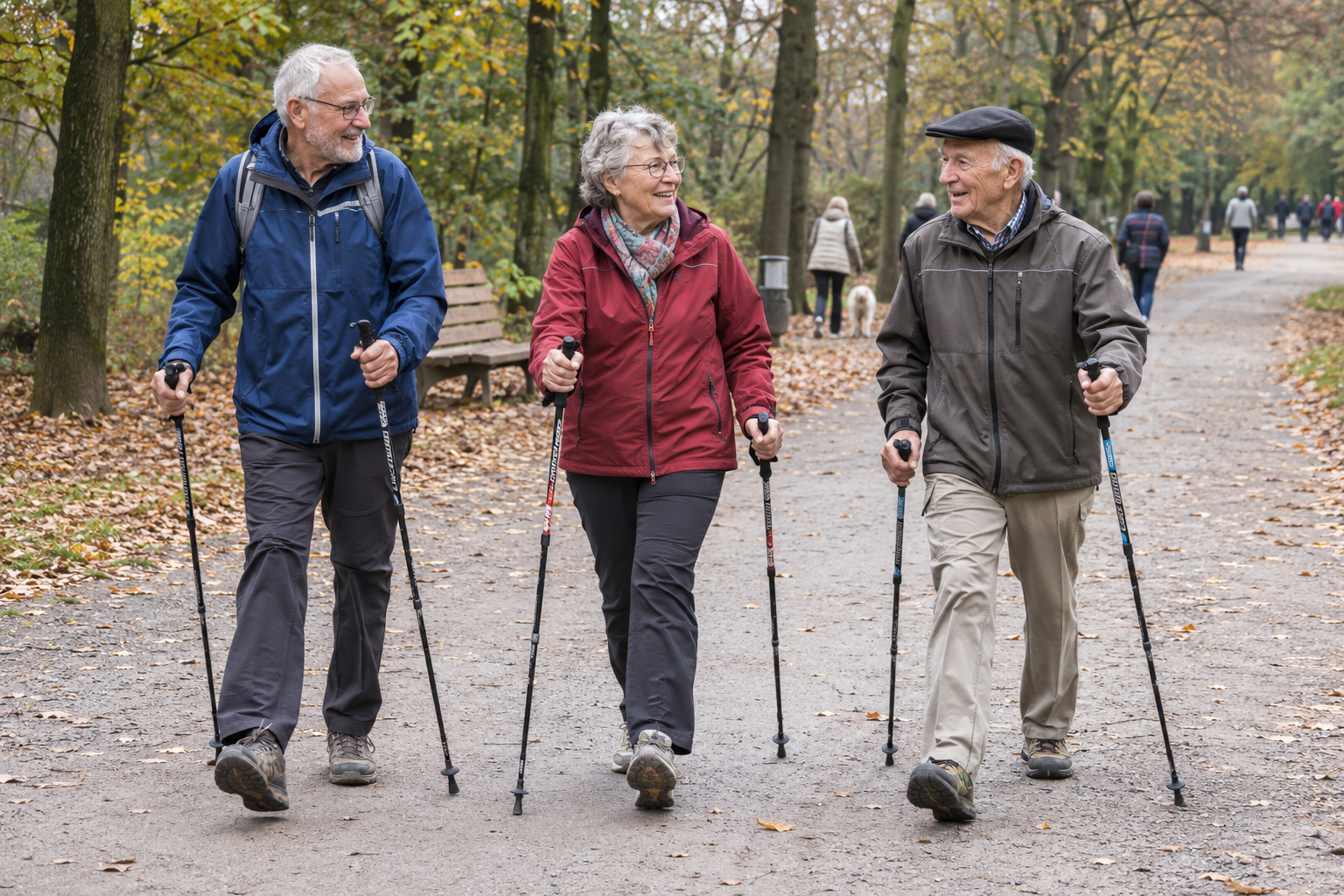
The knee result was the one I cared about most, and it was genuinely good, better than I had dared hope. My knees, which carry a low chronic ache that flares on longer walks, felt noticeably better over the month of pole walking, with less of the nagging discomfort during and after walks that I had come to expect. By the back half of the month I was walking farther than usual without the familiar knee complaints, which was the clearest and most welcome effect of the whole experiment.
I think several things were going on, and it is worth being honest that I cannot cleanly separate them. The poles share some of the load that would otherwise go through the knees, taking a bit of the impact into the arms and the ground through the poles, which plausibly eases the strain on the joints. Just as importantly, the poles improved my posture and stability, keeping me more upright and balanced, and the better, more supported gait may have been as responsible for the comfort as any direct offloading. And the general strengthening from more complete activity may have helped too.
Whatever the exact mechanism, the practical result was that pole walking let me walk more comfortably and farther than ordinary walking did, which for someone with cranky knees is a real and valuable thing. I want to be careful not to oversell it as a cure, because it is not, and anyone with a genuine knee problem needs proper assessment rather than poles bought on the strength of a blog. But as a personal result, the reduction in my background knee nuisance over the month was clear enough that it alone would keep me using the poles. My knees liked them.
What My Resting Heart Rate Did
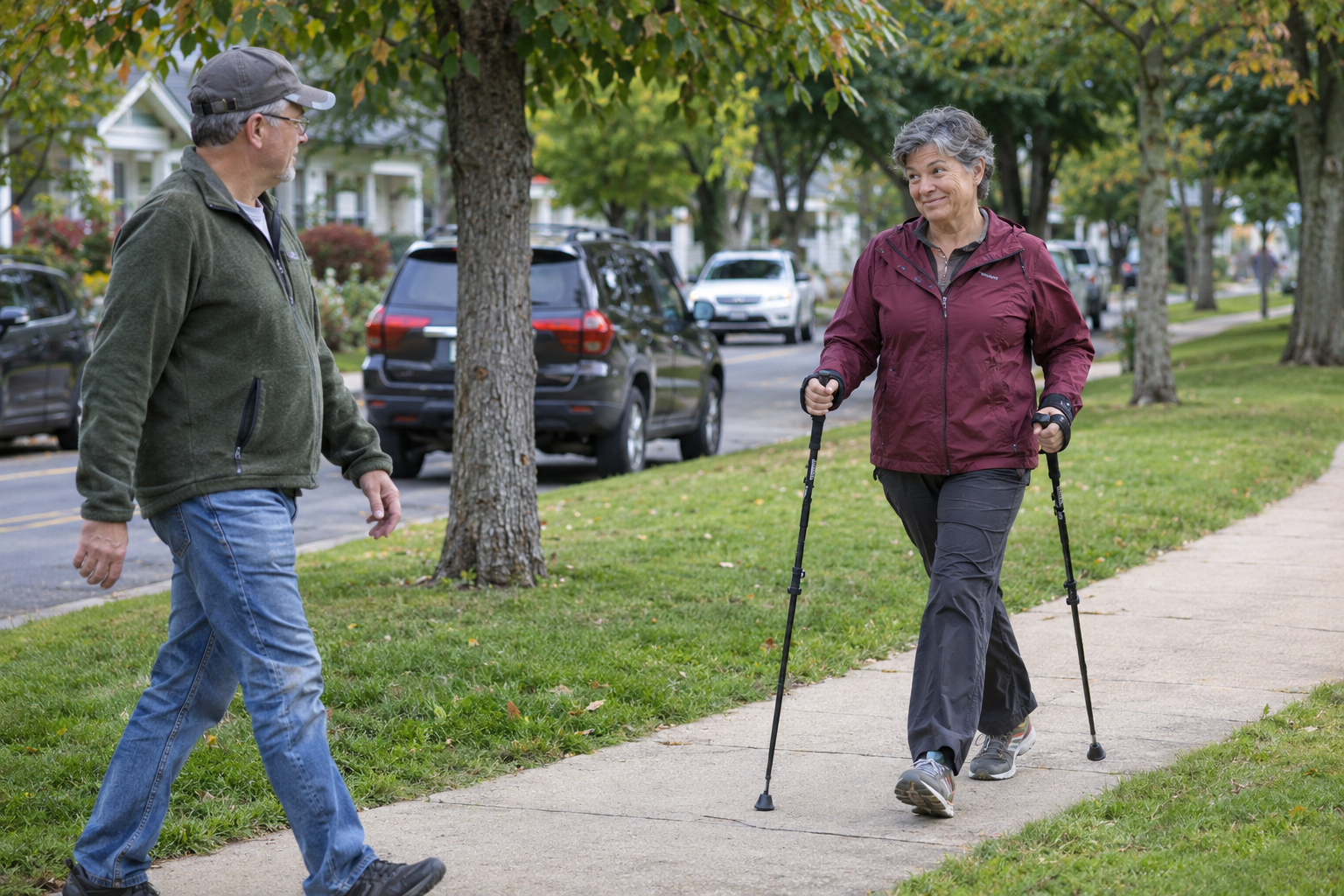
The resting heart rate was the second number, and here too there was a modest, encouraging result. Over the thirty days my average resting heart rate drifted down by a few beats per minute compared with my baseline, the kind of small decline that tends to reflect improving cardiovascular fitness, which is exactly what you would hope to see from a month of more intense exercise. A lower resting heart rate is generally a good sign, associated with better fitness, and seeing mine edge down over the month was a satisfying confirmation that the harder walking was doing something.
The reason this is plausible rather than wishful is that Nordic walking genuinely raised the intensity of my walks, which I could feel. Pushing with the poles and engaging the upper body made the same routes feel like more of a workout, my heart rate during the walks running higher than it would empty-handed, so over a month of this my walks were simply more of a cardiovascular stimulus than my usual strolls. More training stimulus leading to a slightly lower resting heart rate is a textbook, unremarkable result, and it is nice when your own body does the textbook thing.
As with everything in a thirty-day self-experiment, a few beats per minute is a small change and within the range of ordinary variation, so I hold it loosely, but it leaned in the right direction and matched the subjective sense that I was working harder. The honest reading is that Nordic walking turned my gentle daily walk into a more genuine workout, and that my fitness markers nudged accordingly over the month, which is a real if modest benefit. I was getting more exercise from the same amount of walking, and my heart rate quietly reflected it.
The Upper Body Surprise
The effect I had not anticipated at all was how much the activity worked my upper body, which announced itself as soreness in my shoulders, arms, and back in the first week. Carrying and pushing the poles properly, it turns out, is real work for muscles that ordinary walking never touches, and I finished my early walks with a pleasant ache across my shoulders that I had never once felt from walking empty-handed. It was a vivid reminder that Nordic walking is genuinely a whole-body activity and not just walking with accessories.
This upper-body engagement is actually one of the main points of Nordic walking and one of its real advantages, because it means a single activity exercises far more of the body than walking alone, giving the arms, shoulders, and back a workout while the legs do their usual job. For older people especially, keeping some strength and activity in the upper body is valuable, and an activity that builds it in painlessly as part of a daily walk is a genuine bonus. I had gone in thinking of the poles as being about the legs and the heart, and discovered they were quietly working my top half too.
The soreness faded as my body adapted, the way it does with any new activity, and by the end of the month the walks felt complete rather than taxing, the upper-body work having become part of the pleasant rhythm. But the early soreness was a useful lesson in what the activity actually is, which is a far more complete form of exercise than its gentle appearance suggests. Walking with poles, done right, is closer to a full workout than to a stroll, and my aching shoulders made that point more convincingly than any article could.
What the Science Supports
My experience lines up well with what the research on Nordic walking supports, which is more solid than you might guess for such a humble-looking activity. Studies have found that Nordic walking increases heart rate and energy expenditure compared with ordinary walking at the same speed, thanks to the upper-body involvement, so it delivers more of a cardiovascular and muscular workout from the same walk, which matches the harder effort and the nudged-down resting heart rate I experienced. It is an established way to make walking more intense without walking faster or farther.
The research also supports the benefits for older adults in particular, with Nordic walking associated with improvements in fitness, balance, and function, and the poles providing added stability that can make walking feel safer and more confident for those who need it. The effect on joint load is real but should be described modestly: the poles can take some strain off the lower body and the improved posture and stability help, which is consistent with my easier knees, though Nordic walking is not a medical treatment for knee conditions. The overall picture is of a well-regarded, evidence-backed activity, especially valuable for older people.
So I hold my results and the science comfortably together, because they agree: Nordic walking makes a walk a fuller, more intense, whole-body workout, tends to improve fitness markers, engages the upper body, aids stability, and can be gentler on the joints than its intensity would suggest. That is a genuinely strong set of benefits for an accessible, low-cost activity, and it explains why the German-speaking countries have embraced it so thoroughly. The pensioners with their poles, it turns out, are doing something quietly excellent, and the research backs them up.
The Cautions Worth Knowing
A few cautions make the difference between pole walking helping and pole walking disappointing, and they are worth stating. First, technique and pole height matter, because walking with poles the wrong way, just carrying them or dragging them, gives you little of the benefit and can even throw off your gait, so it is worth learning the basic plant-and-push form and setting the poles to the right height for you. A short video or a session with someone who knows the technique is a sensible start, because the whole value is in doing it properly.
Second, and importantly, persistent knee pain or any joint problem deserves proper assessment, because while the poles eased my low-grade chronic ache, Nordic walking is not a treatment for a genuine knee condition, and anyone with real, ongoing, or worsening joint pain should see a doctor or physiotherapist rather than self-treating with poles. My knees had a background nuisance that the poles happened to ease, which is different from a diagnosed problem, and I would not want anyone to walk off a serious issue on the strength of my comfortable month.
Third, as with starting any new physical activity, it is sensible to begin gradually and, if you have any health conditions or concerns, to check with your doctor before taking it up, because Nordic walking is more of a workout than walking and ramps up the intensity. For most people it is a safe and gentle-seeming activity that is more effective than it looks, but easing in and getting medical clearance if you have reason to is simply prudent. Learn the technique, respect real pain, start gently, and the poles will reward you.
The Verdict
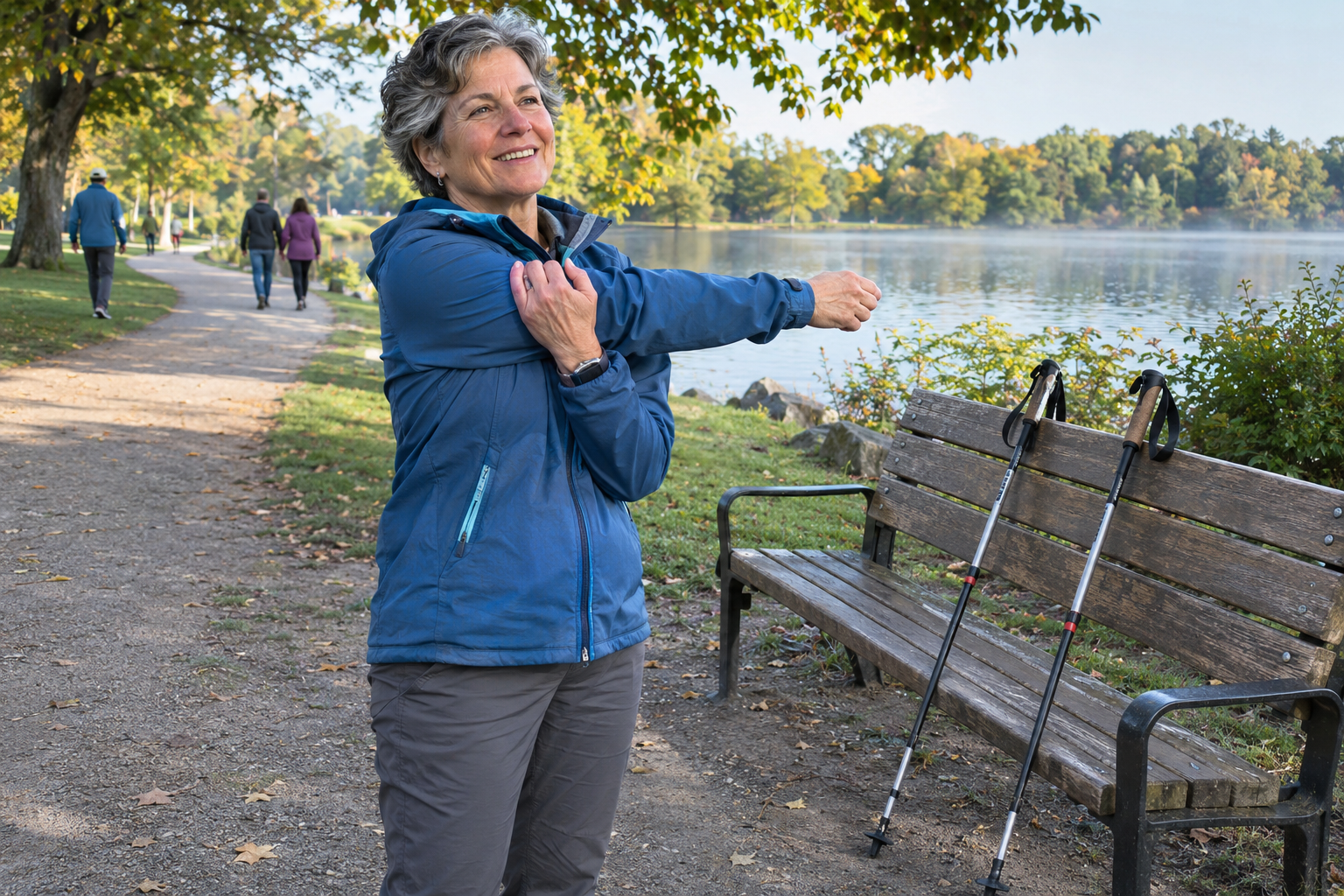
Thirty days on, I am a quiet convert, poles and all. Nordic walking took my ordinary daily walk and turned it into a fuller, more satisfying workout, eased my cranky knees enough to let me walk farther in comfort, nudged my resting heart rate in the right direction, and surprised me with a genuine upper-body workout I never got from walking alone. For an activity I started out thinking looked faintly ridiculous, that is a remarkable return, and it has earned a permanent place in my routine.
I hold the results at their honest size, a few beats off the resting heart rate, a real but personal easing of a low-grade knee ache, a modest gain in overall workout from the same walk, none of it miraculous but all of it real and worthwhile. The science supports every bit of it, which is reassuring, and the German pensioners striding along with their poles turn out to have been onto something the rest of us dismissed too quickly. The poles do real work, and so does the person using them.
If you have slightly cranky knees, want more exercise from your walks, or simply want a complete, accessible, low-impact activity to carry you through the years, Nordic walking is well worth getting over the self-consciousness for. Learn the technique, set the poles right, take real pain to a professional, and then go stride along like a German pensioner, because they, as so often with fitness, appear to have quietly figured out something sensible while the rest of us were still smirking at the poles.

About the Author: Ruben, co-founder of Gamintraveler.com since 2014, is a seasoned traveler from Spain who has explored over 100 countries since 2009. Known for his extensive travel adventures across South America, Europe, the US, Australia, New Zealand, Asia, and Africa, Ruben combines his passion for adventurous yet sustainable living with his love for cycling, highlighted by his remarkable 5-month bicycle journey from Spain to Norway. He currently resides in Spain, where he continues sharing his travel experiences with his partner, Rachel, and their son, Han.