
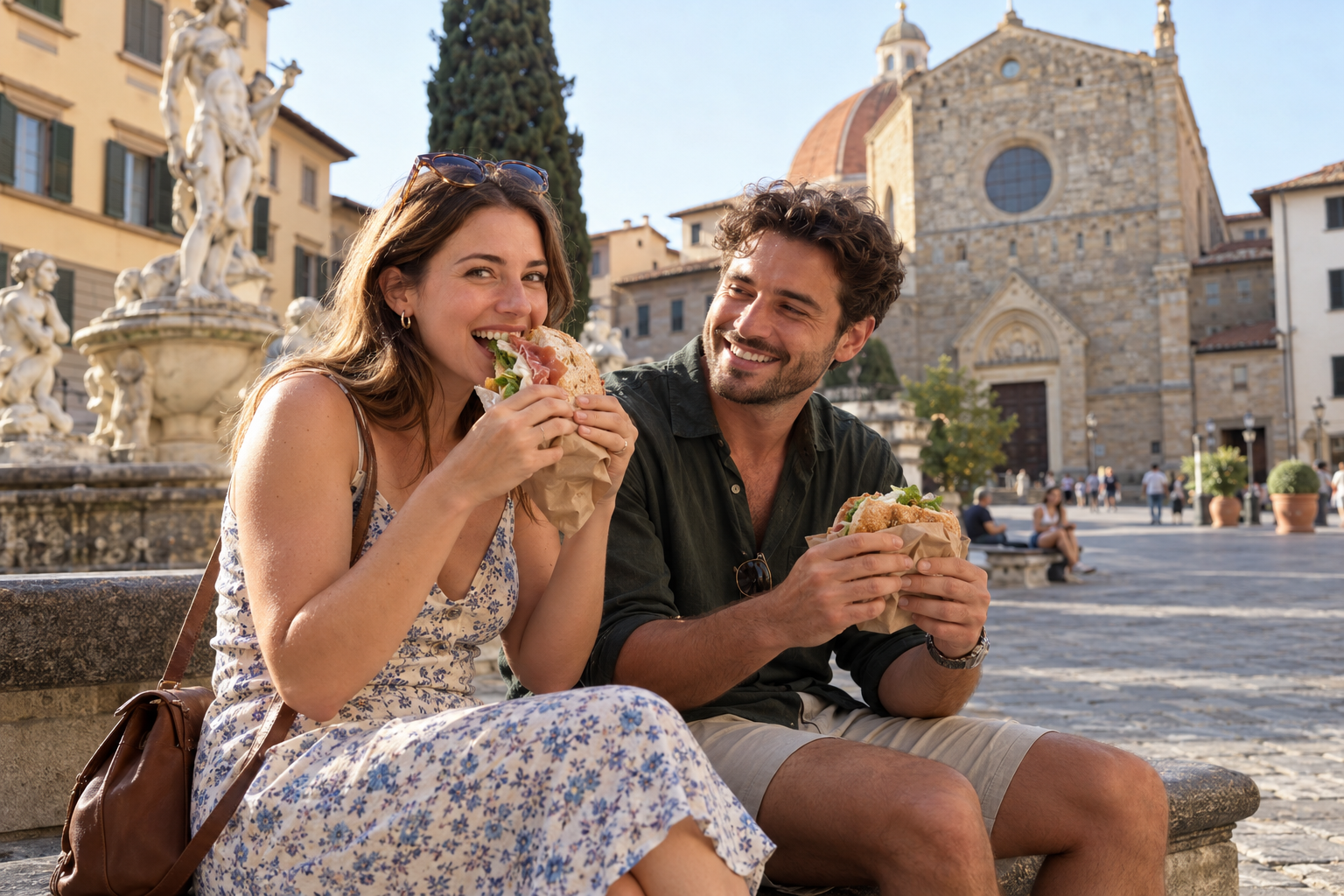
You have read about the sandwich. Everyone has. The legendary Florentine panini shop with the queue stretching down the street, the one every guidebook and food blogger insists you cannot leave the city without trying. So you join the line, you get your enormous, glorious sandwich, and then you look around for somewhere to sit down and eat it.
Here is what nobody told you. On the very street where you bought it, at the very hour you are hungry, sitting down to eat that sandwich can cost you up to five hundred euros.
Florence has a rule, a real one with a real fine attached, that bans stopping to eat on four specific streets in its historic center during mealtimes. It was aimed, more or less directly, at exactly the crowd you have just joined: the tourists clutching takeaway food with nowhere to sit. Here is what the rule actually is, the sandwich shop that started it, where and when it applies, the one crucial detail that keeps you out of trouble, why Florence felt it had to do this, and how to enjoy the city’s famous street food without the fine. It is a lot less scary than the headline, once you know the one thing that matters.
The Rule and the Sandwich
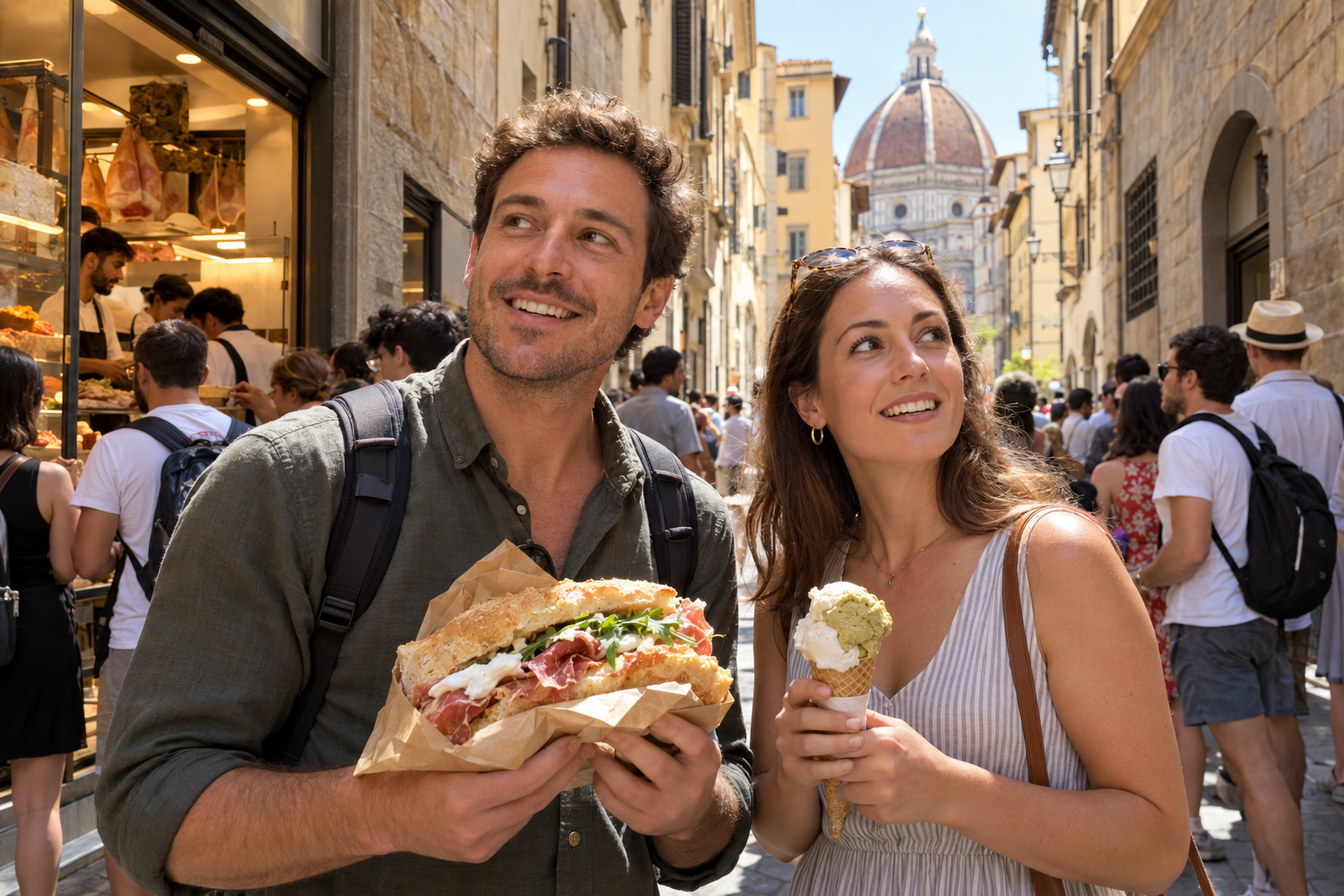
The rule is laid out in a city ordinance, first introduced some years ago by Florence’s then-mayor and renewed since. It forbids people, tourists and locals alike, from stopping to eat food while sitting or standing on the sidewalks, curbs, roadways, and doorsteps of four particular streets in the historic center, during the busiest eating hours of the day.
The fine for breaking it ranges from one hundred and fifty euros up to five hundred, depending on the circumstances and the enforcement decision. Five hundred euros is a staggering amount to pay for sitting on a curb with a sandwich, which is precisely why the rule makes headlines and catches visitors so completely off guard. In practice the full five hundred is the top of the range rather than the norm, but even the lower end, starting at a hundred and fifty, is more than enough to ruin an afternoon.
And it was, quite openly, aimed at the food crowds. The streets it covers are home to some of the most famous cheap-eats spots in Florence, including a wildly popular sandwich shop and a beloved gelateria, places so busy that their customers spill out and colonize every nearby curb, step, and doorway to eat. The ordinance was the city’s response to those overflowing crowds, an attempt to stop the famous streets from turning into one long open-air picnic at lunchtime.
The Shop That Started It All
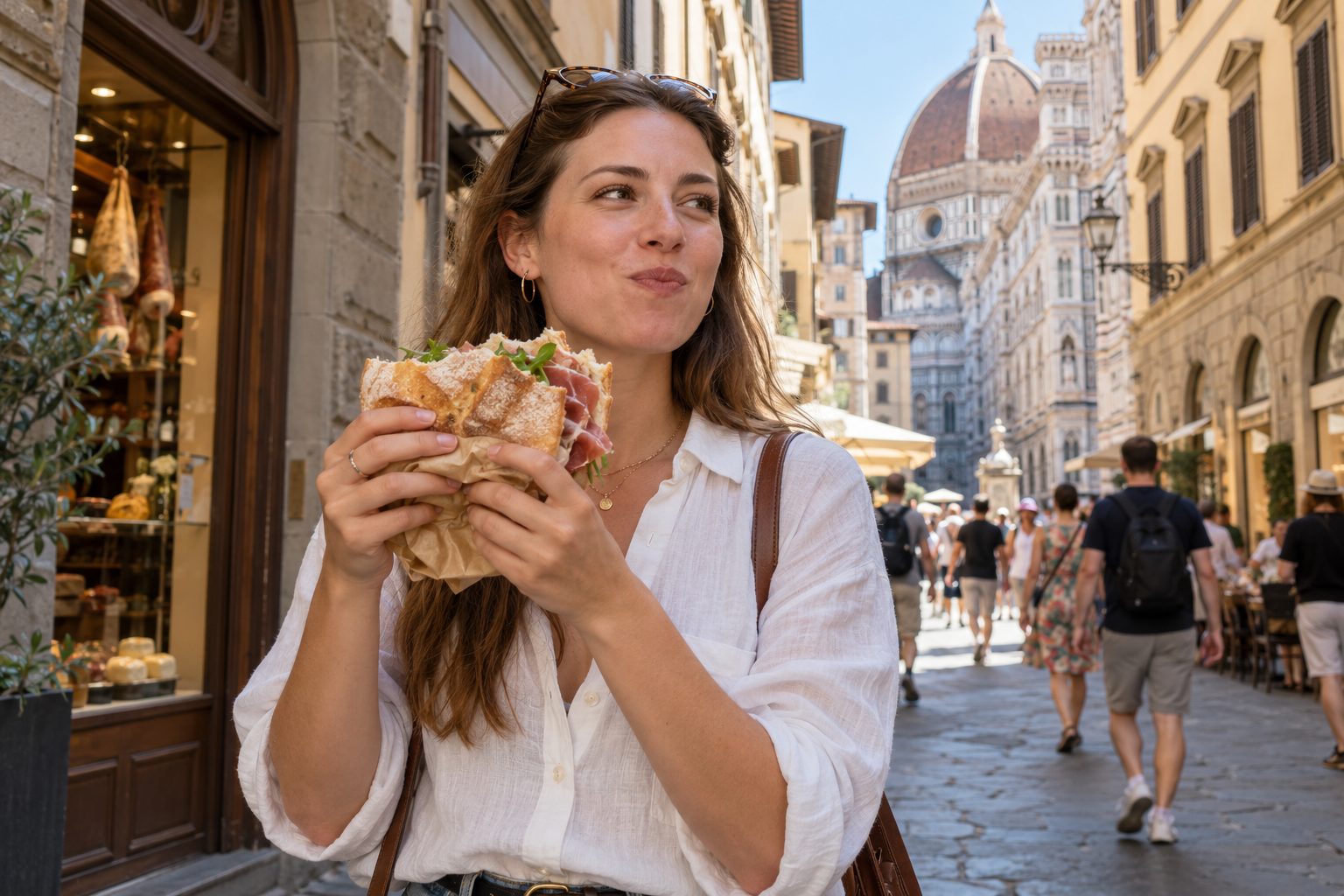
To understand this rule, it helps to understand the phenomenon that provoked it, because it really did begin with one or two extraordinarily popular food shops. On Via de’ Neri sits a sandwich shop that has become, through word of mouth and social media, one of the most famous cheap-eats destinations in all of Italy.
Its enormous, generously stuffed panini cost only a few euros, and the queue for them regularly stretches far down the narrow street, made up almost entirely of visitors who have seen it recommended online. Nearby, a popular gelateria does similar business. Between them, these little shops draw a staggering concentration of hungry tourists into one short, tight stretch of medieval street.
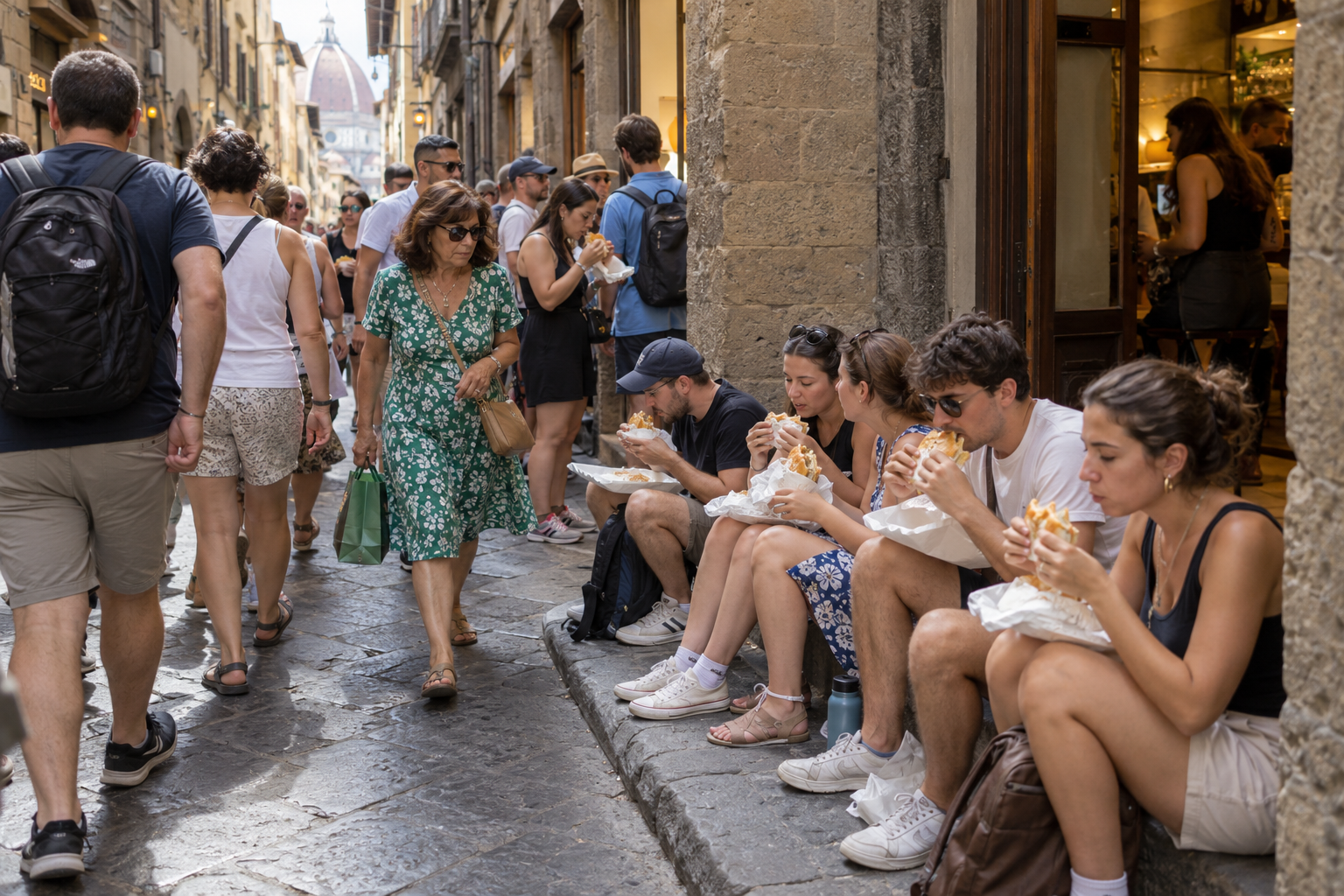
The trouble is that the shops have almost no seating of their own, by design; they are grab-and-go operations. So their thousands of daily customers took their food and sat down on whatever was nearest, turning the curbs, steps, and doorways of Via de’ Neri into a permanent, crowded, crumb-strewn picnic ground. The rule, in other words, is the direct downstream consequence of a sandwich becoming too famous for the street it lives on.
Where and When
The rule is narrow, which is important, because it does not ban eating in Florence at all. It applies to just four streets, all clustered in the historic core near the Uffizi Galleries and the Palazzo Vecchio: Via de’ Neri, Via della Ninna, Piazzale degli Uffizi, and Piazza del Grano.
These are among the most congested tourist thoroughfares in the whole city, narrow Renaissance lanes never designed for the crush of modern crowds. Via de’ Neri in particular, home to that famous sandwich shop, became the epicenter of the problem, with so many people stopping to eat along its short length that it could become nearly impassable.
The timing is just as specific. The ban is only in force during peak meal hours, from noon to three in the afternoon and from six to ten in the evening.
Outside those windows, and anywhere beyond those four streets, you can sit and eat wherever you like. Arrive for an early lunch at eleven, or a late one at half past three, and even those streets are fair game again. So the whole rule is really a tight little box: four streets, two time windows, aimed at the exact moment and place where the eating crowds were at their worst.
The Detail That Saves You
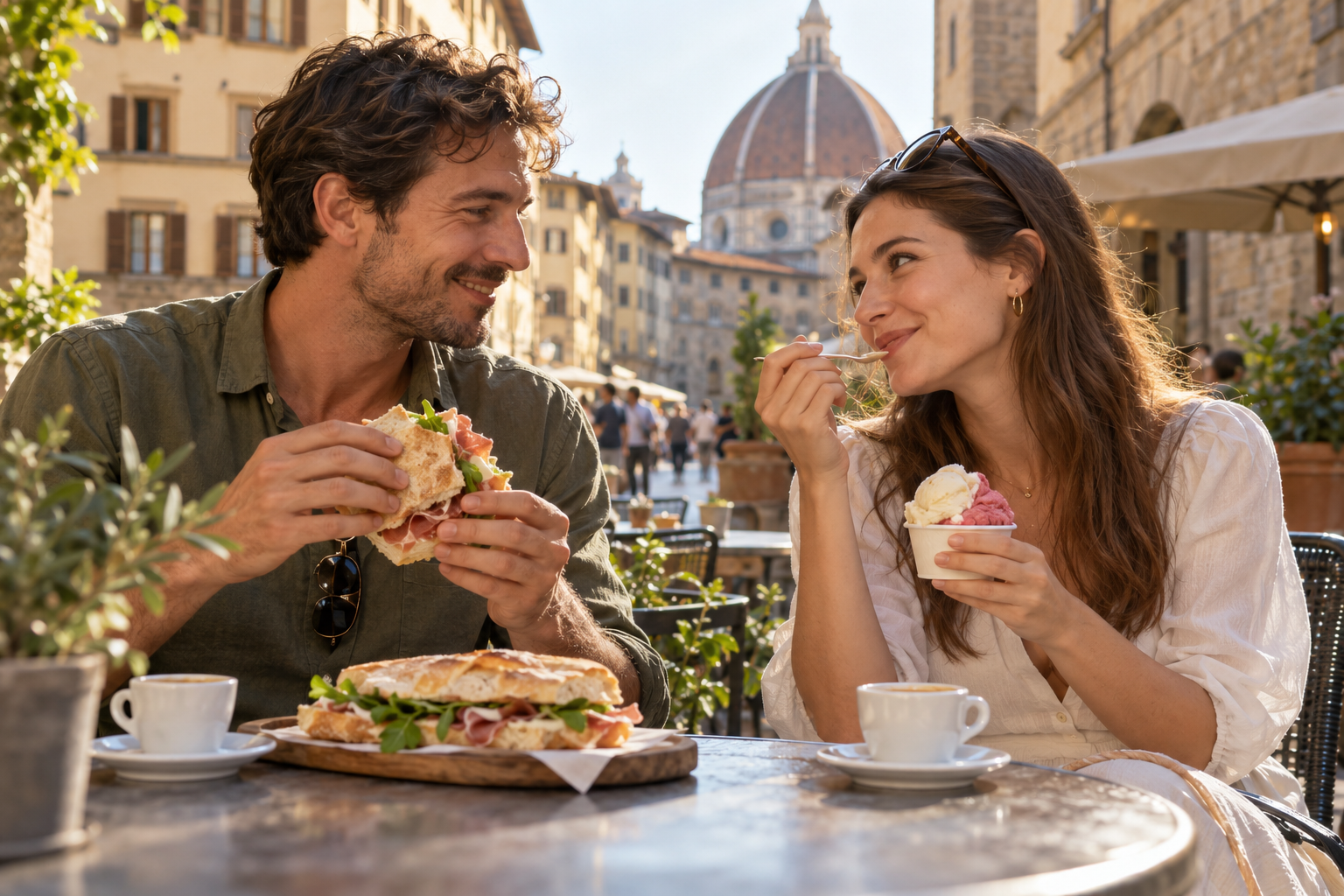
Here is the single most important thing to understand, the detail that keeps a sandwich from costing five hundred euros: the rule is about stopping, not about eating. In the words of a city spokesman at the time, you can walk while eating, but you cannot stop.
That distinction is everything. Strolling down the street with your gelato in hand is perfectly fine, as is sitting at a cafe or restaurant terrace, or eating inside a shop or bakery.
What is forbidden is specifically the act of stopping to eat: planting yourself on a curb or a doorstep or a stretch of sidewalk, on those four streets during those hours, and settling in for a meal that blocks the way and leaves a mess.
So you are never actually banned from eating your famous sandwich. You are only banned from sitting down to do it in the four worst spots at the busiest times.
This is the part that gets lost in the breathless headlines about five-hundred-euro sandwiches. The rule is narrow, specific, and frankly reasonable once you see what it is actually targeting, which is not eating but blocking, not food but the mess and congestion that come when hundreds of people plant themselves to picnic in a space with no room for it. Keep moving, or carry it a couple of streets away to a piazza or a bench, and the rule simply does not apply to you. Understood properly, it is far less draconian than the five-hundred-euro headline suggests, though no less real for that.
It is also worth a word on enforcement, which is patchy. For much of the rule’s life, the patrolling has been done partly by volunteers who watch for offenders but cannot themselves issue fines, with actual penalties depending on police presence. So the odds of being caught vary enormously with the day and the crowd. But the amounts involved are large enough, and the behavior easy enough to avoid, that treating the rule as real is simply the sensible approach.
Why Florence Snapped
To understand why a city would pass such a rule at all, you have to picture what those streets had become. Florence receives something like ten million visitors a year, funneled through a historic center of narrow medieval and Renaissance streets built for a fraction of that number, centuries before mass tourism was imaginable.
The takeaway food shops made a particular pressure point. The most famous of them do a roaring trade but offer little or no seating of their own, so their huge crowds of customers simply took their food outside and sat wherever they could: on the curbs, on the steps of churches and shops, in the doorways of people’s homes. The result was streets lined with picnicking tourists, strewn with wrappers and crumbs, and residents who found they literally could not get to their own front doors past the crowds eating on their thresholds.
It had, by some accounts, turned genuinely ugly. The mayor was reported to have introduced the measure after a shopkeeper was assaulted by tourists he had asked to stop picnicking at the entrance to his store. Before the eating ban, the city had tried other tactics, including the memorable move of hosing down the steps of churches at lunchtime to make them too wet to sit on. The eating fine was the next, more formal step in a long campaign to restore what the ordinance called the decorum and livability of an area that had tipped from popular into overwhelmed.
Not Just Florence
Florence is part of a much wider story, and this kind of rule is popping up all over Europe as its most beloved and most crowded destinations push back against the strain of overtourism. What once would have been handled with a polite word from a local has, in city after city, hardened into an actual ordinance with an actual fine.
Dubrovnik now fines tourists for rolling noisy wheeled suitcases through its stone Old Town. Venice has experimented with entry fees for day-trippers and rules about sitting and picnicking. Rome discourages people from lounging and eating on the Spanish Steps. Each of these rules sounds faintly comic on its own, a city apparently at war with suitcases or sandwiches or staircases.
Put them together, though, and a pattern emerges. These are small, historic, achingly beautiful places, built long before mass tourism, now receiving visitors in numbers their delicate centers were never designed to hold. The fines are the blunt instrument these towns have reached for to protect their residents and their fabric, a way of saying that they are still living cities with limits, not infinite backdrops for other people’s holidays. Florence’s eating ban is simply one of the more memorable examples, because it collides so directly with one of the great pleasures of visiting Italy.
Eating in Florence Without the Fine
The good news is that enjoying Florence’s wonderful street food while staying firmly on the right side of the rule is genuinely easy, once you know how. The simplest approach is just to keep walking: buy your sandwich or gelato, and eat it strolling slowly through the streets rather than parking yourself on a curb to devour it.
If you would rather sit, the fix is to take your food a short distance away from the four restricted streets, which cover only a tiny slice of the center. Florence is full of piazzas, benches, church steps outside the banned zone, and green spaces where you can happily sit and eat, and the lovely Piazzale Michelangelo, with its sweeping view over the city, is a classic spot for an informal picnic. A few minutes’ walk opens up the whole city to you, and honestly, a sandwich eaten overlooking the Arno or in a quiet square tastes a great deal better than one wolfed down on a crowded curb anyway. The rule, in pushing you to move along, accidentally nudges you toward a nicer lunch.
And of course, there is always the option of simply sitting down somewhere that wants you to eat. Pulling up a chair at a cafe or trattoria terrace, or eating at whatever seating the food shop itself provides, is never a problem anywhere in the city. The rule targets the specific antisocial version of street eating, the blocking-the-doorway picnic, not the civilized enjoyment of food.
Seen in full, the Florence rule is less a war on tourists than a plea for a little consideration in a place that was being smothered by its own popularity. The city is still, gloriously, made for walking and eating, and nobody is going to begrudge you your famous sandwich.
They just ask that you not sit down to eat it in their doorway at the height of lunch. Keep that one detail in mind, stroll or find a proper spot, and you can eat your way happily through Florence without ever meeting the five-hundred-euro fine.

About the Author: Ruben, co-founder of Gamintraveler.com since 2014, is a seasoned traveler from Spain who has explored over 100 countries since 2009. Known for his extensive travel adventures across South America, Europe, the US, Australia, New Zealand, Asia, and Africa, Ruben combines his passion for adventurous yet sustainable living with his love for cycling, highlighted by his remarkable 5-month bicycle journey from Spain to Norway. He currently resides in Spain, where he continues sharing his travel experiences with his partner, Rachel, and their son, Han.