
On the night of the fifth of December, while small children across Germany and Austria are setting out their boots for St Nicholas, something far darker is stirring in the Alpine towns. As dusk falls, the streets begin to fill with monsters.
They are enormous, horned, and hairy, with long lolling tongues and fearsome carved faces, dragging chains and clanging heavy cowbells as they lurch through the crowd. Children shriek and cling to their parents. The creatures snarl, chase, and swat at legs with bundles of birch twigs.
This is Krampus, and the night belongs to him. He is the dark companion of kindly St Nicholas, a genuine Christmas demon, and the tradition built around him does something that strikes many outsiders as almost unthinkable: it sets out, quite deliberately, to frighten children. Here is who Krampus is, where he runs, the night he runs wild, why a culture would scare its own children on purpose, the real debate around it, and why the darkness has a place in Christmas after all. It is one of the strangest and most striking things any European country does in December.
The Devil Who Comes With Santa
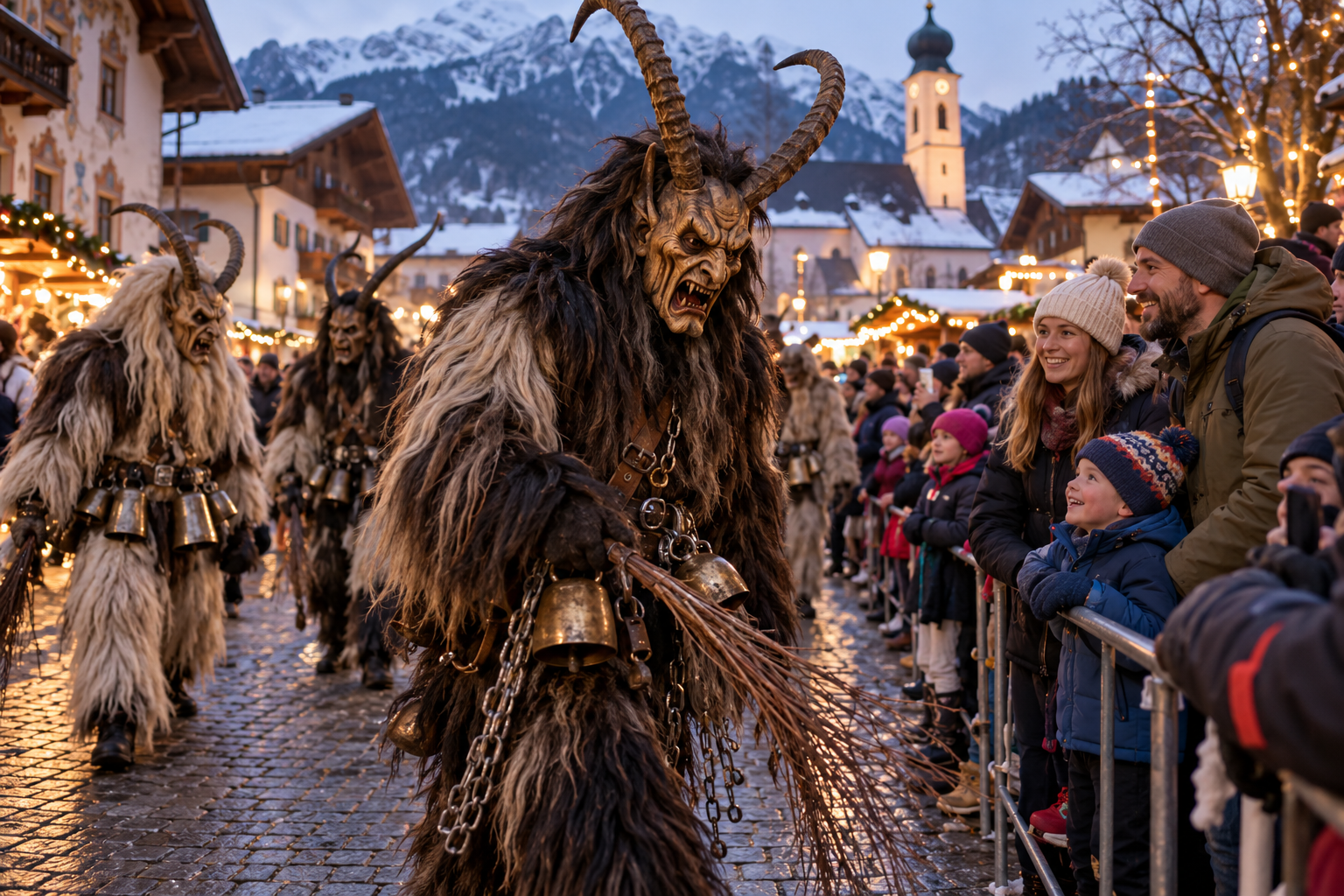
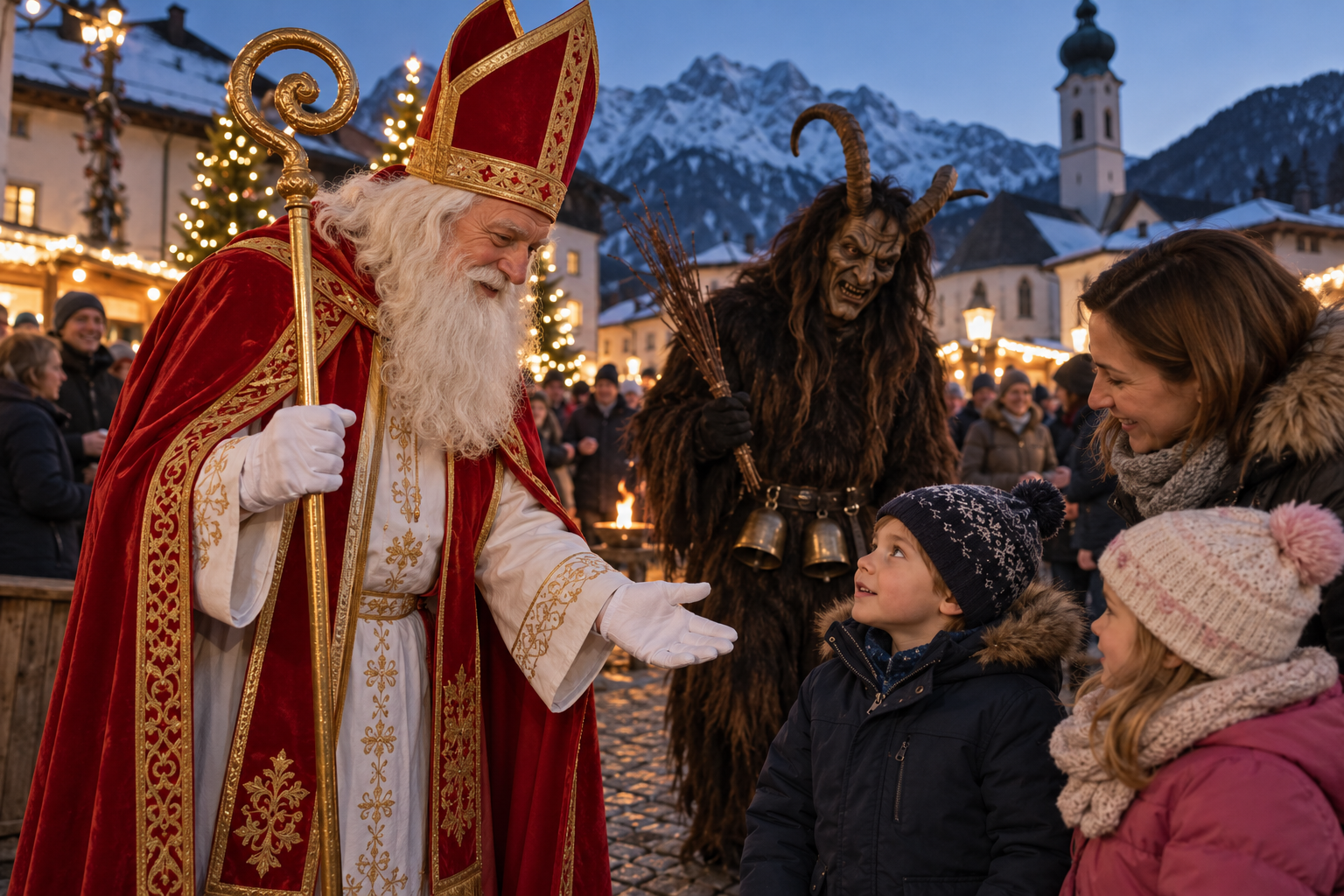
To understand Krampus, you have to understand that he does not replace St Nicholas. He travels with him. The two are a pair, light and dark, reward and punishment, bound together in the old Alpine telling of the season.
In central European folklore, Krampus is a half-goat, half-demon figure, horned and hairy and monstrous, and his role is the exact shadow of the saint’s. Where St Nicholas rewards the children who have been good, filling their boots with chocolate and oranges, Krampus deals with the ones who have been bad.
In the legends he does not leave a polite birch switch. He rattles his chains at misbehaving children, swats them with his branches, and in the darkest versions of the story stuffs the very worst of them into the basket on his back to carry them away. He is the stick to St Nicholas’s carrot, taken to its most frightening extreme, and for centuries he has been scaring Alpine children into good behavior while thoroughly entertaining the adults.
The pairing is the whole point. A saint who only ever rewards is a gentle thing; a saint shadowed by a demon who punishes is a far more vivid and memorable one. The Alpine imagination chose vivid.
Krampusnacht and the Krampus Run
The fifth of December, the eve of St Nicholas Day, is Krampusnacht, Krampus Night, and it is when the creature comes out to play. The centerpiece in many towns is the Krampuslauf, the Krampus run.
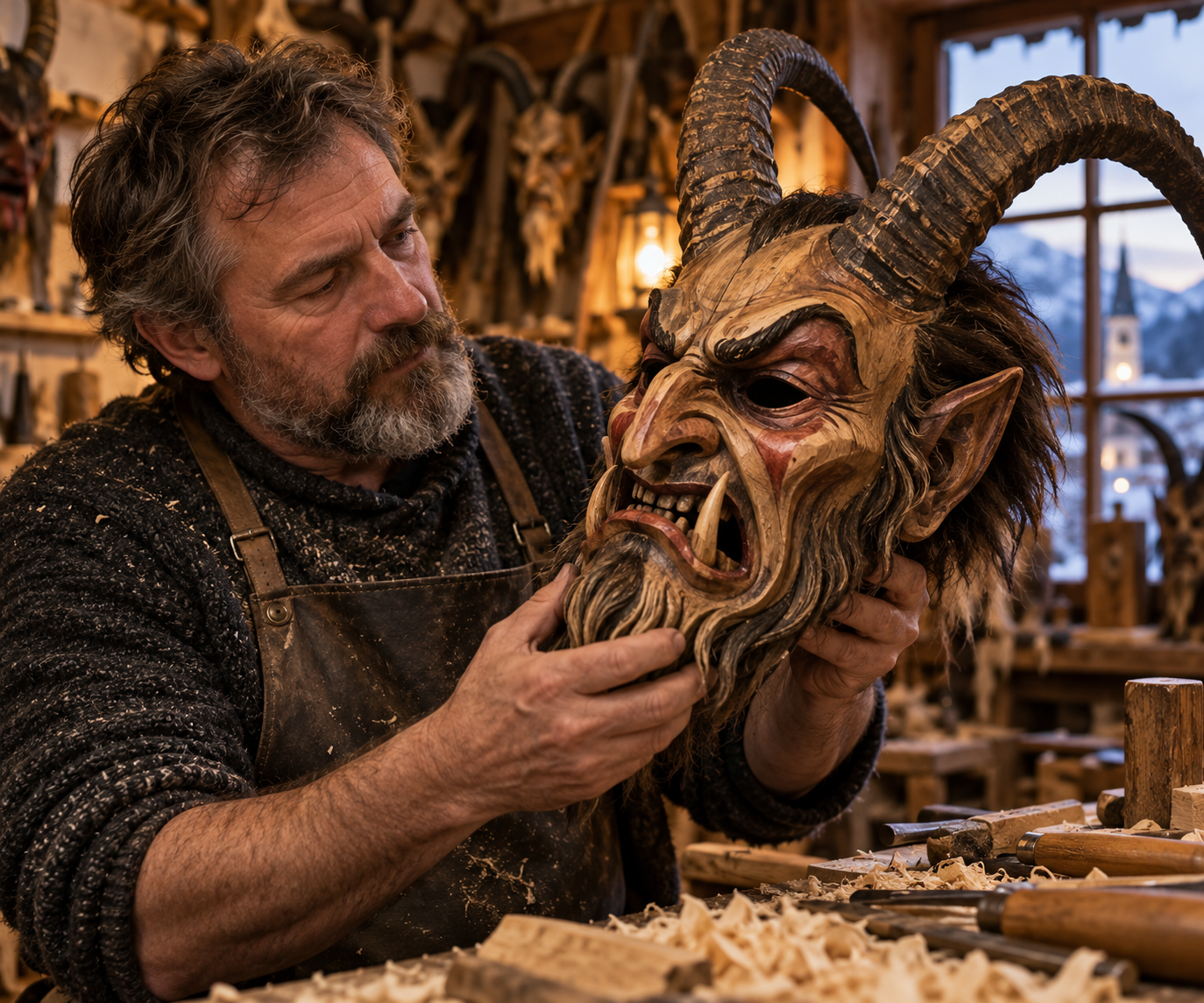
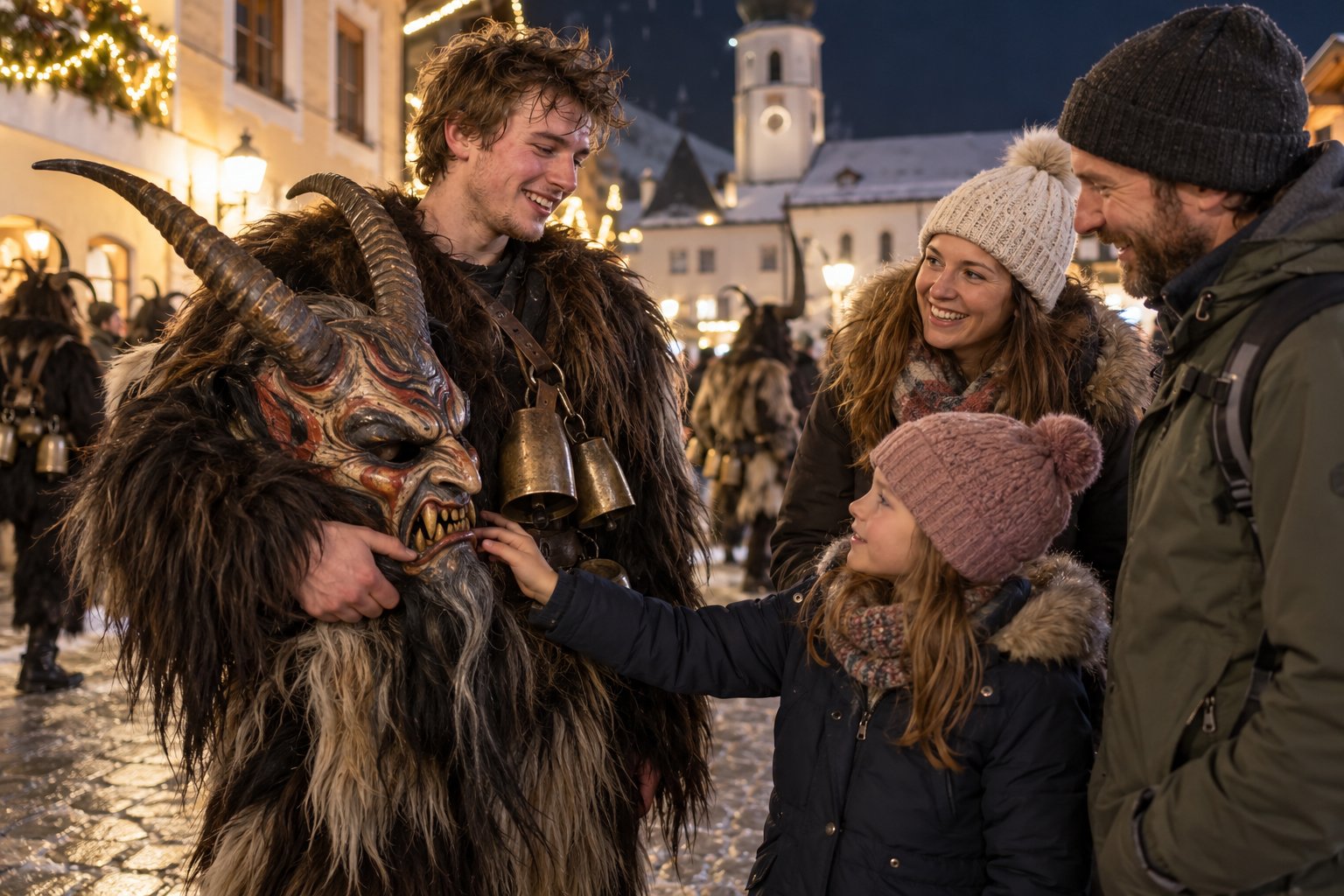
This is a procession, part parade and part controlled chaos, in which young men dress up in astonishingly elaborate Krampus costumes and run through the streets. The costumes are no joke: hand-carved wooden masks that can be genuinely terrifying, towering horns, full suits of shaggy fur or sheepskin, and great clusters of cowbells and chains that announce the creatures’ approach with a din you feel in your chest.
As the Krampuses move through the crowd, they growl, lunge, and chase, and getting a light swat from a Krampus’s switch is all part of the experience. For the young men inside the costumes it is a chance to transform into something wild and frightening for a night, and the processions often spill over into beer halls and celebration afterward.
For spectators it is genuinely thrilling, in the way a good haunted house is thrilling. You know, at some level, that the monster lurching toward you is a neighbor in a costume. It does not stop your heart from jumping when the mask turns your way and the bells start to roar.
Where Krampus Runs
Krampus is not a nationwide German thing so much as an Alpine one. The tradition is strongest in the mountain regions, in the Austrian states of Salzburg, Tyrol, and Styria, in Bavaria in southern Germany, in the South Tyrol region of northern Italy, and across the border into Slovenia and beyond.
In these areas the runs can be major events. The city of Graz in Austria holds large, famous processions, and countless mountain towns and villages stage their own, often organized by dedicated Krampus clubs whose members take the tradition extremely seriously.
That seriousness shows most in the costumes. The masks are frequently hand-carved from wood by specialist craftsmen, genuine works of folk art that can cost a great deal and are treasured and reused for years. A good Krampus suit, with its real fur, heavy bells, and fearsome carved face, represents real money and real craft, and the clubs compete, in a friendly way, to field the most impressive and most terrifying creatures. This is not a cheap bit of dressing up but a living folk art with deep local pride behind it.
Fear on Purpose
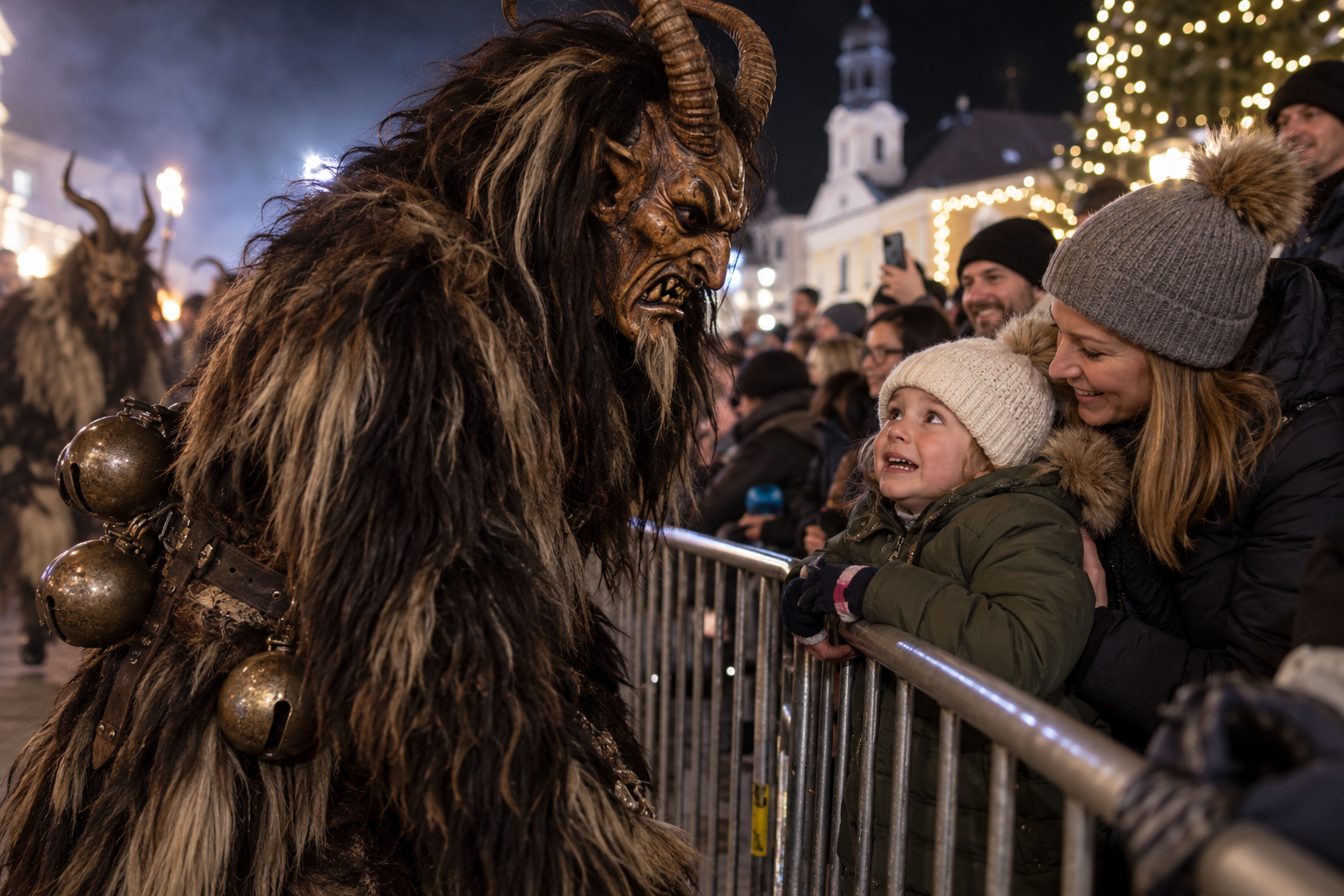
Here is the part that stops Americans in their tracks. The whole point of Krampus, at its root, is to frighten children, and the culture is entirely open about that.
The logic is the oldest in the parenting book, just dialed up to an Alpine extreme. St Nicholas offers the reward, and Krampus supplies the threat, and a child who knows that a chain-rattling demon might be lurking behind the good saint has a powerful incentive to behave in the run-up to the sixth. The fear is not an accident or an unfortunate side effect; it is the mechanism. The whole arrangement runs on a child’s healthy respect for the thing in the mask.
It is worth saying that this is less alien than it first sounds. Plenty of cultures use a bit of benign dread to guide children, from boogeymen to cautionary tales. Krampus is simply the most elaborate, most theatrical, and most committed version of that very old idea anyone has ever built.
To an Austrian, this is not cruelty but tradition, and a beloved one. Children grow up with Krampus, half-terrified and half-thrilled, and most look back on the shivery excitement of Krampusnacht with real fondness, the way others remember a good scary story told at the right age. The fright is understood, by adults and eventually by the children themselves, as a kind of game, a safe and ritual encounter with the monstrous rather than genuine danger.
The Night Americans Would Never Allow
Still, it is easy to see why the tradition gives many American parents pause. The idea of deliberately setting loose terrifying demons to chase and lightly whip small children, as a holiday activity, runs hard against a modern instinct to shield children from fear rather than stage it. More than a few visitors watch a Krampus run with a mixture of fascination and quiet alarm.
And here is the fair and honest part: that unease is not only American. Even within Austria and Germany, there is a real and ongoing conversation about whether Krampus is too much for the very youngest children. Some events now offer gentler, child-friendly versions, post warnings about how frightening the run will be, or keep the scariest Krampuses away from the littlest spectators.
The runs can also, frankly, get rowdy. With young men, elaborate costumes, crowds, and often a fair amount of drinking, there have been occasional complaints and injuries over the years, and some towns have tightened the rules. So this is not a case of one culture simply being braver than another. It is a genuine difference of instinct about children and fear, one that even the home of Krampus is still working out, and both views deserve to be taken seriously.
Why the Dark Belongs to Christmas
Set the debate aside for a moment, though, and there is something worth appreciating in what Krampus represents. His roots reach back before Christianity, into old pre-Christian winter rites, and he carries that ancient weight into the modern holiday.
The pairing of St Nicholas and Krampus is really a very old idea dressed up in horns: that light means more when there is darkness beside it, that goodness is clearer when evil stands next to it, and that a season of reward is also, honestly, a season of reckoning. The Alpine Christmas does not tidy the darkness away. It puts the kindly saint and the horned demon side by side and lets children meet both.
There is something bracing in that, especially measured against the relentlessly sweet and sanitized version of Christmas much of the world now knows. Krampus has lately become a bit of a pop-culture curiosity abroad, turning up in films and ironic greeting cards, but the real tradition remains stubbornly, gloriously Alpine.
For the children who grow up with him, Krampus is not a horror but a part of home, the dark half of a season that has never pretended the dark was not there. The fright and the warmth arrive together, on the same night, and somehow that is exactly the point. And perhaps that is the most interesting thing the tradition has to teach: that a Christmas with a little genuine fright in it can be richer, older, and stranger than one without.

About the Author: Ruben, co-founder of Gamintraveler.com since 2014, is a seasoned traveler from Spain who has explored over 100 countries since 2009. Known for his extensive travel adventures across South America, Europe, the US, Australia, New Zealand, Asia, and Africa, Ruben combines his passion for adventurous yet sustainable living with his love for cycling, highlighted by his remarkable 5-month bicycle journey from Spain to Norway. He currently resides in Spain, where he continues sharing his travel experiences with his partner, Rachel, and their son, Han.