
Here is a fact that shapes the lives of a great many American retirees more than they expected: Medicare simply stops at the border. It pays nothing, with only the narrowest exceptions, the moment you leave the United States. And even at home, basic Medicare has never covered the things that empty retirees’ wallets fastest, dental work above all. But for millions of retirees living in the American Southwest and along the southern border, there is a quiet workaround hiding in plain sight, because the cheap, high-quality healthcare of Mexico is not an ocean away but a short drive, in many cases two hours or less.
So a growing number of them have started doing something genuinely clever: they split their healthcare between two countries, using Mexico for what the American system makes ruinously expensive and keeping Medicare for what it actually covers. Here is how the border healthcare split works, where exactly they go, how much it saves, why the whole thing exists in the first place, and the honest catches to weigh before you try it. It is one of the most practical and least-discussed realities of retiring on a fixed income near the southern border. None of this is medical or financial advice.
What follows is where Medicare actually stops, the famous dental border, the wider border pharmacy, how the split strategy works, and the honest catches to weigh.
Where Medicare Actually Stops
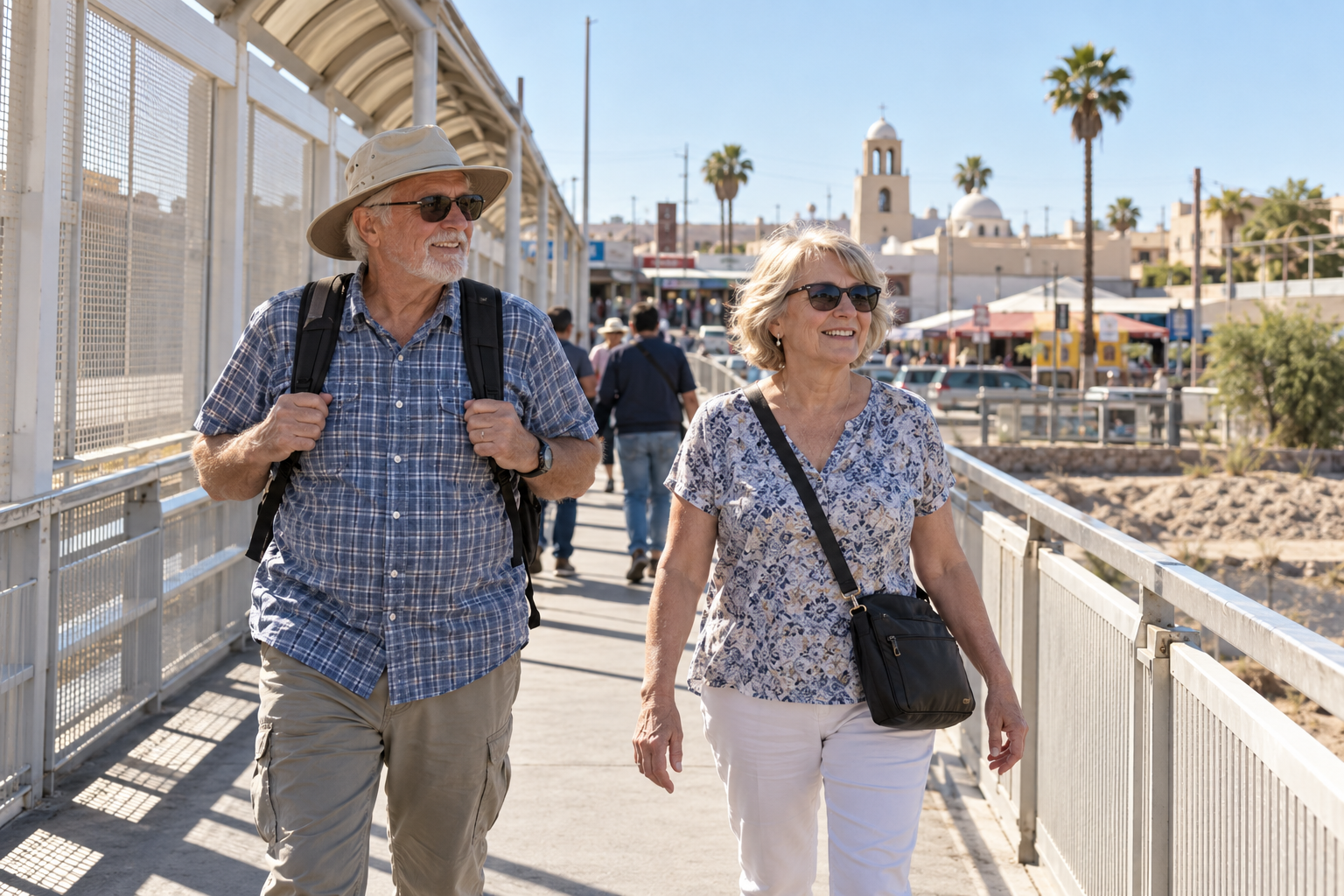
To understand why this strategy exists, you have to understand the two gaps in American coverage that drive it. The first is geographic: Original Medicare does not cover healthcare received outside the United States, so the moment a retiree crosses into Mexico, their Medicare is worthless, and anything they do there comes out of pocket. The second gap is one that catches people even at home: basic Medicare does not cover routine dental care at all, nor most vision and hearing needs, which means that for the single most common and most expensive everyday health cost many older people face, their teeth, they are largely on their own even in the United States.
Put those two gaps together and you get a very particular kind of squeeze. An American retiree needs a crown, a set of dentures, an implant, a pair of glasses, or a stack of prescriptions, and finds that Medicare covers little or none of it and that American prices for all of it are brutal. A single dental implant in the US can run well over two thousand dollars, a crown over a thousand, a full set of work many thousands more, and that is simply not money that most retirees on a fixed Social Security income have sitting around to spend. Faced with those numbers and no coverage, a great many Americans quietly go without the dental care they need, which has real consequences for health and dignity, and it is that grim choice the border strategy is really answering. It is exactly this gap, the care that is both expensive and uncovered, that sends people looking across the border, because it turns out that the very things American healthcare treats as luxuries are available cheaply and competently a short drive south. The strategy is not born of adventure; it is born of arithmetic.
Molar City and the Dental Border
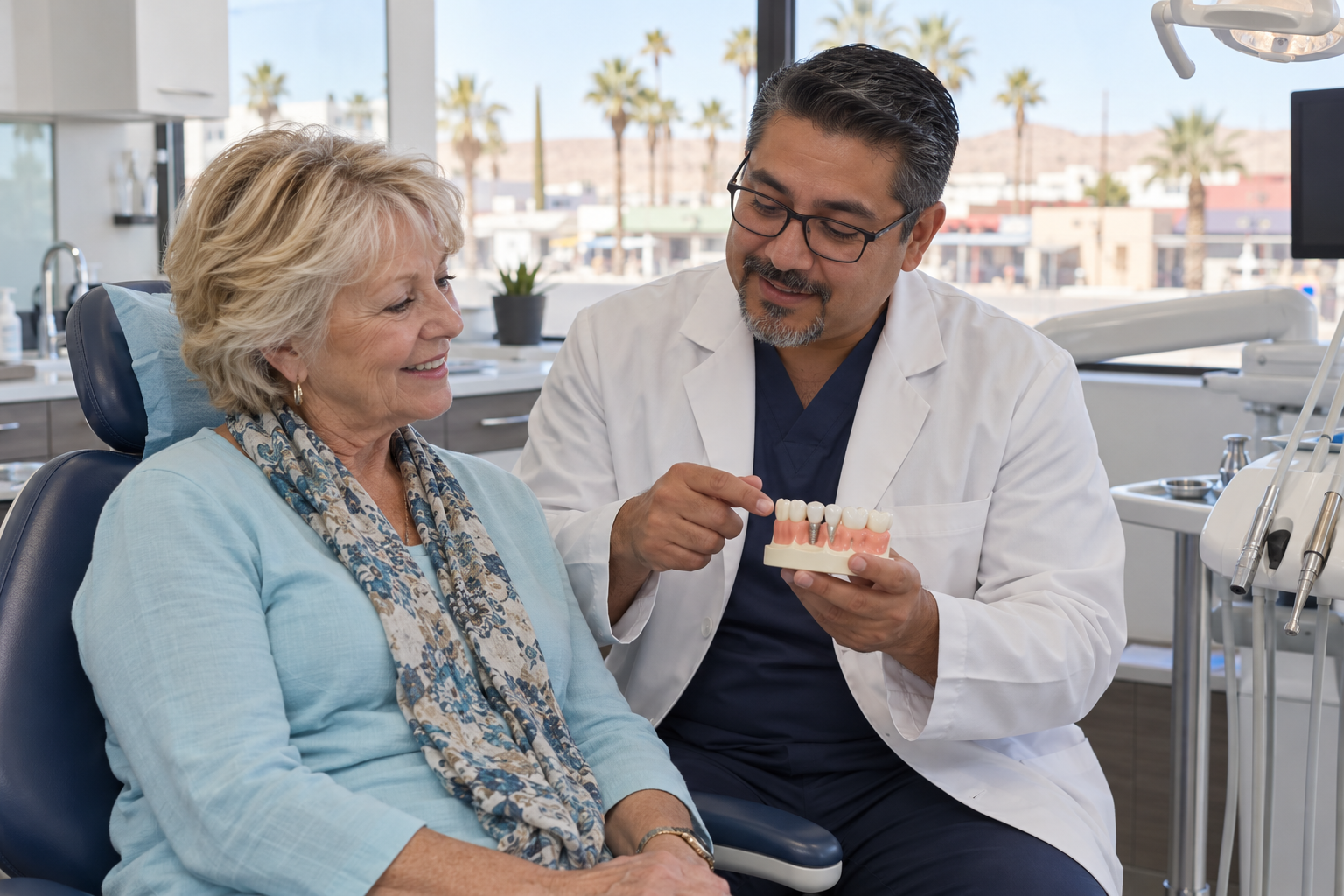
The clearest expression of all this is a tiny Mexican town Americans nicknamed Molar City. Officially it is Los Algodones, in Baja California, sitting right against the border just across from Yuma, Arizona, and it has become, improbably, the dental capital of the world, packing somewhere between three hundred and six hundred dentists into a handful of city blocks, the highest concentration of dentists anywhere on earth. Its entire economy is built around American and Canadian retirees who walk across the border, typically parking their cars in a secure lot on the US side and crossing the last stretch on foot, to get their teeth fixed at a small fraction of US prices before walking back the same day. It is organized, well-trodden, and about as un-intimidating as crossing an international border to see a doctor could possibly be, which is a large part of why so many wary retirees are willing to do it.
And the savings are not small. Dental work there runs fifty to eighty percent cheaper than in the US, with a crown that might cost sixteen hundred dollars at home running around three hundred and fifty there, and an implant that runs well over two thousand dollars in the US starting at a few hundred. For a retiree facing thousands of dollars of uncovered dental work, crossing the border can mean the difference between getting the care and simply going without. Los Algodones is the most famous example, but it is not the only one: Tijuana, just minutes from San Diego, is another major hub, where a basic cleaning can cost as little as sixty dollars and where medical plazas catering to Americans have sprung up near the crossing. Along the whole length of the border, from California to Texas, this kind of dental and medical crossing has become such a routine part of retired life that the snowbirds and Winter Texans who do it hardly think of it as tourism at all; it is just the dentist, who happens to be in another country. Billboards advertising Los Algodones line the highways as you approach the crossing, one after another, a whole visible infrastructure built around the trip.
The Whole Border Pharmacy

Dental care is the headline, but it is only part of the picture, because the border towns have become all-purpose discount health centers for the things the American system prices out of reach. The same Americans who cross for a crown also cross for their prescription medications, which can cost a fraction of US prices at Mexican pharmacies, a saving that for a retiree on several ongoing medications can add up to real money every single month. They cross for eyeglasses and optical care, for routine procedures, and for various elective and specialist treatments that would cost a fortune at home.
Tijuana in particular has grown into a serious medical-tourism destination with modern facilities, and the sheer scale of the cross-border flow is striking: by some estimates around a million Californians travel to Mexico each year for care for medical treatment of one kind or another. The common thread in all of it is proximity. None of this works if the care is a long, expensive, exhausting flight away, but when it is a short drive or even a walk across a land border, it becomes something you can do on an ordinary Tuesday and be home for dinner. That closeness is the entire enabler of the strategy, turning what would otherwise be a daunting medical expedition into a simple errand, and it is why this particular form of cross-border healthcare is concentrated so heavily among retirees who live within easy reach of the border.
How the Split Actually Works
So the strategy that emerges is a deliberate division of healthcare across two countries, matched to what each one does best for the person’s wallet. On the American side, the retiree keeps their Medicare and uses it for what it is built for: hospital care, major medical treatment, serious illness, and the kind of complex or emergency care where being in the US system matters. They do not give up Medicare or stop paying their Part B premiums; it remains the bedrock of the whole arrangement, their coverage for the big, frightening, genuinely expensive things, the hospital stay, the surgery, the serious diagnosis, where you absolutely want to be inside a system with real protections and no out-of-pocket ceiling to worry about. The Mexican side is never meant to replace that; it is meant to handle everything around it.
On the Mexican side, they handle everything that American coverage leaves exposed, the dental work, the prescriptions, the glasses, the routine and elective procedures, paying out of pocket but at Mexican prices that make out-of-pocket affordable. In effect, they let geography do their health insurance shopping for them, sending each type of care to whichever side of the border handles it most sensibly. For a retiree living in Yuma or San Diego or a Texas border town, or in one of the Mexican border communities that attract American expats, this is not exotic at all; it is simply how you manage your health on a fixed income when you happen to live near a line that separates two very different healthcare economies. The border, which to most people looks like a barrier, becomes for these particular retirees something closer to an asset, a seam between two systems that a clever person can work to assemble a complete package of affordable care that neither country, on its own, would have provided them. Living near that seam turns out to be a genuine, if accidental, financial advantage in old age, one that retirees in the interior of the country simply do not have.
Why This Is Really an American Problem

It is worth stepping back to notice what this whole phenomenon actually reveals, because the border healthcare split is less a quirky retiree hack than a symptom of something specific about the United States. A retiree in almost any other wealthy country does not drive across a border to afford a crown, because their own system covers dental care, or prices it reasonably, or both. The elaborate cross-border strategy exists precisely because American healthcare, and American dental care in particular, is both extraordinarily expensive and, for older people, strikingly uncovered, with Medicare leaving teeth, eyes, and ears largely outside its protection. The Mexican dental industry on the border did not spring up by accident; it grew to fill a gap that the American system created.
Seen that way, Molar City is a monument, built entirely out of the holes in US coverage. Every one of those hundreds of dentists in Los Algodones is there because enough Americans could not afford, or were not covered for, the care they needed at home to make a whole town’s economy out of their crossing the border to get it cheaper. That is a striking thing to sit with, and it reframes the retirees who make the trip not as bargain-hunting tourists but as people responding rationally to a system that priced essential care out of their reach. They are not doing anything exotic or irresponsible; they are doing the sensible thing when the care you need is unaffordable on one side of a line and affordable on the other, and the line happens to be a short drive away. The strategy is clever, but the fact that it is necessary at all says more about American healthcare than about the people using it.
The Honest Catches
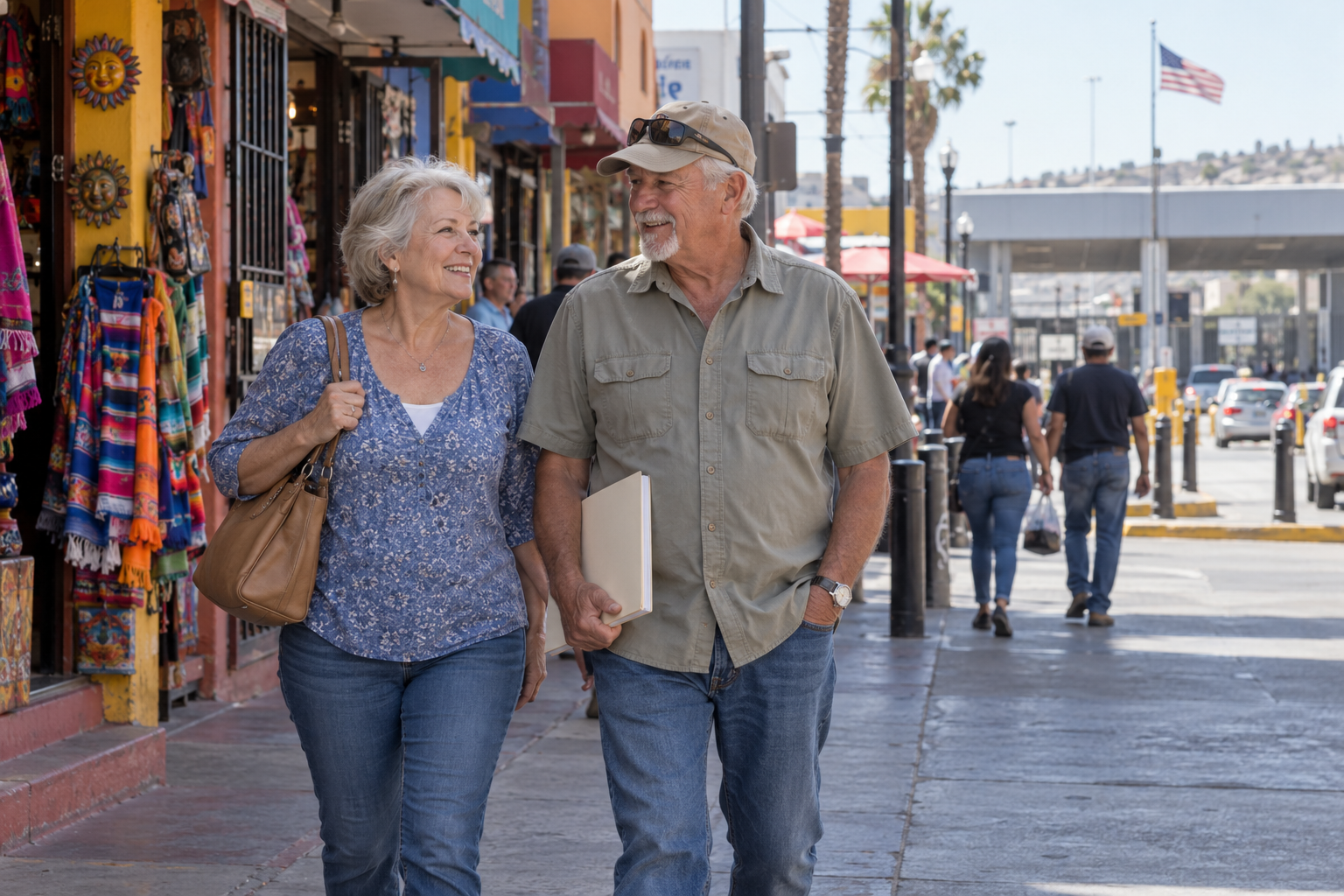
None of this is a free lunch, and anyone considering it should go in clear-eyed about the real limitations. The first is simple: Medicare will not reimburse you for care received in Mexico, so everything you do across the border is money you spend yourself, which works only because the prices are low enough to make that worthwhile. The second, and by far the more important, is quality and vetting, which you cannot afford to be casual about. Standards vary, and while the established border clinics that cater to Americans are often excellent and the best Mexican hospitals are genuinely first-rate, there is a wide range, so doing your homework matters enormously, checking credentials, reading reviews, getting referrals, and choosing reputable, well-reviewed providers rather than whichever storefront is closest to the crossing.
There are structural limits too. Complex treatment that requires multiple visits and follow-up can be genuinely harder to manage across an international border, and continuity of care, having one set of providers who know your whole history, is sacrificed when your care is split between two countries.
This is emphatically not a strategy for true emergencies, where you want the nearest capable hospital regardless of price, and it is not a replacement for Medicare but a supplement that fills specific gaps. The honest bottom line is that for retirees who live within easy reach of the border, who carry sensible US coverage for the serious things, and who approach the Mexican side carefully and deliberately with well-vetted providers rather than whoever is cheapest, splitting healthcare between two countries can be a genuinely smart, practical, money-saving response to the very real holes in American coverage, especially for dental work and prescriptions. Done thoughtfully, it is not a reckless shortcut but a reasonable piece of financial planning for old age. It is not for everyone and it is not without risk, but for the right person in the right place it has quietly become a normal and reasonable way to afford growing old.

About the Author: Ruben, co-founder of Gamintraveler.com since 2014, is a seasoned traveler from Spain who has explored over 100 countries since 2009. Known for his extensive travel adventures across South America, Europe, the US, Australia, New Zealand, Asia, and Africa, Ruben combines his passion for adventurous yet sustainable living with his love for cycling, highlighted by his remarkable 5-month bicycle journey from Spain to Norway. He currently resides in Spain, where he continues sharing his travel experiences with his partner, Rachel, and their son, Han.