
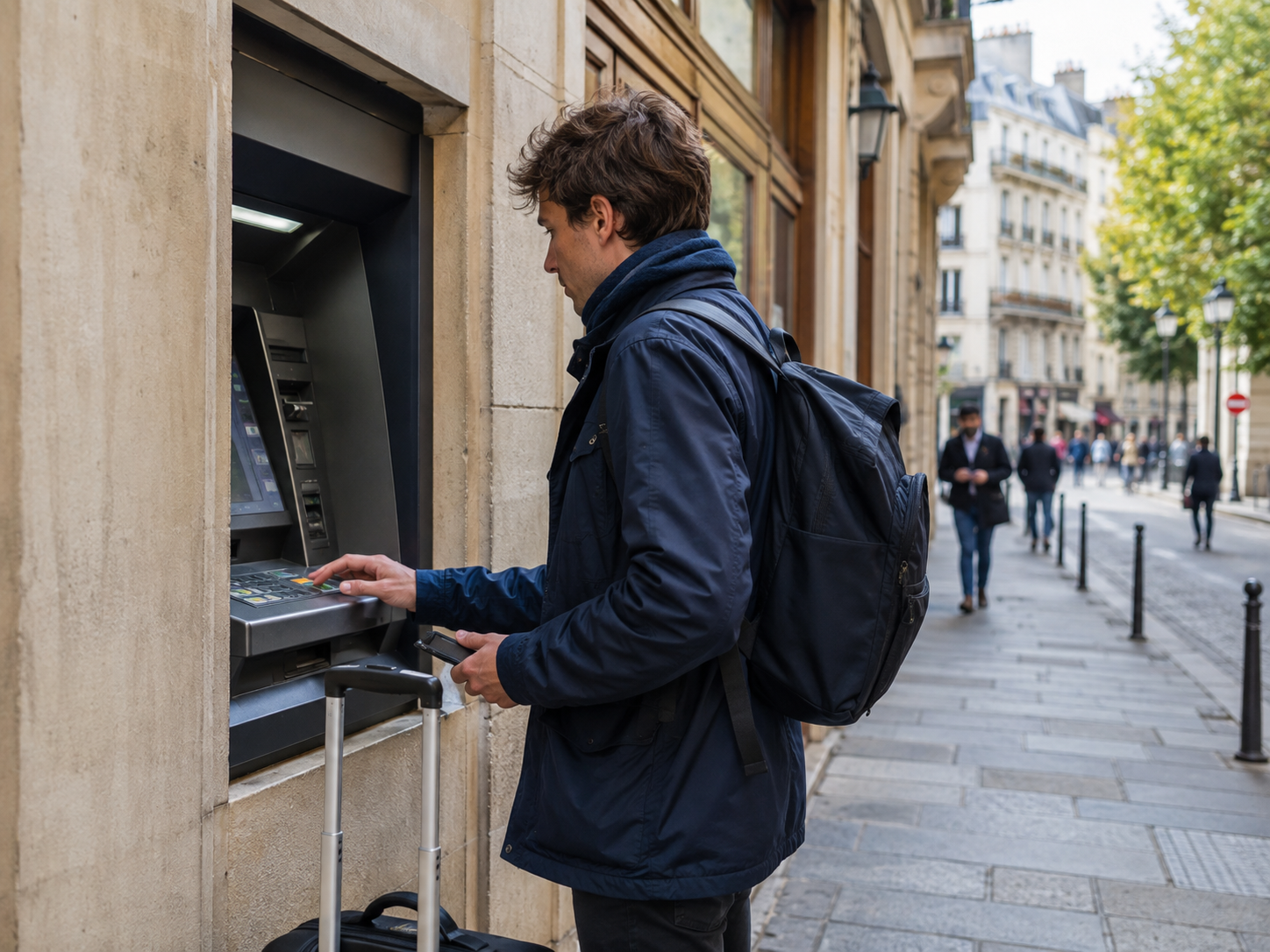
You are standing at an ATM in Rome, or Barcelona, or Prague, asking it for two hundred euros, and just before it hands over your cash it asks one last helpful-looking question. Would you like to be charged in euros, or in your own dollars? Dollars sounds safer, since at least you will know exactly what you are paying, so you tap the dollar button, take your money, and walk off a few percent poorer without ever knowing it. That single screen is one of the most reliable ways travelers and expats overpay in Europe, and the maddening part is that the wrong choice is the one dressed up to look like the smart one.
The button is called Dynamic Currency Conversion, and once you understand what it is really asking, you will decline it every time for the rest of your traveling life. Here is exactly how it works and why the answer is always the same.
What the Button Is Actually Asking
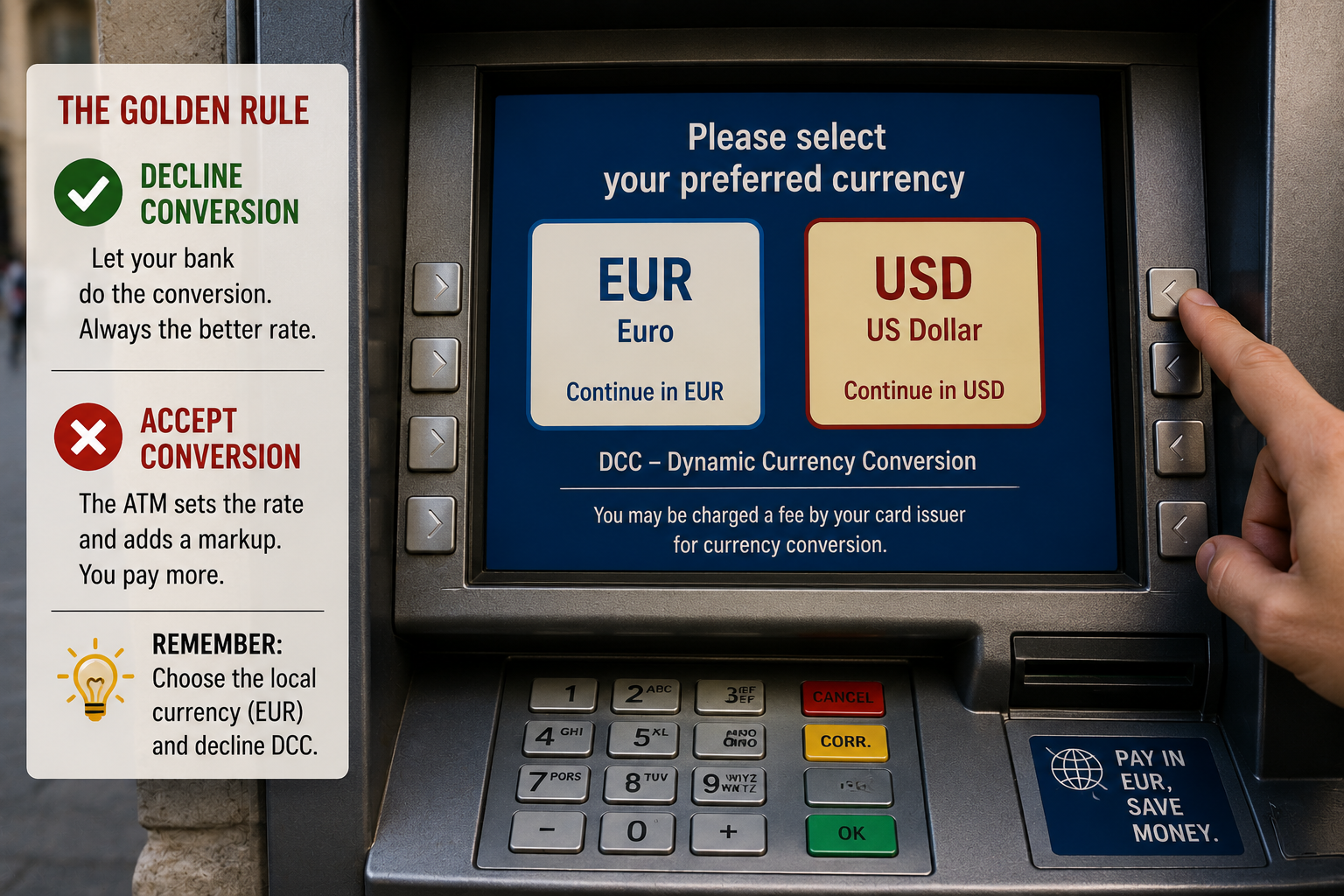
When your card is from one country and the machine is in another, the payment system notices the mismatch and offers you a choice about who does the currency conversion. Dynamic Currency Conversion, or DCC, is the option to have the conversion done then and there, on the spot, so you are billed in your home currency rather than the local one. Choose it, and the ATM shows you a tidy dollar figure and charges you that. Decline it, and you are charged in euros, and your own bank or card network converts the amount later at its own rate.
On the surface this looks like a genuine convenience, because being shown the exact dollar amount removes the small uncertainty of not knowing quite what you will be charged. That is the entire psychological hook, and it is a good one, since seeing a familiar dollar figure feels safer and more controlled than accepting a euro charge you cannot yet translate. But the convenience is a trap, because the price of that certainty is a markup buried in the exchange rate, and it is a markup you almost never want to pay.
Why “Charge Me in Dollars” Is the Wrong Answer
The heart of the problem is who sets the exchange rate. When you accept DCC and choose to be billed in dollars, the conversion is done by the ATM operator or the merchant’s payment processor, not by your card network, and they set a rate that suits them rather than you. That rate carries a markup over the real, wholesale exchange rate, and across Europe that markup typically runs somewhere between 3 and 7 percent, with an average often quoted around 5 percent and extreme cases climbing well into the double digits.
When you decline DCC and let the charge go through in euros, something very different happens. Your own card network, Visa or Mastercard, does the conversion instead, and it uses a rate close to the true interbank rate, usually within about half a percent of the real mid-market figure. So the choice is not really dollars versus euros at all; it is a bad exchange rate set by the machine against a good one set by your card network, and the button that looks like it is protecting you is quietly the expensive door. The reason the operators push it so hard is simple, because that markup is pure profit shared between the ATM operator, the merchant, and the conversion processor, which is exactly why the dollar button is so often the bigger, brighter, friendlier-looking one on the screen.
The Real Numbers on a Single Withdrawal
The percentages sound small until you put real money against them. Take a straightforward €200 cash withdrawal at a European ATM. Decline the conversion, and your card network converts those euros at close to the real rate, so the charge lands at roughly $218. Accept the conversion and let the machine bill you in dollars, and the same €200 is converted at the marked-up rate, so you are charged closer to $230 or $235 instead.
That is somewhere between $12 and $17 gone on a single withdrawal, for absolutely nothing in return, since you received the identical two hundred euros either way. The only thing the extra money bought you was the fleeting comfort of seeing a dollar figure on the screen.
Now scale that across a real trip, with several ATM visits, a hotel bill or two paid by card, and a string of restaurant and shop payments that each offer the same tempting button, and the leak turns into real money. A traveler who accepts DCC everywhere on a two-week trip can quietly hand over the better part of a nice dinner, or more, purely in avoidable markup, which is a genuinely painful way to lose money you never had to spend. And the sting is sharpest for anyone doing this repeatedly, since an expat who withdraws cash and pays bills in Europe month after month, year after year, is not looking at a one-off holiday leak but a small standing tax on their whole financial life, paid over and over for nothing.
Where the Button Ambushes You
Most people first meet this trick at an ATM, but the ATM is only where it is most obvious, and the button hides in far more places than that. It appears whenever you pay by card in a currency different from your card’s, so a restaurant card machine in Lisbon may quietly ask, on the handheld terminal the waiter brings, whether you would like the bill in dollars, and the same offer waits at hotel checkouts, in shops, at ticket machines, and increasingly on foreign websites when you buy online.
The hotel version is one of the sneakiest, because a hotel bill is large, so a few percent of markup on a multi-night stay is a serious sum, and the front desk often frames the dollar option as a courtesy to you. Restaurants and shops are trickier still, since the terminal is in someone else’s hand and the choice flashes by quickly, so it is easy to have the dollar option selected for you before you even register the question. The rule that saves you is the same in every one of these places, whether it is a cash machine, a card terminal, or a checkout page, so once you know to watch for it you can shut the leak everywhere it tries to open. The one place it does not apply is a machine or shop that only ever deals in the local currency and never offers you a choice at all, which is common and completely fine, since there is nothing to decline when no conversion is being pushed. It is only the moment a screen offers you your home currency that the flag should go up.
The One-Word Rule: Local
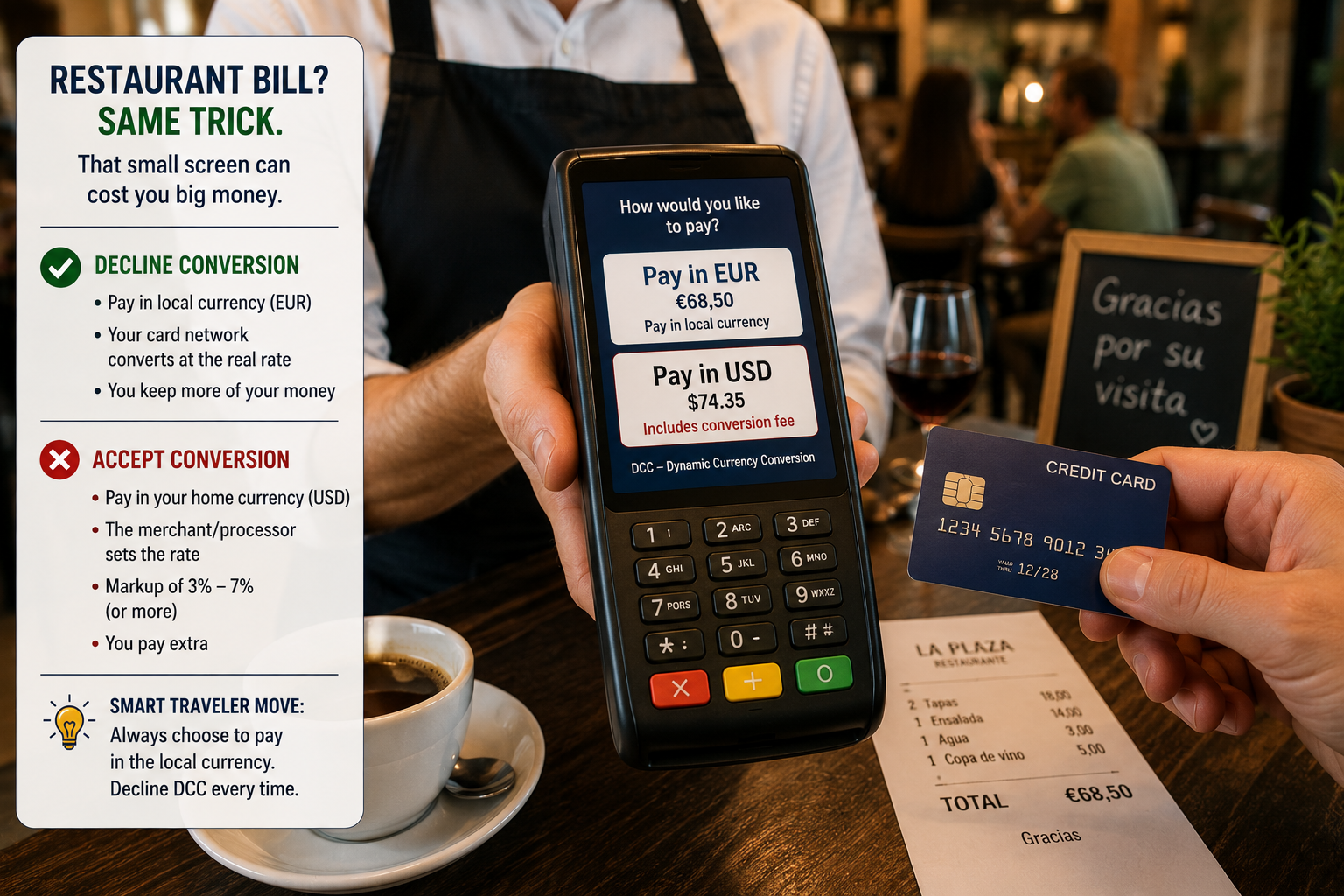
Here is the whole defense, reduced to a single word you can carry for life: local. Whenever a machine or a terminal or a website asks whether you want to be charged in your home currency or the local one, always choose the local currency, euros in the eurozone, koruna in Prague, pounds in London, and let your own card network handle the conversion. Decline the conversion, refuse the dollars, and pay in the money of the country you are standing in, every single time, without exception.
It really is that absolute, because paying in local currency is cheaper in essentially every case, and the rare situation where DCC might come out even is not worth the effort of trying to spot it. The wording on the screen varies and is sometimes deliberately confusing, so you may see “charge in USD” against “charge in EUR,” or “with conversion” against “without conversion,” or “your currency” against “local currency,” but the principle never changes. Pick the option that keeps you in the local currency, and if you are ever genuinely unsure which button does that, choosing to be charged in euros while standing in Europe is the safe instinct.
Decoding the Screen When the Wording Is Tricky
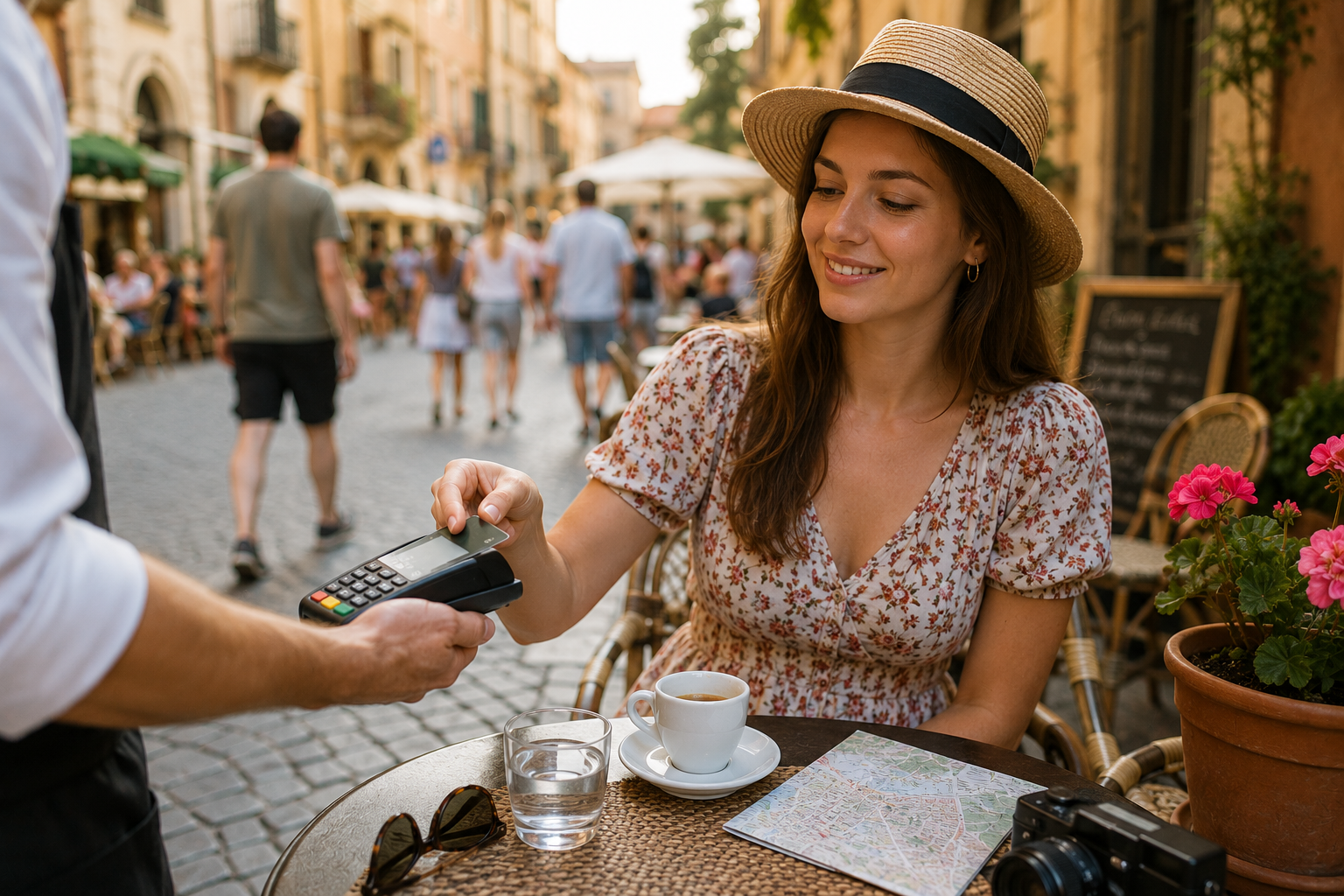
The reason smart people still get caught is that the screens rarely say “pay a hidden markup here,” and the wording is often designed to blur the choice. On an ATM you will usually see two buttons, one offering a clear figure in your home currency and one that says something like “continue without conversion” or “charge in EUR,” and the home-currency button is frequently the larger, greener, more inviting one. Train yourself to distrust the friendly button and reach for the plainer option that keeps you in the local currency.
The phrasings to recognize are worth memorizing, because they recur everywhere. “With conversion” against “without conversion” means you want the one without, since the conversion being offered is the expensive one. “Your home currency” against “the local currency” means you want local. A big USD figure against a smaller-looking EUR button means you want the euros.
On a card terminal a waiter hands you, the machine may simply ask you to press one color for one currency and another for the other, so if you are unsure, ask which one charges in euros and choose that, or hand the card back and say you would like to pay in euros. The staff hear it constantly and it is a completely normal request. When a foreign website offers to bill you in dollars at checkout, the same logic holds, so look for the setting that keeps the charge in the site’s local currency and let your own card convert it afterward.
The Card That Makes It Painless
Declining DCC is the first half of getting this right, and the second half is carrying the right card, because the two work together. The ideal setup is a card with no foreign transaction fees, paired with the habit of always declining the conversion, and together they mean you pay the fair card-network rate and almost nothing on top. Plenty of modern travel and online-bank cards now charge zero foreign transaction fees, so this is an easy upgrade to make before a trip, and it quietly removes the other small leak that sits alongside DCC.
It is worth being clear about the two costs so you do not confuse them. A foreign transaction fee is what some cards charge you for any purchase abroad, typically a percent or two, and it is set by your own bank, while DCC is the separate markup the machine tries to add when it does the conversion instead of your network. A no-fee card removes the first, and declining DCC removes the second, and you want both handled, since a great card still gets skimmed if you keep tapping the dollar button, and a disciplined decliner still pays a little extra on a card that charges foreign fees. Get the card sorted once, build the decline-the-conversion habit, and you have closed both leaks for good.
Why It Feels Safe and Is Not
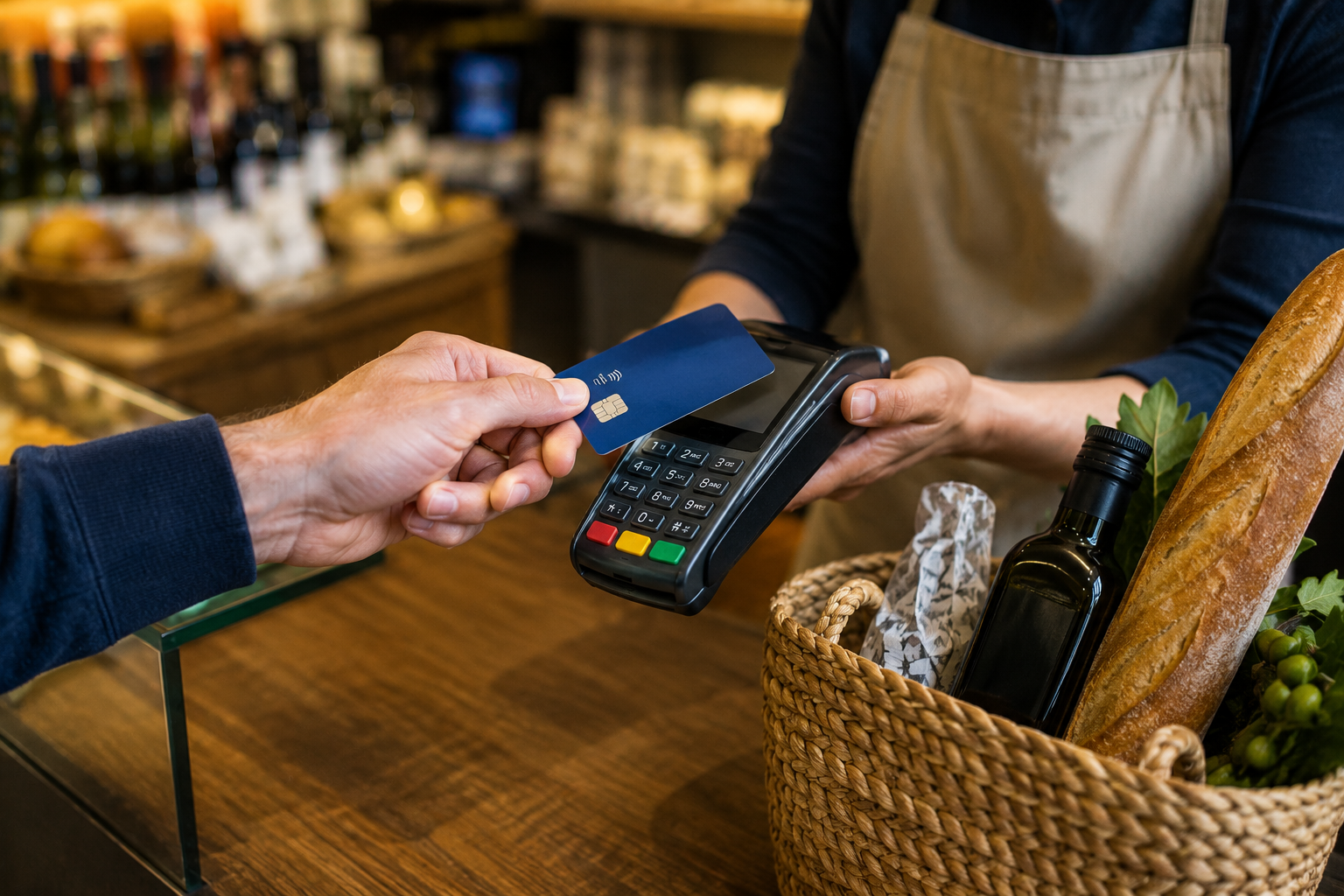
It helps to understand why so many careful, intelligent people fall for this, because the trap is built on a real psychological instinct rather than pure inattention. Seeing a price in your own currency genuinely feels safer, since it removes an unknown, and in most of life reducing uncertainty is the smart move, so the button is designed to hijack a normally sensible instinct and turn it against you. The dollar figure feels like control, when in fact it is the more expensive and less transparent choice hiding behind a friendlier face.
European regulators have noticed, and the rules have tightened, so in 2026 a DCC offer is generally required to show you the markup compared to the official reference rate and to make you actively choose rather than have it slipped past you. That transparency helps, but it does not save the traveler who still taps the dollar button out of habit or hurry, because the disclosure is only useful if you read it and understand what it is telling you. So the regulation is a backstop, not a substitute for the simple rule, and the reliable protection is still your own decision at the screen. Know that the comfortable-looking option is the costly one, choose local anyway, and the tightened rules become a bonus rather than your only defense. Think of the disclosure as a receipt for a mistake you are choosing not to make, useful to glance at but never something to rely on in place of the habit itself.
Say No, Every Time

The lovely thing about this particular money leak is how completely it is within your control, since unlike airfare or exchange-rate swings, DCC is a cost you simply decline. There is no app to download, no rate to track, and no timing to get right, just one steady habit: when the machine offers to charge you in dollars, say no, and pay in the local currency instead. Do that at every ATM, every card terminal, and every foreign checkout, and you keep the few percent that would otherwise vanish into someone else’s margin.
For anyone who travels to Europe often, or who is building a life that straddles the Atlantic, this one small discipline adds up to real money over the years, quietly, in the background, for no effort beyond a moment’s attention at the screen. The button will keep looking helpful, the dollar figure will keep looking safe, and the right answer will keep being the same. Charge me in the local currency, thank you, and let my own bank do the math. It is one of the very few money rules that is genuinely absolute, easy to remember, and pays you back every time you use it, which makes it about the best travel-money habit there is to carry in your head.
Exact markups do vary, of course, by machine, country, and operator, and the rules keep evolving, so treat the percentages here as the usual range rather than a fixed figure, and check your own card’s foreign-transaction terms before a trip so you know precisely what you are and are not paying.

About the Author: Ruben, co-founder of Gamintraveler.com since 2014, is a seasoned traveler from Spain who has explored over 100 countries since 2009. Known for his extensive travel adventures across South America, Europe, the US, Australia, New Zealand, Asia, and Africa, Ruben combines his passion for adventurous yet sustainable living with his love for cycling, highlighted by his remarkable 5-month bicycle journey from Spain to Norway. He currently resides in Spain, where he continues sharing his travel experiences with his partner, Rachel, and their son, Han.