
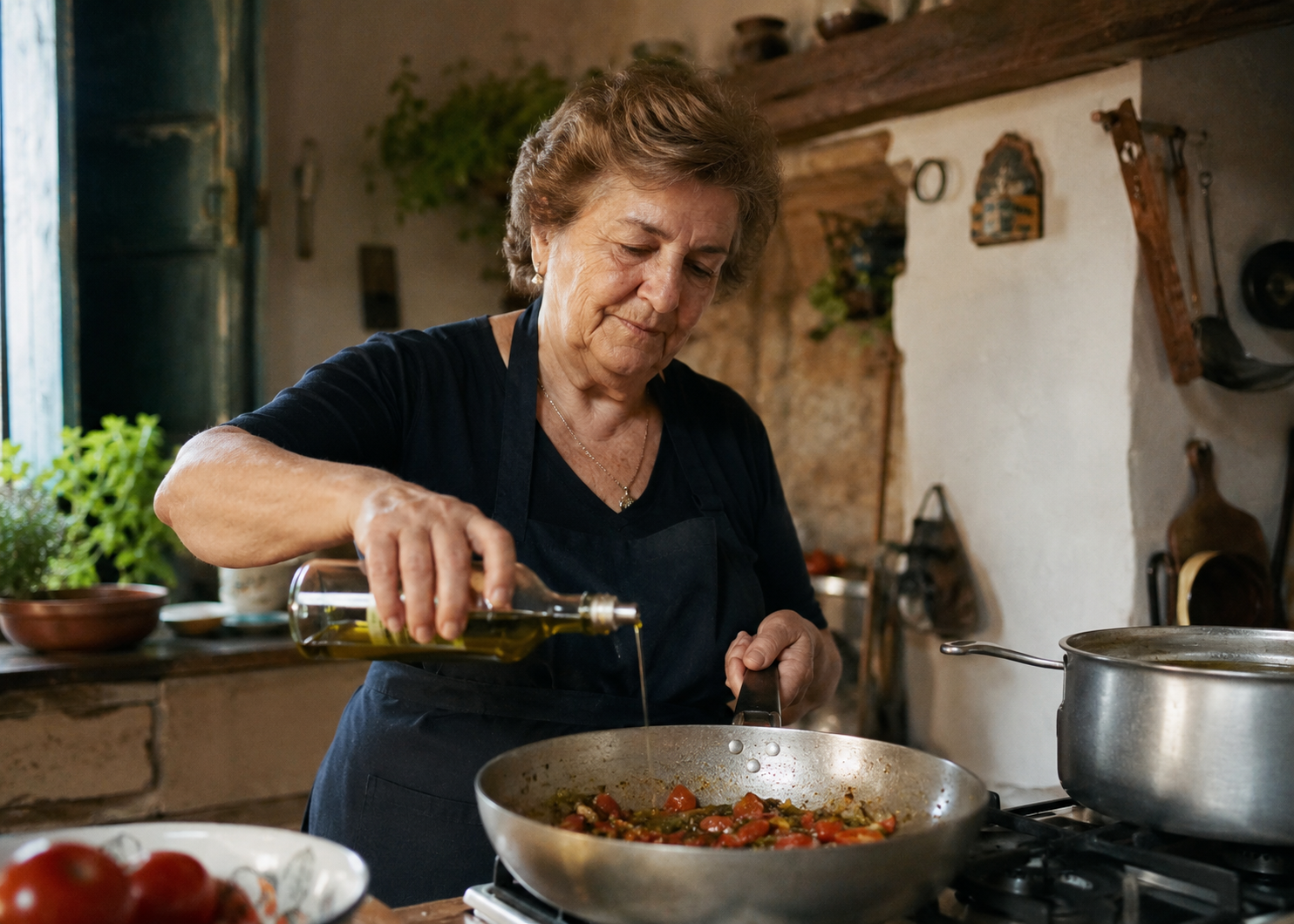
Open the cupboard of a typical American kitchen and somewhere near the stove sits a can of cooking spray, the aerosol that hisses a thin film of oil onto a pan with a press of the nozzle. Open an Italian kitchen cupboard and you will not find it. In its place is a bottle of olive oil, poured by hand, and to an Italian cook the very idea of spraying oil from a can is faintly baffling, a solution to a problem they do not believe they have.
From Spain, where olive oil is poured with the same unselfconscious generosity, the American cooking spray looks like exactly the kind of product that gets invented to solve a problem the Mediterranean kitchen solved centuries ago with a bottle and a steady hand. The spray is not evil, and this is not a health scare. But the gap between the can and the bottle says something real about two different ways of cooking, and the Italian way is worth understanding even for a kitchen that keeps the can.
What Is Actually In The Can

Start with what cooking spray actually is, because most people who use it have never read the label closely.
Cooking spray is not simply oil in a can. It is oil combined with a few other things that let it spray, cling, and keep, typically an emulsifier such as lecithin, an anti-foaming or anti-clumping agent, and a propellant gas that pushes the spray out of the nozzle. The oil itself is usually a neutral refined oil, canola or vegetable or a blend, chosen for being cheap and flavorless rather than for tasting of anything. The result is a product engineered for one job, laying down the thinnest possible non-stick film with the least possible effort.
The Italian objection is not that any of these ingredients is dangerous, because in ordinary use they are not. The objection is more fundamental, that the can contains a processed product assembled from refined oil and additives, where the Italian kitchen wants a single ingredient, good olive oil, and nothing else. To a cook raised on the idea that fewer and better ingredients make better food, a can that turns oil into a sprayable processed product is a step in exactly the wrong direction, adding complexity and additives to something that was perfect as it was.
The Olive Oil The Italians Reach For Instead

What sits in the Italian kitchen instead of the can is the thing the whole cuisine is built on, and the contrast is the heart of the matter.
Italians cook with extra virgin olive oil, the good stuff, poured straight from the bottle, and they use it generously, as a flavor and not merely as a non-stick agent. This is the crucial difference. Cooking spray exists to apply oil invisibly, in the smallest amount that will keep food from sticking, treating the oil as a necessary evil to be minimized. The Italian pours olive oil because the oil is part of the dish, a source of flavor and richness that the cooking is meant to showcase, not hide.
The everyday Italian kitchen often keeps two oils for two jobs. A more everyday olive oil or a regular extra virgin for cooking, for the pan and the heat, and a finer, more expensive extra virgin kept for finishing, drizzled raw over a finished dish, a soup, a salad, a piece of grilled fish, where its flavor comes through undiluted. The oil is treated as an ingredient worth choosing carefully and using with intention, the opposite of the anonymous neutral oil hidden inside a spray can. Where the American reaches for the can to use as little oil as possible, the Italian reaches for the bottle to use the right oil well.
Why The Spray Got Invented At All
It helps to understand why cooking spray became an American staple, because the reasons reveal the different assumptions behind the two kitchens.
Cooking spray rose on the back of the American low-fat era, the decades when dietary fat was treated as the enemy and every gram of oil was something to minimize. A product that let you grease a pan with a fraction of the oil fit that moment perfectly, promising the non-stick function of oil with almost none of the fat and the calories. The spray was a creature of a particular nutritional ideology, the belief that less fat was always better, and it spread through American kitchens as that belief took hold.
The Mediterranean never went through that conversion, which is why the spray never arrived. Olive oil was understood, correctly as it turned out, as a healthy fat central to a healthy diet, not a thing to be minimized but a thing to be embraced, and the science eventually came around to the Mediterranean view. So while the American kitchen was learning to fear oil and reach for the spray, the Italian kitchen kept pouring olive oil with confidence, and the product designed to solve the fat problem simply had no problem to solve in a culture that never believed fat was the enemy in the first place.
The Practical Case Against The Spray

Beyond the philosophy, there are concrete cooking reasons Italians and many serious cooks avoid the aerosol, and they are worth knowing even if you keep a can around.
The propellants and additives in many sprays can build up over time into a sticky, varnish-like residue on pans, particularly on non-stick cookware, where the very product meant to prevent sticking can leave a gummy film that is hard to scrub off and can degrade the pan’s surface. Many non-stick cookware makers actually advise against using aerosol sprays on their pans for exactly this reason, which is a quiet irony given that non-stick pans are where people reach for the spray most.
There is also the matter of control and flavor. A spray lays down an anonymous, flavorless film, while a measured pour of good olive oil from a bottle, or a little oil rubbed around a pan with a brush or a paper towel, gives the cook control over how much goes in and brings actual flavor to the food. For a cook who cares how the dish tastes, the spray trades away flavor and control for convenience, and the Italian view is that the trade is a bad one. A bottle of oil and a moment of attention do the job better in every way that matters except speed.
The Honest Note On Health
Because the question of skin and health deserves a straight answer rather than a sales pitch, here is the honest version, kept brief and bounded.
There is no good evidence that ordinary use of cooking spray harms your skin or that giving it up transforms your complexion, and anyone promising a dramatic skin change from dropping the can is selling a story rather than reporting a fact. Skin is affected by a long list of things, sun, sleep, hydration, genetics, overall diet, hormones, and isolating a single kitchen product as the cause of a change is the kind of simple story that feels satisfying and is almost never true. If your skin changes after a dietary shift, it is far more likely the result of many changes at once than of one swapped ingredient.
What can be said honestly is gentler and more useful. Replacing a processed spray made of refined oil and additives with good extra virgin olive oil is a reasonable swap on its own terms, because extra virgin olive oil is a genuinely healthy fat with real evidence behind it, rich in the compounds that make the Mediterranean diet protective. That is a sound reason to pour the bottle rather than spray the can, no skin miracle required. The benefit is the quality of what you are eating, not a transformation you can photograph, and that is a good enough reason without inventing a better one.
How To Cook The Italian Way Without The Can
For anyone who wants to leave the spray behind, the Italian alternative is simple, cheap, and requires nothing but a bottle and a little technique.
To grease a pan, pour a small amount of olive oil in and wipe it around with a paper towel or a pastry brush, which gives you the same thin even film the spray provides, with real oil and full control over the amount. For most cooking, simply pour the oil you need straight into the hot pan, a circle around the bottom, and let it heat before the food goes in. A refillable oil bottle with a pour spout, or a simple oil mister you fill with your own olive oil, covers the few cases where you genuinely want a fine spray, without the propellants and additives of the commercial can.
The deeper shift is one of attitude rather than equipment. The Italian kitchen does not try to use as little oil as possible. It tries to use good oil well, treating it as a central ingredient to be chosen with care and used with intention, generously where the dish calls for it and finely where it does not. Adopt that view and the cooking spray simply falls away, not because anyone banned it but because once you are pouring good olive oil with confidence, the can in the cupboard stops making any sense. The Italians did not give up cooking spray. They never needed it, and the kitchen that pours from the bottle is the better one for almost everything you will cook.
The Smoke Point Question

One genuine cooking consideration sits underneath the bottle-versus-can choice, and it is worth getting right because it is where defenders of the neutral oil have their strongest point.
Every oil has a smoke point, the temperature at which it begins to break down and smoke, and the worry people raise about cooking with extra virgin olive oil is that its smoke point is lower than that of the refined neutral oils inside most cooking sprays. There is a kernel of truth here, refined oils do tolerate higher heat, but the fear is largely overblown for the way Italians actually cook. Good extra virgin olive oil has a smoke point comfortably high enough for the sautéing, frying, and roasting that fill an everyday Mediterranean kitchen, and Italians and Spaniards have deep-fried in olive oil for generations without trouble.
The real point is that most home cooking does not approach the temperatures where this matters. The gentle sofrito, the simmered sauce, the roasted vegetables, the pan of eggs, none of these run hot enough to trouble a decent olive oil. The cases where a very high smoke point genuinely matters, screaming-hot wok work or certain deep-frying, are the exception in a Mediterranean kitchen, not the rule, and even then olive oil performs better than its reputation suggests. The smoke-point objection turns out to be a reason some cooks keep a neutral oil around for specific high-heat jobs, not a reason to spray refined oil onto every pan, and certainly not a reason to distrust the bottle for ordinary cooking.
What The Cupboard Says About The Cook
Step back from the specifics and the cooking spray becomes a small window onto a much larger difference between the two food cultures, which is the real reason it is worth writing about at all.
The American cupboard, with its can of spray, its bottle of neutral vegetable oil, and often a separate bottle of olive oil reserved for salads, reflects a kitchen organized around convenience and around a decades-old anxiety about fat. Each product does a narrow job, and the oil is frequently treated as a functional necessity to be minimized rather than a pleasure to be used. The spray is the purest expression of that mindset, oil reduced to its non-stick function and stripped of flavor, applied invisibly and apologetically.
The Italian cupboard, with its bottle of good olive oil doing nearly everything, reflects a kitchen organized around flavor, quality, and the confidence that good fat is good food. The same oil greases the pan, cooks the sofrito, dresses the salad, and finishes the soup, because it is genuinely good and genuinely central, not a thing to be hidden but the very taste of the cuisine. The difference between the two cupboards is not really about cooking spray. It is about whether oil is a problem to be managed or an ingredient to be celebrated, and on that question the Mediterranean has been right for a very long time. The empty space in the Italian cupboard where the spray would be is not a gap. It is a statement.
Choosing The Oil Worth Pouring
If the Italian answer is to pour good olive oil rather than spray refined oil, then the practical question becomes how to choose an oil worth pouring, and this is where a little knowledge saves both money and disappointment.
The label matters more than most shoppers realize. Extra virgin olive oil is the top grade, oil from the first pressing with no chemical processing and a low acidity, and it is the one with the flavor and the health compounds intact. Below it sit grades labeled simply olive oil or refined, which have been processed and stripped of much of what makes the extra virgin worth having. A bottle that just says olive oil or pure olive oil is a different and lesser product than one that says extra virgin, and the price difference reflects a real difference in the bottle. Buying the cheapest oil labeled simply olive oil to save money is, from the Italian point of view, missing the entire point of cooking with oil at all.
Freshness and storage matter too, in ways the can never required you to think about. Olive oil is a fresh product that degrades with light, heat, and time, which is why Italians buy it in dark bottles or tins, store it away from the stove rather than beside it, and use it within a reasonable window rather than letting a bottle sit open for years. A good oil kept badly becomes a mediocre oil, and the cook who invests in a fine extra virgin should keep it in a cool dark cupboard and treat the date on the bottle as real. None of this is difficult, but it is a different relationship with the ingredient than spraying from a can that sits by the burner for eighteen months, and it is part of what it means to cook the way the Mediterranean does, with attention to the thing you are actually eating.

About the Author: Ruben, co-founder of Gamintraveler.com since 2014, is a seasoned traveler from Spain who has explored over 100 countries since 2009. Known for his extensive travel adventures across South America, Europe, the US, Australia, New Zealand, Asia, and Africa, Ruben combines his passion for adventurous yet sustainable living with his love for cycling, highlighted by his remarkable 5-month bicycle journey from Spain to Norway. He currently resides in Spain, where he continues sharing his travel experiences with his partner, Rachel, and their son, Han.