
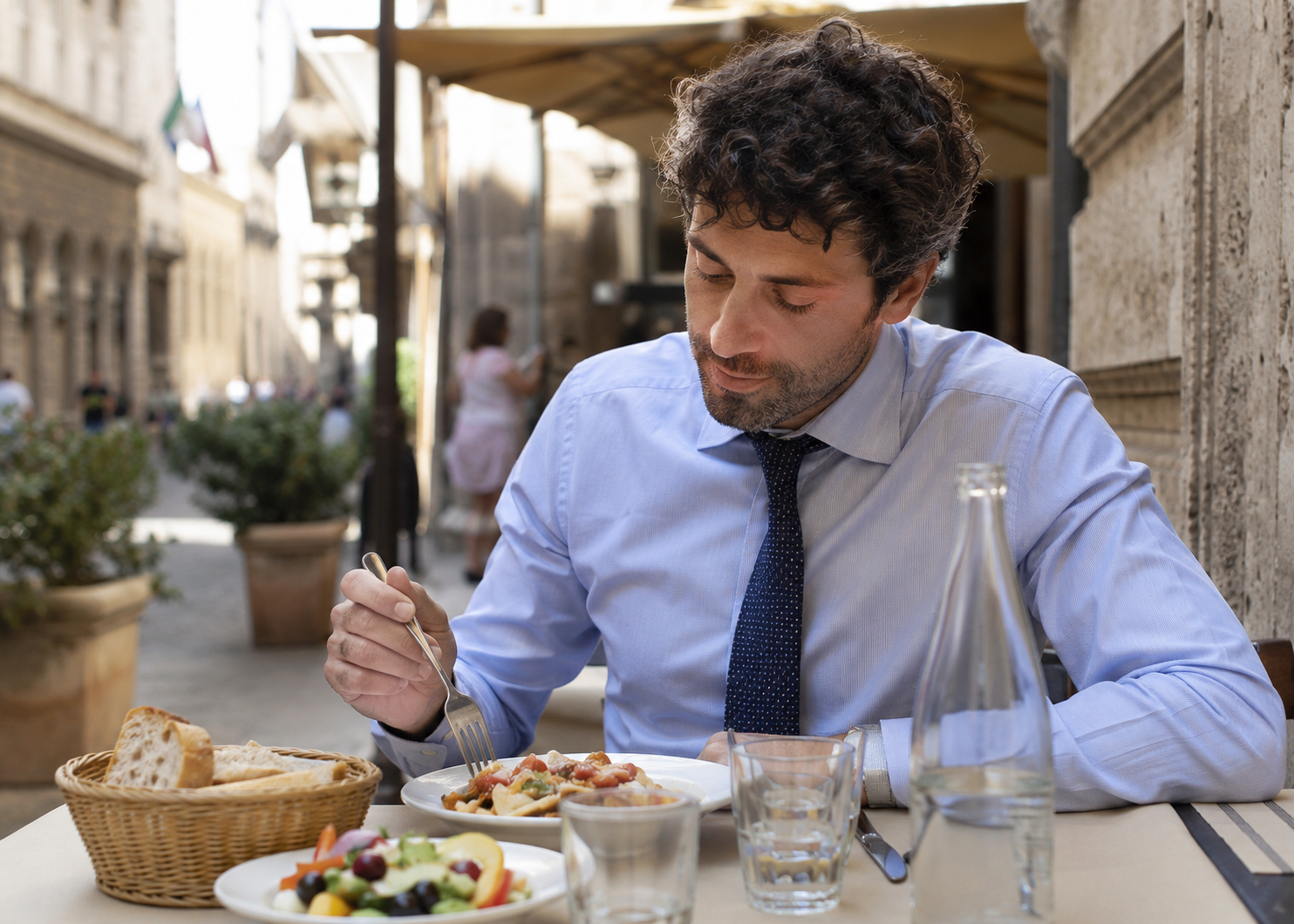
An office worker in Bologna at 12:45pm closes his laptop, walks to a small trattoria three minutes from his building, and sits down at a table. He orders the menu of the day. He eats his lunch sitting in a chair at a table with cutlery, conversation with the waiter and other regulars, and approximately 60 minutes of attention to the food. He returns to the office at 2:00pm. He does not experience post-meal acid reflux.
His American counterpart in Atlanta at 12:30pm eats a sandwich at his standing desk while answering email. The lunch lasts approximately 11 minutes. He continues working through chewing. By 2:30pm he is taking his daily antacid. The bottle of acid reflux medication in his desk drawer is opened multiple times per week. The pattern has been continuous for several years.
The Italian habit of sitting down to eat is not specifically about food. It is about the physiological state in which the body processes food. Eating while standing or while working produces different digestive outcomes than eating while sitting and focused on the meal. The research on this is substantial. The mechanism is increasingly understood. The implications for adults experiencing acid reflux are practical.
This piece walks through what the Italian sitting-to-eat habit actually involves, what the research shows about posture and acid reflux, what the 60-day pattern reveals for adults who shift from standing-or-working eating to sitting eating, and what the broader implications are for daily eating practices. Anyone with diagnosed gastroesophageal reflux disease, active esophageal damage, or who takes prescribed reflux medications should discuss any changes with their physician. The patterns described here are observed across populations and are not medical advice for any specific individual.
What The Italian Sitting-To-Eat Habit Actually Is

The Italian practice of sitting down to eat has specific features that differ from American eating patterns in ways that affect digestion.
Eating happens in chairs at tables. Not at counters. Not at desks. Not in cars. Not while walking. The meal location is a chair at a table with proper place settings. The practice begins with the physical orientation of the body in proper eating posture.
Eating takes time. Italian lunches typically run 30 to 90 minutes. Even quick lunches at neighborhood trattorias take 30 minutes. The duration accommodates the digestive process that begins as soon as food enters the mouth. The American 11-minute desk lunch does not accommodate this process.
Eating is the activity. Not eating-plus-working. Not eating-plus-driving. Not eating-plus-walking. The food is the focus. The mind and body are engaged with the meal rather than distributed across multiple activities.
Eating is social or at least observed. Italian lunches typically involve other people: family, colleagues, friends, or the regular patrons and waiter at the local trattoria. Even solo Italian lunches typically happen in observed contexts (a small restaurant, a café) rather than in isolated work contexts. The social context affects the eating pace and pattern.
Eating involves cutlery and plates. Even casual Italian lunches use proper cutlery and proper plates. The mechanical actions of eating are slower and more deliberate than the actions of eating finger food while typing.
Eating proceeds at conversational pace. Italian lunches develop in pace with conversation. Pauses between bites. Time to taste. Recognition of the food. The pace is structured by the social context rather than by efficiency optimization.
Eating does not involve devices. Most Italian workplaces and homes maintain the convention that phones and screens are not used at meals. The attention is on the food and the company rather than divided across digital input.
Eating ends with a transition. The meal concludes with coffee, with conversation, with the natural completion of the social and culinary event. The transition back to work or other activities happens after the meal has properly ended, not during the eating itself.
The combined practice produces eating that operates in a specific physiological state. The body is sitting, calm, focused, engaged with the food, processing the meal as a meal rather than as fuel injection. The digestive system operates differently in this state than in the state produced by standing-and-working eating.
What The Research Shows About Posture And Acid Reflux

The research on body position and digestion has produced specific findings relevant to the acid reflux question.
Upright sitting posture supports proper esophageal function. When a person eats sitting upright with the torso at approximately 90 degrees to the legs, gravity assists the movement of food from the esophagus into the stomach. The lower esophageal sphincter functions properly in this position. Acid reflux is less likely.
Standing posture produces different esophageal dynamics. When a person eats standing up, the spinal column is in a different orientation. Some research suggests that standing can produce slight changes in lower esophageal sphincter function that affect reflux risk, though the effects are smaller than for other postures.
Slouching or reclining posture substantially worsens reflux risk. Eating while lying down, reclining, or significantly slouched produces conditions in which gastric contents can move backward into the esophagus more easily. The American pattern of eating in cars (often slouched or reclined in seats) and eating in front of televisions (often slouched on couches) produces these conditions reliably.
Eating speed affects reflux risk substantially. Fast eating produces larger boluses of food entering the stomach, more rapid gastric distension, and greater pressure on the lower esophageal sphincter. Slow eating allows the stomach to expand gradually and reduces the pressure that drives reflux. The 11-minute American desk lunch is structurally fast. The 60-minute Italian lunch is structurally slow.
Attention to eating affects digestive function. The cephalic phase of digestion, which begins as soon as the sight and smell of food are recognized, prepares the digestive system for the meal. Eating while distracted by work reduces the cephalic phase activation. The digestive system processes the food less efficiently when it has not been properly prepared.
Stress during eating affects digestive function. Eating while stressed (which the American working lunch often involves) activates the sympathetic nervous system, which suppresses parasympathetic functions including digestion. The food enters a body in fight-or-flight state rather than rest-and-digest state. Digestion proceeds poorly in this condition.
Combined effects compound. A person eating slouched at a desk while stressed, in 12 minutes, while working, produces conditions in which reflux is structurally likely. Each of the conditions individually increases reflux risk modestly. Combined, they produce conditions in which reflux is almost inevitable.
What The 60-Day Pattern Reveals

For Americans who shift from standing-or-working eating to sitting-at-tables eating for 60 days, the pattern observed across consumer reports is consistent enough to describe.
Days 1 to 10: structural adjustment. The shift from standing or desk eating to sitting at a table is mechanically simple but psychologically difficult. American work culture produces continuous pressure to use lunch time for work tasks. Sitting at a table for 30 to 60 minutes feels indulgent or inefficient. The first ten days often involve resistance from work colleagues, from the worker’s own habits, and from scheduling pressures.
Days 10 to 25: digestive shifts begin. Some adopters report improved digestion within the first three weeks. The post-meal acid reflux that drove the antacid use begins to diminish. The frequency of antacid use typically drops noticeably during this period for adopters who experience the structural pattern.
Days 25 to 45: pattern stabilization. The new eating routine becomes habit. The improved digestion stabilizes. The antacid bottle in the desk drawer is opened less frequently. Some adopters report that they have gone more than a week without taking any antacid for the first time in years.
Days 45 to 60: settled new normal. The Italian-style sitting lunch becomes the default. The American working lunch feels uncomfortable when occasionally revisited. The reflux that defined daily life has substantially reduced or, for some adopters, effectively resolved.
The pattern is not universal. Some adopters see modest improvements rather than dramatic ones. Some see no change. Some have underlying conditions (hiatal hernia, severe GERD, esophageal damage) that the postural change cannot address. The 60-day trial reveals individual response rather than producing guaranteed outcomes.
Sleep effects sometimes emerge. The reduced post-meal reflux often improves sleep quality, particularly when the change extends to lighter, earlier dinners eaten sitting at tables. The cascading effect on overall energy and wellbeing is meaningful for adopters who experience it.
Weight effects are usually modest. The slower eating sometimes produces small weight loss as satiety signaling improves and total food consumption moderates. The weight effects are secondary to the digestive changes for most adopters.
Anxiety and stress effects sometimes emerge. The structural pause for meals provides cognitive reset that continuous work patterns do not provide. Some adopters report improved afternoon energy and reduced general stress levels after several weeks of consistent practice.
Why The Mechanism Works

The mechanism by which sitting at a table for meals improves reflux outcomes operates through multiple pathways simultaneously.
Gravity assists digestion when posture is upright. The food moves from mouth to stomach in the direction gravity is pulling. The stomach holds the food in its proper position. Reflux requires food moving against gravity out of the stomach into the esophagus. Upright posture makes this less likely.
Slow eating reduces gastric pressure. Eating across 30 to 60 minutes produces gradual stomach filling. The lower esophageal sphincter experiences less pressure because the stomach is not rapidly distended. The sphincter functions normally rather than being mechanically forced open by gastric pressure.
Focused eating activates the cephalic phase properly. Sight, smell, anticipation of food. The digestive system prepares with appropriate enzyme release, stomach acid production, and digestive readiness. The food enters a properly prepared system.
Reduced stress allows parasympathetic dominance during digestion. The autonomic nervous system in rest-and-digest mode supports proper digestive function. The food is processed efficiently rather than being processed in an unfavorable autonomic state.
Better chewing supports better digestion. Slow eating typically produces more thorough chewing. The food entering the stomach is in smaller, better-prepared pieces that require less mechanical and chemical processing. The stomach works less hard.
Social context produces secondary digestive benefits. Conversation, observation, the social context of the meal. These produce mild positive emotional states that further support parasympathetic function. The meal as social event produces better digestive outcomes than the meal as solo fuel injection.
The structural pause from work matters. The cognitive reset from extended lunch produces afternoon mental and physical states that differ from the states produced by continuous work. The differences extend beyond digestion into general physiological function.
What This Pattern Suggests For American Daily Practice
For American adults considering whether to test the sitting-at-tables eating pattern, the implementation can be approached in stages.
Start with lunch on weekends. Adopting the pattern for Saturday and Sunday lunches only is the entry point. Two days per week of proper meal structure produces meaningful effects even without weekday implementation. The weekend implementation also tests whether the practice agrees with the individual physiology.
Add weekday lunches when possible. Some American workplaces permit longer lunch breaks. Some workers can negotiate this. Some can structure their work to make it possible. The weekday lunch shift is the largest implementation step but produces the largest cumulative benefit.
Eat dinner sitting at a table without screens. Even if lunch cannot be modified, dinner can be. The shift from couch-eating-in-front-of-TV to table-eating-with-attention produces meaningful effects on evening digestion and sleep quality.
Eliminate eating while standing at the kitchen counter. This common American pattern (snacks, breakfast, occasional meals) produces the same digestive issues as desk eating. Sit down for any actual meal.
Eliminate eating in cars when possible. The car is one of the worst eating contexts for digestion. Slouched seat, distracted attention, fast pace, low-quality food typically. The car meal is structurally hostile to good digestion.
Build social eating contexts. Lunch with colleagues. Dinner with family. Coffee with friends. The social context supports the slower pace and attentive eating that the sitting structure encourages.
Track antacid use as objective measure. Many American adults take antacids without consciously counting. Tracking the actual frequency of antacid use across 60 days reveals whether the structural change is affecting the underlying issue. The bottle that was being opened daily that is now opened weekly represents real change.
Consult your physician before discontinuing any prescribed reflux medications. This is the critical safeguard. The Italian eating habit may reduce acid reflux symptoms substantially, but adults on prescribed PPIs, H2 blockers, or other reflux medications must discuss any changes with their prescribing physician. PPI discontinuation can produce rebound acid hypersecretion that produces worse symptoms than the original condition. Any medication changes require medical supervision.
What The Bologna Office Worker Recognizes
The office worker walking to his trattoria at 12:45pm in Bologna is not exercising digestive optimization. He is having lunch. The sitting at the table, the proper meal structure, the social context, the time taken. These are not interventions. They are what lunch is in his cultural framework.
The cumulative effect across his working life is that he does not experience the daily acid reflux that defines his American counterpart’s daily experience. The reflux is not absent because Italians have different digestive systems. It is absent because Italian eating structures support proper digestion in ways that American eating structures do not.
For American adults experiencing daily or frequent acid reflux, the recognition is that the reflux may be substantially structural rather than substantially physiological. The body that is functioning normally in the wrong eating conditions produces the reflux. The same body in the right eating conditions produces different outcomes.
The 60-day trial allows individual testing of whether this is true for the specific individual. The trial is low-cost. The shift is from standing-or-working eating to sitting-at-tables eating. The structural change does not require new equipment, new diet, or new medications. It requires a chair, a table, time, and attention.
For the adults whose reflux substantially improves across 60 days, the implication is that the lifestyle pattern is producing the reflux. The lifestyle pattern can be changed. The reflux can be reduced or eliminated through the change rather than managed through medication that addresses symptoms while leaving the underlying lifestyle pattern intact.
For the adults whose reflux does not substantially improve, the implication is that the underlying issue may be physiological rather than primarily structural. These adults should continue their physician-guided treatment and may need additional medical investigation. The trial reveals which category any specific adult is in.
The Bologna worker at the trattoria at 12:45pm is one example of how eating can be structured to support digestion. The American worker at the standing desk eating in 11 minutes is one example of how eating can be structured against digestion. Both patterns are choices. The Italian pattern was not designed for digestive optimization; it produces the digestive outcomes as byproduct of broader cultural patterns about food and meals. The American pattern was not designed against digestive function; it produces the digestive problems as byproduct of broader cultural patterns about productivity and efficiency.
For American adults willing to test the Italian pattern, the structural change is accessible. The 60 days of consistent practice reveals what the change produces for specific individual physiology. The bottle in the desk drawer that has not been opened in three weeks is the kind of practical outcome the pattern produces for adults whose reflux is primarily structural. The continued daily antacid use is the outcome for adults whose reflux requires medical intervention. The information is real either way.
For adults considering whether to test this, the cost is genuinely low. A chair. A table. Sixty minutes at lunch. Sixty days of consistency. The result is personal data about personal physiology and personal eating patterns. The data either points toward structural change or points toward continued medical management. Either outcome is useful information.
The Italian habit of sitting down to eat is not magic. It is a specific structural choice about how to relate to meals. The choice produces specific physiological outcomes in the populations that maintain it. The same choice is available for American adults willing to adopt it, with the same physiological outcomes available to those whose underlying physiology responds to the structural change.

About the Author: Ruben, co-founder of Gamintraveler.com since 2014, is a seasoned traveler from Spain who has explored over 100 countries since 2009. Known for his extensive travel adventures across South America, Europe, the US, Australia, New Zealand, Asia, and Africa, Ruben combines his passion for adventurous yet sustainable living with his love for cycling, highlighted by his remarkable 5-month bicycle journey from Spain to Norway. He currently resides in Spain, where he continues sharing his travel experiences with his partner, Rachel, and their son, Han.